
DRIFT AUDIO
Listen to this story
Choose a voice, then press play.
Dervish Road, 1974. Lyrical abstraction. Veils of luminous color, delicacy against energy. Light as the subject. Baber was forty-six. New Delhi and Tehran that year. The canvas keeps moving after you stop.
Alice Baber painted Dervish Road in 1974. The brief on the canvas is accurate to the work she was already known for: soft veils of luminous hue, a balance of delicacy and charge, light and atmosphere treated as if they could be walked into. Lyrical abstraction is the period word. She used it in practice before the Whitney’s 1971 survey gave the American version a banner. Circles and ovals. Thinned oil that behaves like watercolor. A white field that is not empty. Color that seems to show and then gather.
Baber was born 22 August 1928 in Charleston, Illinois. Died 2 October 1982 in New York, fifty-four, cancer. By then the Met, MoMA, the Guggenheim, and the Whitney already held her. After her death the name thinned. Gail Levin’s biography is the current correction. 2024 gallery surveys at Jody Klotz Fine Art and Leslie Feely put the paintings back in rooms. Dervish Road belongs to the decade those rooms are rebuilding: mid-career, post-Paris half-years, post-marriage to Paul Jenkins (1964 to 1970), fully inside the color hunger she described herself.
She said it this way. When she first conceived a painting she had to feel a certain tint. See it everywhere. Hear it. Taste it. Want to eat it. The driving force of the imbue. Then a second trust to provide light, luminous light. Dervish Road is that sequence made visible. The title adds rotation. A dervish turns to stay in one place. The painting turns so the eye cannot settle on a single oval.
stir
Dervish is not a motif Baber illustrated. There are no figures in the mature work. The word is motion and devotion compressed. 1974 is also the year she showed in New Delhi at Gallery Chanakya and in Tehran at the Iran-American Society. Travel was already the other practice: half the year in Paris from 1959 to 1968, Osaka with Jenkins in 1964, a USIA lecture tour across thirteen Latin American countries two years after this canvas. Dervish Road sits on that itinerary even if the stretcher never left a studio. Road as path. Dervish as the turn you do while walking it.
Grace Glueck, writing on earlier Baber, saw disks and puffs of pure bright tint slow away as lyric over a white field toward a gentle vortex. That sentence still fits 1974. The vortex is gentler than a storm and more organized than a stain. Ovals overlap. Edges bloom. A second color arrives as light inside the first. The brief calls it emotional transcendence. Baber’s own word was closer to hunger. Tincture first. Light second. Feeling as the thing that made her start.
Lyrical abstraction, in the American 1960s and 1970s, was a way out of hard edge and out of the leftover pathos of 1950s gesture. Baber did not have a long AbEx chapter. From the late 1950s the work is already color and form. Sonia Delaunay is the older cousin she met in Paris and later wrote about. Orphism’s circling flow, not Pollock’s drip, is the family. Sam Francis and Jenkins are the studio neighbors. The difference is the oval as a vehicle she trusted more than the splash.
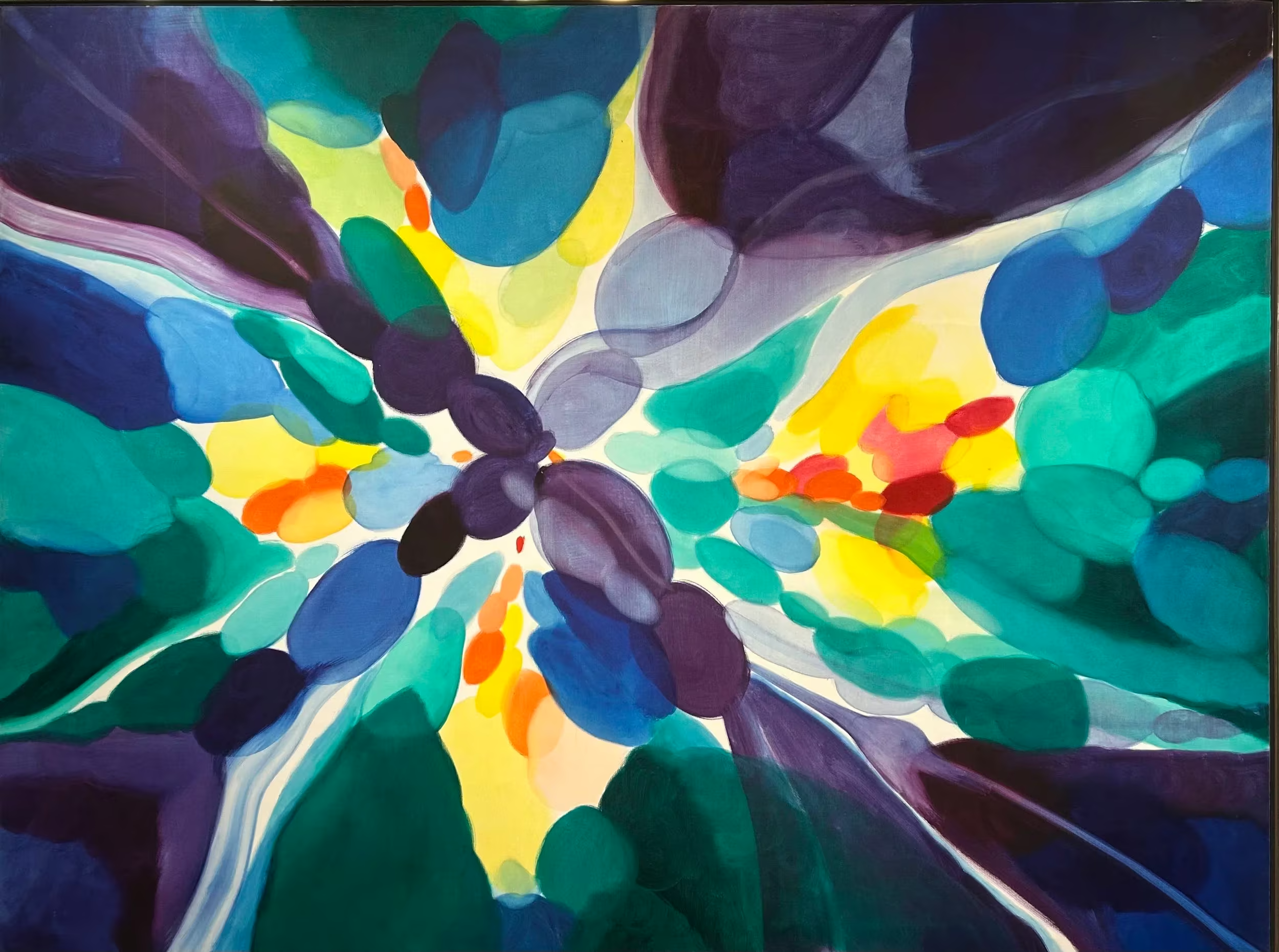
Abstract painting with radiating blue, purple, green, and yellow shapes
straddle
Watercolor taught the oils what to do. In the 1950s she moved from still life into stain. By the mature period she had two studio words for oil: sinking and lifting. Thinned paint spread with rags across primed canvas. Then cloth or tissue drawn through the wet pigment, placing and removing at once, leaving a halo of lighter color inside the form. The veil is not a metaphor. It is a residue of that wipe.
Childhood, she said, was in color. Illinois farm and Miami winters for health. Lessons by eight. College painting by twelve. Lindenwood, then Indiana University, B.A. and M.A. Alton Pickens told her to go to New York. 1951. Cedar Bar. The Club. March Gallery on 10th Street, which she helped found with Wilfrid Zogbaum and Elaine de Kooning. First New York solo there, 1958. She dated her mature style from that year.
Paris half-years put her with Francis, Joan Mitchell, Shirley Jaffe, Jenkins. She wrote for a living early on, art editor at McCall’s. Later she organized for other women: Color Forum at the University of Texas, 1972. Color, Light, and Image at the Women’s Interart Center, where she was a trustee with Alice Neel, Louise Nevelson, Kate Millett. Women Choose Women at the New York Cultural Center, 1973. The advocacy is not a footnote to Dervish Road. It is the same decade. Shade as a public argument and color as a private hunger.
The New York Times on 29 December 1978 called her a prominent colorist since the early 1960s, charting a course between Abstract Expressionism and Color Field. Between is the right preposition. Gesture without the angst. Field without the stain that erases the hand. The oval keeps a hand in the field.
hint
Solo rooms that year: New Delhi, Tehran, Saarbrücken, Düsseldorf. The canvas titled Dervish Road is the studio object that can absorb a year like that without becoming a postcard. No minaret. No documented Konya. The turn is optical. Soft veils. Luminous flow. Energy that does not break the surface.
Dimensions and present collection for this specific title were not on a museum wall label in the sources at hand. Leave those blank rather than invent them. What can be said is the grammar: oil or thinned oil behaving like the watercolors she never abandoned, ovals in radial or drifting balance, white as light not as leftover canvas, a second color arriving as luminosity inside the first. Titles from nearby years run the same way: Hermit in the Cave of Light, 1976. River Ladder Gold, 1972. Light and path and weather in the name. Dervish Road belongs on that list.
After 1982 the work went quiet in public. Ex-husband narratives and the usual thinning of women from the midcentury story did part of that. 2024 was the first concentrated gallery look in forty years. Levin’s book is the first full life. The paintings did not change. The rooms around them did.
Stand in front of a Baber from this period and the eye keeps turning because the ovals will not stack into a pyramid or flatten into a flag. They overlap like breath. Dervish Road is that turn given a year and a name. 1974. Soft veils. Luminous color. The artist still hungry for the next color that would make light.
Related Articles
Modigliani’s Limestone ‘Tête’
Carved from a single block of limestone in Montparnasse more than a century ago, one of Modigliani's rare stone heads goes to auction for the first time…