
DRIFT AUDIO
Listen to this story
Choose a voice, then press play.
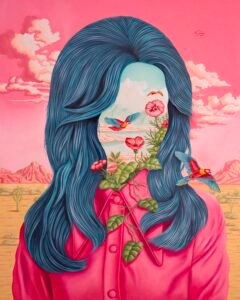
A woman pauses before a glass display case outside a Tokyo restaurant, its glow rendered in silkscreen gold across 166 signed prints.
Jewel Box shows a woman standing outside a Tokyo restaurant, caught in the exact moment she pauses before a glass display cabinet lit from within. It is a small scene, the kind most people would walk past without registering, but Keita Morimoto has spent most of two decades convincing viewers to stop and look at exactly this sort of threshold. The painting behind the print was finished in 2024. The edition itself, offered through Avant Arte in partnership with Tokyo gallery KOTARO NUKAGA, carries a 2025 release date and a production run capped at 166.
The window itself does most of the work. It is the recurring device in Morimoto’s practice, a softly illuminated pane standing in for a doorway between the ordinary street and something closer to reverie, a nod to the old pre-modernist idea that a painting is itself a window onto another space. Release copy for the print describes the piece as inviting the viewer to “step through the image,” language that could sound like sales patter attached to a lesser artist’s work but tracks closely with how Morimoto talks about his own paintings elsewhere: not as documentary street photography translated into oil, but as constructed thresholds a viewer is meant to pause at rather than walk past.
Each print is an archival pigment reproduction of the original oil, output on Somerset TS Radiant White, a 410gsm mould-made cotton paper better known for four centuries of English watercolor and printmaking tradition than for reproducing neon lit Japanese shopfronts. Over the pigment print, a silkscreen layer in gold is applied by hand, concentrated in the glowing areas of the display case so the shimmer catches light exactly where the painted light source sits, then sealed under a matte varnish. Every copy ships with a Certificate of Authenticity and is part of a two print set, its companion piece Evening Embers reading as a nighttime portrait of the block around Morimoto’s own Tokyo studio, its geometry borrowed from Japanese kanban signboard architecture.
View this post on Instagram
The two prints went live together on December 9, 2025 at 19:00 Japan Standard Time and stayed orderable for exactly 48 hours, a mechanic Avant Arte uses across its releases to let demand rather than a preset print run set the final edition size. Jewel Box launched at 625 euro and sold out inside that window. Both it and the combined Jewel Box and Evening Embers bundle now show as sold out on Avant Arte’s own site, with a waitlist open for cancellations. The piece is also catalogued on Artsy, the site tracking Morimoto’s paintings and prints alongside his exhibition history.
flow
Morimoto was born on January 8, 1990, in Sakai City, part of Osaka. At sixteen he left for Canada on a homestay exchange meant mainly to build his English, and ended up finishing high school at Centennial Secondary School in Belleville, Ontario, a small city east of Toronto. His parents encouraged him to stay and pursue painting rather than return home, something he has called unusual for Japanese parents of his generation. He earned a Bachelor of Fine Arts from OCAD University, then still known as the Ontario College of Art and Design, in 2012, and spent the following sixteen years building a painting practice in Toronto before moving back to Japan in 2021.
The formative encounter, by his own account, happened in the Rembrandt room at the Metropolitan Museum of Art while he was still a student. A high school teacher had praised Rembrandt for years without the work translating for him through reproductions in books. Standing in front of the paintings changed that. “I wanted to capture that sense of tangibility,” he told UK culture outlet whynow in a 2021 interview, describing the years he then spent studying the Dutch master’s technique almost obsessively, photographing paintings from every angle much as inventor Tim Jenison approached Vermeer in the documentary Tim’s Vermeer. Nicholas Metivier Gallery in Toronto picked him up early in that period, showing his work from 2016’s Strange Guild onward and building the footing that eventually carried his cityscapes into galleries across the US and beyond.
That Toronto decade shaped the subject matter as much as the technique. Morimoto has said he wanted to paint the ideas and emotions he saw on Toronto’s streets, a quality he found missing from commissioned portrait work. But translating Baroque staging onto contemporary sidewalks took more invention than observation. To get anywhere near Edward Hopper’s isolated, narrowly focused figures, he realized a straight photograph of passersby would not do. Scenes had to be built from scratch, often with figures shot separately and superimposed onto invented backdrops, not unlike the way photographer Gregory Crewdson stages his own elaborate tableaux. It is a working method Morimoto has kept ever since, carried whole from Toronto’s diners and parking lots into Tokyo’s convenience stores and train platforms.
theory
Morimoto’s mature style reads as a collision of two eras of light. From the Baroque he takes the theatrical chiaroscuro of Rembrandt and Caravaggio, a single dramatic source carving figures out of darkness. From twentieth century American realism he takes Edward Hopper’s isolation and William Eggleston’s flat, saturated color, alongside painter Hughie Lee-Smith’s quiet, staged solitude. Layered onto both is a visual grammar he traces to Japanese manga and anime, a medium he wanted to work in as a teenager before painting became, in his own description, an easier way to build a visual narrative than writing one.
The subjects carrying all this are aggressively unglamorous: vending machines, convenience store facades, parking lots, the fluorescent lit thresholds of everyday Japanese urban life. Morimoto has spoken about wanting these mechanical, commercial fixtures to read as autonomous characters rather than backdrop, using their glow to mark out what he has called a robotic harmony in Japanese urban life. A 7-Eleven becomes a 6-Eleven in one Almine Rech exhibited canvas, a small invented detail that turns a specific, trademarked storefront into something anonymous and universal at once, sidestepping any real world signage while keeping the emotional charge of a convenience store’s midnight glow fully intact.
Painter Kerry James Marshall’s compositional precision, landscape painter Peter Doig’s lyricism, and Piet Mondrian’s structural grids all surface in how Morimoto has described building a scene, alongside a debt to Pieter Bruegel the Elder’s habit of using landscape itself to carry narrative weight. “The anonymous, liminal spaces in my paintings echo the feeling of never fully belonging,” Morimoto said in the press materials for his 2025 Almine Rech exhibition, tying the visual language directly to his own back and forth between Osaka and Toronto. It is a fitting description for Jewel Box specifically, a woman on a sidewalk framed by a lit cabinet that could be selling jewelry or bento boxes or nothing recognizable at all, suspended in the kind of transitional moment Morimoto has spent his career trying to hold still.
area
Morimoto’s return to Japan in 2021 did not resolve the sense of displacement so much as relocate it. He has described catching up with his sixteen year old self while thinking and dreaming in English inside his own home country. That friction fed directly into a run of institutional attention that has made 2025 and early 2026 arguably his busiest exhibition stretch to date. Almine Rech gave him his first solo show with the gallery, To Nowhere and Back, at its Tribeca, New York location from March 14 to April 26, 2025, curated with support from Larry Ossei-Mensah. Later that year, the 21st Century Museum of Contemporary Art, Kanazawa included him in its Aperto 19 series with the solo presentation what has escaped us, and that August he opened Quiet Light at Kunsthal n in Copenhagen, his first exhibition in Denmark, running through mid January 2026.
View this post on Instagram
To Nowhere and Back itself leaned on Morimoto’s return migration for its title and its material: paintings like Stairs to Nowhere, Missed Calls, and The Way Back sat alongside Green Room, a canvas built around a convenience store storefront rendered under an empty sky, its signage quietly altered from the familiar seven-eleven mark into something adjacent but not quite recognizable. Almine Rech’s own framing of the show described the work as constructing thresholds between the concrete urban world and the ethereal realm of memory, language that lines up closely with what Jewel Box is doing at a much smaller, more intimate scale a few months later.
Most recently, his longtime Tokyo gallery KOTARO NUKAGA, which has represented him since at least 2021’s After Dark, opened what we told ourselves in January 2026, a show that critics writing in ArtAsiaPacific described as pushing his nocturnal figures toward a more explicitly uncanny register, with painted light in works like Beneath a familiar light behaving almost as if it had acquired its own will, a lone figure under a streetlamp reading less like a passerby and more like a character stranded on a stage. The gallery relationship also produced a 2024 monograph, Illuminated Solitude, published by Bijutsu Shuppan-sha alongside an exhibition at Tsutaya Ginza.
Morimoto’s paintings now sit in public collections spanning three countries: the Shiga Museum of Art and Arts Maebashi in Japan, the High Museum of Art in Atlanta and the Institute of Contemporary Art, Miami, in the United States, and Turin’s Fondazione Sandretto Re Rebaudengo in Italy, alongside Tokyo’s Ueshima Museum Collection. That institutional footprint sits somewhat apart from the print market Jewel Box belongs to, but it is the context that made a KOTARO NUKAGA and Avant Arte print release worth 166 collectors lining up in a 48 hour window in the first place.
turn
Jewel Box and Evening Embers mark Morimoto’s first collaboration with Avant Arte, a print publisher that has worked with artists from Ai Weiwei to Barry McGee to George Condo on limited runs aimed at collectors who cannot access an artist’s gallery represented paintings. The release followed Avant Arte’s usual mechanics: both prints went live simultaneously at 19:00 Japan Standard Time on December 9, 2025, stayed orderable for a fixed 48 hours, and had their final edition sizes locked only once that window closed, a way of letting real demand rather than a speculative print run set scarcity. Jewel Box ended up capped at 166, offered individually at 625 euro or bundled with Evening Embers at 1,300 euro.
Getting from painting to print involved more than a straight scan. Avant Arte’s master printmaker Tom Murphy, who discusses the process in a behind the scenes video tied to the release, worked to translate the built up layers of Morimoto’s original acrylic and oil surface into an archival pigment print without flattening the light effects that define the work. The gold shimmer detailing, concentrated in the display case’s glow in Jewel Box and in the neon signage of Evening Embers, is added afterward as a separate silkscreen pass, so the metallic fleck sits physically on top of the matte pigment print rather than being simulated through ink color alone. A final matte varnish seals the sheet, protecting both layers while keeping the surface from developing the glare a straight gloss coating would introduce.
The choice of Somerset TS Radiant White as a substrate is its own small piece of trivia. The paper is made by St Cuthberts Mill in Wells, Somerset, a papermaking site on the River Axe that has operated since the 1730s. The Somerset line itself was developed there in the mid-1970s, named, according to mill history, for the road sign marking the county border that caught an American paper dealer’s eye on his way to visit. A nearly three century old English mill’s paper, built originally for engravings and watercolors, is what now carries the gold flecked glow of a Tokyo restaurant window out into collectors’ homes worldwide.
hint
Both prints sold out within their rel window, and Avant Arte’s product pages for Jewel Box, Evening Embers, and the combined two print bundle all currently show as sold out, with a waitlist open for cancellations and early access to future Morimoto releases. The edition also appears catalogued on Artsy, where Morimoto’s paintings, unique panel works, and prints are tracked alongside his exhibition history and CV.
For a print job that started as a straightforward reproduction assignment, the scarcity mechanics end up mattering almost as much as the image itself. A woman pausing outside a lit shop window is, on its own, a small and specific observation. Multiplied by 166, hand finished in gold, and released for exactly two days before the order books closed, it becomes something closer to how Morimoto has described his own paintings functioning: a threshold that a fixed number of people got to step through, at a fixed moment, and not again.
Related Articles
Modigliani’s Limestone ‘Tête’
Carved from a single block of limestone in Montparnasse more than a century ago, one of Modigliani's rare stone heads goes to auction for the first time…