DRIFT AUDIO
Listen to this story
Choose a voice, then press play.
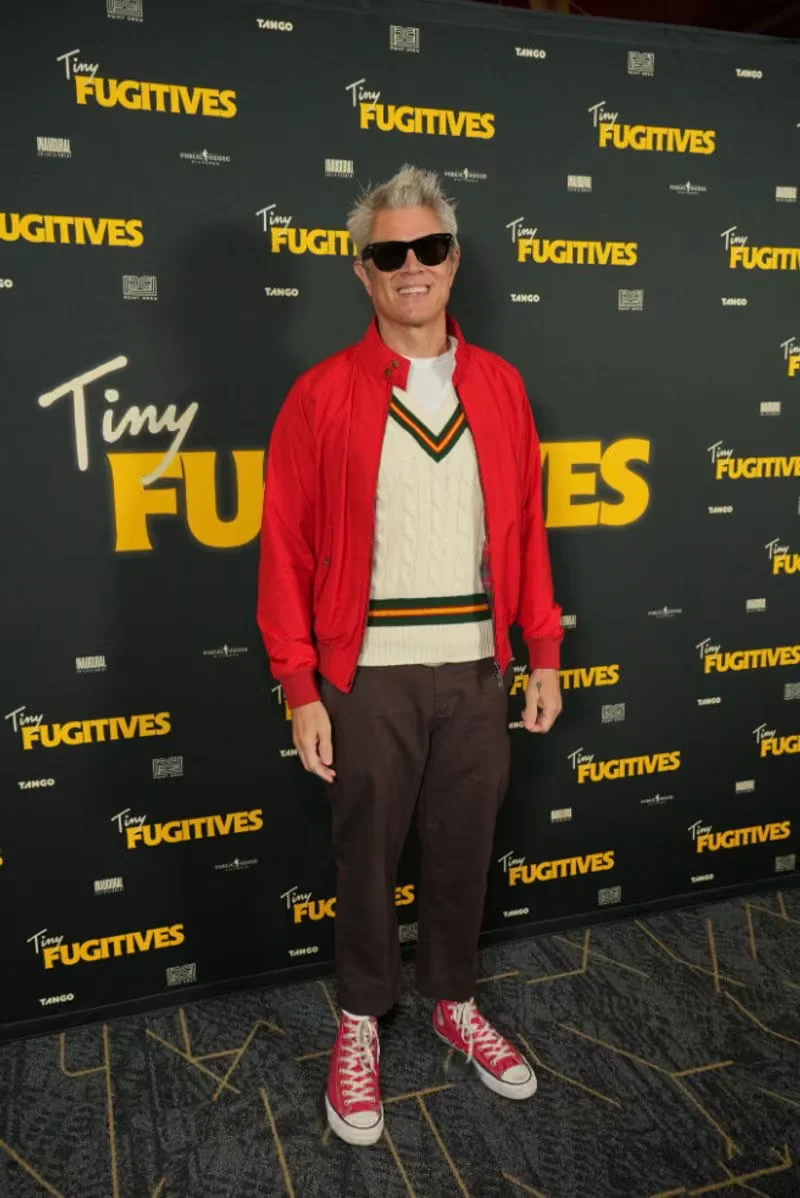
In Tiny Fugitives, a gang of 12-year-olds turns Johnny Knoxville into a human piñata. Off screen, he says the real enemy of comedy is caution.
Somewhere in the middle of Tiny Fugitives, Johnny Knoxville grabs an electrified fence. Director Michael Lewen asked him to shake a little more, the way people do in movies when the current hits. Knoxville politely told him that is not actually what happens when you get electrocuted, and Lewen realized he had hired the one leading man in Hollywood who would know. That story, which Lewen told IndieWire, is a neat summary of why the former Jackass ringleader was cast as Bob, a fifty year old camp lifer who spends the film being outwitted, flattened and generally destroyed by a crew of foul mouthed preteens.
Signal. What happened: Johnny Knoxville, promoting the R-rated summer camp comedy Tiny Fugitives, told IndieWire that studio theatrical comedies have been squeezed out in part by what he called “fun police or joke police,” while his director credited Knoxville’s Jackass background with making the film’s physical gags more believable. Exact object: Tiny Fugitives, directed by Michael Lewen from a screenplay by Lewen and Jacob Kaplan, produced by Seth Rogen and Evan Goldberg’s Point Grey Pictures and distributed by Inaugural Entertainment, starring Knoxville alongside Benjamin Pajak, Aaron Harris, Isa Bernal Steiner, Jai Soundar, Alyssa Gervasi, Blake Anderson and Jay Baruchel. When and where: in select US theaters since September 18, 2026, rated R for language throughout, crude sexual references and drinking, all involving children. Source: Knoxville and Lewen’s interview with IndieWire, plus the film’s MPA rating record via The Numbers. Why it matters: it is one of very few original R-rated comedies released theatrically this year, arriving three months after Knoxville’s own Jackass: Best and Last, and it tests whether the Superbad style raunch comedy can still find an audience on the big screen.
View this post on Instagram
stir
Knoxville’s diagnosis of the state of the genre is blunt. He told IndieWire that comedies are harder to make now, and put a good share of the blame on a culture of caution: “There’s a lot of fun police or joke police out there.” He framed it as a cycle rather than a permanent condition, arguing that taste swings back and forth over time and that the industry is currently sitting at the careful end of that swing.
It is not a new complaint, and it is far from the only explanation on offer. The mid budget studio comedy that filled multiplexes in the 2000s, the era of Superbad, Knocked Up and The Hangover, has also been hollowed out by more prosaic forces. Streaming services absorbed much of the genre’s audience and its output, big studios reoriented their theatrical slates toward franchise films that travel well internationally, and comedy, which often depends on language and local reference, has historically been a harder export than spectacle. Knoxville’s point is about tone and appetite; the business side has its own long list of reasons.
Either way, Tiny Fugitives is a deliberate throwback. IndieWire placed it in the lineage of early 2000s raunch comedies, and the film’s own producers have leaned into that comparison rather than away from it.
edu
Few actors come to a slapstick role with a résumé like Knoxville’s. He co-created Jackass for MTV in 2000 with Jeff Tremaine and Spike Jonze, and over a quarter century of the show and its films he has been knocked out by a professional boxer, shot in the chest while wearing a bulletproof vest, strapped to a rocket and repeatedly flattened by bulls. The last of those injuries was the most serious. During Jackass Forever in 2022, a bull left him with a brain injury and broken ribs, and he later told reporters that his neurologist had drawn a firm line. “My neurologist said I can’t have any more concussions,” he said, as reported by The A.V. Club.
That did not end the franchise. Jackass: Best and Last, billed as a final send off mixing new stunts with archive material from 25 years of the series, arrived in theaters through Paramount on June 26, 2026. Tiny Fugitives followed less than three months later, which means Knoxville has spent the summer of 2026 on screen being hurt twice, once for real and once for fiction.
On the Tiny Fugitives set, the habits of the first career came along for the second. Lewen told The Forward that there was “definitely some push and pull with the stunt coordinator,” because Knoxville wanted to drive his ATV without his glasses and kept urging people to hit him harder. The electric fence scene, which reviewers have noted riffs on the famous fence sequence in Jurassic Park, is where that experience paid off most directly: an actor who has actually been zapped playing a man getting zapped, and correcting his director on the physics.
It is also worth remembering that Knoxville is not only a stuntman. He earned serious notices for the 2003 drama Grand Theft Parsons, and Bad Grandpa, the 2013 hidden camera film built around his elderly Irving Zisman character, picked up an Academy Award nomination for its makeup. The job in Tiny Fugitives asks for both halves: the pratfalls and a character who, by the end, is meant to be the emotional center of the camp.
transition
The film started as something much stranger. Screenwriter Jacob Kaplan began writing a summer camp TV pilot in 2021 while working as a writers’ assistant at Saturday Night Live, and the earliest version, as describe in a Forbes feature, was an animated concept about a small alien sent to observe humanity that accidentally gets dropped at a Jewish summer camp. It was meant as a writing sample. Instead it reached Michael Lewen, a longtime director and producer in Judd Apatow’s orbit who had worked on Trainwreck and The King of Staten Island and wanted to write and direct his own feature.
The two reworked it into a live action film set at the fictional Camp Fineman. Its hero is Jacob Udell, played by Benjamin Pajak, a boy who is somebody at camp and a target at his public school. When his parents arrive on visiting day to announce their divorce and hint that there may not be money for another summer, Jacob and his best friend, nicknamed Charness and played by Aaron Harris, decide they simply will not get on the bus home. Their plan to live at camp indefinitely turns into a breakout, and Bob, the counselor responsible for delivering them back to their parents, becomes the pursuer.
The runaways are not just a duo. Isa Bernal Steiner plays Tali, Jai Soundar plays Leon and Alyssa Gervasi plays Sophie, rounding out a gang of five whose schemes grow steadily more elaborate as Bob closes in. Lewen has said he wanted each of them to read as a real kid rather than a joke delivery system, which is why so much of the script was reshaped around the young cast once they were hired.
Both filmmakers are products of the world they are depicting. Lewen, a veteran of Camp Modin in Maine, told The Forward that Jewish sleepaway camp is a breeding ground for comedy bits and the first place many kids try out material. He also cited Stand By Me as a key influence and said the film includes visual nods to Francis Ford Coppola’s Apocalypse Now and The Conversation. Kaplan makes a cameo as a guitar playing counselor, according to Variety. The production shot at real camps in the Toronto area, and Lewen tried to give his young cast something like the real experience, down to a newspaper the kids produced on set called The Tiny Times, with op-eds and interviews with department heads.
extend
When Kaplan and Lewen took the project out, they went to the most logical home imaginable. Point Grey Pictures, the company run by Seth Rogen and Evan Goldberg, is the house that made Superbad and, more to the point, Good Boys in 2019, which proved a studio could release an R-rated comedy starring sixth graders and turn a profit. Kaplan put it simply in the Forbes piece: for an old style R-rated comedy about 12-year-olds, Rogen and Goldberg are “the best people for that.”
Point Grey’s Josh Fagen and James Weaver developed the script with the filmmakers, and Lewen described that process as highly collaborative, with heavy emphasis on jokes, improvisation and tailoring lines to the actors once they were cast. The ensemble around the kids leans on Point Grey’s extended family: Jay Baruchel, a longtime Rogen convincer from Knocked Up and This Is the End, and Blake Anderson of Workaholics both appear.
View this post on Instagram
The route to release was not quick. Variety reported that production was slowed by strike delays, and the film ultimately landed with Inaugural Entertainment rather than a major studio, opening in a limited theatrical run on September 18.
length
The central commercial puzzle of Tiny Fugitives is written right into its rating. The film carries an R for language throughout, crude sexual references and drinking, with the MPA noting that all of it involves children. That puts its most natural audience, actual 12-year-olds, behind a parent or guardian at the box office.
The filmmakers are unapologetic. Lewen told The Forward he thinks it is a perfectly good movie for young people to see, and argued that the swearing is unlikely to shock the age group it depicts. The producers are betting on so called cross quadrant appeal: adults who remember camp, teenagers who remember being twelve, and fans who will turn up for Knoxville taking a beating. Kaplan, for his part, has said the film plays best in a room full of people laughing together, which is the whole argument for releasing a comedy in theaters at all.
fin
The reviews have been split along predictable lines. The Hollywood Reporter described the film as determinedly outrageous and scatological, noting a run of Knoxville indignities that includes nearly being electrocuted on a fence, wetting himself and clinging to the hood of a speeding jeep. It credited Knoxville with going through the physical routines with the discipline you would expect from a man who has been gored by a bull and ridden a rocket, while arguing that the film leans too heavily on the idea that children swearing is funny in itself, and that its likeliest fans are too young to buy a ticket.
Other coverage has been far warmer. The Forbes feature called it the year’s biggest comedy surprise and praised it as heartfelt as well as crude, singling out Pajak’s earnest lead turn and Harris’s comic energy. Lewen has consistently described the film’s balance as its whole project: big theatrical set pieces with a heist and chase structure, anchored by kids and a counselor who are meant to feel like real people with inner lives.
For Knoxville, the film lands at a turning point. The Jackass franchise has declared itself finished, his neurologist has ruled out further concussions, and his next act as a performer will have to rely more on character than on real injury. Tiny Fugitives sits right on that line: a scripted role in which every hit is choreographed, play by the one actor on set who knew exactly how the real thing feels.
Related Articles

A Milan Temp Store For Invicta’s 120th Year
1906 England. Turin from 1921. Jolly and Minisac on Heritage. Velba, Wasar, Freeway on Icon. […]