Willie Cole Turns A Pile Of Saxophones Into Something That Wants To Fly – JazzBird

June 27, 2026
recall
- The Piece Itself
- A Practice Built On Found Objects
- From Kansas City’s Skies To A Tribeca Gallery
- Inside “Mind, Body, and Soul”
- Why This Show Matters Now
- Fin
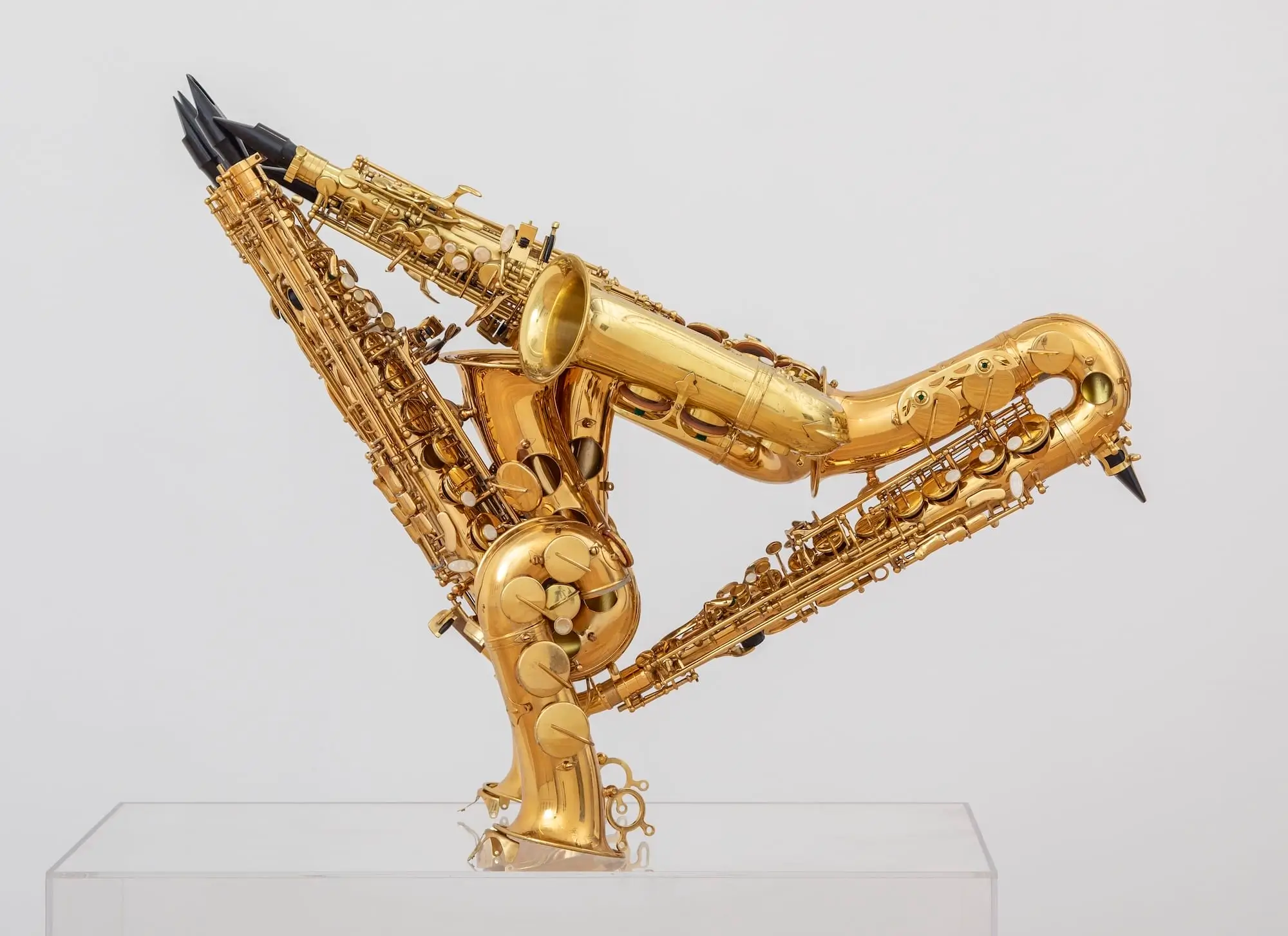
Willie Cole has spent close to four decades convincing steam irons, stiletto heels, and plastic water bottles that they’re capable of being something else entirely. His newest piece asks the same question of a stack of broken saxophones, and the answer is “Jazzbird” — a 2026 sculpture built entirely from reassembled horns, standing 30 by 14 by 40 inches, and currently the anchor of Cole’s first solo presentation at Sargent’s Daughters in New York.
stir
“Jazzbird” doesn’t try to disguise what it’s made of. Look closely and the source material announces itself immediately — bell flares curving into wings, neck joints and key clusters reassembled into something that reads unmistakably as avian without ever pretending the saxophones aren’t saxophones. That tension is the entire point of the work. Cole isn’t sculpting a bird and dressing it in brass; he’s letting a pile of disassembled wind instruments find the bird that was apparently always latent inside their shapes.
It’s a sensible that runs through Cole’s whole body of work, and one the artist has described as the object finding him rather than the other way around — he sees a thing, recognizes a possible inside its form, and follows that recognition rather than imposing a concept onto raw material. Saxophones lend themselves to that approach more natural than almost anything else in Cole’s toolkit. Their curves were never going to look entirely mechanical to begin with; a horn already moves like something organic when it’s disassembled and laid flat, all that brass tubing curling in on itself the way a wing folds against a body at rest.
There’s also something pointed about the choice of instrument specifically, rather than any other category of discarded object Cole could have reached for. A saxophone isn’t industrial waste in the way an old iron or a worn-out shoe is — it’s an instrument built for breath, for show, for a player’s body to animate it into sound. Turning that into a static, silent sculpture creates a reticent kind of tension than Cole’s shoe or iron work: this is an object whose entire purpose was motion and voice, now frozen mid-transformation into something that merely looks like it could take flight.
flow
Born in 1955 in Somerville, New Jersey, and raised in Newark, Cole studied at the School of Visual Arts in New York before stray through theater and music in his twenties — a detail that makes his eventual turn toward sound-producing found objects feel less like a coincidence and more like a return. By the late 1980s, during an artist residency at the Studio Museum in Harlem, everyday objects had become his primary material, and they’ve stayed that way ever since.
The steam iron became his first major recurring motif: Cole imprinted scorch marks from irons across paper, wood, and fabric, using the marks to evoke African tribal shields and the branding of enslaved people in the same gesture, layering domestic labor and African American history into a single scorched image. High-heeled shoes followed, reassembled into masks and figures that draw explicitly on traditional African sculptural forms — stacked stilettos standing in for cheekbones, arches, and brow lines in a way that’s somehow both witty and genuinely unsettling. More recently, his “Survivors” series presses hundreds of crushed single-use plastic bottles into wall-mounted reliefs, pulling consumer waste directly into the same conversation about history and material value.
Saxophones and other salvaged instruments are a comparatively newer thread, but one that’s grown into one of the more view parts of his practice — Cole’s 2022 exhibition “No Strings” was built specifically around transforming instruments into abstract animal and figurative forms, treating disassembled horns, strings, and keys the same way he’d previously treated irons and shoes: as raw vocabulary for something else entirely.
What ties all of these material shifts together is less a signature look than a consistent method of thinking. Cole has spoken about objects “finding him” rather than the reverse, which sounds almost mystical until you consider how literally he means it: a discarded iron, a worn shoe, or a decommissioned saxophone arrives in his studio already carrying its own history of use, wear, and human contact, and his job is to recognize what that history makes possible rather than to impose an unrelated idea onto inert material. That’s a meaningfully different approach than most assemblage art, which often treats found objects as neutral building blocks to be arranged according to the artist’s preexisting vision. Cole’s sculptures instead read as collides with the objects’ own accumulated meaning — the iron already evokes domestic labor before he’s done anything to it; the shoe already carries gendered and racialized history in its shape; the saxophone already implies breath, performance, and Black musical tradition before a single piece has been welded into place.
transition
“Jazzbird” didn’t arrive out of nowhere. It’s a direct descendant of one of Cole’s largest and most visible public commissions: a dozen floating sculptures made entirely from alto saxophones, suspended throughout the new terminal at Kansas City International Airport. That installation, conceived as a tribute to the city’s deep jazz lineage and to Kansas City native Charlie “Bird” Parker specifically, turned salvaged horns into a kind of civic symbol — jazz literally taking flight inside one of the city’s busiest public spaces. The project’s reach extended well past the terminal itself, eventually spinning off into a line of miniature jazz-bird ornaments (one nicknamed “Charlie,” after Parker) sold at gift shops around the city, including at the American Jazz Museum and the Nelson-Atkins Museum of Art.
What’s less widely known is what happened after that installation went up. Cole reportedly had more than a hundred leftover horns once the airport piece was complete — and rather than let that surplus sit in storage, he kept building. “Jazzbird,” the 2026 piece now on view at Sargent’s Daughters, reads as part of that continuing body of work: a smaller, gallery-scaled sculpture pulled from the same well of material and the same formal idea, but built for a different kind of audience than the thousands of travelers who pass beneath the Kansas City originals every day. Where the airport commission needed to read clearly from a distance, at scale, and in motion overhead, “Jazzbird” gets to be examined up close, on a pedestal, with all the joints and seams that make its construction visible still intact.
straddle
“Jazzbird” is the highest-profile new work in Mind, Body, and Soul, Cole’s first solo exhibition with Sargent’s Daughters, running June 4 through July 10, 2026, at the gallery’s Tribeca space. It’s a notable pairing — Sargent’s Daughters, founded in 2014 on the Lower East Side before relocating to Tribeca in 2024, has built its program around artists working at the intersection of tradition and contemporary practice, and around giving emerging and overlooked artists their first New York solo platforms. Cole, by contrast, arrives with museum-scale institutional history already behind him, including past solo presentations at the Museum of Modern Art, the Bronx Museum of the Arts, and the Montclair Art Museum, along with works held in the permanent collections of the Whitney, the Met, and the National Gallery of Art. This is his first show with the gallery, and his first New York solo presentation since 2022.
The exhibition’s title maps onto three distinct registers in Cole’s work, according to the gallery: Mind refers to the artist’s engagement with World, American, and African diasporic histories; Body to the materiality of the found objects themselves; and Soul to the spirit and meaning those objects accumulate once they’re transformed. True to that structure, the show spans roughly three decades of practice rather than presenting a single unified series. Alongside “Jazzbird,” the presentation includes shoe-and-wire assemblages like “Tiger Lilly” (2025) and “Twin Spirits” (2026), the bronze “Shoonufu Female Figure” (2013) — a piece that draws directly on West African fertility-figure traditions — a 2025 silkscreen titled “Summer Shoes,” and a large-scale plastic-bottle wall relief from the ongoing “Survivors” series.
That range is very much the point. Rather than showing one tightly themed body of work, Sargent’s Daughters has framed the exhibition as a survey of how consistently Cole’s underlying questions — about consumerism, history, and the spiritual residue left on discarded objects — show up across radically different materials, from bronze casting to shoe assemblage to brass instrument salvage.
huh
There’s a reason a show built around scorch marks, broken horns, and stacked stilettos lands with particular weight in 2026. Cole’s gallery describes his practice as one that moves fluidly across genres to address history, consumerism, and environmentalism simultaneously, and all three of those concerns feel especially current. The “Survivors” plastic-bottle reliefs sit squarely inside an ongoing cultural reckoning with single-use waste and the Great Pacific Garbage Patch; the shoe-based figures continue a decades-long conversation about labor, gender, and African sculptural tradition that hasn’t lost any urgency; and a saxophone sculpture pulled from the leftovers of a major public commission says something pointed about excess and afterlife in object-making itself — nothing gets thrown away in Cole’s process, it just waits for its next form.
It also arrives at a moment when Cole’s institutional momentum is clearly building rather than coasting. In the past two years alone, his work has been the subject of a substantial solo presentation at the John Michael Kohler Arts Center, a public conversation with fellow sculptor Alison Saar at the National Gallery of Art, and the acquisition of a major piece by the Pérez Art Museum Miami through its Fund for Black Art program. A first show at Sargent’s Daughters slots into that trajectory less as an introduction and more as a New York gallery audience finally catching up with where Cole’s practice already is.
There’s also a generational dimension worth noting. Cole is approaching seventy and has been making work from found materials since the late 1980s, which puts “Jazzbird” in conversation with artists half his age who’ve only recently turned to upcycled and salvaged materials as a response to contemporary environmental anxiety. For Cole, that approach predates the current wave of climate-conscious art-making by decades — his scorched ironing boards and stacked stilettos were already making arguments about consumption, waste, and value long before “sustainability” became a curatorial buzzword. That long runway gives “Jazzbird” a different kind of authority than a comparable piece by an artist newer to the practice: this isn’t a trend Cole is responding to, it’s a trend that’s arguably catching up to him.
hint
“Jazzbird” works because it refuses to fully resolve into either category it’s hovering between — instrument and animal, function and form, waste and value. Cole has built an entire career out of objects that do exactly that kind of hovering, and a sculpture made from a public commission’s leftover horns is about as clean a metaphor for his whole practice as you could ask for: nothing here was supposed to become art, and all of it insists on becoming art anyway. Mind, Body, and Soul runs through July 10 at Sargent’s Daughters in Tribeca, and “Jazzbird” is worth the trip on its own — a cool, slightly uncanny reminder that the most interesting transformations rarely look finished, even when they’re complete.
Related Articles
A Man In A Purple Coat, Green Faced And Floating Above A Vanished Town
Marc Chagall’s fiddler stands on two rooftops at once, one foot in memory and one […]