

DRIFT AUDIO
Listen to this story
Choose a voice, then press play.
Nine years after leaving the island, LOEWE returns to the same Palma street where it opened its first Mallorca store in 1954, now built almost entirely from local material.
LOEWE has opened a new store on Paseo del Borne, in the historic center of Palma de Mallorca, its first freestanding boutique on the island in nearly a decade. The 140-square-metre space carries the house’s full offering for women and men: ready-to-wear, bags, shoes, and accessories, laid out inside a building that until recently held a branch of Santander.
The address matters as much as the inventory. LOEWE first opened a store on this same promenade in 1954, moved a few blocks over to Avenida Jaume III in the late 1990s, and closed that location in 2017 after more than sixty years on the island. In the years since, the house’s only retail presence in Mallorca ran through corners inside El Corte Inglés, alongside a separate freestanding store on Ibiza. The return to the Born, reported first by Diario de Mallorca and picked up across the Spanish fashion trade press, lands in the same year LOEWE marks 180 years since its founding in Madrid, a coincidence of timing the house has leaned into elsewhere this year with a run of new and seasonal stores across the Mediterranean.
View this post on Instagram
The opening also falls under the first full year of design direction from Jack McCollough and Lazaro Hernandez, who took over creative direction of the house in 2025 and showed their debut Spring Summer 2026 collection that October. Palma joins a wider seasonal push this year, as LOEWE opened or reopened boutiques across a run of Mediterranean destinations, from Saint-Tropez and Capri to Ibiza and Formentera, part of a strategy the house has described as expanding its resort network beyond the roughly dozen seasonal locations it ran the previous summer. Unlike most of those, though, Palma is being treated as a permanent addition to the network rather than a summer-only footprint.
The street itself has become Palma’s clearest stretch of luxury retail. Louis Vuitton already operates next door, and a Rolex boutique is expected to follow, both signs of how far the Born has shifted from its earlier life as a mixed commercial promenade. For LOEWE, owned by LVMH since 1996, the location closes a gap the house had reportedly wanted to fill since 2017, putting it back on a street it first walked onto more than seventy years ago.
The wider push includes permanent resort boutiques the house already runs in Marbella, Forte dei Marmi, and Cernobbio on Lake Como, alongside this year’s seasonal additions in Bodrum, Limassol, and Mykonos. LOEWE has said each of these stores is designed around its own surroundings rather than a single repeated template, even as certain materials, principally the handmade ceramic tile, recur across nearly all of them.
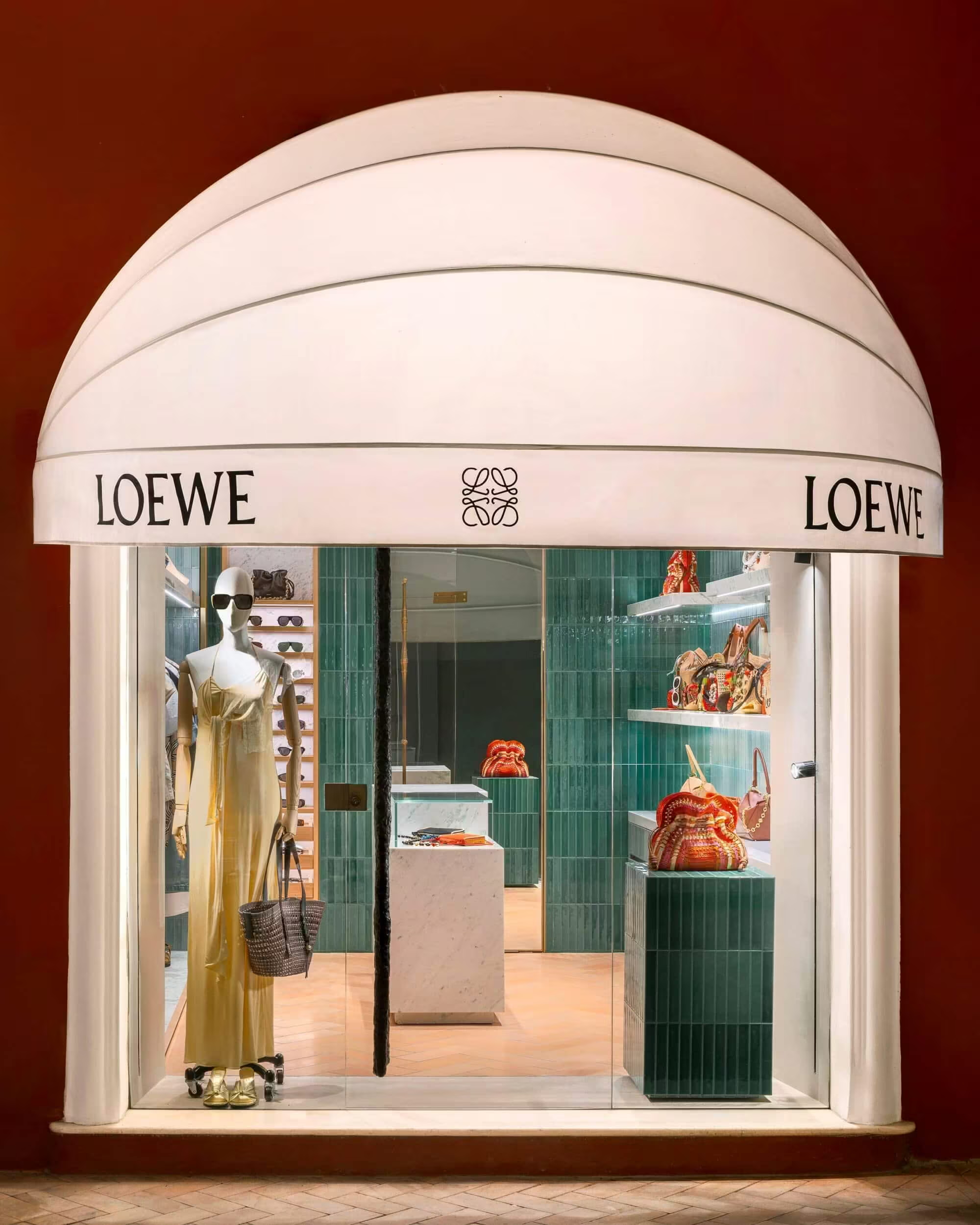
A luxury LOEWE storefront featuring a cream-colored arched awning, a gold mannequin, and a vibrant emerald green tiled interior.
lang
The design begins on the outside. The facade is clad in handcrafted ceramic tiles in a shade of green pulled from the painted wooden shutters found across Palma’s older buildings, the persianas that give much of the historic center its color. It’s a detail specific to this store, but not an unfamiliar one for the house: LOEWE’s newer boutiques across the Mediterranean and beyond, from a recent Vancouver opening to several of its resort locations, have leaned on the same handmade ceramic tile facades in different local colorways, a running architectural signature the house has been building out store by store rather than repeating a single fixed design.
Inside, the tile work widens into a fuller palette: blue, yellow, green, orange, and white, drawn from the Mallorcan landscape rather than any single building or reference point. The floors carry the same logic in a different material. Locally made hydraulic tiles, the cement-pressed technique that has decorated Mallorcan houses since the late nineteenth century and is still produced by only a handful of island workshops, including Huguet in Campos, run underfoot, paired with natural jute rugs that soften the space and mark it off from the tile. Hydraulic tile making has all but disappeared elsewhere in Spain, which makes its use here as much a nod to local craft continuity as a design choice.
The effect reads closer to a Mallorcan house than a showroom, an impression the brand has pursued consistently across its Casa Loewe-styled boutiques worldwide, built around the idea of a collector’s home rather than a retail floor. Here, that idea has been translated into the island’s own materials and color range instead of a generic version of Mediterranean design.
The same tile-driven approach has shown up with different color stories elsewhere this year: custom ceramic walls in green, blue, and soft white at a recent Las Vegas opening, a green facade opening onto a saturated blue interior in Vancouver, and vivid blue-and-green tilework at a Florida store the house opened last year. Palma’s mix of blue, yellow, green, orange, and white is, by comparison, the widest range the house has used in a single space, closer to the full spectrum of a Mallorcan tile floor than the two- or three-color schemes used elsewhere in the network.
A retail display featuring a curated collection of stylish handbags in various colors, arranged on mint green shelving under warm lighting.
idea
Furniture inside the store draws from a similar mix of import and local production. Chairs by George Nakashima, the American furniture maker whose live-edge black walnut pieces have become something of a fixture across LOEWE’s Casa Loewe-concept stores worldwide, sit alongside tables made specifically for this location by craftspeople on the island. The pairing repeats a pattern the house has used from Las Vegas to Shanghai to South Florida: a small set of recurring, easily identifiable design pieces set against furniture and objects made close to each store, so that no two locations read exactly the same even when they share a vocabulary.
LOEWE’s own leather Puffer bench, by now a standard fixture across its stores, anchors the seating. It’s the kind of detail that has less to do with Palma specifically and more with how the house has built out its retail identity since adopting the Casa Loewe format: a handful of signature pieces, the bench, the Nakashima chairs, the martini tables that show up elsewhere in the network, that travel from store to store, while the tile work, the rugs, and the locally produced furniture change from city to city. Nakashima, who died in 1990 after decades working out of his own studio in New Hope, Pennsylvania, built a reputation on leaving each plank’s natural edge and grain visible rather than cutting it away, a philosophy that sits comfortably next to the handmade tile and hydraulic flooring elsewhere in the room.
Nakashima pieces have shown up in more than one form across the network. Las Vegas pairs Mira and Conoid Cushion chairs with the house’s own martini tables; a Casa Loewe concept store in Shanghai used Conoid Cushion chairs and bar stools alongside a wider set of period and contemporary design pieces; a Palm Beach opening combined Conoid Cushion chairs with an antique Spanish ceramic vessel and black iron martini tables. Palma’s chairs, in American black walnut, sit within that same recurring family, paired here with tables made specifically for this store rather than another Nakashima piece.
flow
Display podiums throughout the store were made specifically for this opening, developed alongside the Spring Summer 2026 collection and finished in the same tones of yellow, orange, and white that ran through the runway’s own color story. Their shapes reference what the brand has described as the collection’s broken geometries, an offset, faceted approach to form that showed up across bags and footwear from the same season.
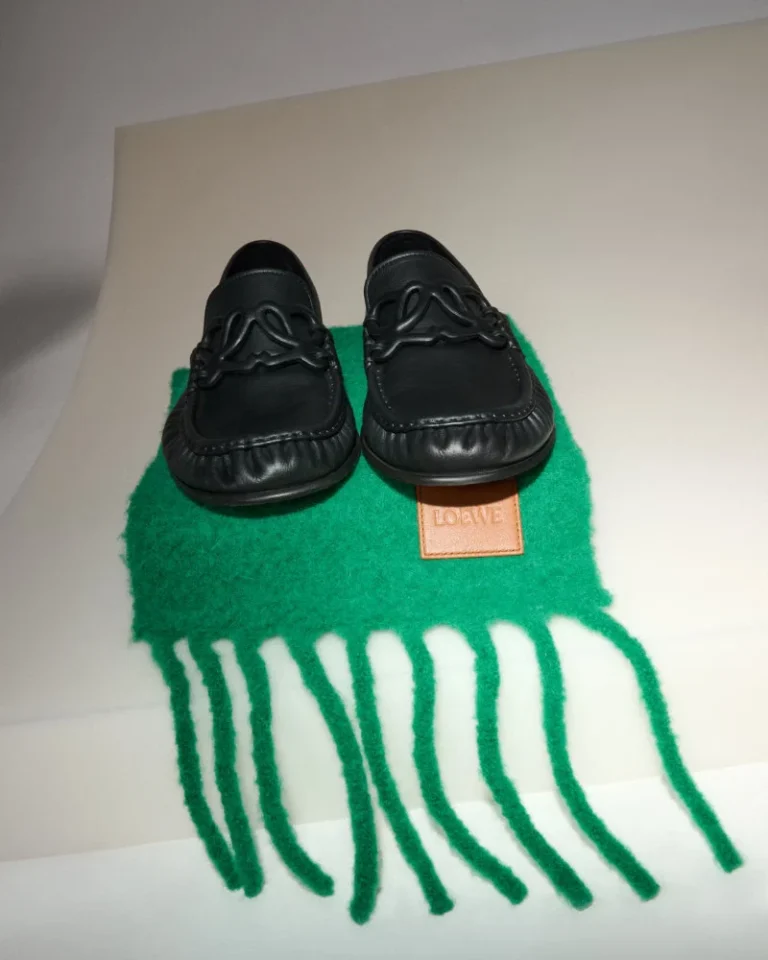
It’s a small but pointed piece of continuity. Spring Summer 2026 was the first collection Jack McCollough and Lazaro Hernandez designed for LOEWE after taking over creative direction in 2025, shown in Paris the previous October to reviews that described a brighter, more playful direction for the house, heavy on color and beach-inflected silhouettes following Jonathan Anderson’s eleven-year run. Reviewers at the time noted the designers repeating certain looks and silhouettes across the runway and front row, a habit carried over from their years at Proenza Schouler, and pointed to the season’s accessories, tasseled loafers in primary colors and semi-transparent kitten heels among them, as some of the collection’s more playful signals. Little of that runway theater survives in a display fixture, but the color range and the faceted, offset geometry clearly do. Carrying that collection’s color and shape language into the store’s own fixtures, rather than defaulting to neutral display furniture, ties the retail space directly to the runway moment that opened the new creative era.
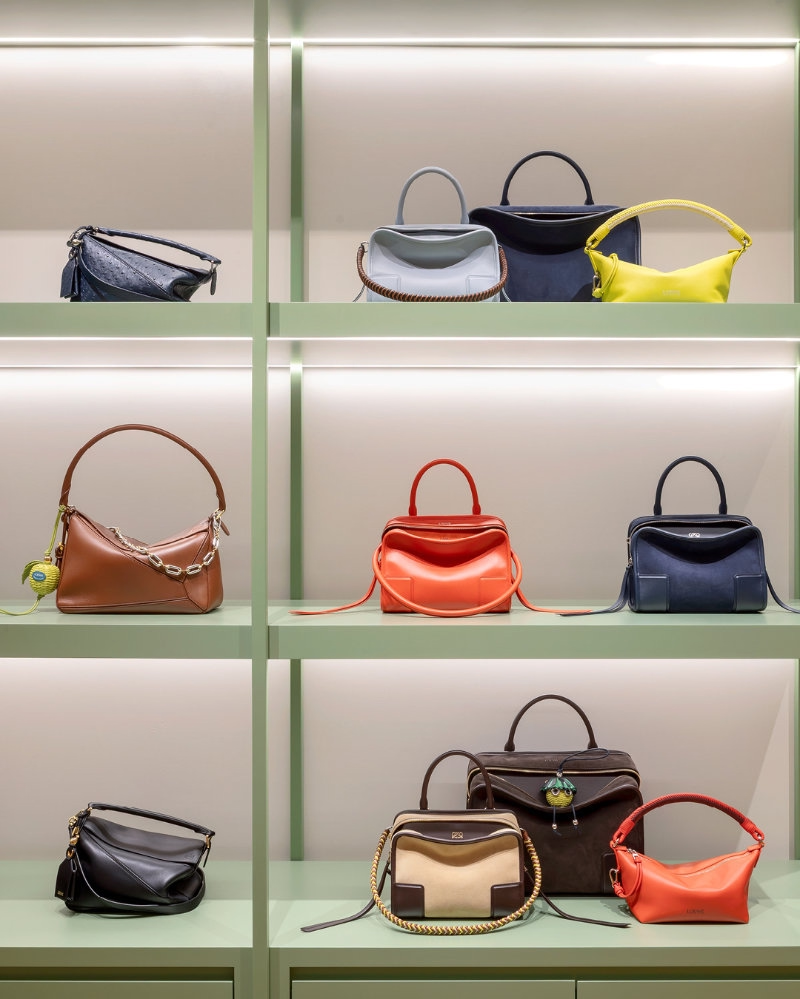
The podiums sit alongside the season’s actual product. Palma’s shelves currently carry pieces from the Spring Summer 2026 line together with LOEWE’s recurring Paula’s Ibiza capsule, the resort-focused collection the house revives each year for its Mediterranean and warm-weather stores, and early looks from the Autumn Winter 2026 pre-collection. It is a lineup built for a store that will do much of its business with visitors passing through Palma over the summer months, even as the boutique itself is being run as a permanent fixture rather than a seasonal one. The result is a room that borrows its structure from the runway and its skin from the island, with little left over that reads as generic.
straddle
Art plays as large a role in the Palma store as it does across LOEWE’s other Casa Loewe-format boutiques, which the house treats less as retail space than as a rotating extension of its own collection. Two etchings by Paul Thek hang inside, drawn from work he left behind before his death in 1988. Better known for the wax-cast “meat pieces” and reliquary-style sculptures he made through the 1960s and 70s, Thek spent much of his career working across sculpture, painting, and printmaking on questions of decay, transformation, and the fragility of the body, themes that have made his work a recurring presence across several LOEWE stores in recent years, including its Paris and Shanghai locations.
Ceramic work by Annie Turner sits nearby. Turner, a finalist for the 2019 LOEWE FOUNDATION Craft Prize, works from a studio in Suffolk near the River Deben, where her family has lived for generations. Her sculptures, built from coiled ropes of local clay into open, lattice-like forms she titles Nets, Sluices, and Mussel Boxes, take their shape directly from the river’s tides and from the fossils, feathers, and driftwood that collect along its banks. Turner has described the resulting pieces as objects that trigger the memory, as tied to collective history as to her own. Her work sits in the permanent collections of London’s Victoria and Albert Museum and Cambridge’s Fitzwilliam Museum, alongside the LOEWE Foundation’s own holdings.
The third artist in the room, Keita Matsunaga, works in a register closer to architecture than landscape. Born in 1986 in Tajimi, a ceramics town in Japan’s Gifu Prefecture, into a family of working potters, Matsunaga trained first as an architect before turning fully to ceramic sculpture. His work is built around ideas of repair, renewal, and reuse, informed partly by Japan’s history with earthquakes and partly by the country’s longer tradition of visibly mending broken ceramics rather than discarding them. Several of his pieces use urushi lacquer, a material historically reserved for repairing cracked pottery, applied instead across the full surface of new work, a deliberate inversion of a repair material into a primary one.
His work has shown across Japan and, since 2019, at Nonaka-Hill in Los Angeles, where his ceramics have appeared in more than one solo exhibition and in the collection of the Museum of Ceramic Art in Hyogo. The urushi-covered vessels that anchor much of that work draw on a lineage that predates glaze itself, reviving a Jomon-era practice that had largely disappeared once faster, more efficient glazing techniques took over.
View this post on Instagram
Placed together, the three artists give the Palma store the same layered, gathered feeling LOEWE has built into its other Casa Loewe boutiques: a room that reads less like a single design brief than an accumulation of objects, materials, and craft traditions pulled from very different places and put in conversation with each other, inside a store whose own premise, a return to a street the house left almost a decade ago, is itself a small act of repair.