
DRIFT AUDIO
Listen to this story
Choose a voice, then press play.
Free matcha, an exclusive Liam Owen ceramics line and a bar that colour-matches your drink take over Goodhood’s Hanbury Street store this week.
For ten days starting today, the corner unit at Goodhood’s Shoreditch store has been stripped of colour and rebuilt in a single shade of green. Monochrome by Oatly, a pop-up collaboration between the oat drink company and the East London concept store, takes over Goodhood’s corner space at 15 Hanbury Street from 3 to 13 September, with free entry and complimentary drinks running for the length of the pop-up.
It lands at a store that has built its identity on exactly this kind of temporary takeover. Goodhood moved into the Hanbury Street address in 2024, expanding into a 5,500 square foot space that, as one trade report described it at the time, was designed with “an always-on programme of pop-ups, brand takeovers and community gatherings in mind.” Co-founders Jo Sindle and Kyle Stewart have spent close to two decades building the store’s reputation on exactly that kind of rotating collaboration, and the shop’s own homeware arm, Goodhood Lifestore, already stocks its own line of matcha whisksamong its kitchenware, so the green takeover is not exactly starting from nothing.
The Hanbury Street site is the third home for a store that first opened its doors in 2007 on Coronet Street in Hoxton, then spent a decade on Curtain Road before that two-storey space closed for good in 2024. Announcing the move at the time, Stewart said “there’s a vibe shift happening,” and that Goodhood’s new home was built to reflect it. The store expanded again within the same building in October 2025, pushing further into beauty, wellness and technology categories alongside its existing fashion and home offer, and now runs a circular retail initiative called Life After Death, reframing and reselling deadstock rather than sending it to landfill.
View this post on Instagram
It is not the store’s first themed capsule, either. Goodhood has previously built limited collections around a single colour story or cultural reference, including an autumn-winter capsule with British label LF Markey built around Goodhood’s own “signature monochromatic palette.” A ten-day retail takeover built entirely around one colour and one ingredient fits comfortably within that history.
stir
The drinks lean into flavour combinations Oatly has not put in front of UK customers before. Visitors can get free Pear & Jasmine Matcha and Pandan Matcha for the length of the pop-up, both built on the brand’s oat base rather than milk or water alone.
Oatly has been building toward a moment like this for a while. Its Matcha Latte Oat Drink launched into UK supermarkets in the summer of 2025, arriving in Sainsbury’s and Morrisons before reaching Ocado that August, pitched at drinkers the company has described as “matcha-curious” rather than committed devotees. Bryan Carroll, Oatly’s UK and Ireland general manager, oversees a matcha and flavoured-drinks portfolio that has kept expanding since: barista-edition flavours in coconut, vanilla and caramel followed in early 2026, part of a wider push to get customers experimenting with specialty drinks at home rather than only in cafes.
It fits a pattern. Oatly’s UK team has built a reputation for collaborations that lean into specific, sometimes unlikely, cultural moments rather than generic sampling campaigns: earlier in 2026 it partnered with south London rapper Giggs on a dairy-free custard and cake kit rooted in his own Peckham upbringing, after he messaged the company directly to say he wanted more of its products on shelves. A ten-day matcha takeover built with a design-forward concept store reads as a continuation of that approach rather than a departure from it.
Oatly has a track record with temporary retail moments, too. In 2023 it opened its first pop-up shop in Amsterdam, serving oat-based soft serve in vanilla, coffee and matcha flavours from a single storefront on Prinsengracht, before taking a version of the same concept on tour with a branded truck across Sweden, Denmark and the UK. Monochrome by Oatly is a different format again: a fixed ten-day residency inside an existing store rather than a standalone shop or a moving truck, and one of the brand’s first UK activations built specifically around design and concept-store culture rather than food service alone.
Pandan, the other featured flavour, is a slightly less obvious choice for a UK pop-up. The long, blade-shaped leaf is a staple flavouring across Southeast Asian cooking, prized in Filipino, Malaysian and Indonesian desserts for a grassy, vanilla-adjacent sweetness and a naturally vivid green colour that sits close to matcha’s own. Pairing the two ingredients keeps the pop-up’s whole drinks menu within a tight, deliberately narrow colour range, which is presumably the point of calling it Monochrome in the first place.
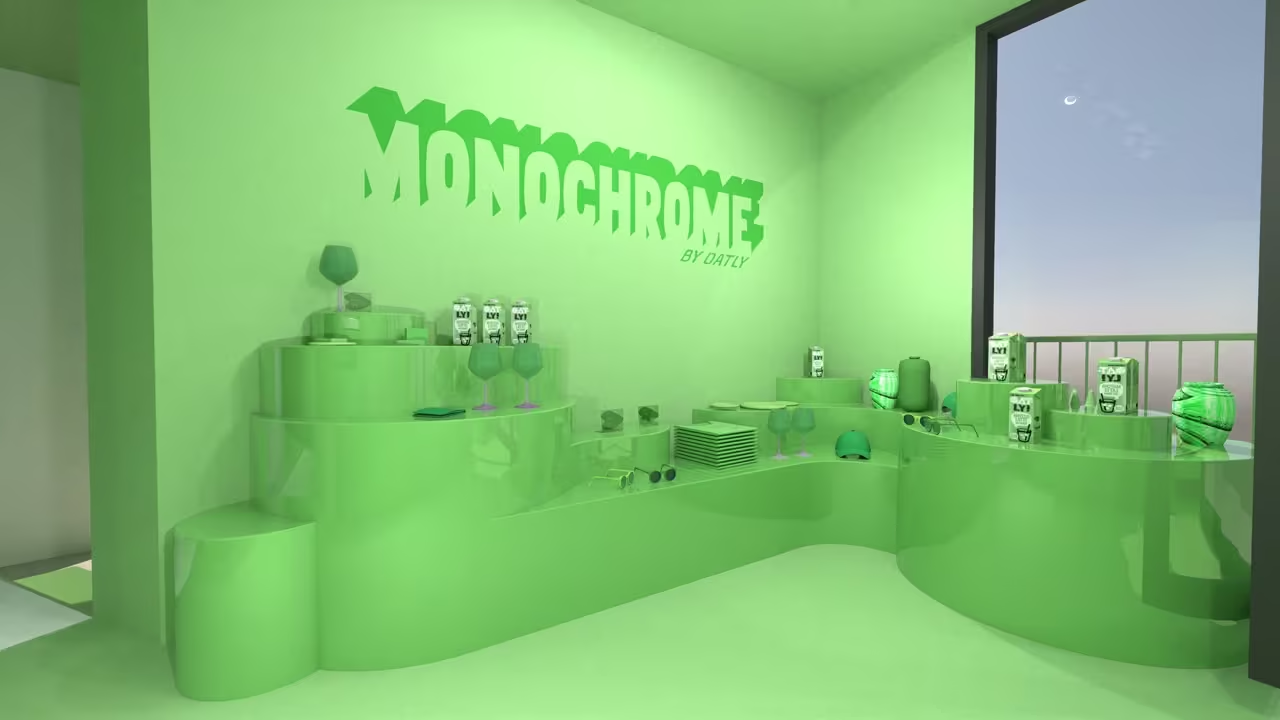
The immersive Oatly pop-up store bathed in a monochrome green hue, featuring a stylized logo wall, sleek product shelving, and geometric architectural details.
scope
The most unusual fixture at the pop-up runs only twice. On 3 and 10 September, Goodhood is hosting what Oatly is calling a Colour Matching Matcha Bar. Visitors get a colour assessment first, the kind more familiar from a personal styling consultation than a drinks counter, and a barista then makes them a drink matched to the result.
The idea borrows a format that has spent the last few years moving from fashion into skincare and now, apparently, into food and drink. Personal colour analysis, the practice of sorting people into seasonal palettes based on skin tone, hair and eye colour, has been a fixture of styling content and in-person consultations for several seasons. Applying the same logic to a cup of matcha, whose colour genuinely does range from a pale, grassy green to a deep, near-spinach shade depending on the grade and grind of the tea, is a fairly literal crossover, though not an entirely absurd one. Matcha’s colour is one of the ways its quality gets judged in the first place: the brighter and more vivid the green, the higher the grade of leaf typically used.
The broader technique borrows from seasonal colour theory long used in personal styling, which sorts people into categories such as spring, summer, autumn or winter based on the warmth or coolness of their skin, hair and eye colouring, then recommends clothing and makeup shades that flatter that palette. It resurfaced as a viral styling trend across social media in recent years, with paid in-person and video-call colour consultations becoming a small industry of their own. Extending that same sorting logic to a drink appears to be new, even if brands experimenting with view personalisation more broadly, from name-printed cups to shade-matched packaging, is not.
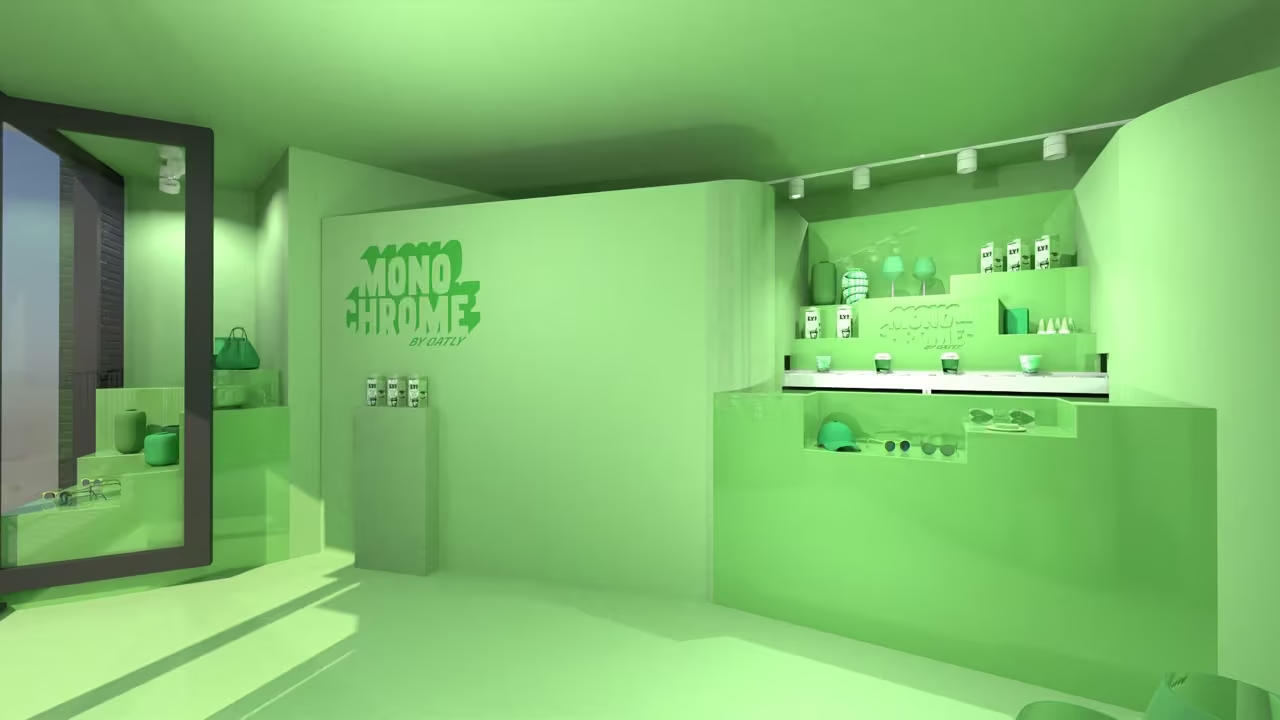
Monochrome by Oatly – A pure green retail display featuring minimalist product staging and a soft gradient dusk sky through the window.
who
Beyond the drinks, Monochrome by Oatly comes with a limited-edition product line sold through Goodhood for the length of the run. Tote bags, keychains and bars of soap make up the smaller pieces, alongside a dedicated ceramic collection made with Liam Owen, the London-based potter behind some of Goodhood’s own Lifestore stoneware. The set includes matcha mugs, incense holders and trinket trays, all worked in the takeover’s single-colour palette. The trinket trays and incense holders extend Owen’s stoneware practice beyond tableware into smaller objects that read more as collectibles than daily kitchenware, fitting a pop-up built as much around merchandise as it is around the drinks themselves.
Owen is not a stranger to this kind of collaboration. He trained in ceramics at Glasgow School of Art before spending years working as a graphic designer, returning to the wheel only later in life after his wife gave him a pottery course as a gift. By his own account, ceramics was one of three subjects, alongside fashion and textiles, that he had to choose between on a foundation course, and it was not something his family background had prepared him for. The graphic design career that followed gave him a transferable eye for composition and restraint that now shows up in the swirling, speckled two-tone glazes that have become his signature, applied to stoneware Goodhood has previously profiled in its own site editorial. He has lent that glaze work to sneaker culture before, too: a set of ceramic pieces for END., the sneaker and streetwear retailer, marked the release of an Ultraboost collaboration built around his “Ceramic Craze” colourway. The mugs, incense holders and trinket trays made for this pop-up will only be available for the length of the run, alongside the tote bags, keychains and soap.
why
Oatly’s takeover lands in a city where matcha has stopped being a coffee-shop side order and started becoming its own category. JENKI, the matcha bar chain founded in London in 2020, opened its first permanent site on Brushfield Street in Spitalfields in 2021, a five-minute walk from Goodhood’s Hanbury Street address. The chain has since expanded to six London locations, including a counter inside Selfridges, and plans to double that count to eleven by the end of 2026, a pace of growth that would make it the largest dedicated matcha bar operator in Europe. Founders Claudia and Otto Boyer built its name on ceremonial-grade matcha sourced from family-run farms around Uji, near Kyoto, regarded as the historic heart of Japanese matcha production. Its bars lean on their own colour-first identity, too: interiors designed by New York-based designer Ruby Kean run on a calming green-and-blue palette, an aesthetic echo, whether intentional or not, of what Oatly and Goodhood are doing with an entire shopfront this month.
The wider market has moved just as fast. Blank Street, the coffee chain that opened its first cart in Brooklyn in 2020 and has since expanded across New York, London and beyond, dropped the word “coffee” from its branding in late 2025 as matcha overtook coffee to account for more than half of its beverage sales in the US and UK, according to a 2026 interview with World Coffee Portal. Starbucks, for its part, has reported that tea sales at its US company-owned stores rose 70 percent between 2022 and early 2026. Industry data tracked by Tastewise puts matcha’s menu presence up more than 30 percent year over year across UK foodservice, with social media mentions of the drink climbing over 100 percent in the same period.
Against that backdrop, a ten-day, colour-coordinated pop-up with a bespoke ceramics line looks less like a novelty stunt and more like standard practice for a category that has gone, in the space of a few years, from garnish to main event. For a company that spent much of the last decade convincing Britain that oat milk could replace dairy, backing a pop-up built around Japanese green tea culture is a fairly direct extension of that same argument into a category Oatly did not invent but is now leaning into hard. Monochrome by Oatly runs at Goodhood, 15 Hanbury Street, London E1 6QR, through 13 September, with entry and drinks free for the length of the run.
Related Articles

Tarantino Hands Sacha Baron Cohen the Plume / Phoenix Theatre
Previews begin February 23 at the Phoenix Theatre, the house that opened with Noël Coward in 1930.