DRIFT AUDIO
Listen to this story
Choose a voice, then press play.
Marc Chagall, a Russian-French artist of Jewish descent, is celebrated for his dreamlike compositions that intertwine personal history, folklore, and religious themes. Among his significant contributions are the stained-glass windows created for the Hadassah Hebrew University Medical Center Synagogue in Jerusalem, representing the Twelve Tribes of Israel. These windows not only exemplify Chagall’s mastery in stained glass but also serve as a profound symbol of Jewish heritage and spirituality.
The Jerusalem Windows and Their Commemoration
Between 1959 and 1961, Chagall designed twelve stained-glass windows for the synagogue, each symbolizing one of the Twelve Tribes of Israel. These windows were inaugurated in February 1962 and are considered some of his most significant works in this medium. In 1973, to honor these masterpieces, Israel issued a series of twelve postage stamps, each depicting one of the stained-glass windows. This philatelic tribute not only celebrated Chagall’s artistry but also aimed to share the beauty and symbolism of the windows with a broader audience.
First Day Covers: Art Meets Philately
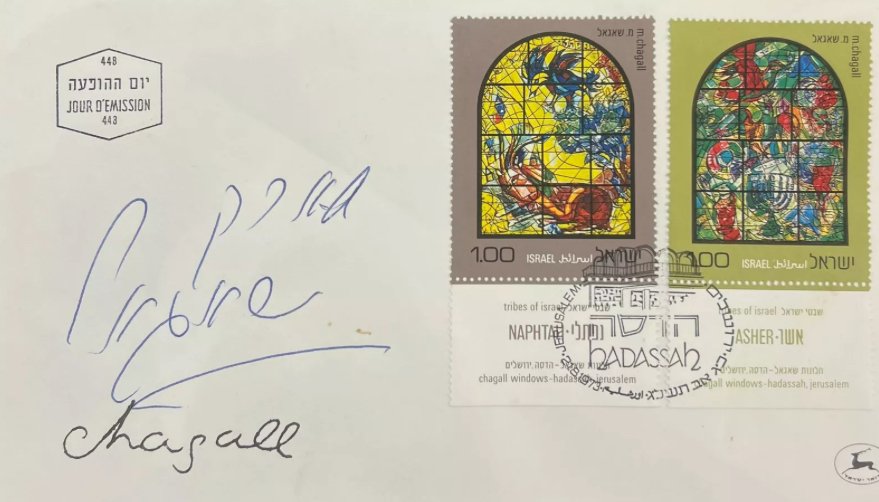
First Day Covers (FDCs) are specially designed envelopes issued on the first day of a stamp’s release, often featuring related artwork and postmarks. The release of the 1973 stamps led to the creation of FDCs that combined Chagall’s stained-glass designs with philatelic elements. These covers became collectible items, bridging the worlds of art and stamp collecting.
Design and Symbolism
The FDCs typically showcased images of the stamps alongside complementary artwork, often echoing the motifs and colors of the original stained-glass windows. Each window, and consequently each stamp and FDC, was dedicated to a specific tribe of Israel, incorporating symbols and themes pertinent to that tribe’s identity and biblical blessings. For instance, the window representing the Tribe of Levi features symbols associated with the priestly class, reflecting their unique role in Jewish tradition.
Chagall’s Personal Involvement
Chagall’s engagement with these FDCs extended beyond the initial artwork. He personally signed several of these covers, adding a layer of authenticity and personal connection to the pieces. Such signed FDCs are highly valued in both the art and philatelic communities. For example, a signed FDC featuring stamps of the Jerusalem Windows was sold by HistoryForSale, highlighting its collectible significance.
Artistic and Cultural Impact
The issuance of these FDCs served multiple purposes. Artistically, they disseminated Chagall’s work to a wider audience, allowing individuals who might never visit the Hadassah Medical Center to experience the windows’ beauty. Culturally, they reinforced the connection between art and Jewish heritage, celebrating the stories and symbols of the Twelve Tribes. The FDCs acted as ambassadors of Chagall’s vision, merging his artistic interpretation with tangible representations of Jewish identity.
Collectibility and Legacy
Today, these FDCs are sought after by collectors of both Chagall’s works and philatelic items. Their value lies not only in their aesthetic appeal but also in their historical and cultural significance. They represent a unique intersection of art, history, and postal heritage, encapsulating a moment when Chagall’s vision was immortalized through a medium accessible to the public. The colbetween Chagall and the Israeli postal service exemplifies how art can transcend traditional boundaries, reaching audiences in unexpected and meaningful ways.
The First Day Covers issued between 1970 and 1980, featuring Marc Chagall’s designs for the Israeli stamps commemorating the Jerusalem Windows, stand as testament to the enduring power of art to convey cultural narratives. They encapsulate Chagall’s artistic genius and his dedication to preserving and celebrating Jewish heritage through innovative mediums.
Related Articles
Modigliani’s Limestone ‘Tête’
Carved from a single block of limestone in Montparnasse more than a century ago, one of Modigliani's rare stone heads goes to auction for the first time…