
DRIFT AUDIO
Listen to this story
Choose a voice, then press play.
A 6,500 word essay landed Monday, and it arrived on the same day Meta quietly shipped a new open model.
Mark Zuckerberg posted an essay on Monday titled “The Future Is for Everyone,” and the number that every outlet reached for first was its length: 6,500 words, published directly on Meta’s own site with no paywall in sight. It is not a new position for him so much as a fuller one. Two weeks earlier, a shorter version of the same argument had run as an op-ed in the Wall Street Journal, and a year before that, a much shorter memo called “Personal Superintelligence” laid out the same basic thesis in a fraction of the space. Monday’s essay reads like the director’s cut. It restates the core claim, that AI should empower individuals rather than concentrate power in a handful of labs or governments, and then spends thousands more words on the mechanics of how Meta intends to make good on it.
The essay’s own framing is direct about what it is trying to counter. Zuckerberg writes about a future where a personal agent understands a person’s goals well enough to work on their behalf continuously, reachable from a phone, a laptop, or, pointedly, a pair of glasses. That last detail is not incidental. Meta has spent years and a great deal of money trying to make its Ray-Ban smart glasses a mainstream computing device, and the essay treats them as a natural home for the kind of always-on assistant it describes, a device that can see what a person sees and hear what they hear throughout the day.
The July 28 Wall Street Journal op-ed that preceded it covered similar ground but stayed closer to the WSJ’s own format constraints, a tighter argument aimed at a business readership already following the AI investment story. Monday’s version drops that constraint entirely. Published with no length limit and no paywall, it reads less like an op-ed making a single case and more like a policy document trying to answer every objection in one pass, safety, jobs, privacy, infrastructure, and governance included. That shift in format, from a newspaper’s opinion page to the company’s own unrestricted platform, is itself part of the argument the essay is making about who should control distribution.
hinge
Structurally, the piece organizes itself around three stated commitments: individual empowerment as the source of prosperity, invention as the primary purpose of superintelligence, and a balance of power as the foundation of safety. Each one doubles as a rebuttal to a rival know circulating elsewhere in the industry, the idea that advanced AI is so dangerous that it has to be developed and controlled by a small, trusted circle. Zuckerberg calls that notion of extreme concentration a bigger risk than the technology itself, arguing that broad access to personal agents and open weight models is what actually keeps any single actor from steering the outcome.
The through line is a familiar one from Zuckerberg’s public writing: agents, plural, in the hands of individuals rather than institutions. In the essay he puts it plainly, saying that everyone will eventually have an agent that understands their goals and everything they care about. It is an expansive claim, and the essay spends a long stretch trying to make it feel concrete, describing agents that manage a person’s health, finances, relationships, and hobbies at once.
scope
The section most likely to get quoted back at him is the one on labor. Zuckerberg rejects the idea that automation has to mean mass unemployment, leaning on the standard historic argument that new technology has always destroyed some jobs while creating others nobody could have described in advance. He points to app developers, social media creators, electric vehicle technicians, and data center operators as categories that did not exist a gen ago, and then extend the logic forward: one person product studios, world builders design games and stories, and personal biologists using superintelligence to formulate individual treatments.
He frames superintelligence less as a replacement for labor and more as what he calls an invention tool, something that lets small teams do what used to require large organizations. Company headcounts might shrink, in his telling, but the total number of companies should grow, which he presents as evidence that the net effect on work is expansion rather than contraction. It is an optimistic read, and one that leaves out the transition period for anyone whose specific job disappears before the new ones material, a gap that has shown up in the response to the essay more than once.
The examples he reaches for are consistent with the rest of the essay’s approach, specific enough to sound concrete without commit to a timeline. One person product studios design custom toys, furniture, or clothing. World builders and experience designers build games, stories, and adventures. Personal biologists using superintelligence to formulate individual treatment. None of these categories exist in any meaningful way today, which is precisely his point: the app developer and the electric vehicle technician did not exist a gen ago either, and describe a job that does not yet exist is, by definition, going to sound speculative right up until it is not.
challenge
The sharpest new commit in the longer essay is about privacy, not culpable. Zuckerberg describes a fully private mode for personal agents in which, he writes, even Meta itself cannot see or grant access to a user’s information. He draws the comparison directly to WhatsApp’s end to end encryption, a system Meta already operates at scale. For a company whose core business has run on data collection and advertise for two decades, that is a notable promise to put in writing, and it is the kind of specific, falsifiable claim that will be easy to check against whatever Meta actually ships.
The essay also gets into infrastructure that most manifestos skip. It describes a dynamic auction system for compute, design to hold prices down for personal agent use while still direct capacity toward whatever people value most in the moment. Zuckerberg gives one small show of what that could look like day to day, describe an agent that flags an interest rate change or a bill coming due before the person ask would have thought to check. It is a modest example next to the essay’s bigger claims about superintelligence, but it is also the kind of detail meant to make an abstract product feel like something a person could actually picture using next year rather than next decade.
On governance, Zuckerberg proposes that frontier labs share intermediate training checkpoints with the U.S. government earlier in the development process, before a model is finished, so officials can flag national security concerns without slowing public release. It is a specific enough proposal that it reads as an opening bid in a policy conversation rather than a rhetorical flourish, and it lands at a moment when the relationship between AI labs and federal regulators is still being negotiated in public, through hearings, executive orders, and competing voluntary commit rather than settle law.
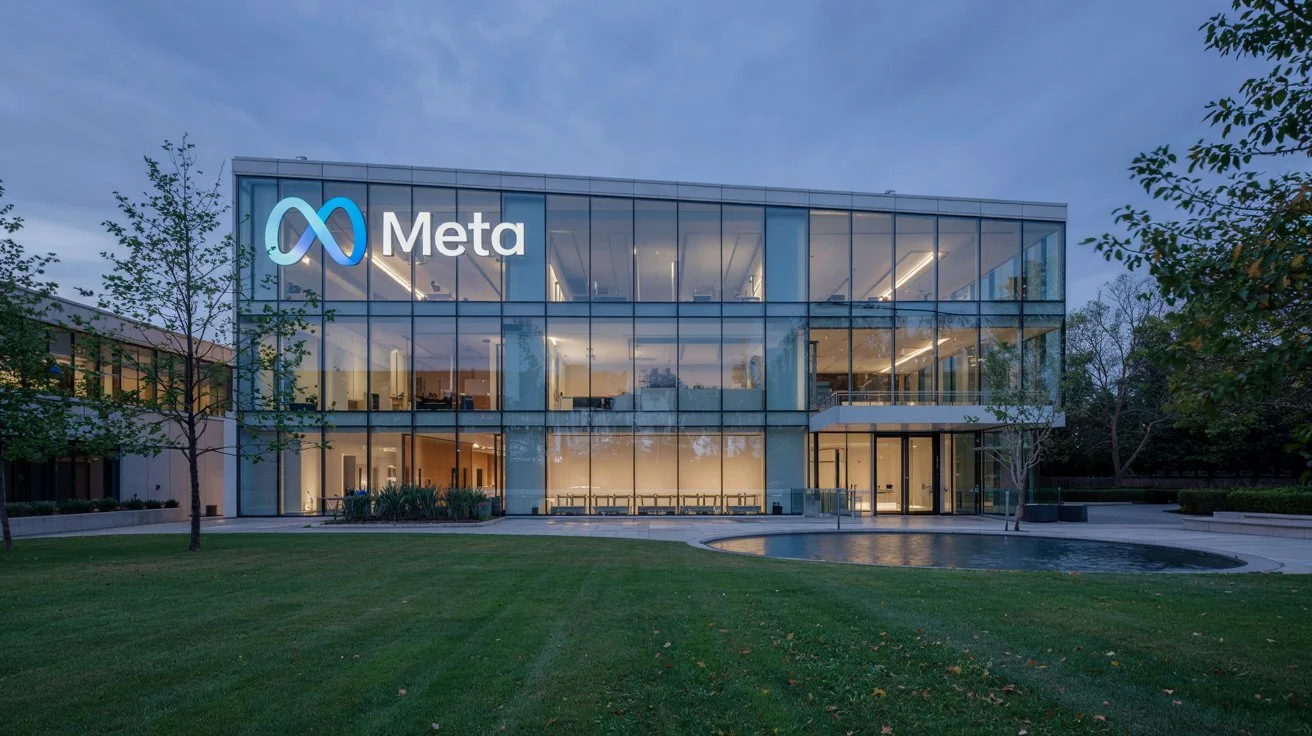
Modern glass-fronted Meta headquarters building at dusk, with the show Meta logo and offices view through the floor-to-ceiling windows.
extend
Timing is doing a lot of work here. The essay went up the same day Meta open weight Muse Glimmer, a 30 billion parameter agentic model rel under an Apache 2.0 license, following an earlier rel called Muse Spark. The essay itself acknowledges the connection, noting that now that Meta Superintelligence Labs is up and running, the company plans to resume open source models soon. That lab was staffed in part through Meta’s reported 14.3 billion dollar investment in the data annotation company Scale AI, a deal that brought Scale’s chief executive, Alexandr Wang, into Meta’s AI leadership along with a wave of researchers recruited from rival labs.
Financial Times coverage read the combination of essay and rel as Meta position itself against closed model competitors without naming any of them directly, OpenAI, Anthropic, and Google chief among the implied targets. Axios reported a detail the essay itself leaves out: a new Future Is for Everyone Fund, seeded with 1 billion dollars for communities that host Meta’s data centers. Zuckerberg does cite one example inside the essay, pointing to Richland Parish, Louisiana, where teachers reportedly received a 50,000 dollar bonus this year tied to tax revenue generated by a nearby Meta data center project. Axios also noted that Meta’s America’s Workforce Academy, a training program tied to the same community focused framing, graduated its first class the week before the essay went up, timing that reads less like coincidence and more like a company laying groundwork for an argument before making it.
None of that is incidental to the essay’s core claim. Data centers are one of the more view, physical costs of the AI buildout Zuckerberg is describing, and communities near them have increasingly pushed back on water use, power draw, and noise. Folding a bonus program and a fund into the same essay that argues for personal empowerment is Zuckerberg trying to make the infrastructure side of the story, the part people actually encounter in their own neighborhoods, sound like it belongs to the same generous view as the software.
fin
This is not the first time Zuckerberg has used a long public essay to mark a turning point for the company. He has done it before at pivotal moments in Meta’s AI strategy, going back to earlier public statements on open source development, and outside observers have started to treat the format itself as a recognizable move: know published in the same week as a product decision it happens to justify.
The response so far has split along familiar lines. TechCrunch’s own summary called it more a description of why Zuckerberg personally finds the coming changes exciting than a rebuttal to AI skeptics, noting that even as he paints the upside, he keeps circling back to ways it could go wrong. Other write ups have been rougher, with 404 Media’s take arguing that the vision described sounds less social than the platforms Meta already built, and independent AI researcher Ben Goertzel writing that he struggles to see how a future built through the business model of one advertising driven corporation can really be for everyone. Goertzel’s specific objection is worth sitting with because it does not dispute the philosophy so much as the vehicle: he calls Zuckerberg’s underlying instincts good hearted, even open minded, while questioning whether personal empowerment can actually be delivered through a company whose products were built on closed source code, aggregated personal data, and advertising.
Meta’s own materials note that the company’s independent board, not Zuckerberg personally, will now approve the safety criteria attached to future model releases, a governance detail that reads as a direct answer to that exact criticism. Either that board level check functions as a meaningful constraint or as a procedural formality is not something the essay itself can settle, and it is likely to be the detail outside observers watch most closely as Meta Superintelligence Labs starts shipping models under the new open source pledge.
What happens next is mostly a matter of watching whether the specific commitments hold up: the private mode that even Meta cannot see into, the compute auction meant to keep prices down, the checkpoint sharing arrangement with government reviewers. The essay itself puts a lot of weight on distribution over centralization. Whether that plays out the way it is described will depend less on the writing and more on what actually ships out of Meta Superintelligence Labs over the next year.
Related Articles

Four-Fifths of a Giant Killer: Hedley Studios Builds an Electric Porsche 550 J
Porsche opened its archive to a workshop in Bicester. What came back is a two-seat, […]