Masters of the Universe Review: Nicholas Galitzine Powers a Surprisingly Fun Fantasy Epic

June 4, 2026
In the post-COVID era of fragmented attention and cultural exhaustion, launching a big-budget franchise film feels like an increasingly Sisyphean task. Gone are the days when monolithic blockbusters could reliably compel audiences—and their coworkers—to Google “Infinity Stones explained” during water-cooler chats. Fatigue with interconnected cinematic universes and the relentless mining of 1980s nostalgia—prolonged by hits like Stranger Things—has left many viewers wary. Enter Masters of the Universe, a wildly expensive summer tentpole based on decades-old Mattel toys, primarily nostalgic for men now in their forties (this writer is 34, for the record). The film opens wide on June 5, 2026, landing squarely in the first weekend of Pride Month with He-Man ready to wield his sword. Yet it faces stiff competition from Gen Z-skewing originals: Obsession and Backrooms, two horror-thrillers that tap directly into young adults’ anxieties about romance, social isolation, and venturing beyond screens.
Box-office tracking has been grim, with projections hovering between $25–35 million domestically for the opening weekend against a reported budget north of $170 million. Part of the challenge stems from general unfamiliarity with the Mattel brand beyond Saturday-morning cartoon devotees. Another factor is the perception of yet another action-adventure spectacle featuring square-jawed, broadsword-wielding heroism that can feel painfully dated in 2026. Two years ago, Mattel struck gold with Barbie, but that $1.4 billion phenomenon owed as much to Margot Robbie’s star power and the viral “Barbenheimer” cultural moment as to its clever themes. Today, even established properties struggle—Star Wars entries can’t always outdraw low-budget horror about liminal empty rooms. Such is the uphill battle for Masters of the Universe.
Here’s the crazy thing, though: Masters of the Universe actually rocks.
sense
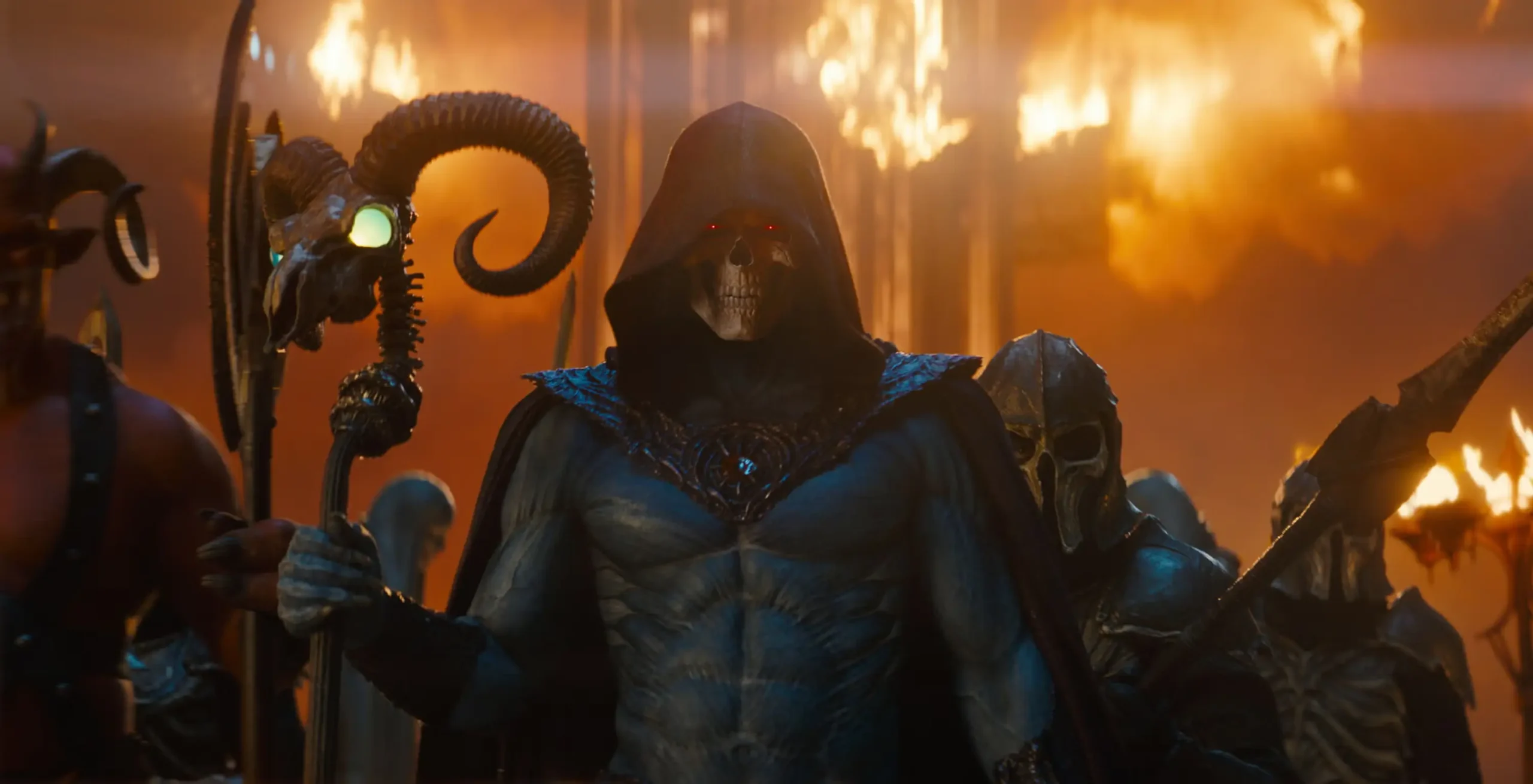
Anchored by a charismatic Nicholas Galitzine as Prince Adam/He-Man and helmed by Travis Knight—whose stop-motion roots with Laika (Kubo and the Two Strings, ParaNorman) bring a tactile, epic storytelling sensibility—the film delivers pure, unapologetic summertime escapism. Galitzine stars as a young man whose home world of Eternia has fallen under the tyrannical rule of Skeletor (Jared Leto, in a scene-stealing, flamboyantly fantastic performance). Exiled to Earth as a child, Adam grows up leading an ordinary life with a desk job, haunted by dreams of swords, heroes, and a destiny he insists is real—much to the skepticism of his peers and potential Hinge dates. When his old friend (and crush) Teela (Camila Mendes) reappears, Adam embarks on a journey to reclaim his powers and save Eternia.
The supporting cast bolsters the adventure: Idris Elba as Man-At-Arms, Alison Brie as Evil-Lyn, and others rounding out a vibrant ensemble. At 141 minutes, the film balances spectacle with heart, clocking in as a visually coherent, color-popping fantasy that feels like a live-action cartoon brought to vivid life.
Swap “Masters” and “Universe” for “Guardians” and “Galaxy,” and the DNA feels familiar: quippy dialogue, found-family dynamics, and high-stakes battles against cosmic evil. The original 1980s series blended Frank Frazetta-inspired epic fantasy with whimsical humor—Skeletor was always a theatrical diva—and this adaptation leans into that camp without irony. Knight’s direction ensures the action is zippy, the costumes pop, and the practical-to-CGI blend feels wonderfully alive. Early reviews praise its 76-78% Rotten Tomatoes score for fun, heartfelt escapism.
theme
On X (formerly Twitter), film critic Darren Mooney sparked debate by comparing Masters of the Universe to I Saw the TV Glow (2024), Jane Schoenbrun’s subversive horror about nostalgia, identity, and questioning reality through a beloved TV show. While the comparison raised eyebrows—given Schoenbrun’s arthouse style and pronounced transgender subtexts—Mooney elaborated thoughtfully: it’s a story about childhood nostalgia, rigid gender roles, the disconnect between the body you’re given and the one you feel you belong in, and how conforming to expected performances can be self-destructive.
Masters of the Universe isn’t operating at that level of introspective experimentation. It’s a popcorn movie selling action figures and Fortnite tie-ins. Yet it invites intelligent readings. At its core, it’s about reconciling who you are with who you know you can be, despite the world’s insistence otherwise. Prince Adam’s arc resonates as a “Barbie for Men”—a story grappling with masculinity, self-belief, and authenticity. He never doubts his inner truth, yet faces challenges from Skeletor’s flamboyant provocations about worth and destiny. The film celebrates absolute faith in oneself, a message with profound impact on impressionable young viewers.
Chuds may cheer the brawny hero rejecting “soft” modernity to reclaim heritage. Others can interpret it as empowering broader ideas of identity and performance. Either way, its triumphant, feel-good tone lands powerfully.
engine
The road to this film was long and turbulent, with multiple studios, directors, and scripts over the years. Amazon MGM Studios and Mattel finally greenlit it, with Knight directing from a screenplay by Chris Butler (with contributions from others). Principal photography in London from January to June 2025 emphasized practical sets and transformative performances—Galitzine bulked up impressively for the He-Man reveal.
Jared Leto’s Skeletor has been a talking point. Some expected over-the-top eccentricity; the voice is more grounded than anticipated, yet Leto’s physicality and theatrical menace shine through prosthetics and performance capture. It captures the character’s diva energy while fitting the film’s sincere tone.
Knight’s stop-motion background informs a respect for craft. The film avoids winking cynicism, embracing the source material’s earnest heroism. This sincerity helps it stand out amid nostalgia fatigue.
scope
Despite positive buzz, Masters enters a tough marketplace. It competes with lingering holdovers like The Mandalorian & Grogu, the sleeper hit Backrooms (Kane Parsons’ feature debut for A24, exploding with $81 million openings thanks to liminal horror vibes), and Obsession (Curry Barker’s micro-budget YouTube-honed crush-gone-wrong thriller, defying norms with legs).
Obsession and Backrooms speak to Gen Z fears—social anxiety, the terror of the unknown, digital-age isolation—in ways IP spectacles sometimes can’t. Their success highlights a renaissance of young, online-trained filmmakers (Barker at 26, Parsons similarly youthful) echoing New Hollywood trailblazers like Spielberg or Coppola.
Pre-sales for Masters skew toward adult males nostalgic for the cartoon. Marketing has been solid—trailers emphasizing epic battles, character moments, and Leto’s villainy—but awareness remains a hurdle compared to Transformers-level penetration. International distribution by Sony helps, yet analysts question whether it can reach Barbie-like cultural ubiquity.
A strong opening could still lead to decent legging if word-of-mouth holds, especially with family audiences over the summer. Tie-ins like toys, games, and a synth-rock score featuring Brian May add layers of engagement.
straddle
It feels counterintuitive to champion Masters of the Universe—the ultimate IP play from Bezos-backed Amazon MGM—in an era prizing originality. Yet when a movie resonates, it deserves attention. The decline of the superhero bubble has cleared space for fresh voices, but polished, sincere spectacles still have a place. Dismissing Masters risks repeating the Dungeons & Dragons: Honor Among Thieves fate: critically beloved, commercially ignored, no sequel.
The film’s themes of self-discovery amid expectation mirror broader 2020s conversations. In a world pressuring conformity—whether through social media gender norms, career paths, or cultural signals—He-Man’s journey to embrace his power feels relevant. It’s not revolutionary, but it’s effective.
For older millennials and Gen X, it’s a joyful reclamation of childhood joy. For younger viewers, it offers escapist heroism with subtle depth. The vibrant visuals, coherent action, and humor make it rewatchable.
fin
Masters of the Universe isn’t trying to be the next arthouse breakthrough. It’s a summer movie that delivers on spectacle, heart, and fun. Galitzine brings earnest charm, Leto chews scenery delightfully, and Knight’s direction elevates the material.
In an industry questioning franchise viability, this one succeeds by leaning into what made the property enduring: optimism, power, and believing in something greater. It may not top charts like Barbie, but it could carve a niche as a crowd-pleaser that sparks conversations about masculinity, nostalgia, and faith in oneself.
As theaters fill (or don’t) this June 5 weekend, Masters of the Universe stands as a reminder that sometimes the simplest stories—man turning into hero, good vs. evil—still hold power. By the Power of Grayskull, it might just surprise skeptics. Whether it conquers the box office or becomes a cult favorite on streaming, its message endures: have faith in who you truly are.
The broader industry lesson? Franchises face headwinds, but well-crafted ones with heart can still connect. Meanwhile, the rise of Barker, Parsons, and peers signals exciting evolution. Hollywood needs both: bold originals and smart spectacles. Masters of the Universe threads that needle better than many expected.
Related Articles
France Just Banned Social Media for Kids Under 15, and the Fight Over Anonymity Is Only Getting Started
France becomes the first EU nation to bar under 15s from social platforms, and critics […]