DRIFT AUDIO
Listen to this story
Choose a voice, then press play.
The 1300 that helped build New Balance’s cult following in Japan is getting an autumn-ready update to its Made in USA lineup.
New Balance is carrying the 1300 into another season of its Made in USA rotation, this time in a colorway named U1300SS, built around Angora, Blue Oyster, and Mulled Wine. Where the 1300’s spring and summer 2026 releases leaned into cooler, muted tones, tonal grays and light blues meant to read as understated daily wear, this one shifts toward something warmer. Angora functions as the neutral base across the mesh, Blue Oyster brings in a cooler counterpoint through the overlays, and Mulled Wine adds the kind of deep, wine-toned accent that reads as a clear seasonal cue toward autumn.
New Balance has used this same three-part naming convention across the current Made in USA collection all year, pair a light neutral with two contrasting accent tones rather than sticking to a single dominant color. It’s a formula that lets the 1300, a shoe originally built as a performance runner, read as a lifestyle piece without losing the details that made it a cult object in the first place.
Earlier rel this year leaned into landscape-inspired neutrals across the Made in USA lineup, olive tones on the 990v4 and 992, slate grays and steel blues on the 1300 itself, rolled out in phases between February and June. A fall-facing colorway carrying a deeper accent like Mulled Wine tracks with that broader pattern: New Balance treats its premium USA-made runners less like a single seasonal drop and more like an ongoing rotation, cycling in new tonal stories every few months while leaving the shoe’s actual construction untouched.
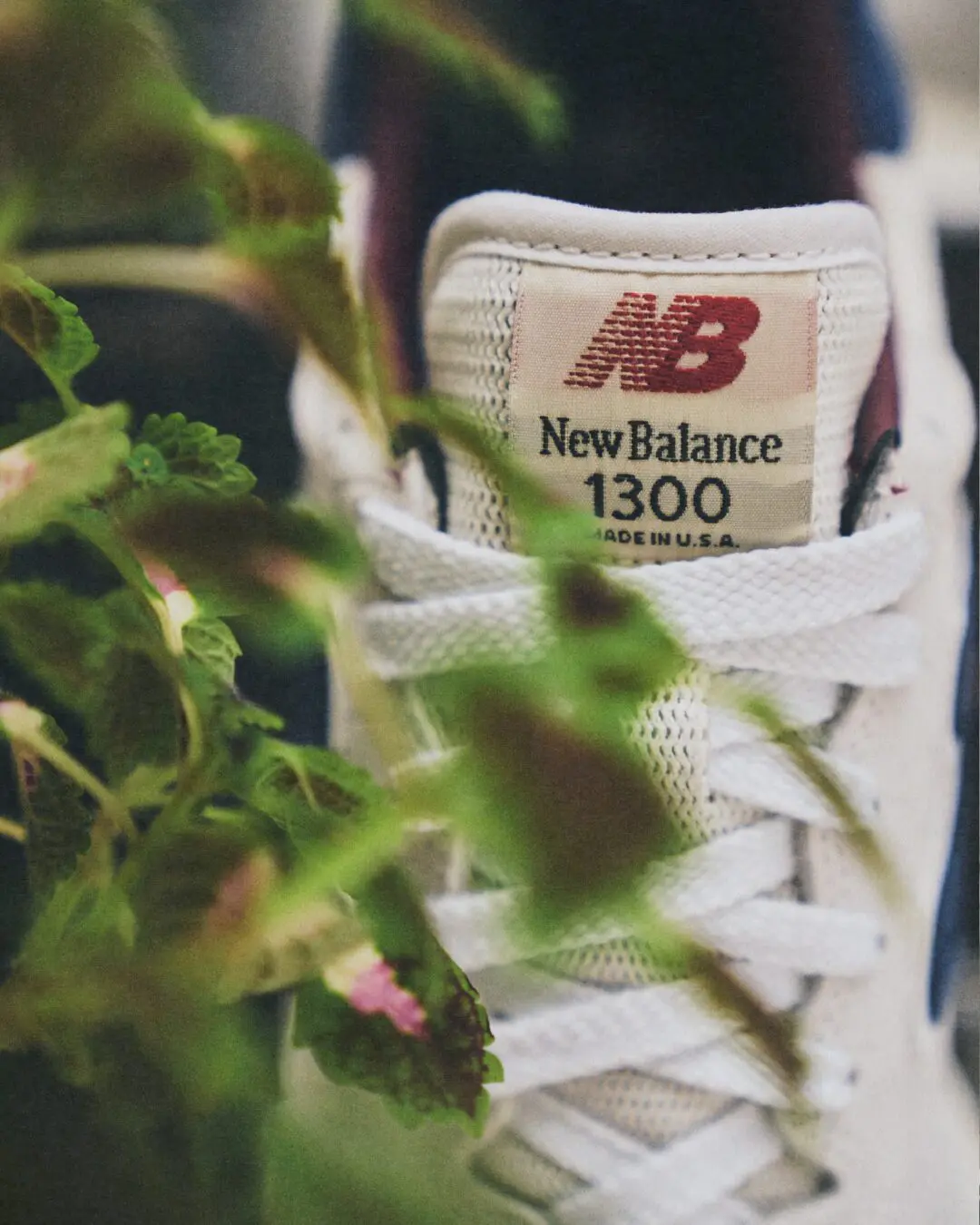
The tongue tag confirms Made in U.S.A. construction on the New Balance 1300.
matter
The 1300 has a specific weight in New Balance‘s history that most of its Made in USA siblings don’t carry. Rel in 1985 at $130, an aggressive price for a running shoe at the time, it was positioned as a genuine premium performance product rather than a lifestyle play from the start. It was the first New Balance model built around the brand’s ENCAP midsole technology, which paired a lightweight EVA foam core with a firmer polyurethane rim to manage both cushioning and stability in a single unit, a construction method the brand still uses across its current USA-made lineup.
That combination of new technology and premium materials, pigskin suede overlays wrapping a mesh base, built a reputation that outlasted the shoe’s original performance position. The 1300 found a particularly devoted following in Japan, where its detailing and construction quality turned it into something closer to a status object than a running shoe, a dynamic that continues to shape how New Balance times and markets its Made in USA releases for that market today. Runners and collectors alike have kept the model in steady rotation for four decades, and New Balance has leaned into that history rather than away from it, regularly returning to the silhouette for both core colorways and more experimental treatments, including versions that swap standard suede panels for textured finishes on select overlays.
The brand has periodically revisited the 1300 through region-specific special editions as well, built around premium leathers sourced from tanneries like Horween and priced well above the standard Made in USA line, underscoring how much collector weight the sil carries beyond its original running-shoe brief. Those special editions tend to sell out quickly through New Balance’s own flagship stores, and the interest they generate tends to spill over into demand for the more accessible seasonal colorways that follow, which is roughly the lane this fall’s Angora, Blue Oyster, and Mulled Wine release occupies.
struct
The 1300 Made in USA has carried a retail price around ¥46,200 in its most recent domestic rel, position it well above New Balance’s mainline sneakers and in line with its status as a genuine handmade product rather than a mass-produced retro. The shoe is assembled at New Balance’s Massachusetts and Maine factories, where construction still follows the brand’s original approach: a mesh base overlaid with cut-and-sewn suede panels across the toe, saddle, and heel, an ENCAP midsole unit, and a tread outsole built for durability rather than trend cycles. The N logo and heel branding are typically rendered in a contrasting suede to match the accent colors in each rel.
View this post on Instagram
A Japan market release notice lists this Angora, Blue Oyster, and Mulled Wine colorway as arriving this fall, tracking with New Balance’s established pattern of rolling its Made in USA seasonal collection out in phases across the year. A specific street date, regional pricing, and confirmed retailer list for this particular colorway could not be independently verified at time of writing, and should be confirm directly with New Balance or its authorized retailers closer to launch. New Balance’s Made in USA 1300 has typically been distributed through the brand’s own flagship stores and select boutique accounts in both the US and Japan, alongside newbalance.com and shop.newbalance.jp.
Buyers weighing this release against past 1300 drops should expect the same fit and construction they’ve come to know from the model, this update is squarely about seasonal tint rather than any change to the shoe’s underlying build. Sizing has historically run true across the Made in USA 1300 line, and the shoe ships in a unisex fit spanning a wide adult size run, consistent with how New Balance has positioned the rest of its current USA-made catalog.
For a form that has spent forty years proving its staying power one suede panel at a time, that consistency is arguably the entire pitch. New Balance isn’t chasing hype cycles with the 1300 the way some of its collective rel do, it’s counting on the same audience that made the shoe a phenomenon in 1985 to keep showing up for whatever color comes next.