

DRIFT AUDIO
Listen to this story
Choose a voice, then press play.
New Balance’s newest hybrid sil lands in Japan on October 1st, its sculpted pod sole tracing back to the 9060’s Y2K architecture.
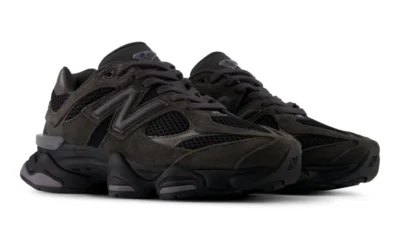
New Balance is bringing a new silhouette to Japanese retail on October 1st: the U9833M7, dressed in a colorway called “Black/Dark Night” and priced at ¥22,000. The style surfaced through a Japan market rel notice ahead of any official campaign, and neither New Balance’s own product pages nor its usual U.S. retail partners have listed the shoe as of this writing, so there is no confirmed release window, pricing, or avail outside Japan yet.
A Japan-first rollout on a non-collision New Balance release is not unusual. The brand has a long track record of send its best or earliest colorways through Japanese retail first, a pattern rely sources has flagged repeat across the 990 line and elsewhere. If either the U9833M7 stays Japan-exclusive or eventually shows up through New Balance’s other regional stores is not something the current rel notice addresses. What is clear is the shape underfoot. The U9833M7 carries a molded, bulbous sole unit, with ABZORB cushion pods embedded directly into the outsole rubber so that they visibly bend and warp along with the contour of the pod itself, rather than sitting as a flat slab beneath the foot. That detail, together with the sole’s overall silhouette, is what ties the shoe back to New Balance’s 9060 line. The rel notice describes the U9833M7 as a new hybrid model built by fusing two existential form though it stops short of naming the second reference point, and that gap has not been filled in by New Balance or anyone else covering the release yet.
stir
The 9060 is the shoe doing most of the explaining here. New Balance introduced the form in July 2022, reworking its own 99X archive, specific the 990’s structural sway bars and the 860v2’s running proportions, into an oversized, tech-forward shape pulled from early-2000s design lang. ABZORB and SBS cushioning, both technologies New Balance had built into flatter, more conventional soles for decades, got scaled up into the exaggerated sculpted pod that has since become the model’s signature.
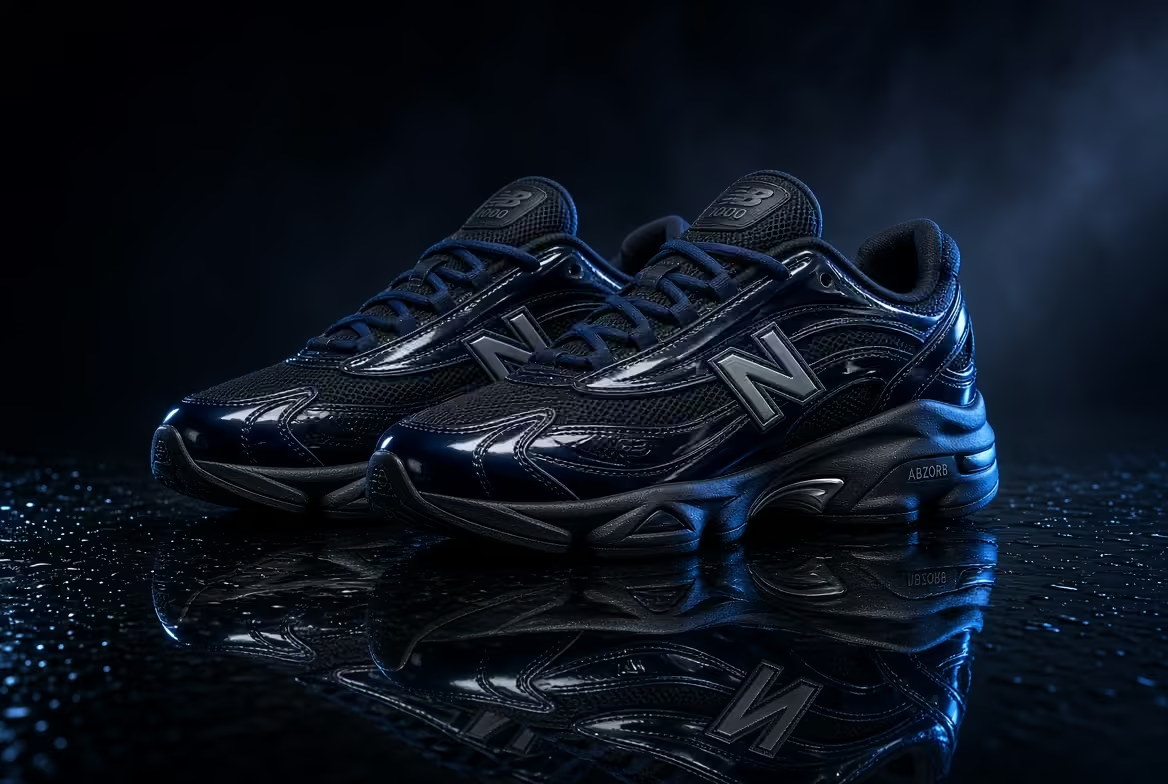
A pair of dark navy New Balance 1000 sneakers with glossy patent leather overlays and mesh, resting on a wet, reflective surface in moody blue lighting.
Black entered that story almost immediately. New Balance moved off the 9060’s original “Mindful Gray” launch colorway within weeks, following it with a black, brown, and grey mix that echoed tones the shoe had already worn before its retail debut. A “Black/Dark Night” treatment on a new pod sole hybrid sits comfortably inside that same pattern: darker colorways have tended to arrive quickly on this design family, more so than on New Balance’s more traditional running silhouettes.
visit
ABZORB itself is older than either of those references. New Balance introduced the cushioning system in 1993, first putting it inside the 998, and has spent much of the past three decades treating it as a functional, mostly hidden midsole component rather than a design centerpiece. That changed with the 9060 in 2022, and New Balance leaned further into it in May 2025 with the ABZORB 2000, a separate lifestyle sil built around a full-length ABZORB sole reinforced with ABZORB SBS pods, alongside a companion ABZORB 2010 model. Both were pitched by New Balance itself as part of an ongoing exploration of 2000s-era running influences, distinct from the 9060 line but working the same idea: take a three-decade-old cushioning platform and make its shape the whole point of the shoe. The ABZORB 2000 had already been previewed months earlier at Milan Design Week before its consumer rel, giving New Balance a design-world audience for the sil before it ever reached shoe retail.
A new hybrid contour arriving roughly a year after that pair, with a sole unit exaggerated enough that a Japan market rel notice pegged it to the 9060 on sight, fits a brand that has now returned to this well at least three separate times since 2022 rather than treating any one of them as a closed chapter.
extend
New Balance has spent the past several years running its own archive through different decades on purpose, and outlets covering the 9060’s 2022 debut framed it as the deliberate next step in that sequence: the 327 and 237 had already leaned on 1970s track-shoe proportions, and the 57/40 pulled from the brand’s late-1980s and early-1990s running catalog, before the 9060 became the entry that pushed forward into the 2000s instead of further back. That put it in a different position than the others. Rather than reissuing or lightly updating an old running shoe, the 9060 took the structural logic of the 99X series (990, 993, 998, and the rest) and rebuilt it as something closer to speculative footwear, exaggerated proportions, visible tech, a shape that reads as more concept than reissue.
A new hybrid silhouette that leans on that same pod sole architecture, arriving under its own style number rather than as another 9060 colorway, suggests New Balance is treating that design lang as a platform to build on rather than a single model to keep recoloring. Whether the U9833M7 becomes an ongoing line of its own or stays a one-off variation inside the 9060 family is not clear yet, and nothing in the release notice settles the question either way.
fin
Counted up, the U9833M7 marks at least the third time since 2022 that New Balance has turned ABZORB’s now three-decade-old cushioning platform into the visual centerpiece of a new outline after the 9060 and the 2025 ABZORB 2000/2010 pair. What is on the record for now: an October 1st Japan release, a ¥22,000 price, a “Black/Dark Night” colorway name, and a sole architecture that reads as a direct descendant of a design New Balance keeps finding new reasons to rebuild.
Related Articles
A Moccasin Apron On A Run
1890A. Truffle Salt is U18909VF, 22 October, 10:00. Pink Granite was 8 October. Cow Print 16 September. Dark Night 6 August. Snakeskin 1 July. ¥29,150.