DRIFT AUDIO
Listen to this story
Choose a voice, then press play.
Amazon MGM Studios has set a November 18 Prime Video premiere for Madden, and the first footage suggests Cage is juring it straighter than anyone expected.
Late in the middle of an NFL Sunday slate this November, Amazon MGM Studios will drop a film that has been shh building toward this moment for two years. Nicolas Cage plays John Madden, the Hall of Fame coach, longtime broadcaster, and namesake of the billion-dollar Madden NFL video game series, in a biopic that is simply titled Madden. Madden died in 2021 at 85, and the project has carried a certain weight ever since it was first announced, the question being whether anyone could plausibly play a figure whose voice and face were fused into American living rooms for three straight decades.
On August 6, the studio confirmed the film would begin streaming worldwide on Prime Video on November 18, releasing a short announcement video built around Cage speaking directly about Madden’s influence. The clip runs about a minute and mixes Cage’s own reflections with brief cuts from the film itself. A day or two later, a fuller trailer followed, giving the widest look yet at how Cage, styled in a wig and Raiders gear, moves and talks in the role. It is not an impression in the Saturday Night Live sense. It reads more like an actor building a person from the outside in, gesture by gesture, rather than chasing a vocal caricature.
The timing is not an accident. Dropping a football biopic in the middle of football season, with a limited theatrical run reportedly planned for November 11 ahead of the Prime Video debut, positions the film for both audience attention and a shot at awards qualification.
View this post on Instagram
in
The film is set in the 1970s, tracking Madden’s run as head coach of the Oakland Raiders, a stretch that included a run of playoff appearances and a Super Bowl win in the 1977 season. That championship, and Madden’s decade-long stretch without a losing season as a head coach, forms the spine of the story. Rather than treating the on-field material as a checklist of scores and standings, the film appears more interested in Madden as a personality: a coach who managed a locker room full of famously difficult personalities and somehow made it work through sheer force of temperament.
What separates this from a standard sports biopic pitch is the relationship at its center, not between Madden and his players, but between Madden and Raiders owner Al Davis. The two men are described in the film’s own marketing as best friends first and business partners second, an unusual framing for an owner-coach pairing in professional football, where that relationship is more often adversarial. Davis, known across the league for his combative reputation and his rebellious streak against the NFL establishment, gives the film a built-in tension that does not require inventing conflict.
Production notes describe the film’s world as “wildly inventive” and specific to its decade, a phrase that director David O. Russell used when the project was first announced back in 2024. That period specificity, 1970s Oakland, sideline fashion, broadcast technology still finding its footing, appears to be doing real work in the film’s visual identity based on the released stills.
people
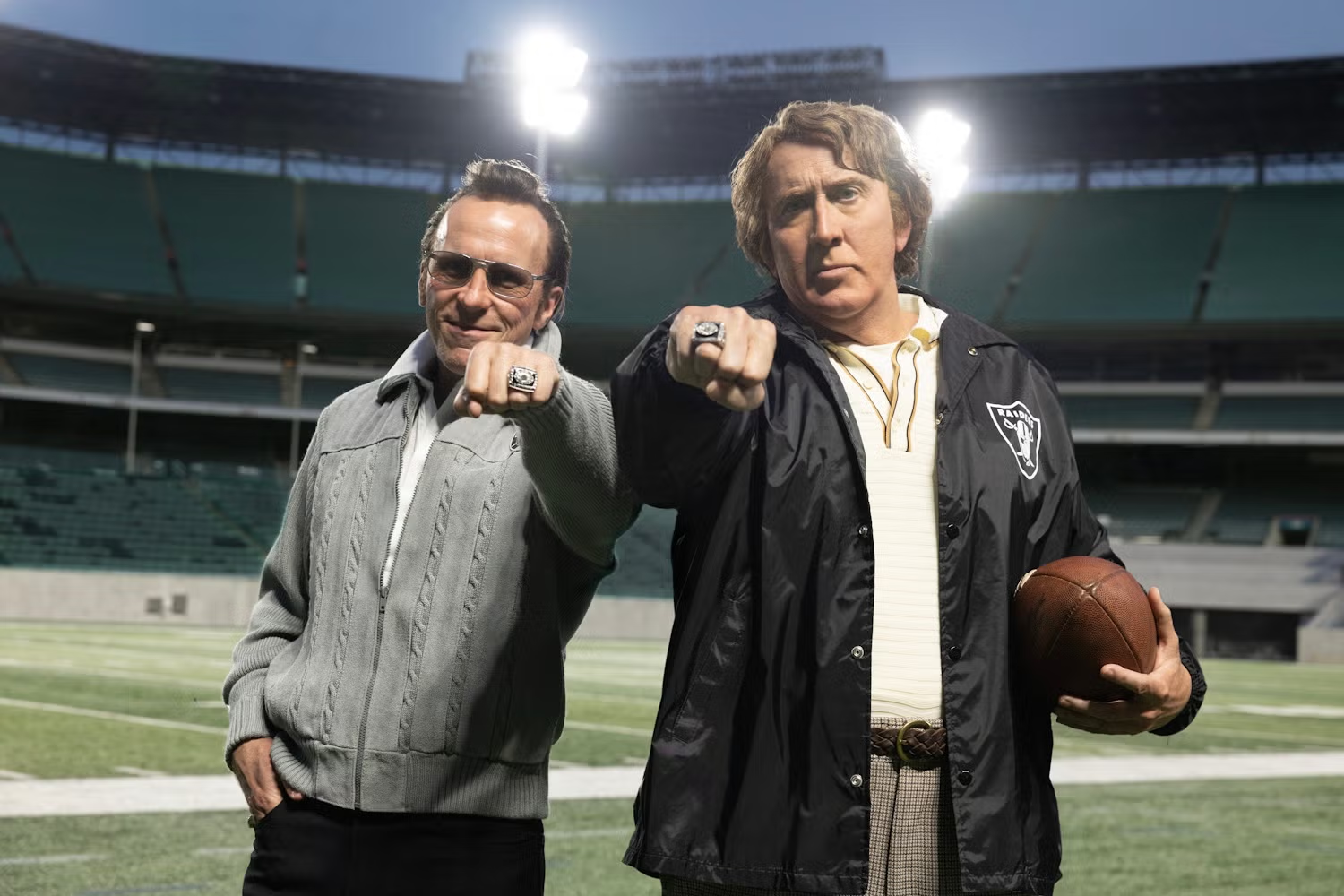
Playing opposite Cage is Christian Bale as Al Davis, a casting choice that pairs two actors known for physical transformation and committed character work rather than movie star magnetism. Early stills show Bale in slicked back hair and the kind of glasses Davis was known for, distinct enough from Bale’s own features that the transformation reads as immediate. Where Cage is playing warmth and charisma, Bale appears to be leaning into Davis’s sharper, more guarded public persona, and the contrast between the two performance styles could end up being the more interesting dynamic in the finished film.
The rest of the cast fills in the human scaffolding around that central friendship. Kathryn Hahn plays Madden’s wife Virginia, a role described in the film’s marketing as a genuine creative and personal partnership rather than a background figure. Sienna Miller plays Carol Davis, Al’s wife and a part owner of the Raiders in her own right. John Mulaney takes on the role of Trip Hawkins, the EA Sports founder who signed Madden to the deal that eventually became the Madden NFL video game franchise, a storyline that gives the film a clean throughline from 1970s coaching to a game franchise that still sells millions of copies a year. Shane Gillis rounds out the credited cast in a role that has not been publicly detailed, and reports indicate Joel Murray appears as broadcaster Pat Summerall, Madden’s longtime booth partner during his years calling NFL games.
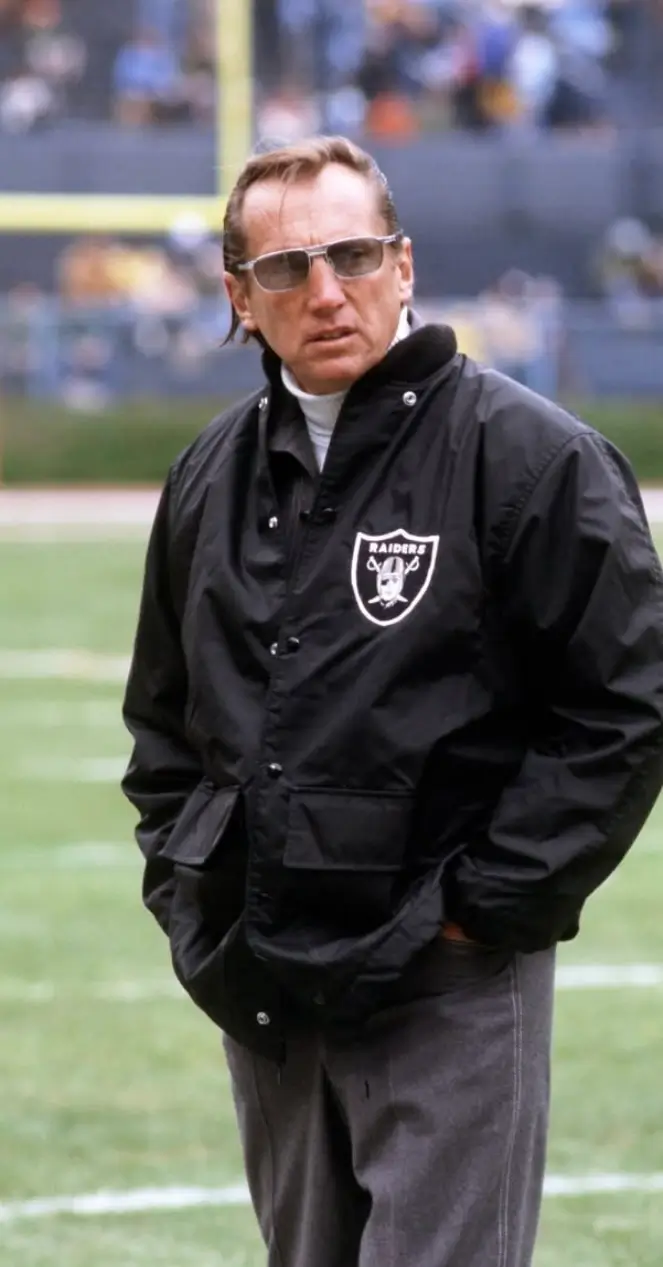
Christian Bale in character as Oakland Raiders owner Al Davis, wearing slicked back hair and glasses, alongside Nicolas Cage as John Madden.
flow
Behind the camera is David O. Russell, the filmmaker behind Silver Linings Playbook, American Hustle, and The Fighter, working from a script he wrote after an earlier draft by Cambron Clark. Russell has not made a film since 2022’s Amsterdam, a starry period piece that struggled badly at the box office and drew some of the harshest reviews of his career. Madden represents a return to the kind of character driven, ensemble heavy storytelling that made his earlier films awards contenders, and the industry attention on this project is at least partly a referendum on whether that instinct still holds after Amsterdam’s failure.
Russell also carries a well documented history of contentious behavior on past sets, something that has followed coverage of this production even as the focus has largely stayed on Cage’s performance. It is worth noting plainly rather than glossing over, since it is part of the honest context around why a film with this much star power drew some surprise over its release plan.
The producing team includes Todd Black, Jason Blumenthal, and Steve Tisch through the Escape Artists banner, along with Jonathan Shukat and Matthew Budman, with the film produced in association with Skydance Sports and NFL Films, a partnership that suggests the league itself had some hand in shaping the football material’s authenticity.
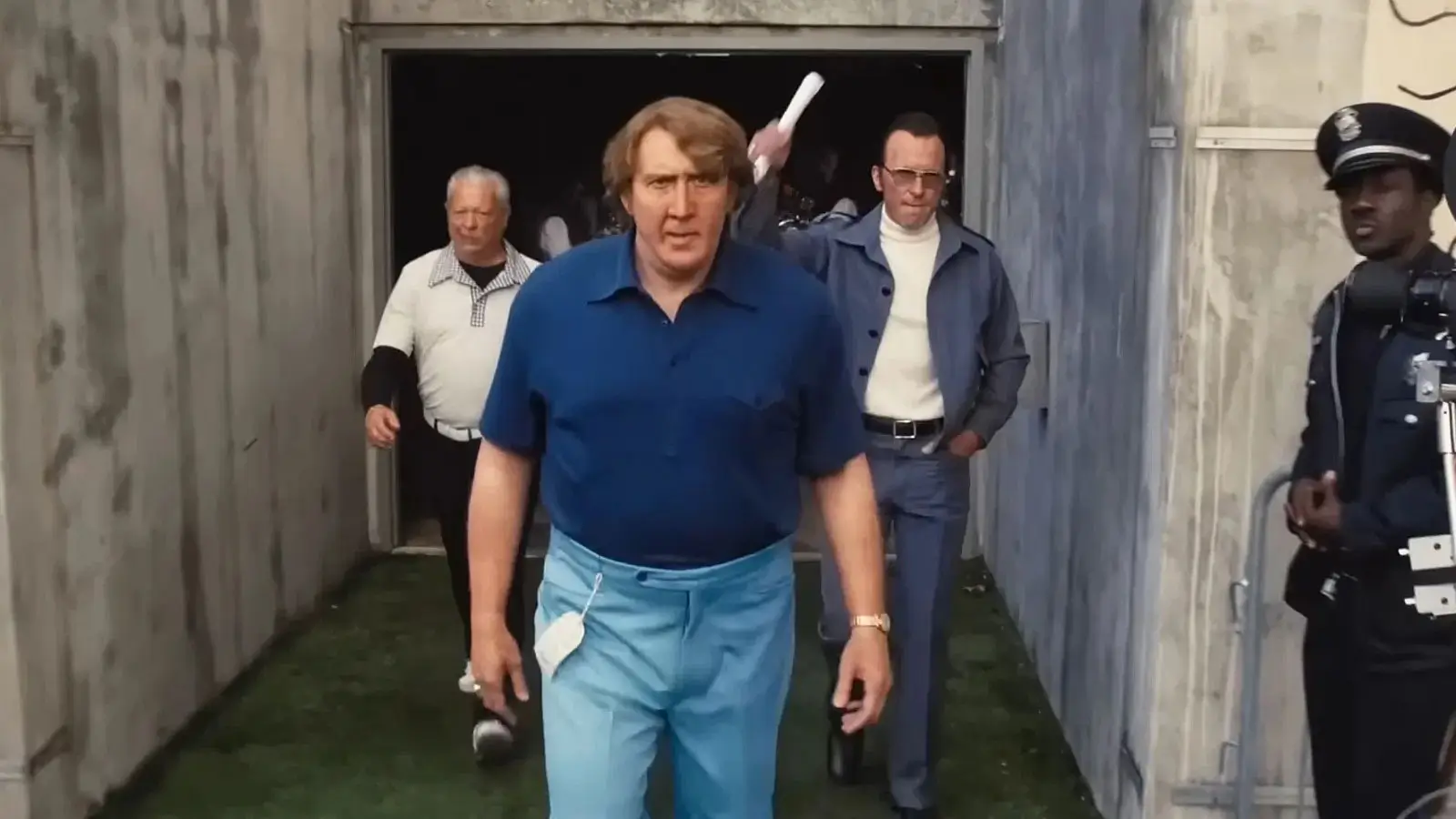
Cage in a navy polo shirt and light blue pants walking out of a stadium tunnel, followed by several men and a uniformed police officer.
mere
Coaching only accounts for part of Madden’s story, and the film seems aware that his second act, the one that made him a household name well beyond Oakland, actually reached a far bigger audience. After retiring from coaching in 1979, Madden spent close to three decades as a television analyst, first alongside Pat Summerall, building a broadcasting style built on plain language and genuine enthusiasm rather than jargon. That voice, half professor and half enthusiastic uncle explaining the game from the couch, became as recognizable to a generation of football fans as any player on the field.
The film’s decision to bring John Mulaney in as Trip Hawkins gives the video game side of Madden’s legacy real narrative weight rather than treating it as a coda. Hawkins signed Madden to what became a defining partnership for both men, and the deal eventually produced Madden NFL, a franchise that has sold well over a hundred million copies since its first release in 1988 and remains one of the best selling annual sports titles in the industry. Framing that partnership as a plot thread, rather than a footnote mentioned in a closing title card, suggests Russell’s script is trying to connect Madden’s three separate careers, coaching, broadcasting, and gaming, into a single coherent character study instead of three disconnected chapters.
That structural choice also explains why the film’s marketing keeps circling back to the phrase “once in a century spirit.” It is a big claim, but it is one the film seems to be building its entire case around: that Madden’s real talent was not football strategy or broadcasting technique specifically, but an ability to make football feel accessible and joyful to people who had never set foot on a field, whether they were watching from a stadium seat, a living room couch, or eventually a game console.
extend
The release date itself has a small story behind it. Madden was originally positioned for a Thanksgiving window, but Amazon MGM Studios moved the premiere earlier to November 18, a shift that puts the film squarely in the heart of the NFL regular season rather than competing with holiday programming. Reports also indicate a limited theatrical run will precede the streaming debut, likely opening November 11, structured specifically to qualify the film for awards consideration without committing to a wide theatrical release.
That choice, a starry, awards pedigreed film skipping a full theatrical rollout in favor of streaming, has drawn some pointed questions from industry observers, particularly given Russell’s Oscar nominated track record. It is a pattern that has become more common across the streaming landscape, where even prestige projects increasingly launch as platform exclusives rather than nationwide theatrical events, but it still reads as a notable bet for a film built around two Academy Award winning leads.
fin
Based on what has been shared publicly, the announcement video and the trailer that followed it, the most striking thing about Cage’s performance is what it is not. He does not sound like Madden’s famously excitable broadcast voice, and he does not attempt the exaggerate physical mannerism that made Madden an easy target for parody over the years. Instead, the footage leans into warmth, a kind of lived in ease that suggests Russell and Cage were more interested in capturing who Madden was to the people around him than in reproducing his public persona beat for beat.
Reaction to the trailer so far has been split, with some early commentary raise concerns about the wig work and either the tone occasional tips toward parody rather than the fuller show the announcement video suggest. That tension, between an actor clear working to build a real character and a production that still needs a recognizable, marketable version of a beloved public figure, may end up defining how the finished film is received. Cage’s recent run of shows, from Pig to Longlegs, has shown a willingness to underplay roles that could easily have tipped into excess, and Madden looks like another test of that same instinct, this time applied to a man whose actual voice is burned into the memory of anyone who watched football on Sunday afternoons for the better part of thirty years.
There is also the simple matter of expectations. Madden was not a distant, myth figure the way some subjects of sports biopics are. He was on television every week for decades, which means most of the audience for this film already has a fixed idea of how he sounded, how he laughed, how he leaned into the camera during a broadcast. That familiar cuts both ways. It gives Cage an easier entry point into the character’s warmth, since the emotive register is already well documented on tape, but it also raises the bar for anything that feels like a miss, since there is no ambiguity to hide behind the way there might be with a subject the public only half remembers.
The film streams global on Prime Video from November 18, with a limit theatric run report opening one week early on November 11.
What happens between now and then, additional trailers, press interviews, maybe a look at how Bale and Cage handle their scenes together, will likely shape expectations further. For now, the studio has given audiences a coach, a friend, and a wig, and left the rest for November.
Related Articles

Miffy Gets Her Ceremony Best: United Arrows Dresses Dick Bruna’s Rabbit for KIDDY LAND’s 80th
A Miffy mascot in United Arrows’ formal-occasion wardrobe, and a pouch where she peeks out […]