DRIFT AUDIO
Listen to this story
Choose a voice, then press play.
Paris has always understood death as part of its culture. The city’s cemeteries are not quiet corners of decay but living museums—gardens of memory where art, architecture, and mortality coexist. Now, in a decision that feels both poetic and pragmatic, the City of Paris has launched a cemetery lottery, allowing residents to apply for restored burial plots within its most storied necropolises: Père-Lachaise, Montparnasse, and Montmartre.
The announcement, made in early November 2025, stirred international curiosity. Media headlines simplified it into a glamorous notion—“Rest in peace beside Jim Morrison and Oscar Wilde.” Yet the project’s meaning is far richer. Behind the romantic allure lies an urban innovation—an initiative that intertwines heritage conservation, civic participation, and existential symbolism.
To understand the significance of this “lottery of eternity,” one must look beyond the headline and into the layered story of how a city renowned for its relationship with art, memory, and mortality continues to reinvent the boundaries between life and death.
silhouette
Père-Lachaise, Montparnasse, and Montmartre are not mere burial grounds; they are landscaped archives of Parisian history. Together, they form a trinity of remembrance—each with its own rhythm and artistic atmosphere.
Père-Lachaise Cemetery, opened in 1804, is the resting place of Oscar Wilde, Jim Morrison, Edith Piaf, Marcel Proust, and Gertrude Stein. It’s the largest cemetery in Paris and perhaps the most visited in the world.
Montparnasse Cemetery, created in 1824, offers a quieter counterpart, where Jean-Paul Sartre and Simone de Beauvoir rest side by side.
Montmartre Cemetery, nestled under the shadow of the Sacré-Cœur, carries the spirits of artists like Edgar Degas and Émile Zola.
These cemeteries are at once spiritual, artistic, and architectural spaces. They are maintained as part of the city’s cultural patrimony, protected like cathedrals and palaces. But the centuries have taken their toll. Many graves have been abandoned—descendants vanished, family lines broken, ownership rights expired. As a result, hundreds of ornate tombs have fallen into disrepair, cracked by time and nature.
The lottery initiative emerges as a solution to this quiet crisis: a way to preserve the beauty of the dead while offering living Parisians a place in the continuum of the city’s story.
ideology
Under the program, 30 neglected tombs—ten in each of the three major cemeteries—have been selected for restoration and adoption. Parisians can enter a free public lottery for the right to purchase and restore one of these historic plots. Winners will not simply buy a place for eternal rest; they will inherit the duty of restoration.
Each chosen grave will be sold for around €4,000, a symbolic price compared to its location and heritage value. However, the true cost lies in the restoration process, which must be completed to municipal standards—respecting the original design, material, and ornamentation.
Once the restoration is approved, the new owner can acquire a burial concession—a lease ranging from 10 to 50 years, or even perpetual rights. Prices vary from around €976 for a 10-year lease to €17,000 for perpetual ownership.
Crucially, only residents of Paris are eligible to apply, grounding the project in civic belonging rather than tourism. Applications opened in November 2025 and close on December 31, with winners to be announced in early 2026.
This process transforms the idea of a grave from a final resting place into a public-private restoration project, where each participant contributes to the conservation of collective history.
the manage
In a city where space is limited and cemeteries have long reached capacity, this program marks an innovative form of urban death planning. Rather than expanding outward, Paris turns inward, recycling forgotten graves while preserving their artistry.
Municipal officials describe the project as a balance between practicality and heritage stewardship. The initiative revives neglected plots while preventing overdevelopment of new cemetery land. It also alleviates the moral discomfort of letting historically valuable tombs crumble.
As one cultural affairs spokesperson noted, “We are not selling proximity to celebrities. We are reviving abandoned heritage while inviting Parisians to share in their city’s cultural immortality.”
In a sense, the city is curating its own afterlife, transforming what might have been a bureaucratic necessity into a collective artwork—a living installation about death, memory, and civic duty.
flow
Popular headlines paint an enticing image: the chance to be buried “next to Jim Morrison” or “beside Oscar Wilde.” While technically inaccurate, the allure is understandable.
The Père-Lachaise experience is deeply symbolic. Tourists make pilgrimages to Morrison’s grave, leaving flowers, notes, and even graffiti tributes. Wilde’s tomb, sculpted by Jacob Epstein, remains one of the most visited monuments in Europe. To share the same grounds—even distantly—is to enter the mythology of Parisian eternity.
But in reality, the lottery plots are not adjacent to these famous tombs. They are scattered among the vast networks of forgotten family vaults and decayed stone chapels, often dating back to the 19th century. The charm lies not in celebrity adjacency, but in joining a poetic community of memory—artists, writers, revolutionaries, and unknown citizens who collectively shaped the identity of Paris.
That is the genius of the project: it turns burial into a form of cultural citizenship.
eco
While €4,000 may seem modest for a historic Parisian grave, the broader cost tells a different story. Restoration requires specialized craftsmanship—stone carving, metalwork, historical replication—which can cost tens of thousands of euros.
For the city, the incentive is preservation; for the participant, it’s symbolic immortality. By restoring a neglected tomb, a Parisian effectively adopts a fragment of history. The project also ensures that future generations can appreciate the architectural legacy of funerary art—a blend of Gothic, Romantic, and Art Nouveau aesthetics that define Paris’s cemeteries.
The initiative represents a broader movement in heritage management, where citizen engagement replaces passive state maintenance. Similar models have been seen in Italy and the UK, where private citizens adopt decaying statues or frescoes. In Paris, the subject is more intimate: the tomb becomes a personal heritage asset, a site of emotional and existential investment.
phil
Paris has always been at the intersection of philosophy and aesthetics, and even this administrative policy resonates with existential thought. From Sartre to Camus, the city’s intellectuals grappled with death not as an end, but as an affirmation of presence.
To participate in this lottery is to accept that death is also a cultural act—a final gesture of belonging. It reasserts the idea that one’s story, when intertwined with the city’s collective memory, gains permanence.
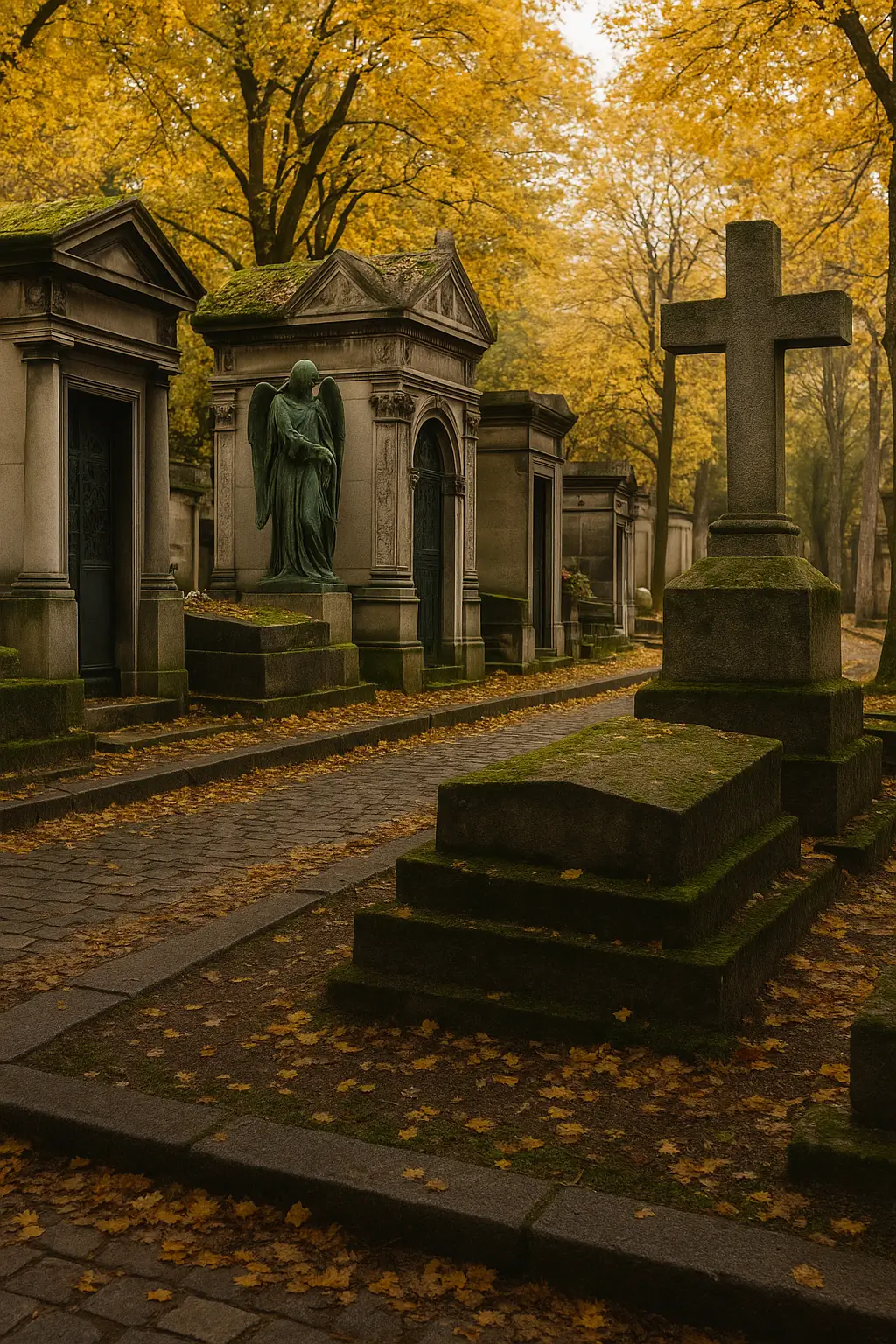
The visual of restored graves emerging among moss-covered monuments becomes metaphorical: rebirth within decay, the eternal return of meaning through preservation. In the 21st century, where digital memorials replace gravestones and cremation is rising globally, this initiative re-grounds mortality in material form—a counterpoint to our increasingly virtual afterlives.
The lottery thus revives a deeper conversation about how societies choose to remember—through architecture, through ritual, through shared space.
commune
The act of restoration is not just technical; it’s emotional. Participants will work alongside the city’s heritage departments, artisans, and conservators. They will learn about the lives buried beneath the stone and the craftsmanship that built the tombs. In many cases, plaques will acknowledge the restoration effort—giving visibility to living contributors within the realm of the dead.
This model democratizes heritage. It invites ordinary Parisians to become caretakers of history, breaking the boundary between museum and citizen.
Imagine walking through Père-Lachaise years from now and reading the inscription: “Restored by the citizens of Paris, 2026.” It redefines civic pride—not through ownership, but through stewardship.
the poetry of place
Few cities mythologize space like Paris. Streets are named after poets, bridges after battles, cafés after revolutions. In this context, cemeteries are not margins—they are extensions of cultural identity.
The idea of “resting near Wilde” or “across from Piaf” becomes a final act of participation in the city’s creative continuum. Each tomb, with its inscriptions, reliefs, and sculptures, tells a story that blends art and existence.
This project reanimates that narrative, giving forgotten tombs new caretakers and ensuring that the poetry of place—so vital to Paris’s identity—continues beyond mortality.
reflect
From a modern urban perspective, this initiative also embodies sustainable city planning. Space in Paris is scarce; horizontal expansion is impossible. By restoring existing plots rather than creating new cemeteries, the city practices ecological and spatial restraint.
There is also an implicit critique of consumer culture: in a world obsessed with novelty, the idea of reusing and restoring tombs for future generations carries environmental and ethical resonance.
At a symbolic level, this represents a reconciliation of modernity with mortality. The city, rather than pushing death to the periphery, reabsorbs it into its civic core—transforming death from taboo into continuity.
the endure
Internationally, the story has captured fascination precisely because it merges romantic imagination with bureaucratic logic. For outsiders, it’s an eccentric, charmingly Parisian idea. For residents, it’s a tangible invitation to participate in the life (and afterlife) of their city.
Foreign press outlets—Euronews, Quartz, SpotMedia—have emphasized the poetic absurdity: a lottery to share eternity with icons. Yet for Parisians, it’s also a recognition that even in death, belonging matters.
The program has drawn comparisons to the artistic avant-garde—turning death into a conceptual installation where every participant is both patron and artist.
fin
To die in Paris has always carried mythic weight. From the bohemians of Montmartre to the exiles who found solace in Père-Lachaise, the city has long offered both a stage and a sanctuary for creative souls.
The cemetery lottery doesn’t merely sell burial plots—it sells participation in the story of Paris itself. It converts death into an act of cultural continuity, where each restored tomb becomes a new stanza in the city’s long poem of existence.
It reminds us that in Paris, even the end can be beautiful. Here, mortality isn’t a void but an invitation—to belong, to restore, to remember. The city, forever aware of its ghosts, continues to prove that its greatest art form is not fashion or philosophy, but the choreography between life, death, and the spaces that hold them both.
Related Articles
Modigliani’s Limestone ‘Tête’
Carved from a single block of limestone in Montparnasse more than a century ago, one of Modigliani's rare stone heads goes to auction for the first time…