DRIFT AUDIO
Listen to this story
Choose a voice, then press play.
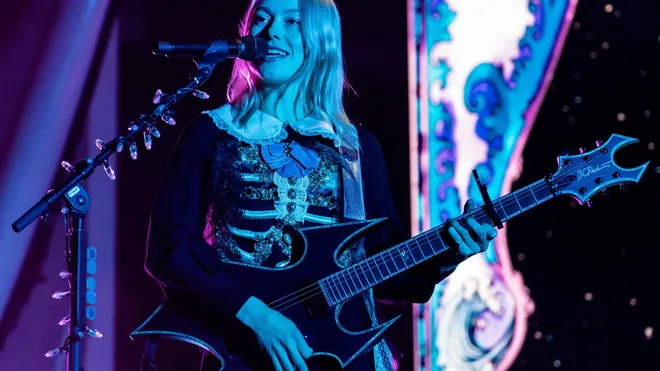
Lost Tour. Lost Weekend. Yondr pouches. Phones, watches, glasses. Arenas. She is 32. The set is personal. The bag is magnetic.
The line outside the arena still looks like every other line: last texts, last maps, last proof you exist on a lock screen. Then the pouch. Yondr is a magnet bag. Phone, AirPods, smartwatch, Meta glasses go in. The bag stays with you. It opens in a marked zone or after the last song. Cashless rooms want a physical card at the bar. A paper ticket replaces the screenshot.
Phoebe Bridgers is 32. The tour is the Lost Tour, built around the record Lost Weekend. North America opened in September at Indianapolis and has already passed St. Paul, Chicago, Brooklyn, Philadelphia. Europe follows. Support on the American dates includes Alex G as listed on the routing. One dollar from American tickets goes to RAINN.
She is not the first to lock a room. Jack White ran pouches on a full tour in 2018. Bob Dylan and Alicia Keys have used the same grammar recently. Bridgers is the one doing it at 15,000 seats for a crowd that grew up filming the chorus.
Signal. What happened: Bridgers banned phones on the Lost Tour. Exact tool: Yondr pouches for phones and wearables. When and where: arenas, September 2026 onward. Source: tour notices and venue pages. Why it matters: a young-catalog artist asked an arena to look up.
View this post on Instagram
stir
Yondr is not a metaphor. It is a pouch with a magnetic lock. Staff seal it at the threshold. You keep the sealed thing. You do not keep a live camera. Designated unlock spots exist for emergencies and, depending on the building, for a text in a lobby. Venue pages do not always agree on either the bag opens only at exit or also in a marked atrium. That disagreement is already part of the night.
The list of banned objects is longer than a phone. Earbuds. Watch. Glasses that record. Anyone using a non-permitted device during the set is told they will be walked out. The policy is the set design as much as the lights.
Critics of pouch nights call the rule ableist when a person needs a device to watch a glucose number or a heart rate. They call it elitist when the only document of the night belongs to people who could buy a seat. Those objections travel with every Yondr headline. They are not solved by a lace dress and a thank-you speech.
What the bag does well is simpler. No forest of screens. No neighbor filming the bridge you came to hear. Lighters came out in Brooklyn on an old song because there was nothing else to raise. That is the picture the policy wants.
Cashless arenas make the analog night incomplete. You can lock a phone and still tap a card. The uncle-with-CDs joke in the excerpt only goes so far. Bridgers is not asking for 1994. She is asking for three hours without an upload.
why
At stops already played she has said the quiet part. The new songs are personal. She wanted to return to a stage and not watch the room watch her through glass. Self-preservation is the word that keeps coming back. Not a lecture about kids. A working condition for material she called intense, written in a stretch when people felt unsafe.
That is different from a heritage act banning phones because the catalog is already on YouTube. Bridgers’ crowd is young enough that the ban sounds like a parent and old enough that they bought arena tickets. The contradiction is the story. A 32-year-old with a fan base that lives on clips asked them to put the clip machine in a bag.
Presence is the altruistic line. Scarcity is the other. If the night does not leave the building as video, the night stays a ticket. Both can be true in the same policy. Neither needs a sermon.
MSG in June was the rehearsal: surprise room, pouches, printed tickets in silver ink, press told not to bring pens. The Lost Tour scaled that to a 45-date arena run. Indianapolis first. Intuit Dome at Halloween to close the American map. Then Europe.
She thanked rooms for giving her faces. That sentence is the brief. The album is the reason the sentence exists.
who
Jack White put pouches on a whole tour eight years ago. Theater scale, then the idea leaked upward. McCartney has used them on small underplays. Dylan and Keys are in the recent column of names. Comedy clubs and plays used Yondr first. Music arrived late and louder.
Bridgers’ version is notable because of scale and age of the room. Fifteen thousand people who know how to shoot a story in vertical. An artist whose catalog already lives as fan clips of “I Know the End” and “Kyoto.” Taking the camera away from that catalog is a bet that the new record needs a closed circuit.
The lost-in-the-moment copy writes itself. So does the grievance copy. Health monitoring. Parents at a show. The person who documents for a friend who could not get in. Those are real frictions. The pouch does not answer them. It only chooses the stage over the feed for the length of a set.
fin
Lost Weekend is the record. Lost Tour is the routing. The bag is the third title. Until the last date, the night ends when the magnet opens in the concourse and the first clip of the parking lot goes up, not of the song.
Phoebe Bridgers. Phone in the pouch. Face toward the new ones.