DRIFT AUDIO
Listen to this story
Choose a voice, then press play.
Swift marked Bridgers’ 32nd birthday by praising her grief-soaked third album as an “absolute triumph,” reviving a friendship built on shared songwriting and a decade of shh mutual admiration.
Taylor Swift does not often review other artists’ albums in public. On August 17, 2026, which happened to be Phoebe Bridgers‘ 32nd birthday, she made an exception. Swift shared Bridgers’ post about her new record on Instagram Stories and wrote that the timing felt almost unfair to everyone else: it was Bridgers’ birthday, and she had still found a way to hand her fans a present. Swift said she had not been able to stop listening, called the album an “absolute triumph in every way,” and praised Bridgers specifically for how much vulnerable and detail she brought to writing about grief, and for trusting listeners with material that honest. She closed the note simply: happy birthday, and that she loved her.
The praise arrived three days after Bridgers released Lost Weekend on August 14 through Dead Oceans, her first solo album since 2020’s Punisher and only her third overall. Swift’s timing, tying the endorsement to Bridgers’ birthday rather than the album’s release date, gave the post a personal register that a standard promotional shoutout would not have carried, and it landed at a moment when critics and fans were already treating the record as one of the year’s most emotionally direct rel.
It is also a rare public act for Swift specifically. She has spent much of her career keeping a careful distance from directly reviewing peers’ work in real time, reserving that kind of unprompted, specific praise for a small circle of artists she has actually worked alongside. That restraint makes the Lost Weekend post stand out from the usual current of celebrity birthday messages and album shoutouts that circulate on release weeks, less because of what Swift said and more because of how rarely she says anything like it at all.
in
Lost Weekend runs 16 tracks, Bridgers’ longest release to date, and it centers on the death of her father, Tony Bridgers, in December 2022. The album is dedicated simply “For Dad,” and that dedication shapes much of its structure: a voicemail he once left her surfaces on the track “Never Going Back!,” layered over acoustic guitar, and songs including “Still Standing” and the closing “Lost Weekend (Reprise)” return repeatedly to the difficulty of mourning someone whose relationship with her had been complicated long before his death. Bridgers has written about her father before, most notably on Punisher’s “Kyoto,” but Lost Weekend places him at the album’s center rather than at its margins.
Grief shares space on the record with romance and its aftermath. Bridgers dated actor Paul Mescal from 2020 until reports of their split surfaced in late 2022, and Lost Weekend’s title track includes a line acknowledging she was once supposed to be married before calling it off, a lyric widely read as addressing that relationship. Weeks after the reported split, Bridgers was linked to comedian Bo Burnham, and the two were seen together publicly the following spring. That relationship now runs through much of the new album: several songs are addressed to someone Bridgers calls “Bobby,” widely understood to reference Burnham’s given name, Robert, and “Kill Me” recounts the two meeting at a costume party. Where the album’s grief tracks look backward, its Burnham-directed songs largely describe a relationship that gave Bridgers a reason to keep going.
Critics who have reviewed the record since its release have largely converged on the same reading Swift offered in her own words: that Lost Weekend earns its emotional weight through specificity rather than vagueness. Reviewers have pointed to the album’s opening track, which moves between violence and a Bridgers-narrated dive into a concert crowd, and to the interplay between her signature vocoder-inflected delivery and moments where her voice appears unprocessed and plain, as evidence that the record is willing to sit inside discomfort rather than resolve it neatly. That combination of specific, sometimes uncomfortable detail and a refusal to tie things up cleanly is close to exactly what Swift singled out in her own praise, framing vulnerability and trust in the listener as the album’s defining qualities rather than any single hook or lyric.

Phoebe Bridgers Poses In A Grainy Teal-Tinted Portrait.
and
Bridgers built Lost Weekend with the same core team behind her earlier work, producers Tony Berg and Ethan Gruska, but the album’s credits also include a name more closely associated with Swift’s own catalog. Jack Antonoff, Swift’s longtime producer and a frequent collaborator across her recent albums, co-wrote songs and shared co-production duties across the record alongside Berg and Gruska, giving Lost Weekend a production lineage that quietly overlaps with Swift’s own. Antonoff’s presence is one of several connective threads running between the two artists’ camps this year, even without either of them framing it that way publicly.
Burnham’s involvement goes beyond inspiration. He appears as a credited convincer on the album, co-writing and singing on the tracks understood to be written about their relationship, an unusually direct level of participation for someone who has largely stayed out of the music industry since focusing on comedy and film. The album’s broader guest list extends further into Bridgers’ exist musical community: Alex G contributes across the record, while boygenius bandmates Lucy Dacus and Julien Baker show together on the track “Lost Boys,” and Conor Oberst rounds out the list of contributors. Between the grief material and the guest roster, Lost Weekend reads as much like a document of Bridgers’ surrounding relationships, romantic, familial, and creative, as it does a conventional singer-songwriter record.
Antonoff’s role here is worth sitting with a moment longer, since it says something about how tightly interconnected the current generation of confessional singer-songwriters has become. He has produced or co-produced for Swift across nearly every album she has rel since 1989, alongside extensive work with Lana Del Rey, Lorde, and Clairo, and his fingerprints, dense synth layering pair with unusual intimate vocal mix, have become one of the more recognizable sonic sign in contemporary pop and indie alike. Bringing him in to co-produce all 16 tracks on Lost Weekend, rather than a handful of standout singles, represents a deeper structural commitment than a guest-producer credit typically implies, and it puts Antonoff’s stamp on two of the most talked-about records of the year within the same summer.
friend
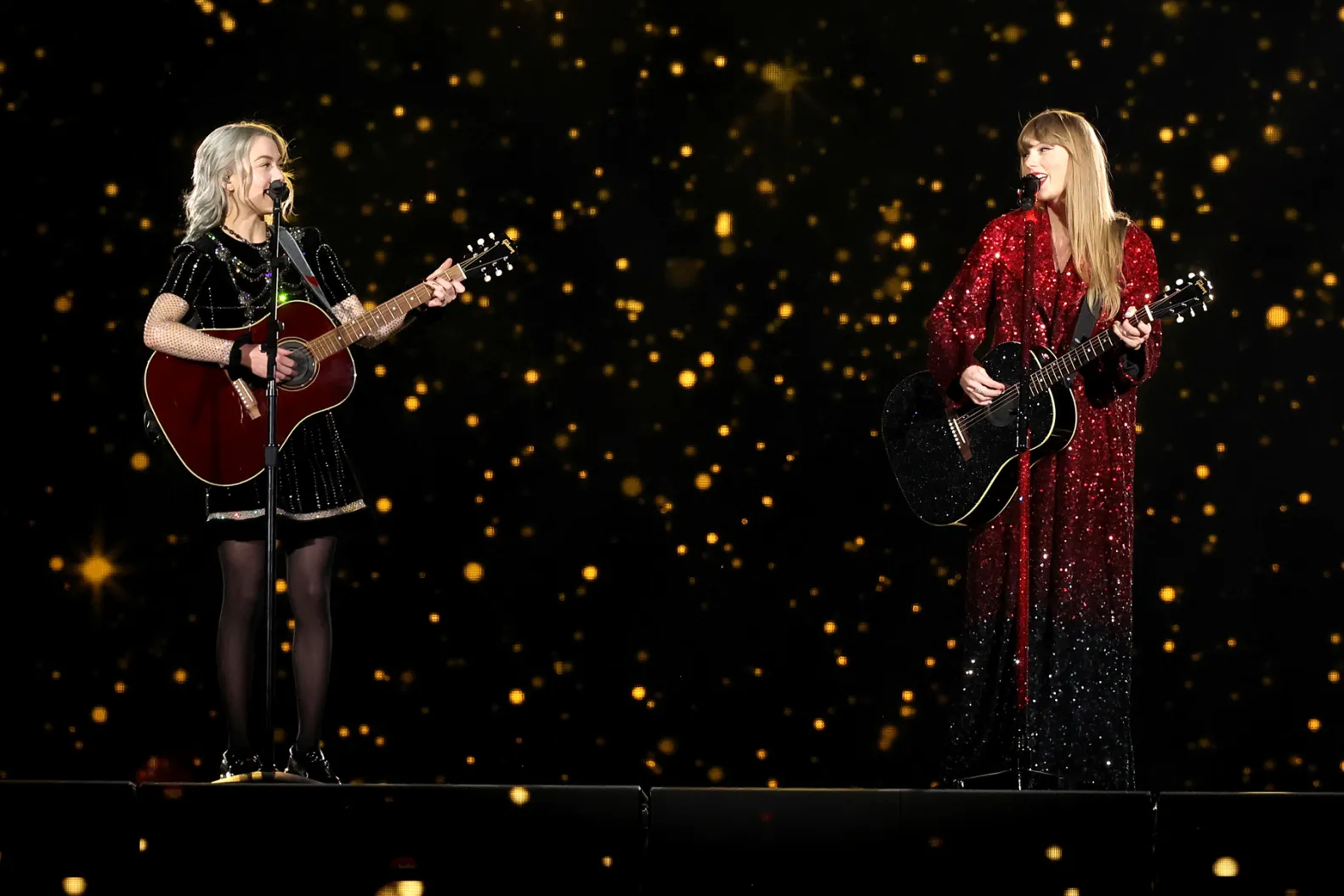
Swift and Bridgers’ public relationship dates back to 2021, when Swift invited Bridgers to sing on “Nothing New,” a From the Vault track included on her Red (Taylor’s Version) re-recording. Bridgers later described the experience to Billboard as a dream, and the two performed the song live together for the first time during Swift’s Eras Tour stop in Nashville on May 5, 2023, trading acoustic guitars and vocals on a stage in front of a sold-out Nissan Stadium crowd. Bridgers went on to serve as an opener across nine Eras Tour dates that year, including stops at Lincoln Financial Field, Gillette Stadium, and two nights at MetLife Stadium, occasionally bringing her boygenius bandmates onstage during her own opening sets along the way.
The friendship has surfaced in both directions since. Swift has previously described Bridgers as one of her favorite artists in the world, and earlier this year, at the 2023 iHeartRadio Music Awards, Bridgers presented Swift with the ceremony’s Innovator Award, using her introduction to credit Swift’s songwriting for shaping her own approach to telling the truth in music. Set against that history, Swift’s Lost Weekend post reads less like a celebrity co-sign and more like a continuation of a relationship that has run through award shows, tour stages, and studio credits for the better part of five years.
That relationship has also played out at close range on tour. During the same May 2023 Nashville run where Bridgers and Swift performed “Nothing New” live for the first time, Bridgers used her own opening set to bring out her boygenius bandmates for an unannounced performance of “Not Strong Enough,” a moment that folded her band’s Grammy-winning momentum directly into Swift’s stage before the two artists even appeared together. Fans in attendance also noted that Swift adjusted her own set list specifically on the nights Bridgers was on the bill, adding “Nothing New” only for those shows rather than performing it as a fixed part of the tour’s usual rotation, a small logistical choice that underlined how much the collaboration meant to both artists rather than functioning as a one-off tour stunt.
two
Bridgers arrives at Lost Weekend from an unusually high point in her career, even after a six-year gap between solo albums. In between Punisher and this release, she formed boygenius with Dacus and Baker, and the trio’s 2023 album The Record won the Grammy for best alternative music album, while its single “Not Strong Enough” won both best rock performance and best rock song. That run gave Bridgers a louder cultural footprint than Punisher alone had, even as she stepped back from a heavier public presence through much of 2025, and it means Lost Weekend arrives with a wider audience already primed to meet her most personal record yet.
Swift, for her part, has increasingly used her platform to publicly champion peers whose work overlaps with her own instincts toward confessional songwriting, and her enthusiasm for Lost Weekend fits a pattern of that kind of support rather than reading as an isolated gesture. Both artists have spent the past several years mining specific relationships and specific losses for material, trading the guarded songwriting of pop’s earlier eras for something closer to direct autobiography, and Antonoff’s fingerprints across both of their recent catalogs only reinforce how much creative overlap now exists between them. Swift’s birthday message did not need to say any of that explicitly. Calling an album a gift, on the day its creator turned 32, did the work on its own.
There is also a symmetry worth noting in how each artist has chosen to write about loss and love this decade. Swift’s own recent albums have leaned heavily on precise, almost diaristic detail, a songwriting mode she has said she developed in part by paying close attention to how younger peers like Bridgers approach vulnerability on record. Bridgers, in turn, has cited Swift’s willingness to write from wherever she actually is, rather than from behind a more polished public persona, as something that shaped her own sense of what a song is allowed to say. Lost Weekend, arriving in the middle of that mutual influence, gives both artists’ audiences a clear look at where the overlap currently sits: a record built on a father’s death, a broken engagement, and a new relationship sung about in first-name terms, delivered with the kind of directness that neither artist’s early catalog would have attempted quite so plainly.
Related Articles

From Sailing Jackets to Global Ambassador, Travis Kelce’s Full Circle Tommy Hilfiger Turn
A rooftop at the Plaza, a scene-stealing Samoyed, and a brand Kelce has loved since […]