DRIFT AUDIO
Listen to this story
Choose a voice, then press play.
She built two billion-dollar companies while the world waited for an album. Now, a decade after “Anti,” the music is finally catching up.
On the night of July 12, 2026, Rihanna walked out under the lights of Yankee Stadium wearing something closer to a smirk than an outfit. It was the final night of Jay-Z’s thirty-year career celebration, and nobody in the crowd had been told she was coming. She joined him for “Run This Town,” their old duet snap back into place like no time had passed, and then she took the mic alone for “Bitch Better Have My Money.” Before she sang a note, she addressed the crowd with the kind of self-aware honesty that has defined her public voice for two decades: she admitted she was “a bit rusty,” that it had been a while. It was her first full concert performance since 2016, and her first live appearance of any kind since the 2023 Super Bowl halftime show. The crowd did not care that she was rusty. They had waited ten years for exactly this.
That gap, the one between 2016’s “Anti” and whatever comes next, has become one of the most discussed absences in pop music. It is also, depend on who you ask, one of the least accurate. Rihanna did not disappear. She built.
stir
It is easy to forget, watching fans count down the days since her last studio album, that Rihanna spent the last decade becoming something the music industry has no real precedent for: a founder first, an artist second, at least by the calendar. Fenty Beauty launched in September 2017 in partner with LVMH’s Kendo Brands, with 40 foundation hue at a time when most prestige beauty lines topped out around 20, and the industry’s quiet agreement not to formulate for darker skin tones collapsed within a season. Savage X Fenty followed a year later, built around the same instinct: design for the body that actually exists, not the one the industry has always pretended is universal.
Both brands have since cross the billion-dollar mark, making Rihanna, by most tallies, the first Black woman to build two separate billion-dollar companies. She has done this while serving as executive chair rather than CEO of Savage X Fenty, a title she moved into in 2023 so she could step back from day-to-day operations. It has not made her any less view in the brand’s marketing. She modeled and personally announced all three of Savage X Fenty’s 2026 collections herself, from the Aphrodite-themed Valentine’s Day launch to the cherry-toned “Cherry Nouveau” line to a traffic-sign-themed summer campaign that had her directing imaginary lanes of desire in a bodysuit and a five-figure diamond necklace.
The road has not been frictionless. Fenty, her LVMH-backed ready-to-wear label and the first new house the conglomerate had launched since Christian Lacroix in 1987, closed in February 2021 after less than two years, a rare public miss for both Rihanna and LVMH. Fenty Beauty’s own ownership picture is shifting too: LVMH has reportedly retained the investment bank Evercore to explore selling its 50 percent stake in the brand, and Jay-Z’s venture firm MarcyPen Capital Partners has emerged as a leading bidder, a deal that would put Rihanna into business with one of her oldest convincers rather than a luxury conglomerate. Savage X Fenty has weathered its own headwinds, including a change in leadership at the top when its CEO departed for Victoria’s Secret in 2024. None of it has slowed the larger trajectory. In April, Rihanna received the Edison Achievement Award, honored alongside NBA commissioner Adam Silver for reshaping an entire product category around inclusion rather than exception.
mother
The other project that has occupied Rihanna’s last several years is one she discusses far less clinically. She and A$AP Rocky now have three children together: sons RZA and Riot Rose, and a daughter, Rocki, born in September 2025. It was that third pregnancy, in fact, that forced Rihanna to cancel a planned run of London Stadium shows in the summer of 2025, shows that had been shh position as the beginning of her return to the road.
She has been unusually candid about the tension between the two halves of her life. At this year’s Met Gala in May, where she arrived on Rocky’s arm in a custom Maison Margiela gown, she describe the rare night out without their children as feeling “good and sad,” a small, honest admission about what fame costs even when you have built an empire design to buy your way out of most of its costs. It is the kind of quote that reveals more about Rihanna’s actual temperament than any press release: she has never pretended that having everything means feeling nothing about the trade-offs.
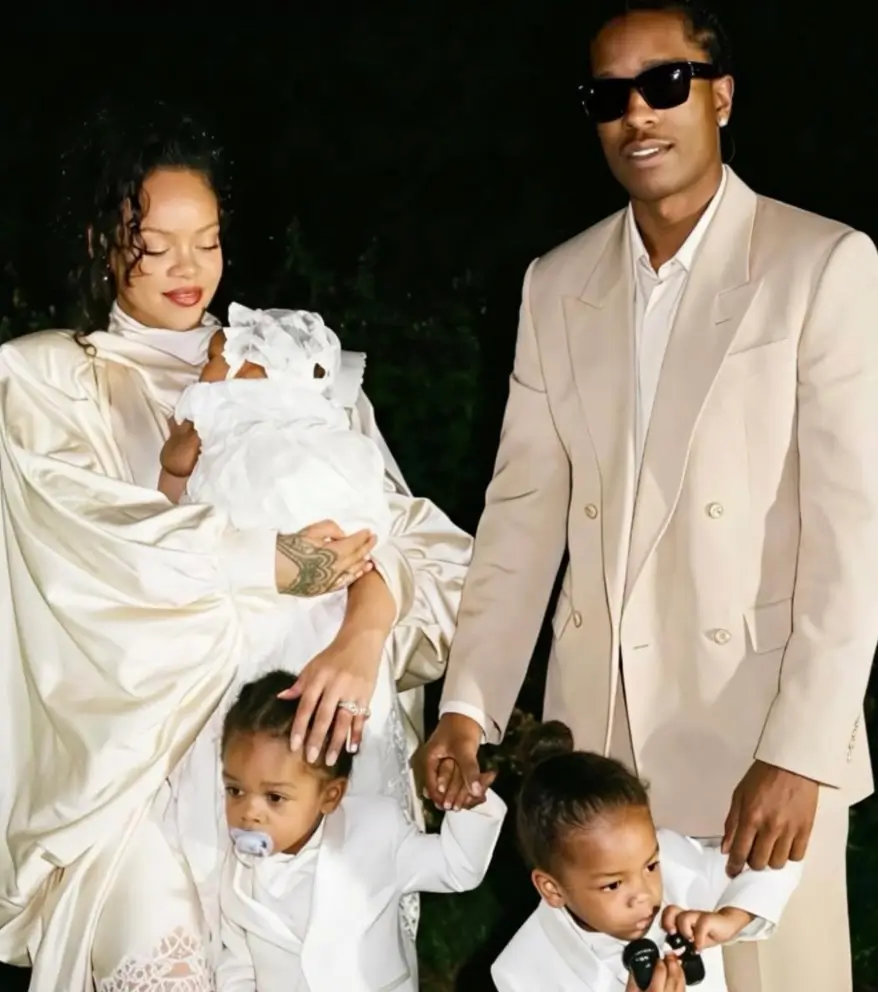
Family Portrait In Coordinated Neutral And White Formalwear
The tabloid ecosystem has spent much of 2026 trying to determine whether a fourth child is coming. Rihanna, characteristically, has treated the speculation as material rather than as an invasion, joking in a stranger’s Instagram comments in January about the “hot and sexy or pregnant” dilemma, then needling a gossip account months later with a single dry line asking whether the rumored baby was “in the womb with us.” It is a good illustration of how she has always managed the press: not by disappearing from the conversation, but by occasionally hijacking it.
stir
January marked ten years since the release of “Anti,” the moody, genre-blurring record that closed out Rihanna’s most prolific recording stretch and became, in hindsight, the last studio album she has released. The anniversary reignited the same question that has trailed her since 2017: where is the follow-up, colloquially known among fans as “R9”?
The honest answer, gathered from years of scattered interviews and secondhand reporting, is that Rihanna has never framed music as a debt she owes anyone on a schedule. She has described the new material, when she has described it at all, as something she wants to release only once it meets her own standard, not the fanbase’s timeline. The Yankee Stadium appearance did more to fuel comeback speculation than any statement could have. So did a cryptic Instagram caption in June, written entirely in Barbadian patois, teasing the summer Savage X Fenty collection with the phrase “new savage for de summa,” which pulled 2.3 million likes and was immediately, perhaps overzealously, parsed by fans for musical subtext.
What is verifiable is this: she has not confirmed a release date, an album title, or a lead single. What is also verifiable is that an artist who has not put out an album in a decade remains, according to Spotify’s own reporting, the most-streamed Black woman on the platform. Absence, for Rihanna, has never functioned the way it does for most pop stars. It has only sharpened the appetite.
challenge
Rihanna’s public year began with a private loss. Her father, Ronald Fenty, died in May 2025 at 70 after a battle with pancreatic cancer, and she returned home to Barbados for his memorial. She has said comparatively little about it publicly since, which tracks with a pattern that has held for most of her career: the parts of her life that are actually painful get the least amount of stage time, while the parts that are fun, glossy, or strategically useful to a brand launch get amplified.
That same instinct extends to her philanthropic work through the Clara Lionel Foundation, named for her grandmother and grandfather, which funds education, emergency response, and climate resilience programs, much of it concentrated in the Caribbean and on the African continent. It rarely generates the headlines her lingerie campaigns do, which seems to be exactly how she prefers it.
fin
There is a version of the Rihanna nar that reads as a cautionary tale about an artist who let commerce swallow her music. It is not the version that holds up under scrutiny. What the last decade actually shows is an artist who correctly identity, earlier than almost anyone in her cohort, that a pop career has a shelf life but a well-built company does not, and that the two are not in competition so much as sequential seasons of the same project.
She has, in the process, redrawn what a music career’s second act can look like: not a comeback tour propping up a legacy, but a full decade of building something else entirely, with the music held in reserve, unreleased and unrushed, gaining value the way anything scarce does. Either R9 arrives this year, next year, or on no timeline at all, Rihanna has already made her point. She was never gone. The rest of the industry was just looking in the wrong place.
Related Articles
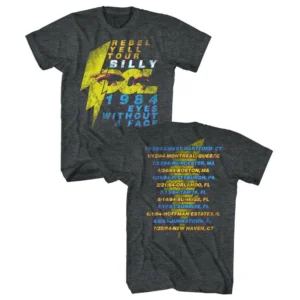
Billy Idol’s Rebel Yell Returns as a 3,000-Copy One-Step Press
Cut from the original analog masters and capped at 3,000 numbered copies, Rebel Yell returns […]