DRIFT AUDIO
Listen to this story
Choose a voice, then press play.
Three years after scattering 200,000 nickel coins across Manchester for free, the artist behind The Find is now coordinating the Royal Academy’s 258th Summer Exhibition.
A hundred volunteers fanned out across central Manchester in the last week of June 2023, tucking small nickel discs into places nobody was told to look: parking ticket machines, tram seats, library shelves, the gaps between benches. By the time Ryan Gander‘s The Find officially opened alongside the rest of the 2023 Manchester International Festival programme, roughly 200,000 of these coins were already hiding in plain sight, and the number kept climbing as the festival stretched from June 29 to July 16.
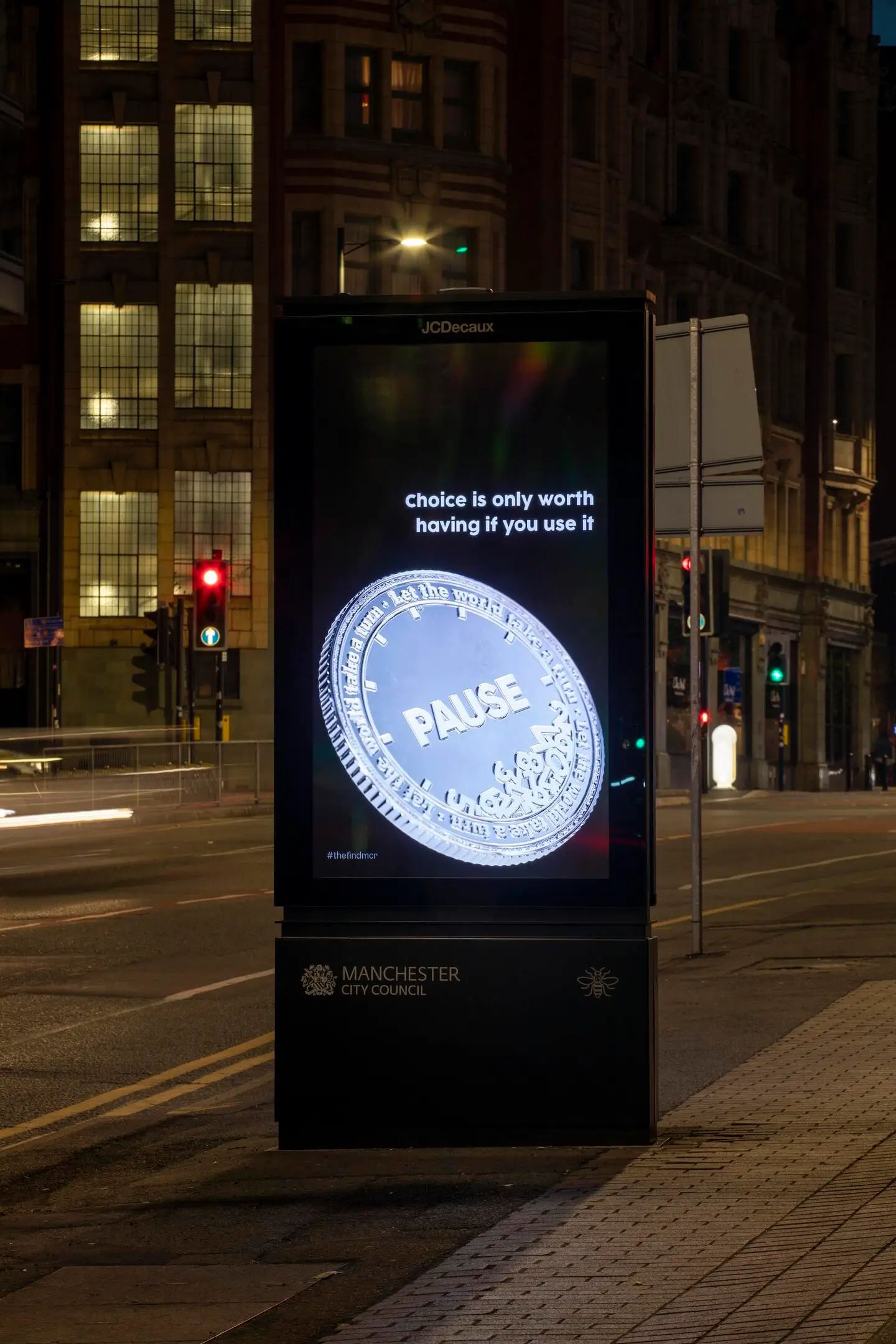
None of them were worth anything in the conventional sense. Gander had them minted from cheap nickel specifically so the objects would carry no resale value, a decision that ran directly against the logic of the art market he has spent two decades quietly ribbing. Each coin doubled as a tiny philosophical prompt, printed with a pair of opposing words on either face, and it was left entirely up to whoever picked one up to decide what, if anything, to do with it.
View this post on Instagram
Commissioned and produced by Factory International, the piece asked almost nothing of the institution behind it beyond logistics and trust. There was no admissions desk, no security rope, no wall text explaining what the viewer was supposed to feel. Once the coins went into circulation, Gander effectively lost control of them, and that loss of control appears to have been the point. A coin dropped near a tram stop in Salford could end up in someone’s coat pocket for a single afternoon, or it could sit on a windowsill for years, or it could get spent, in the loosest sense of the word, as a small piece of currency for a conversation between strangers who both happened to be looking down at the pavement at the right moment.
stir
The three coin designs each carried a binary choice rather than a slogan. One offered solo against together, another set action against pause, a third weighed speak against listen. Gander has said the pairings were drawn from things his own parents used to tell him, small pieces of guidance stripped down until they could fit on an object the size of a coin. A line from his father, reading roughly that time is a person’s greatest asset, ran in large lettering across the front of the piece he built to hold and distribute the coins in the city.
What made the project unusual was how little it asked of anyone. There was no ticket, no app to download, no queue. A person could walk past a coin on a bench and never notice it, or notice it and walk on, or pick it up and carry it in a pocket for years. Gander told Studio International that the coins were partly a reminder to himself as much as to anyone else, an argument that attention and agency outrank money on almost any honest scale of value.
There is also a quieter argument buried in the choice of nickel over anything more precious. A gold coin, or even a well struck bronze medal, would have changed the entire emotional register of the piece, turning a game of chance into something closer to a lottery. By keeping the material deliberately cheap, Gander made sure nobody could reasonably resell a coin for profit, which meant the only value on offer was the one printed on its face: a nudge toward a decision, or proof that a stranger had thought about the person who eventually found it. Factory International’s own audio description of the project describes it as an invitation for the people of Manchester to take part in a citywide quest, with coins placed at different heights across public but hidden spots so the hunt stayed open to as many people as possible.
flow
Manchester itself became the display case. The Find spread well beyond the festival’s ticketed venues and into food courts, coffee shops, and tram platforms across Greater Manchester, with Selfridges among the partners folding the hunt into its own Exchange Square activity that summer. That expansion mattered to how the piece read: MIF23 also brought Yayoi Kusama’s inflatable sculptures into the warehouse space at the festival’s new home, along with new commissions from Tino Sehgal and a river-bank installation from Risham Syed and Angie Bual, and against that backdrop of ticketed spectacle, The Find was the one piece a person could stumble into by accident on the way to buy a coffee.
The route also stretched into everyday commercial spaces that had nothing to do with the festival’s official venues. Creative Tourist’s own guide to the hunt pointed people toward a Japanese-Peruvian restaurant outpost, an Ethiopian and Eritrean food stall, a sprawling street food hall in Salford Quays, and a coffee shop known for its brunch in the Northern Quarter, treating the whole of central Manchester’s food and drink scene as a kind of extended gallery annex. That decision mattered more than it might sound. A festival piece confined to a warehouse or a museum foyer asks a visitor to opt in, to plan a trip and buy a ticket. A coin left on a café counter asks nothing at all, and simply waits to be noticed by whoever happens to be standing there.

A faceted contemporary building clad in white metal panels rises along a canal, its sharply folded architecture contrasting with surrounding high-rise towers and historic industrial structures under a bright blue sky.
That new venue, Aviva Studios, opened its doors for the first time that same festival, in advance of a formal opening later in 2023, giving Factory International a permanent home on Water Street to go with its biennial festival. The organisation, which also runs the shorter-lived predecessor brand people still call MIF, had been building toward that moment since construction began in January 2019. The building itself, designed by the Office for Metropolitan Architecture under lead architect Ellen van Loon, cost close to £186 million and holds up to 7,000 people across a flexible warehouse space and a smaller auditorium. One commission filled a 13,300 square metre building with light and sound. The other filled an entire postcode with 200,000 objects small enough to lose in a coat pocket.
from
Gander was born in 1976 in Chester, a short train ride from Manchester, and the city has a specific hold on his biography. He studied Interactive Arts at Manchester Metropolitan University in the late 1990s before going on to postgraduate research residencies at the Rijksakademie van Beeldende Kunsten in Amsterdam and the Jan van Eyck Akademie in Maastricht, and Manchester Metropolitan later awarded him an honorary doctorate, one of two he now holds alongside a similar honour from the University of Suffolk.
Returning to commission a city-wide piece there in 2023, roughly a quarter century after arriving as an undergraduate, gave The Find a homecoming quality that distinguished it from Gander’s gallery shows. He has also held a professorship in visual art at the University of Huddersfield, another institution not far from where he studied, and continues to teach and lecture at schools including the AA School of Architecture in London and the Barbican, alongside Barnard College in New York and the École nationale supérieure des Beaux-Arts in Lyon.
His father worked as a planning engineer on a commercial gearbox line at a car plant in Ellesmere Port, a detail Gander has folded into his own work more than once, and his mother worked first as a teacher and later as a schools inspector. Gander has said he became interested in art after his father took him to one of the early British Art Shows as a child, a chance outing that eventually led to a Chester teenager studying interactive art in Manchester and, decades later, hiding coins across the same streets he once walked as a student.
emotive
The Find was, in some ways, a distillation of habits Gander has repeated across a career that now spans sculpture, film, writing, graphic design, architecture, painting, and performance without settling comfortably into any single one of them. He resists being filed simply under conceptual art, describing himself instead, somewhat wryly, as a kind of neo-conceptualist and amateur philosopher. Recurring in the writing about his work is the idea of absence: objects standing in for something withheld, clues scattered for a viewer to reassemble rather than a finished statement handed over whole.
That instinct runs through decades of prizes and institutions. He won the Dutch Prix de Rome for Sculpture in 2003, the ABN Amro Art Prize in 2006, the Baloise Art Statements prize at Art Basel that same year, and the Zurich Art Prize in 2009, and his work sits in the collections of the Museum of Contemporary Art Chicago, the Museum Boijmans Van Beuningen in Rotterdam, the Carnegie Museum of Art in Pittsburgh, the LVMH Foundation in Paris, and the Fundación Jumex in Mexico City, among many others. In 2017 he received an OBE for services to contemporary art, in 2019 he held the Hodder Fellowship at Princeton University, where he later returned to discuss his book A Melted Snowman, and in 2022 he was elected a Royal Academician in the category of sculpture, the credential that would matter most for what came next.
The work itself resists a tidy summary in a way that seems intentional. Recent solo presentations have ranged from a show built around fluctuating value systems of time, money, and privilege at a Los Angeles space run in partnership with the fashion house Dries Van Noten, to animatronic sculptures depicting a life-sized mosquito twitching next to its own wall label, to a series of resin figures depicting his own children encountering the world for the first time. Running underneath almost all of it is the same move The Find made on a city-wide scale: withhold the full explanation, hand the viewer a fragment, and trust that curiosity will do more work than didactic wall text ever could.
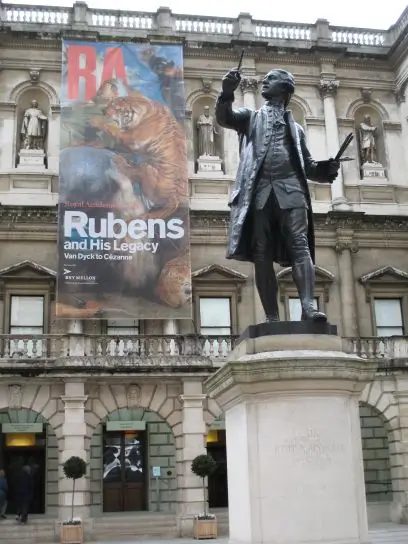
A bronze monument stands before a stately neoclassical museum displaying a large Rubens and His Legacy exhibition banner.
show
In late 2025, the Royal Academy of Arts named Gander coordinator of its 258th Summer Exhibition, the open-submission show that has run every year at Burlington House since 1769 and that funds the Academy’s free postgraduate school. He chose interconnectedness as the theme, describing an interest in the unplanned overlaps between artists working in completely different media, and pushed for a hang that mixes architecture, print, painting, and sculpture in the same rooms rather than sorting them by discipline. Submissions opened to anyone, with a specific invitation extended to degree students and recent graduates.
The show opened on June 16, 2026 and runs through August 23, featuring more than 1,800 works, the large majority available for sale, with proceeds supporting the exhibiting artists and the Academy’s charitable training programme. Alongside the public submissions, Royal Academicians including Antony Gormley, who contributed an 8.2 metre cardboard piece titled Hide, Tracey Emin, Anish Kapoor, Michael Craig-Martin, Wolfgang Tillmans, and Grayson Perry are showing new work, and honorary academicians such as Marina Abramović, William Kentridge, and Joan Jonas, exhibiting at the Summer Exhibition for the first time, appear in the same rooms. The 2026 edition also marks twenty years of sponsorship from Insight Investment, a milestone the Academy is folding into this year’s programming.
fin
Gander’s own lexicon around the theme leans on the same associative logic that runs through The Find. In his announcement for the show, he described wanting submissions built from process as much as finished statement, work that is, in his words, cognitive first and retinal second, a phrase that reads like a fair description of his own practice as much as an instruction to the thousands of artists submitting work. The curatorial approach mixes media deliberately rather than sorting painting from sculpture from architecture into separate rooms, a hang designed to surface exactly the kind of unplanned connection the exhibition’s title promises.