DRIFT AUDIO
Listen to this story
Choose a voice, then press play.
In April 1997, Albert Oehlen showed new work at Max Hetzler’s gallery on the old Berlin death strip, weeks after losing his closest friend, in a show almost nothing has been written about since.
Some exhibitions leave behind reviews, catalogue essays, a stack of install photographs, maybe a controversy or two that keeps getting cited for decades. Albert Oehlen’s 1997 show at Galerie Max Hetzler, titled Lass Spielen (Vergessene Kinder), left behind almost none of that. What survives, even in the gallery’s own archive, is a name, an address, a set of dates, and a single black and white install photograph. There is no surviving press release text on record, no contemporary review that has surfaced in searchable form, no catalogue.
That thinness is worth sitting with rather than papering over. It would be easy to fill the gap with confident sounding description of what the paintings looked like or what the show was “about,” but nobody writing about this now was in the room on Zimmerstraße in the spring of 1997, and the documentary record simply does not stretch that far. What follows instead is the context that does exist and can be checked: who Oehlen was as a painter at that exact moment, what kind of gallery was hosting him, where that gallery sat in Berlin’s still raw post reunification map, and one date, five weeks before the opening, that any account of this show has to reckon with.
It is worth being honest, too, about why a show this thinly documented is worth writing about at all. Part of the answer is simply that gaps in an artist’s record are themselves a kind of evidence, a reminder that even a painter as thoroughly catalogued as Oehlen has stretches of his career that were never fully written down, photographed, or filed away for later. Most retrospectives and biography timelines move so brisk through a five-week commercial gallery show that the show barely registers as anything more than a line item between larger, better documented exhibitions on either side of it. Slowing down on exactly this kind of gap, rather than skipping past it toward the next well-documented milestone, is its own small act of paying attention.
stir
The title itself deserves a slower look than it usually gets. Lass Spielen translates most literally as “let it play” or “let play,” though in everyday German it can also carry the sense of a referee waving off a stoppage, the familiar football call to let the game continue rather than blow the whistle. Vergessene Kinder means, plainly, forgotten children. Put together, the phrase sits somewhere between an instruction and a lament, and it resists being flattened into a single tidy English equivalent.
It would be tempting to build a whole interpretive theory on that title, particular given what else was happening in Oehlen’s life that spring. But no surviving statement from Oehlen or from Max Hetzler explains what the words were meant to point to, and guessing at a grieving man’s intentions from a gallery listing decades later would be exactly the kind of overreach this piece is trying to avoid. The honest answer is that the title is on record, its literal meaning is checkable, and its deeper motivation is not.
five
What is on the record, and matters simply because of when it happened, is this: Martin Kippenberger died in Vienna on 7 March 1997, five weeks before Lass Spielen (Vergessene Kinder) opened. Kippenberger and Oehlen were not just gallery mates or fellow travelers of German neo-expressionism. They had studied together at Hamburg’s Hochschule für Bildende Künste in the 1970s, played in a jazz group called The Alma Band, traveled together, and spent close to two decades at the center of the loose, hard-living circle of German painters that also included Oehlen’s brother Markus, Werner Büttner, and Georg Herold. Kippenberger died of liver cancer at forty-four, and Roberta Smith’s obituary in the New York Times called him one of the most talented German artists of his gen, a judgment that took years after his death to become the consensus view rather than a niche one.
Stating that timeline is not the same as claim the show was somehow “about” that loss. There is no quote from Oehlen tying the two together, and this piece is not going to manufacture one. But leaving the date out entirely would be its own kind of distortion, since any reader encountering this exhibition history without that context is missing something a contemporary visitor to the gallery in April 1997 could not have missed. The two facts, the death and the opening, sit five weeks apart on the calendar, and that proximity is simply true, whatever it did or did not mean to the person who lived through it.
a place
The gallery itself sat inside a piece of very recent history. Max Hetzler had run galleries in Stuttgart, then Cologne, then a short lived outpost in Santa Monica before relocating to Berlin in 1993, opening a first space in Charlottenburg in 1994. A year later, in 1995, he found a second location on Zimmerstraße, right beside Checkpoint Charlie, the crossing point that had spent nearly three decades as one of the most photographed and most heavily guarded borders on earth. That Zimmerstraße space soon eclipsed Charlottenburg and became Hetzler’s main Berlin address for the following decade.
The choice of location was not incidental. In the mid-1990s, artists and galleries were pouring into Berlin-Mitte precisely because it offered something no other German city could: enormous, cheap, half-finished buildings sitting on streets that had been part of the death strip or its immediate surroundings only a few years earlier. A gen of Berlin galleries built their identities on that raw, unfinished quality, showing work in spaces that still had the texture of the recent past built into their walls. Zimmerstraße, a few hundred metres from where the wall itself had run, put Oehlen’s paintings in a building that was, in a very literal sense, still catching up to what had happened to the city around it.
Hetzler’s relationship with Oehlen went back even further than the gallery’s move to Berlin. As early as 1981, back when Hetzler was still operating out of Cologne, he had already exhibited Oehlen alongside Kippenberger, Günther Förg, and Reinhard Mucha, the loose cohort of painters that critics eventually shorthanded as the “Hetzler boys.” By 1997, Oehlen showing at Hetzler’s gallery was not a new pairing being tested out. It was one of the oldest working relationships either man had in the art world, tested across three cities and roughly sixteen years.
That long working relationship mattered practically as well as symbolically. Galleries that represent an artist across multiple cities and multiple decades tend to build a kind of institutional memory that a newer, less established gallery simply cannot offer, a working shorthand between artist and dealer about pacing, presentation, and how much explain a show does or does not need. By the time Hetzler had settled into Zimmerstraße, he was no longer introducing Oehlen to a new market or building a reputation for him from scratch. He was giving an already well established painter another wall to work against, in a city and a building that were both still visible in the middle of becoming something else.

stance
Whatever hung on those walls in April 1997 arrived at a genuine hinge point in Oehlen’s working method. He had bought a computer, a Texas Instruments laptop, back in 1990 while living in Los Angeles, and by 1992 that machine had produced his first Computer Paintings, a series he would keep working on for another fifteen years. The process, as he later described it, involved drawing crude gestures on the computer, printing the results, silkscreening them onto canvas at a larger scale, and then painting back over the printed image by hand, sometimes erasing sections with white paint, sometimes extending a line with a brush or a burst of spray paint. It was a way of running a hand-made gesture through a machine and then dragging it back out the other side, closing the loop between the two.
By most accounts, 1997 marks roughly when that computer-driven direction hardened into something closer to a defined body of work, the same year Oehlen also began what he called his Grey paintings, a self-imposed constraint that would run for another decade. He had, by his own description in later interviews, spent much of the preceding years assigning himself odd formal problems to solve one at a time: a period restricted to gray tones, an earlier period restricted to red, yellow and blue, a stretch of collages built from supermarket advertising cut-outs and painted back over. Lass Spielen (Vergessene Kinder) landed in the middle of that restless, rule-bound way of working, at a moment when Oehlen was still actively deciding what the next constraint would be.
That context does not tell us exactly what was on the walls at Zimmerstraße 89 that spring. It does tell us what kind of painter was making the decisions: someone roughly seven years into a self-directed experiment with computer generated imagery, still mid-stream, still testing how far a printed and silkscreened gesture could survive being painted over by hand.
survive
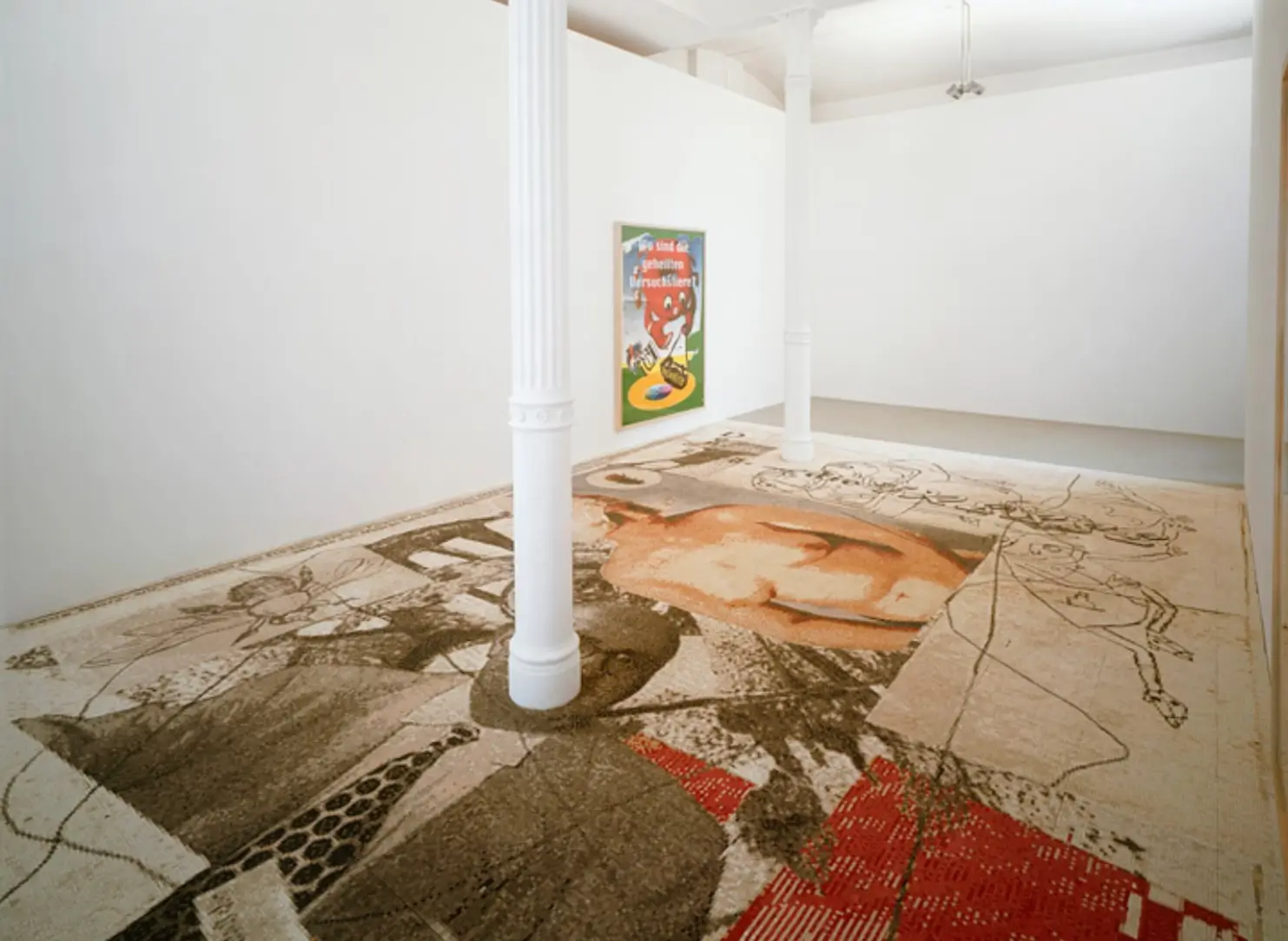
What survives publicly today, on Max Hetzler’s own exhibition archive page, is a single install view, undated in caption but filed under the 1997 show, showing the gallery space itself rather than any individual canvas in isolation. It is a modest thing to have as the only visual record of a five-week exhibition, and it says something about how differently galleries documented their programming three decades ago, well before every opening gen its own folder of high-resolution install photography destined for a website.
There is no publicly listed catalogue for this particular show, unlike several of Oehlen’s other 1997 exhibitions that year, including Albert vs. History at Kunsthalle Basel, which did receive one. Either that is because Lass Spielen (Vergessene Kinder) was treated as a smaller, more contained gallery present rather than an institutional survey, or simply because the paperwork from a commercial gallery show in 1997 was less likely to be preserved and digitized than a museum catalogue, is not something that can be answered from the outside. What can be said plainly is that this is one of the thinner entries in an otherwise heavily documented career, a five-week window in a very specific spring that mostly exists now as a title, an address, and a photograph of an empty-feeling room.
There is a version of this story that treats the gap as a problem to be solved, filled in with inference until it reads as a finished narrative. This piece has tried to do the opposite, treating the gap itself as the most honest thing on offer. Anyone who eventual turns up a review from that spring, a surviving invitation card, or a photo of an actual painting from the show rather than the room it hung in will know more about April 1997 than currently exists in any searchable public record, and that would be worth writing about on its own.
Read Drift’s related feature, Albert Oehlen’s “Untitled” (2023): A Painterly Vestige in the Digital Age.