DRIFT AUDIO
Listen to this story
Choose a voice, then press play.
In the overlapping worlds of street art, punk rock, and New York counterculture, few pairings feel as inevitable as Shepard Fairey and Debbie Harry. Fairey, the graphic provocateur behind the OBEY Giant empire and the iconic Obama “HOPE” poster, and Harry, the platinum-haired front-woman of Blondie who helped define new wave, punk, and pop in the 1970s and beyond, share a fascination with view power, subversion, and mass communication. Over more than a decade, Fairey has repeatedly turned his stencil-and-propaganda lens on Harry, producing prints, murals, clothing connections, and tributes that cement her status as a pop-cultural deity. This relationship isn’t just artistic fandom—it’s a meeting of two forces who understand how images shape resistance, desire, and identity.
stir
Frank Shepard Fairey was born on February 15, 1970, in Charleston, South Carolina. He grew up immersed in skateboard culture, which instilled in him an early appreciation for DIY aesthetics, rebellion, and public space as a canvas. After attending Idyllwild Arts Academy in California, he earned a BFA from the Rhode Island School of Design (RISD) in 1992.
While at RISD, Fairey launched his breakthrough project in 1989: the “Andre the Giant Has a Posse” sticker campaign. Using a simplified, high-contrast image of wrestler André the Giant paired with the word “OBEY,” Fairey experimented with phenomenology—how repeated exposure to ambiguous propaganda could alter perception. What started as a student prank evolved into a global street-art phenomenon. The OBEY Giant face, with its stern, Big Brother-like stare, became a symbol of questioning authority, consumerism, and media manipulation.
Fairey’s style draws heavily from Soviet constructivism, Warholian pop art, and 1960s protest posters: bold reds, blacks, and whites; stenciled portraits; layered collage elements; and slogans that blur the line between commercial branding and political critique. He founded OBEY Clothing and Studio Number One, blending art with entrepreneurship. His work appears in major collections including MoMA, the Smithsonian’s National Portrait Gallery, and the Victoria and Albert Museum.
The pinnacle of his mainstream fame came in 2008 with the Obama “HOPE” poster. Created independently and later adopted by the campaign, it became one of the most recognizable political images of the 21st century. Yet Fairey has faced controversy, including a copyright dispute with the Associated Press over the source photo and arrests for unsanctioned public art. His practice consistently challenges the boundaries between fine art, street art, activism, and commerce.
flow
Deborah Ann Harry (born Angela Trimble on July 1, 1945, in Miami, Florida) was adopted as an infant and raised in New Jersey. She moved to New York City in the late 1960s, drawn to its burgeoning underground scene. After stints as a Playboy Bunny, secretary, and backing vocalist with the folk-rock group Wind in the Willows, she joined the Stilettos and then co-founded Blondie with guitarist Chris Stein in 1974.
Blondie emerged from the CBGB punk scene alongside acts like the Ramones, Television, and Patti Smith. However, the band—fronted by Harry’s magnetic, detached-cool persona—fused punk energy with disco, reggae, rap, and pop. Albums like Parallel Lines (1978) produced massive hits: “Heart of Glass,” “One Way or Another,” and “Hanging on the Telephone.” Harry’s image—platinum blonde, sharp cheekbones, comic-book heroine poise—made her a style icon and sex symbol who subverted expectations. She wasn’t just singing; she was performing femininity as both armor and weapon.
Blondie disbanded in the early 1980s amid tensions and health issues for Stein, but Harry pursued solo work (KooKoo, collabs with the Jazz Passengers) and acting. The band reunited in the late 1990s and continues performing. Harry’s 2019 memoir Face It offers candid insights into her life, from New York’s gritty glory days to personal struggles. At over 80 years old, she remains an enduring symbol of resilience, creativity, and unapologetic individuality.
scope
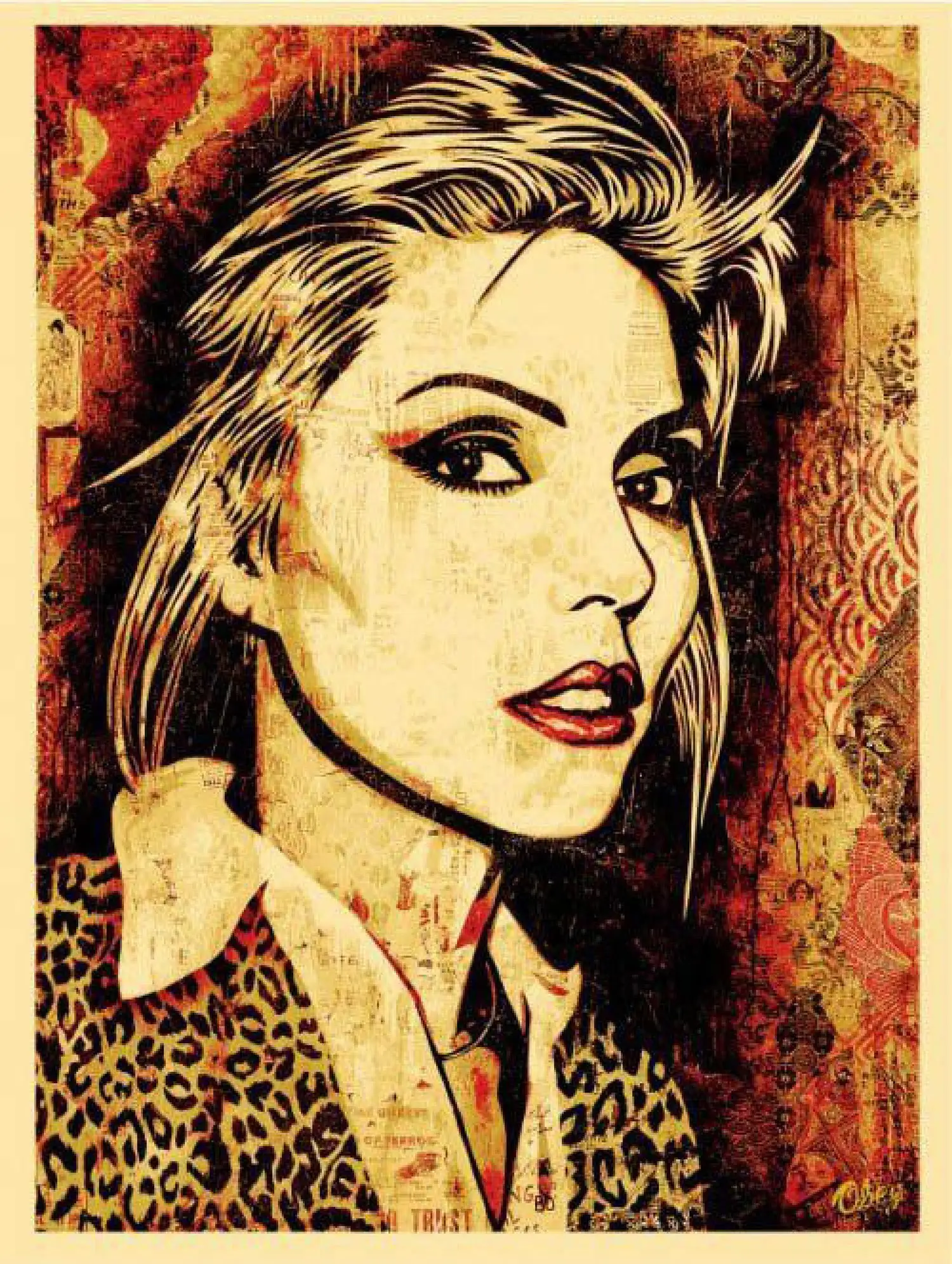
Fairey’s engagement with Harry dates back to at least the mid-2000s. One of his earliest known works is a 2005 screen print titled Debbie Harry, an 18×24-inch editioned piece capturing her in his signature stylized, high-contrast manner. Subsequent prints followed, including variations with zebra-print backgrounds referencing a famous photo by Chris Stein.
These images transform Harry into propaganda-style iconography: strong, direct gaze, bold outlines, often paired with OBEY motifs or slogans like “Destiny” or “Doom.” They elevate her from rock star to mythic figure—much like Fairey’s treatment of André the Giant or political leaders. The zebra series, in particular, plays with pattern and texture, blending pop glamour with street-art grit.
In 2017, Fairey created a large-scale mural on the Bowery in Manhattan, directly across from the former site of CBGB. Titled Blondie on Bowery (or simply the Blondie mural), it celebrated the 40th anniversary of Blondie’s debut album. The mural depicted Harry prominently, alongside band imagery referencing Parallel Lines. Harry and Chris Stein visited the site for photos, underscoring the personal connection. Though later replaced (a Bad Brains mural took its place in 2022), it became a landmark tribute to New York’s punk heritage. Limited-edition silkscreen prints of the mural were released, some signed by both Fairey and Harry.
Fairey has produced additional works like Debbie Harry: Destiny and Debbie Harry: Doom letterpress prints, and stencils. These pieces circulate in the art market, with signed editions fetching significant prices and appearing in galleries and auctions.
portrayal
The artistic dialogue culminated in a commercial and cultural partnership. In 2016-2017, Fairey and Harry collaborated on a women’s capsule collection for OBEY Clothing. The line featured bomber jackets, sweaters, shirts, and accessories emblazoned with Harry’s portrait, “OBEY Debbie” slogans, plaid patterns, and urban motifs in a predominantly grey palette with pops of color.
Fairey described the collection as “natural,” citing years of prior projects with Harry, Stein, and Blondie. The collection blended Harry’s punk-glam aesthetic with OBEY’s streetwear ethos, appealing to fans across generations. Prices ranged from $35 to $275, making it accessible yet collectible. It highlighted themes of female empowerment, NYC cool, and resistance—core to both artists’ identities.
This wasn’t purely commercial; it extended Fairey’s practice of using clothing as a medium for art and messaging, much like his earlier band posters and activist wear.
straddle
Why does this pairing resonate so deeply? Both Fairey and Harry excel at weaponizing image and persona. Harry’s stage presence—cool, androgynous, powerful—lent itself perfectly to Fairey’s propaganda-inspired aesthetic. His portraits don’t just depict her; they mythologize her, turning a rock icon into a symbol of defiance akin to his political works.
They both emerged from subcultures (skate/punk) that infiltrated the mainstream while retaining edge. Fairey’s OBEY questions blind obedience; Harry’s music and style challenged gender norms and musical boundaries. Their collaboration reflects nostalgia for New York’s raw creative energy in the 1970s-80s while addressing contemporary issues through style and art.
Fairey’s work often critiques consumerism while participating in it—Harry similarly navigated fame’s contradictions. Their intersection bridges generations: punk’s DIY spirit meets street art’s viral potential.
leg
Fairey’s depictions of Harry have amplified her icon status for new audiences, particularly younger fans discovering Blondie through view culture. Conversely, associating with Harry lends Fairey authenticity within music and punk history.
In a digital age of fleeting images, their physical prints, murals, and garments create tangible connections. The Bowery mural, though temporary, embodied site-specific storytelling—honoring a legendary venue and artist in the exact location where history unfolded.
Both continue evolving. Fairey produces murals worldwide and engages in activism. Harry tours, writes, and inspires. Their merge stand as testaments to cross-disciplinary creativity: art influencing music, music inspiring art, and both shaping culture.
endure
The relationship between Shepard Fairey and Debbie Harry exemplifies how icons recognize and elevate each other. Through prints, murals, clothing, and shared ethos, they’ve created a body of work that celebrates rebellion, style, and the power of the image. In Fairey’s stark, commanding portraits, Debbie Harry isn’t just a singer—she’s a force to be obeyed. And in her enduring career, we see the real-world impression of the kind of cultural dissent Fairey champions.
Their story reminds us that true influence transcends mediums. Either on a sticker, a stage, a T-shirt, or a city wall, the message is clear: question authority, embrace your image, and make the world take notice. In an era still hungry for authentic rebels, Fairey and Harry remain essential.
For related context, see Shepard Fairey, 2009 — Be The Change: The Image and Its Moment.
Drift has also covered ODULAR FREQUENCY: Shepard Fairey @ Subliminal Projects, Los Angeles Subliminal Projects, Los Angeles — February 28, 2026 – April 11, 2026.
Related Articles
Joël Andrianomearisoa Finds More Than One Black in a Square of Buttons
In La Guerre des Boutons I, a field of ordinary fasteners turns a modest textile […]