DRIFT AUDIO
Listen to this story
Choose a voice, then press play.
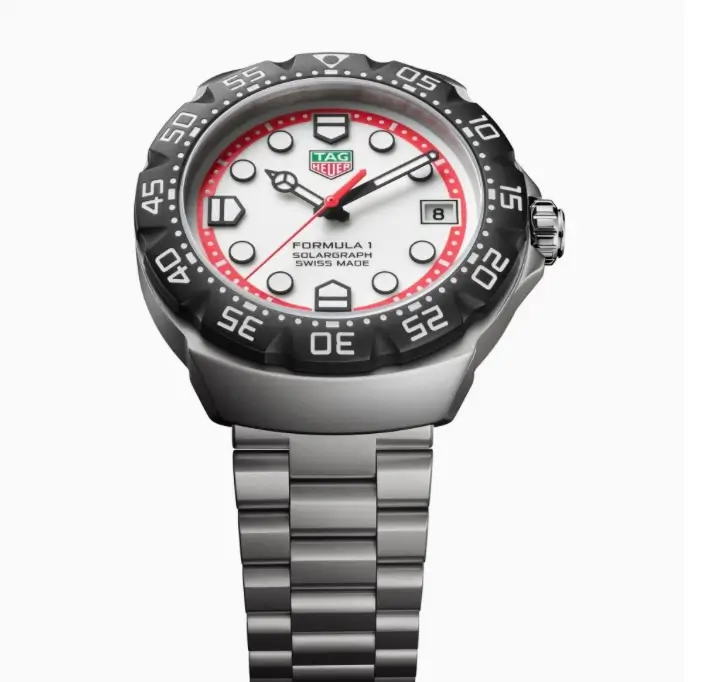
The Formula 1 Solargraph brings TAG Heuer’s 1986 racing watch back at 38mm, trading batteries for light and multiplying its tincture nar across a full Grand Prix calendar.
Stainless steel bracelets rarely come in yellow. Neither do most watch bezels, dial flanges, or the rubber straps that TAG Heuer now bolts onto its most recognizable entry-level watch. The TAG Heuer Formula 1 Solargraph doesn’t try to make a case for restraint. It’s a 38mm steel and polymer object built around a single premise from four decades ago: a Swiss watch doesn’t have to look serious to be taken seriously.
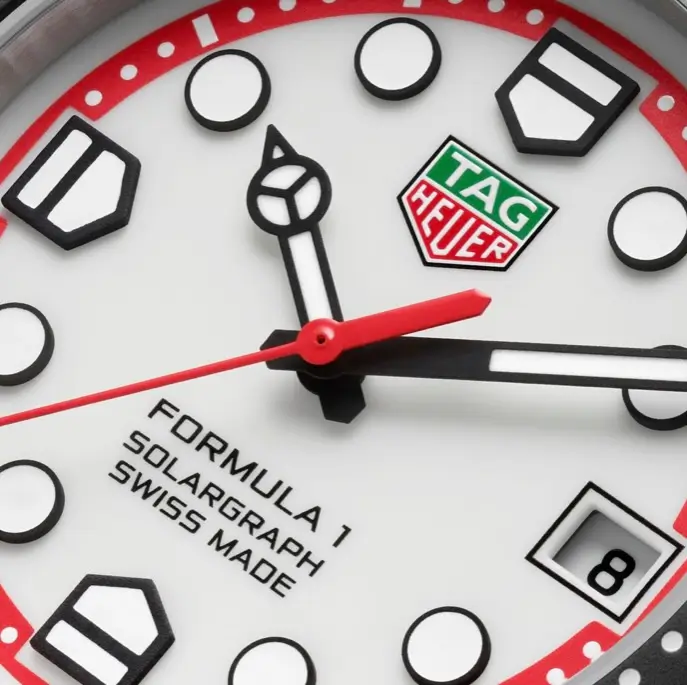
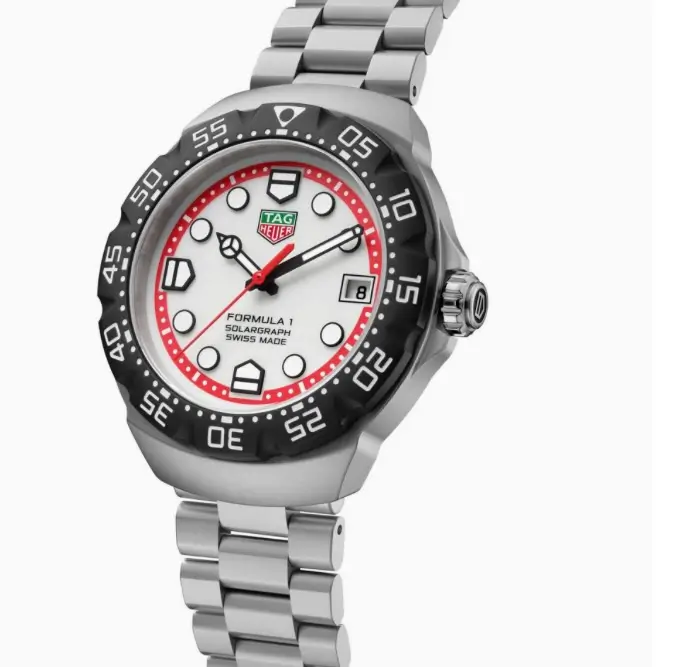
Macro view of the TAG Heuer Formula 1 Solargraph dial, highlighting its white face, red accents, raised markers and Solargraph branding.
build
The Formula 1 name has been sitting in TAG Heuer’s back catalog since 1986, the year the brand introduced its first watch under the newly formed TAG Heuer identity, a combination of the old Heuer name with the Techniques d’Avant-Garde group that had bought a controlling stake. That original watch was cheap by Swiss standards, built from plastic and quartz, and sold in colors that had more in common with skateboard decks than dress watches. It became the entry point for an entire generation of TAG Heuer owners, and it stayed in rotation through several redesigns before quietly falling out of the brand’s primary lineup.
Its return wasn’t spontaneous. A 2024 connection with streetwear label Kith reintroduced the sil to a younger, fashion-first audience and reportedly sold out fast enough to convince TAG Heuer the appetite for a loud, accessible watch hadn’t gone anywhere. The Solargraph, unveiled at Watches and Wonders 2025 and rolled out through the Formula 1 season that followed, is the brand’s answer: not a reissue, but a fuller rebuild that keeps the attitude while replacing almost everything under the hood.
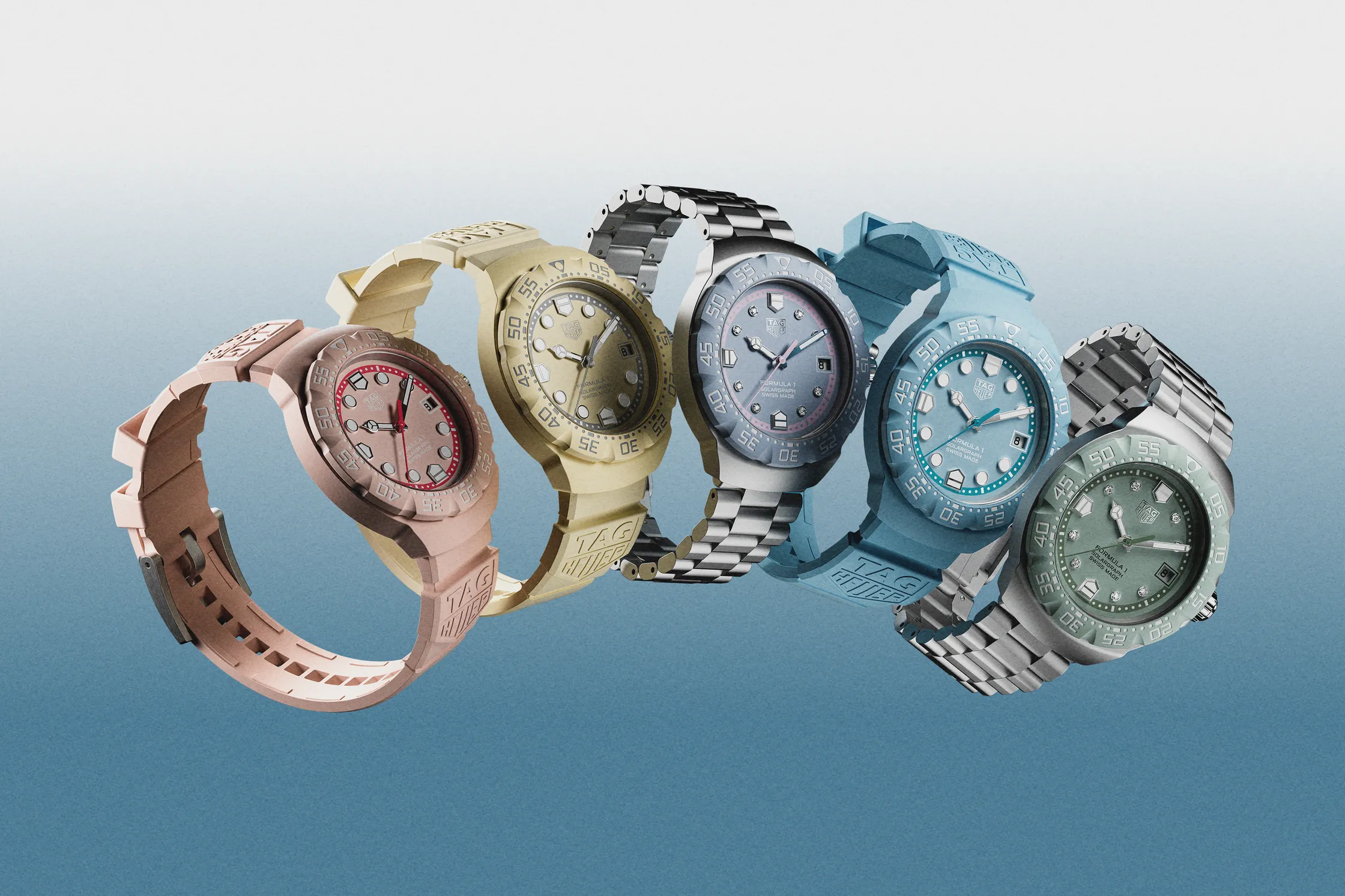
TAG Heuer Formula 1 Solargraph watches presented across pink, yellow, silver, blue and green colorways.
form
The case shape is the clearest link between old and new. TAG Heuer kept the shroud lugs that made the original Formula 1 instantly identifiable, the ones that wrap protectively around the strap and give the watch a slightly armored look on the wrist. What’s changed is scale and material. The case has grown from the 35mm of the 1980s version to 38mm, a size increase that tracks with how watch proportions in general have shifted upward over the past twenty years, while the thickness has been held to a compact 9.9mm so the watch doesn’t sit any taller on the wrist than its predecessor did.
Most references in the collection use a sandblasted stainless steel case, with select models finished in black DLC coating for a harder, more monochrome look. A sapphire crystal with anti-reflective treatment sits over the dial, a notable upgrade from the mineral crystal the original relied on, and water resistance is rated to 100 meters, enough for swimming and light water sport without qualify as a true dive watch. The dials themselves borrow the shield-shaped quarter-hour markers that were part of the Formula 1’s original view sig, rendered here in Super-LumiNova for view after dark.
flow
The mechanical story is where the Solargraph earns its name. Instead of a conventional battery, the watch runs on the Calibre TH50-00, a solar-powered quartz movement built on a base from movement specialist La Joux-Perret. Photovoltaic cells sit beneath the dial and convert both natural and artificial light into stored energy, meaning the watch effectively recharges itself every time it’s worn in daylight or under indoor lighting.
The numbers behind that system are the part TAG Heuer leans on hardest in its marketing, and they hold up as a genuine practical upgrade over a standard quartz watch. A full charge delivers up to ten months of running time with no light exposure at all, while as little as a minute of direct light can power the watch for a full day, according to TAG Heuer’s own specifications for the movement. The cell itself is rated for roughly fifteen years of service life before it would need replacing, which for most owners functions as effectively permanent. It’s a quieter kind of innovation than a new complication or a novel escapement, but it solves the one real annoyance that plagued the original Formula 1 and every other cheap quartz watch of its era: the battery that dies without warning.
Solar-powered quartz isn’t new to watchmaking, and TAG Heuer isn’t claiming to have invented the category. What’s notable here is the decision to build an entire collection identity around it rather than treating it as a footnote spec, folding “Solargraph” directly into the collection name and using it as the throughline that connects nine otherwise very different-looking watches back to the same underlying engineering.
show
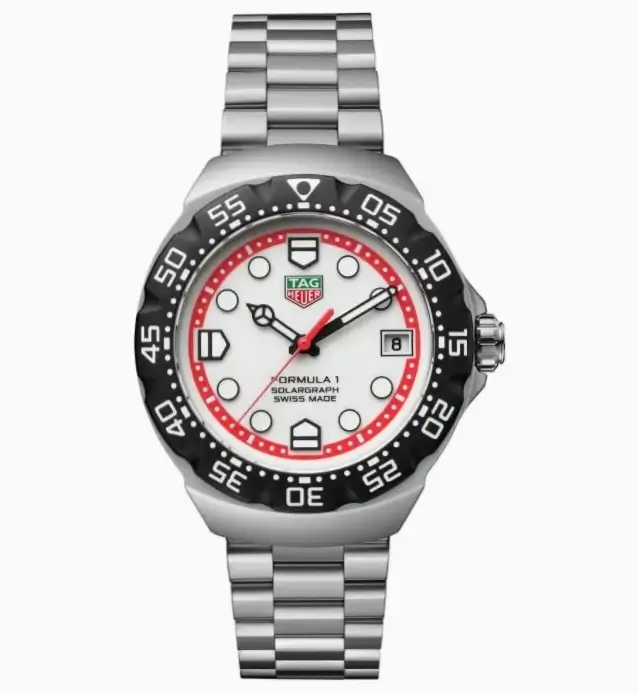
TAG Heuer split the Solargraph launch into two tiers. Three references form the permanent collection: a black and white model with red accents on a steel bracelet, a blue-dialed version with red detailing on the logo and seconds hand, and a black DLC case paired with a yellow bezel and strap, each priced identically regardless of case finish. These are the watches meant to anchor the line for the long term, sold without a production cap or an expiration date.
View this post on Instagram
The other six references are limited editions, released in staggered drops timed to specific races across the 2025 Formula 1 calendar rather than dropping all at once. A green-bezel bracelet model tied to the British Grand Prix at Silverstone was capped at 3,000 pieces, while other editions referencing Miami, Mexico City, and the Dutch Grand Prix at Zandvoort came in varying run sizes and color treatments, including a bright orange strap built specifically around the Zandvoort race’s traditional orange fan culture. Two references in the range, distinguished by pastel pink and pastel blue dials on lightweight TH-Polylight cases, lean further into the collection’s fashion audience than its motorsport one, pairing shield-shaped rhodium-plated indexes with the same solar movement running underneath. One version adds eight small diamonds around the dial, a detail that pushes the line briefly into jewelry-watch territory without changing anything about how the movement functions.
extend
Beyond the steel references, TAG Heuer built several Solargraph models around a proprietary material it calls TH-Polylight, a lightweight polyamide used for the bezel across nearly every reference in the collection and, on select models, for the case itself. It’s the part of the watch doing the most view work: the saturated yellows, greens, and oranges that define the collection’s identity come almost entirely from Polylight components rather than from painted or anodized metal, since polymer takes color more vividly and consistently than steel does.
That choice puts the Solargraph in conversation with other plastic-cased fashion watches on the market, most obviously the Omega and Swatch Bioceramic MoonSwatch collaboration that reignited interest in tint, accessibly priced quartz watches a few years earlier. TAG Heuer isn’t hiding from the comparison so much as making its own case within the same territory: where the MoonSwatch trades on borrowed heritage from a different brand entirely, the Solargraph is rebuilding a design that already belonged to TAG Heuer, with a solar movement and sapphire crystal that push the specification sheet above most watches typically found in that colorful, youth-facing bracket.
fin
Pricing across the permanent collection sits at CHF 1,850 for bracelet models, with rubber strap versions starting slightly lower around CHF 1,750, converting to roughly $1,950 to $2,050 depending on exchange rates at time of purchase. The limited editions carry similar pricing at launch, though several have already moved into resale territory above their original retail price given capped production numbers, a pattern common to watch rel timed around major sporting calendars.
The staggered rollout that began in April 2025 around Watches and Wonders and continued through race-specific drops into the following year means the full nine-piece lineup wasn’t available simultaneously at any single point, a structure that mirrors how TAG Heuer’s rival watchmakers have started using Formula 1’s own rel calendar as a built-in marketing rhythm. Each new colorway effectively functions as its own small media cycle, timed to land in the days before a race weekend rather than folded shh into a single catalog drop, which has kept the collection circulating in watch press and secondhand markets well past its initial April debut.
n
From the DRIFT archive: Tactical Elegance: Inside Bramford London Aqua Blue Three-Pocket Watch Roll · PANTONE’s 2026 Color of the Year Takes Shape With Play-Doh and Post-It Editions
Related Articles

Miffy Gets Her Ceremony Best: United Arrows Dresses Dick Bruna’s Rabbit for KIDDY LAND’s 80th
A Miffy mascot in United Arrows’ formal-occasion wardrobe, and a pouch where she peeks out […]