DRIFT AUDIO
Listen to this story
Choose a voice, then press play.
In a Tokyo warehouse, a curator found hundreds of drawings Yohji Yamamoto never meant to show anyone. Now they fill 310 pages.
May 2024, a warehouse in Tokyo, a pile of cardboard boxes nobody had opened in years. That is where Alexandre Samson, a curator at the Palais Galliera in Paris, found what he later called the story of a discovery. Inside the boxes were hundreds of sheets of paper, some loose and bundled together, some filed away in ring binders, all of it drawn by Yohji Yamamoto over roughly two decades of his career.
There was no ceremony to the find. Samson has described the sheets as they were: worn, stacked, unlabeled in any curatorial sense, treated by their own author as scrap. Some pages were loose, others had been slid into ring binders at some point, presumably by a studio assistant trying to impose a little order on a growing pile that nobody had earmarked for preservation. That is the detail that separates this discovery from the kind of archival find that gets orchestrated for a museum’s own anniversary. Nobody was keeping these boxes for later. They were simply not thrown away, which is a different thing entirely.
View this post on Instagram
Yamamoto, when Samson eventually asked him about them, waved the whole thing off. He called them “just drawings,” the same offhand dismissal he had given his own sketching practice years earlier in his 2010 memoir “My Dear Bomb.” That book had already hinted at what the warehouse would later confirm. It just took over a decade for anyone to go looking, and it took a curator with the right kind of patience to actually sort through a box of unsorted paper rather than wait for an official archive to hand over something already catalogued.
What makes the find unusual is not that a fashion designer sketches. Every designer sketches. What makes it unusual is that so little of Yamamoto’s sketching had ever surfaced in public before this. Across more than four decades of runway shows in Paris and Tokyo, only a handful of his drawings had been previously published or exhibited, most of them cropped into press materials or displayed briefly in retrospective exhibitions rather than presented as a body of work in their own right. The rest sat in storage, doing the quiet, unglamorous work that design drawings are actually for: communicating construction ideas to the people who cut and sew the clothes, not communicating a designer’s personality to the public. A working sketch, by definition, is meant to be used up and forgotten once the garment it describes has been made. That so many of these survived at all owes more to accident than to any deliberate act of preservation.
in
The result of that Tokyo find is “Yohji Yamamoto Drawings,” a hardcover volume from Thames & Hudson set for release on November 17, 2026. The book runs 310 pages and reproduces 183 drawings spanning 1981, the year of Yamamoto’s first Paris show, through 1999. Every image in the book was personally selected by Yamamoto himself, not chosen for him by an editor or an estate.
The drawings cover both menswear and womenswear collections, and they were made on whatever paper happened to be at hand at the time, including scraps of old newspaper. That detail matters more than it might first appear. A sketchbook implies intention, a designated space set aside for drawing. Newsprint implies the opposite: an idea that needed to get down on paper immediately, wherever paper happened to be.
Descriptions of individual pages that have circulated ahead of the release mention coats rendered with lines that suggest flame, figures drawn hunched and folded into themselves, a crane captured in the same loose, energetic strokes as a human body twisting mid motion. None of it reads like fashion illustration in the conventional sense, the kind built to sell a finished garment to a buyer. It reads closer to a private notation system, quick marks meant to be understood by exactly one other person: the patternmaker standing next to Yamamoto in the studio.
The choice to use old newspaper as drawing paper, rather than something more deliberate, tells its own small story about how these images came into being. A designer reaching for whatever surface is nearest at hand, mid thought, is not staging a mood board moment. He is trying to get an idea down before it disappears, in the same way a person might scrawl a phone number on the back of a receipt because that is what happens to be in a pocket. Reproducing that paper at full scale in a 310 page book, rather than cropping it out or transferring the drawings onto a clean white page, is itself an editorial decision. It keeps the evidence of how fast and unceremonious the original act of drawing actually was, rather than smoothing it into something that looks more considered in hindsight than it was in the moment.
The eighteen year span the book covers, 1981 through 1999, also happens to line up with the period when Yamamoto’s reputation in Paris was being built and then hardening into something closer to institutional. It is the era that includes his early, deliberately unfinished looking collections that unsettled the Paris fashion establishment, through to a decade in which his silhouettes had become reference points other designers were openly working against or around. Seeing the drawings from that specific stretch, rather than a career spanning survey, means the book functions less like a retrospective and more like a document of a designer figuring something out in real time, one sketch at a time, long before any of it had settled into the reputation it would eventually carry.
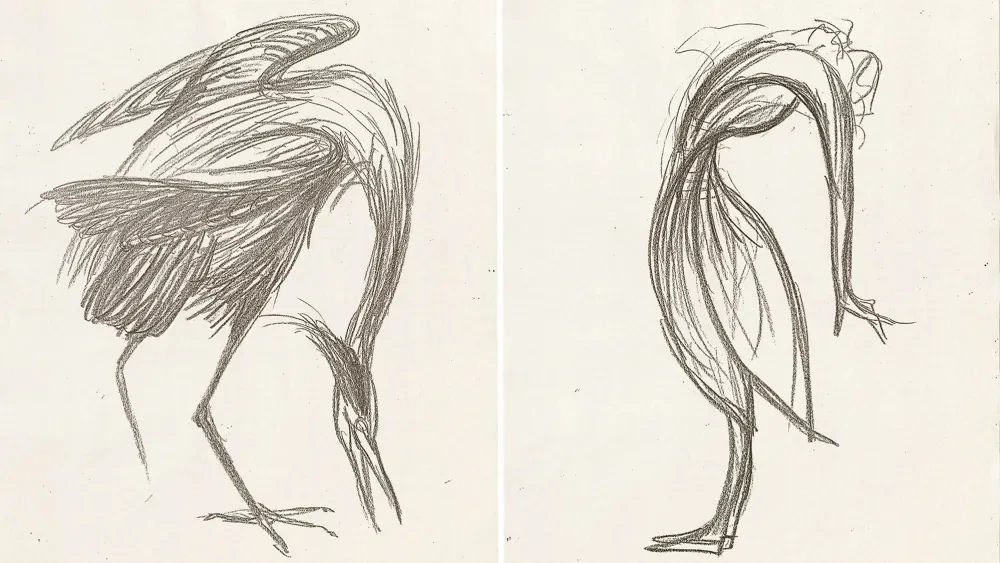
Two expressive bird studies from Yohji Yamamoto’s sketchbook, rendered in loose pencil lines that echo the fluid silhouettes of his fashion designs.
made
Samson wrote the text and organized the archive into its final sequence. He has a track record with exactly this kind of material. As a curator at the Palais Galliera, he co-authored “Givenchy Catwalk” and has built exhibitions on Martin Margiela’s womenswear years, on Rick Owens, and on fashion photographed from behind rather than from the front, a curatorial habit of looking at the parts of fashion history that don’t usually get looked at directly. Yamamoto’s own drawings, arguably, fall into that same category: the working documents nobody thought to preserve because nobody expected anyone to want them.
Graphic design on the book came from Peter Saville, the British art director best known for the record sleeves he designed for Factory Records in Manchester in the late 1970s and 1980s, and for corporate identity work since then for brands including Burberry and Salvatore Ferragamo. Saville’s involvement is a small but pointed choice. His entire design career has been built around stripping marketing noise out of an image and letting a single strong graphic gesture carry the weight, which is more or less what a Yamamoto sketch already does on its own.
There is also a quieter symmetry in pairing these two names on one project. Saville made his name turning music that was often deliberately unglamorous, post punk records out of Manchester, into some of the most recognizable album art of the era, largely by refusing to explain the music through the cover art rather than illustrating it directly. Yamamoto’s clothes have drawn a similar kind of description for years: austere, monochrome heavy, more interested in construction than in ornament. Handing a book of his private working sketches to a designer with that particular sensibility means the presentation is unlikely to oversell material that, by its own creator’s account, was never meant to be sold as art in the first place.

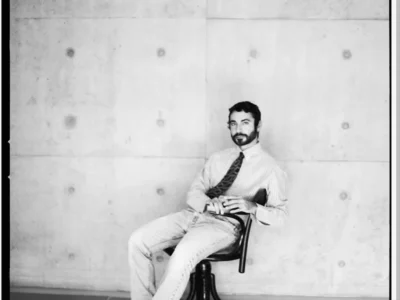
Yohji Yamamoto photographed in his signature black attire, framing his face with raised hands in a playful yet characteristically understated portrait.
length
Yamamoto has talked about drawing before, and what he has said complicates any impulse to treat these sketches as art objects in their own right. In “My Dear Bomb,” he wrote that a design sketch is not a miniature version of a garment, not a realistic illustration, not a cartoon. He was specific that the artistic quality of the drawing itself is beside the point. What matters, in his own description, is that the sketch functions as a code, a private shorthand shared between the designer and the person who will actually construct the garment from it.
That framing is worth sitting with, because it runs against the instinct a fashion book like this one might otherwise invite, which is to treat each page as a finished work to be admired for its line quality or its expressive energy. Yamamoto’s own account suggests the opposite reading: that the drawings are valuable specifically because they were never made to be looked at by anyone outside the workroom, and that whatever beauty ended up on the page arrived as a byproduct of function rather than as the goal.
Samson’s account of unpacking the warehouse boxes leans into that tension rather than smoothing it over. He has described the sketches as a kind of language, one that the book is now translating for an audience that was never supposed to need the translation in the first place.
terse
Yamamoto was born in Tokyo in 1943 and originally studied law, a path he abandoned once it became clear the courtroom held no pull for him. He went to work instead for his mother’s dressmaking business, learning tailoring on the job rather than in a design school, though he later also studied at Tokyo’s Bunka Fashion College. He showed his first collection in Tokyo in 1977 and opened a shop in Paris in 1981, the same year the drawings in this book begin.
The decades since have taken him well outside the runway. He designed costumes for film, including Takeshi Kitano’s “Brother” and Wim Wenders’ “Until the End of the World.” In 2003 he launched Y-3, a partnership with adidas that put his tailoring instincts onto sportswear and shoe introduced his show to an audience that had never set foot near a Paris fashion week showroom. Across all of it, the through-line has been a resist to anything that looks decorative for its own sake, the same instinct that, according to his own writing, shaped how he thought about a sketch in the first place.
extend
“Yohji Yamamoto Drawings” is listed at 115 dollars for the hardcover edition, distributed through W. W. Norton in the United States with an ISBN of 9780500029909. There is no ebook edition planned. The book measures roughly 9 by 12 inches, large enough that the drawings, many of them originally made small and fast on whatever paper was around, get room to be read at something closer to their intended scale.
Pre orders are open now through Thames & Hudson’s own site as well as through Amazon, Barnes & Noble, and Bookshop.org, ahead of the November 17 release. For a designer who spent forty years treating his own working sketches as disposable, the arrival of a 310 page book built entirely around them is its own kind of statement, made not by Yamamoto in an interview but by the sheer volume of paper that was sitting in that warehouse waiting to be found.
Related Articles

Inside The Airstream Elon Musk Calls His Memphis Palace
Elon Musk says he is living in an Airstream trailer parked beside xAI’s Colossus supercomputer […]