DRIFT AUDIO
Listen to this story
Choose a voice, then press play.
American Football’s fourth record trades campus longing for the harder math of middle life, and it is landing louder than anything they made at twenty two.
Mike Kinsella has a black eye, a hoarse voice, and a tiger being needled into his thigh above the words “No Feeling.” None of it seems to bother him much. It is a sweltering Sunday afternoon in London, and outside the O2 Forum Kentish Town, football chants drift over from the neighboring pubs while a line of fans, some of them not yet born when American Football first pressed a record, snakes around the block hours before doors.
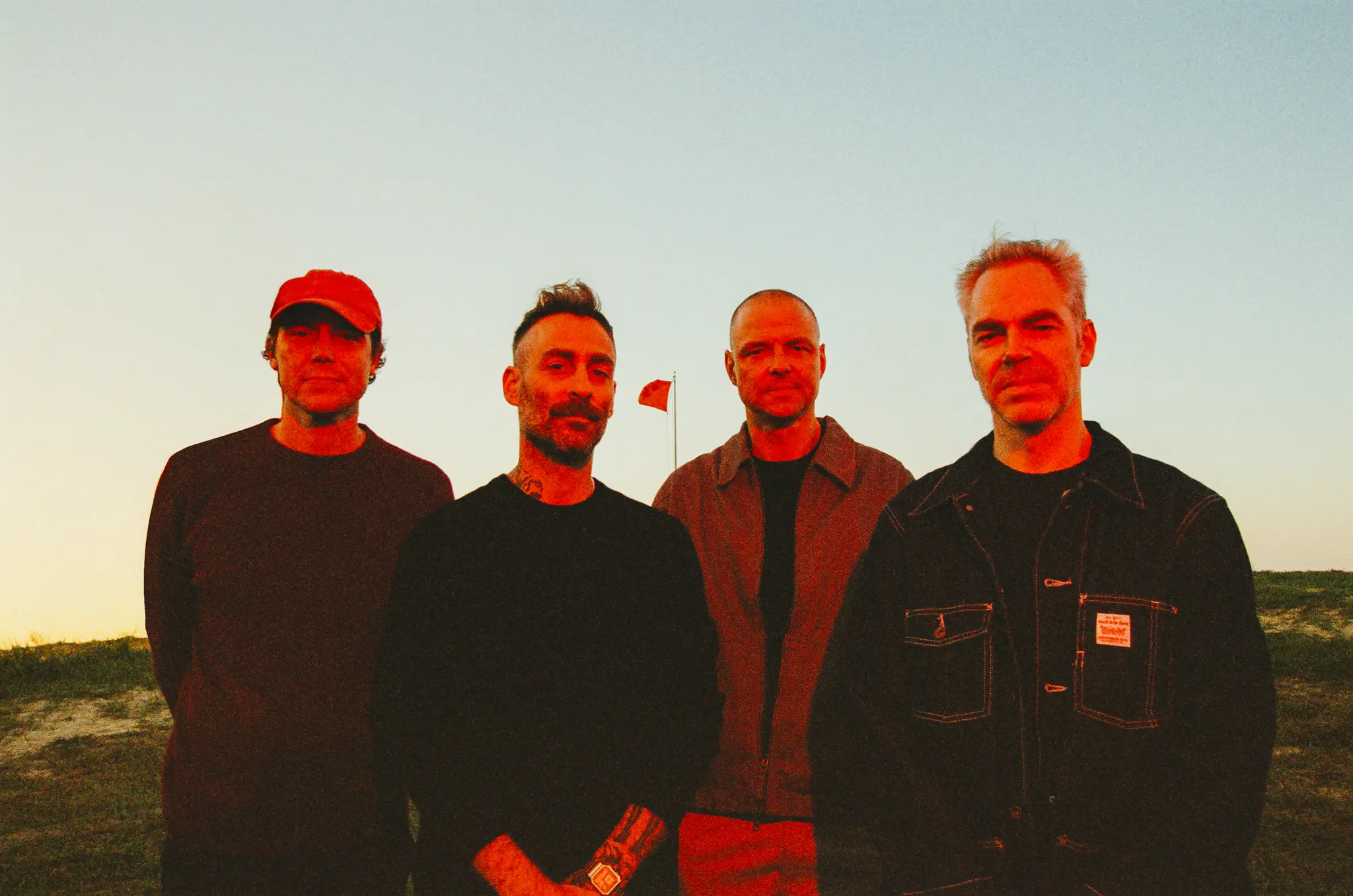
Backstage, Kinsella smirks when his own guitarist’s line gets read back to him. Steve Holmes had put it plainly in the band’s own album notes for the new record: the charm of the first record is that it could have only been made by kids. This one could only have been made by adults. It is a tidy way of describing twenty seven years of a band that broke up before most of its future audience had heard of it, then came back to discover that audience had been quietly multiplying the whole time.
The show at the O2 Forum Kentish Town sold out well before the band arrived in the U.K., part of a run of European dates squeezed between a spring leg through the American West and a summer swing back through the East Coast and Canada. For a band that spent its first fifteen years of existence as a rumor more than a going concern, the scale of the operation now, arenas’ worth of demand funneled into rooms that hold a few thousand people, still seems to catch American Football a little off guard.
dosage
The story, at this point, has been told so many times it risks calcifying into myth, but the bones of it are simple. In 1997, Mike Kinsella, fresh off drumming in Cap’n Jazz, and Steve Holmes, his old high school roommate, began writing songs together as students at the University of Illinois Urbana-Champaign. Steve Lamos, who had played with Kinsella in an earlier, short lived project called The One Up Downstairs, came aboard on drums and trumpet.
By Holmes’s own account, the trio was consciously moving away from the noisier post hardcore they had grown up on. They wanted something slower, quieter, built more on interlocking guitar lines than volume. The result was a self titled EP in 1998 and, a year later, a full length that would become one of the most quietly influential records of its decade: American Football, retroactively known as LP1, released through the Champaign based label Polyvinyl Records.
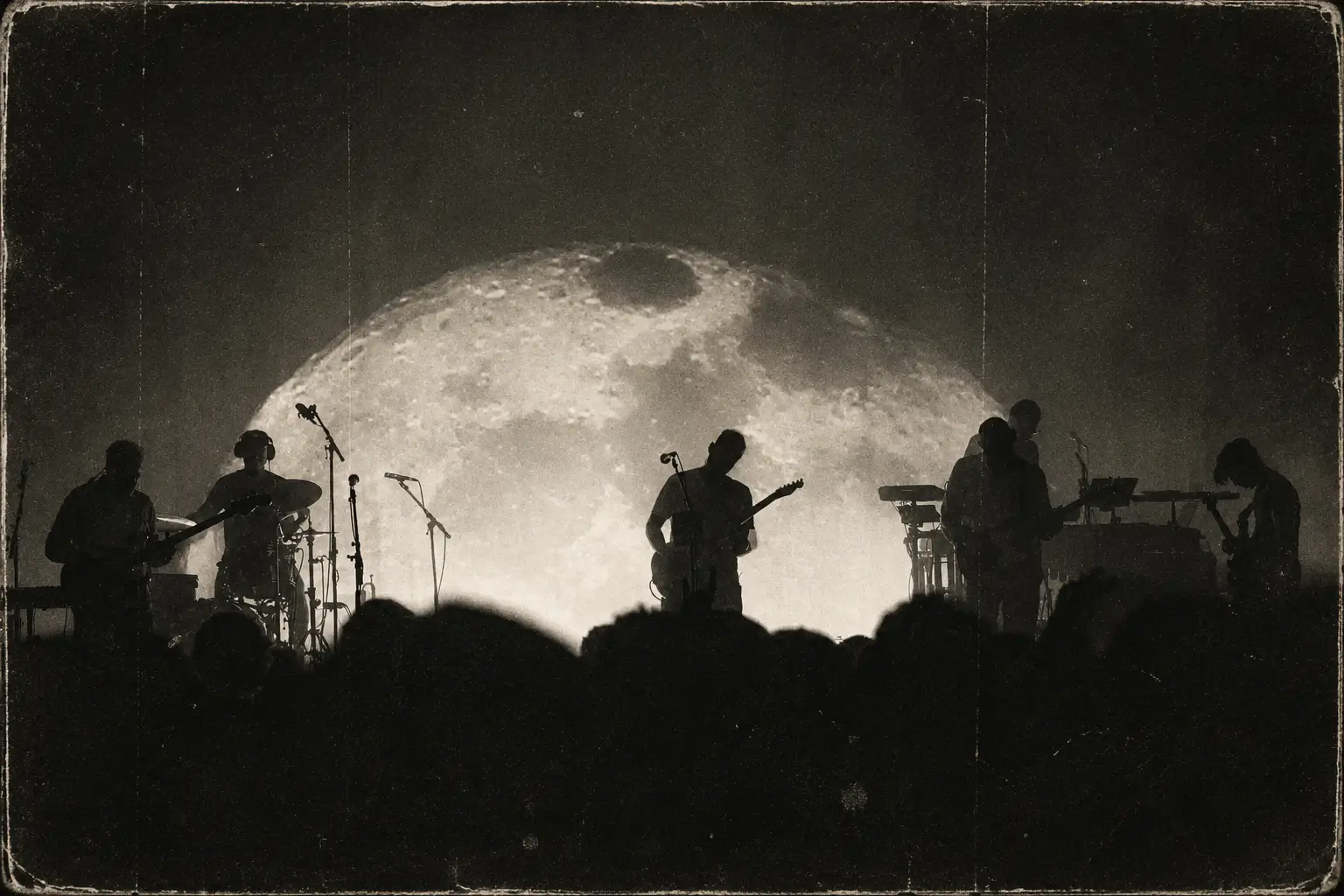
American Football live under a moonlit stage backdrop, reimagined with a distressed 1940s film photograph aesthetic.
Within a year of the album’s release, the members had scattered to their separate lives, and the band quietly folded. It would be fifteen years before they played together again.
thrasher
There, a scene built around Dischord Records and a loose collective of hardcore bands, including Rites of Spring and Ian MacKaye’s Embrace, staged what became known as Revolution Summer, a deliberate turn away from the violence and machismo that had crept into hardcore shows. Skate magazine Thrasher coined the label “emo core” to describe the sound, a term MacKaye himself reportedly despised on sight.
That first wave burned out fast, but the sensible it left behind traveled. By the mid 1990s it had resurfaced in the American Midwest, stripped of most of its hardcore aggression and fused instead with the angular time signatures of math rock and the unhurried atmospherics of bands like Nick Drake, the Sea and Cake, and Slint. Chicago, Urbana, and a scattering of other college towns became the unlikely capital of what fans and critics alike now call Midwest emo. American Football did not invent the subgenre so much as perfect it in a single record, an accident of a house, a semester, and three students who happened to be paying close attention to Drive Like Jehu and deciding to do the opposite.
Bands like Braid and the Get Up Kids had already been circling similar territory, but LP1’s particular combination of open tunings, capoed guitars, and a lyric sheet that reads more like a diary than a manifesto gave the style its lasting template. One critic later observed that after the collapse of the MySpace era, hundreds of bands treated Kinsella’s elliptical lyrics as unfinished business, rebuilding an entire subgenre around a sound that turned out to be far easier to imitate than to replicate in spirit. Polyvinyl grew up alongside the band, expanding from a Danville, Illinois fanzine into a label whose roster would eventually include Rainer Maria and Braid, plus a fourth generation of Midwest emo revivalists who treat American Football less as a peer than as an origin point.
shh
If LP1 has one image attached to it, it is the house. A green tinted photograph of a white two story building at 704 West High Street in Urbana, Illinois, shot upward toward a lit second floor window by photographer Chris Strong, became the album’s cover almost by accident. None of the band members ever lived there. They were simply friends of the tenants who threw the parties.
It hardly mattered. As the record’s cult following grew through the 2000s, the house became a pilgrimage site for a generation of fans who had never seen the band play live, its silhouette recognizable in the same way the Andy Warhol banana is instantly legible without a single word of context. Fans have scratched an X into the sidewalk marking the exact spot where Strong stood to take the photo. In 2023, the band bought the house outright, in partnership with Polyvinyl, Strong, photographer Atiba Jefferson, and a Chicago arts nonprofit, to keep it from being torn down by developers. It has since been listed on Airbnb for anyone who wants to sleep inside the myth for a night.
arrive
The reunion in 2014 was supposed to be a lap of honor: a reissue of LP1 with a disc of unreleased demos, a couple of sold out shows in Champaign and New York to mark the occasion. Mike’s cousin Nate Kinsella joined on bass for those dates and never left. What followed instead of a quiet victory lap was two more albums, LP2 in 2016 and LP3 in 2019, each one pulling the band further from nostalgia act territory and closer to an ongoing, evolving unit, one that brought in guest vocalists like Slowdive’s Rachel Goswell and Paramore’s Hayley Williams without ever losing the interlocking, twinkling guitar language that made the first record what it was.
Then came the pause nobody planned for. After touring LP3, the band intended a short break. The pandemic stretched it into three years. Steve Lamos, who works by day as an English professor in Colorado, stepped away from the band entirely in 2021, and attempts to write together over video calls went nowhere. “It was not easy to do on Zoom,” Holmes has said of the period, “and honestly, it wasn’t clicking.” Lamos rejoined in 2023, the same year the band purchased the American Football House and played its first live show in nearly four years, at Beat Kitchen in Chicago.
stuff
What emerged from that long, interrupted gestation is LP4, released on May 1 through Polyvinyl and recorded largely at Panoramic House in Stinson Beach, California, with producer Sonny DiPerri, known for his work with My Bloody Valentine and Trent Reznor. Nate Kinsella built out an elaborate system of demos and scratch tracks that let the songs evolve before the band ever set foot in a studio together, a process Holmes credits with giving the album its unusually layered, sometimes dissonant textures: piano, vibraphone, synthesizer, and Lamos’s trumpet woven through the guitar interplay that has always been the band’s signature.
Lyrically, the record does not flinch. On “Patron Saint of Pale,” Kinsella sings about proposing a game of rock paper scissors with his soon to be ex wife as a way of avoiding the actual signing of divorce papers. On the eight minute centerpiece “Bad Moons,” he works through addiction, shame, and self loathing with a directness he has said made him briefly worry about his own mother hearing it. Where LP1 dealt in the ache of not yet knowing what your life would look like, LP4 deals in already knowing, and finding that the knowledge does not necessarily bring peace.
Steve Lamos has described the album’s arc as something close to the stages of grief: rage against how things work, followed by widening moments of acceptance. Kinsella himself is characteristically less clinical about it. His goal, he has said, has always been to say something large and heavy in a very plain way, and on this record he lets himself stay a little more vague, which he thinks makes it more honest rather than less. Guest turns from Rainer Maria’s Caithlin De Marrais, Wisp’s Natalie Lu, and Turnstile’s Brendan Yates widen the record’s palette further without ever tipping it into spectacle.
The album’s opener, “Man Overboard,” sets that tone from its first bar, built around a knotted, near prog drum pattern that Lamos reportedly had to relearn from his own demo before the band could play it live. Its maritime imagery of a man born castaway, already lost at sea before the song even begins, previews the record’s refusal of tidy resolution. That refusal extends to the album’s closing stretch, where “Desdemona” threads phased, wordless vocals reminiscent of Steve Reich’s minimalist choral work through the same twinkling guitar lines that made bedrooms full of strangers cry two decades earlier. Nothing about LP4 apologizes for the three year gap that produced it. If anything, the delay, the pandemic, Lamos’s departure and return, the two divorces scattered across the band’s personal lives, reads on the finished record as the reason it sounds as unguarded as it does.
The album’s lead single, “Bad Moons,” passed a million Spotify streams within weeks of release, a scale of reach that would have been unthinkable to three students recording shh in a rented house in 1999.
flow
Back at the Forum, none of that commercial arithmetic seems to be on anyone’s mind. The room fills early. Support act Mei Semones plays to a crowd still filing in from the beer garden, and by the time American Football walks out, the venue, a nearly century old Art Deco hall in north London with a capacity just north of two thousand, is packed to its edges.
What is striking, watching the crowd rather than the stage, is the split in ages. There are fans old enough to have caught the band’s first London dates over a decade ago, and there are teenagers who arrived at “Never Meant” through algorithmic playlists rather than word of mouth, discovering in a song about a specific kind of post collegiate uncertainty their own, entirely different, adolescent one. The gap between those two audiences is, in a sense, the whole story of this band: a record built by kids that somehow keeps finding new kids to belong to, even as the band itself has aged well past the emotional register that made it famous.
Either hum the current lineup, Kinsella, Holmes, Lamos, and Nate Kinsella, along with touring members Mike Garzon and Cory Bracken, keeps writing new chapters or eventually lets this one stand as the final word remains an open question the band has not answered publicly. For now, the tour continues through the U.S. and Canada into September, carrying LP4’s harder, plainer version of the same ache that first got scratched into a sidewalk outside a rented house in Urbana more than a quarter century ago.
Related Articles

Inside The Airstream Elon Musk Calls His Memphis Palace
Elon Musk says he is living in an Airstream trailer parked beside xAI’s Colossus supercomputer […]