

DRIFT AUDIO
Listen to this story
Choose a voice, then press play.
Dried tea leaves and spent coffee grounds, ground down and blended into PLA, are being robotically printed into furniture and lighting inside a Hackney Road studio this month.
A used tea bag from a bubble tea counter and a bag of spent grounds from the café next door don’t look like raw material for a chair. Inside a fabrication studio on Hackney Road this month, they are exactly that. The project is called After the Last Sip, and it treats two of London’s most ordinary daily habits, a bubble tea order and a flat white, as the front end of a material supply chain rather than the end of one. Most of what goes into either drink ends its life in a bin behind the counter within minutes of being made. This project asks what happens if it doesn’t.
from
The process starts with collection rather than fabrication. Tea leaves are gathered from London’s bubble tea shops, and spent coffee grounds are sourced from local cafés, the kind of waste stream that most drinkers never think about once the cup is empty. It’s a bigger stream than it looks. Cafés across the UK generate hundreds of thousands of tonnes of used coffee grounds a year, and a large share of it still goes to landfill, where it breaks down and releases methane rather than being put to any further use. Tea waste follows a similar path, and bubble tea in particular has become a fixture of London’s high streets over the past decade, a drink that originated in Taiwan in the early 1980s and has since spread through chains and independent shops across the city.
View this post on Instagram
London’s bubble tea scene has grown considerably in that time, with international chains now sitting alongside independent shops across the city, and market researchers projecting the UK bubble tea sector to nearly double in value by the early 2030s as the drink moves from novelty to habit. Coffee waste scales even further. There are now more than 12,000 independent coffee shops across the UK alone, on top of the major chains, and globally, spent coffee grounds are estimated to exceed 15 million tonnes a year, most of it discarded rather than reused.
For After the Last Sip, both residues are dried, ground down and compounded with PLA, the biodegradable plastic that has become a default material for large-format 3D printing. Compounding rather than printing the waste on its own isn’t incidental. Researchers working on spent coffee grounds as a print material, including a Carnegie Mellon team publishing through the ACM’s Designing Interactive Systems conference, have found that the grounds need a binder to become self-supporting and printable at all, since the raw material alone won’t hold its shape through a print run. PLA plays that role here, giving the composite enough structural integrity to survive large-scale robotic printing while still carrying tea or coffee particulate visibly through the finished surface.
From there, the team runs material tests, adjusting particle size, composition and blending ratio to see how each variable changes the resulting composite’s colour, texture, translucency and structural behaviour. That testing process isn’t hidden away once the finished pieces are ready to show. The exhibition itself displays material samples and process fragments, including failed prints and abandoned formulations, alongside the finished furniture and lighting, so visitors see the material’s development rather than just its outcome.
The approach sits inside a wider, still-small field of designers treating café waste as a construction material rather than compost. A 2024 project at Barcelona’s d·origen coffee shop used spent coffee grounds and large-format robotic printing to produce five bespoke lamps and counters that now furnish the shop itself, and researchers at Carnegie Mellon have published peer-reviewed work developing food-based binders that make spent grounds printable without industrial additives. It fits a broader pattern across design right now, where waste streams that once had no second life, orange peel, mycelium, pineapple leaf fibre, get treated as source material rather than as something to dispose of. After the Last Sip belongs to that same line of experimentation, but its material comes specifically from London’s own tea and coffee culture rather than a single café or a lab-controlled batch, and its scale, full furniture and lighting rather than tabletop objects, pushes further than most of what’s come before it.
lang
The finished works split across three designers, each working the same raw material toward a different formal idea. Parametric design, the method behind all three, means the form isn’t drawn directly but generated from a set of rules and variables, so a single system can be pushed, tuned and re-run rather than redrawn from scratch each time. Chao-Chun Kung’s piece, titled CHA / 茶, uses a tea-waste PLA composite built around a custom parametric system Kung derived from the Chinese character 茶, tea itself, letting the geometry of the written character generate the geometry of the printed object. The work leans directly on Taiwan’s tea-drinking traditions, treating tea as material, cultural reference and generative logic all at once rather than as a sustainability gesture layered onto an unrelated form. A second Kung piece, Iced Tea, translates the same composite into a large-scale 3D-printed lighting fixture, carrying the tea-derived surface texture from furniture scale into something closer to architectural fixture.
Ching-Yu Lin’s contribution, Undetermined Shore, works in coffee-ground composite instead of tea, building layered, sediment-like surfaces that read as geological rather than domestic. The reference point is Taiwan’s own coastline, which Lin frames as shifting rather than fixed, and the printed layering becomes a way of registering that instability directly in the material’s surface rather than illustrating it through imagery or ornament. Where a conventional print might treat each layer as a step toward a smooth final surface, Lin’s piece keeps the accumulation visible, closer to sediment settling than to a manufactured object arriving at a finished state.
Chen-Yang Chang contributes two works, Nexus Bloom and Unfolding Bloom, both built from continuous parametric geometries developed through digital design and large-scale printing. Where Kung’s and Lin’s pieces foreground the specific cultural and geographic references behind their materials, Chang’s works push further into pure form, using the tea-waste composite as a printable substrate for geometry that would be difficult, or in some cases impossible, to produce by hand or in a conventional single material. Read together, the two Chang pieces function almost as a study in continuity, one surface unfolding into the next without a visible seam, even as the material itself carries the irregularity of a recycled input.
Holding the three practices together is Chih-Han Liu’s spatial curation, which arranges the finished works, the material samples and the process fragments as a single walkthrough rather than three separate booths. That framing matters here specifically because the project’s real subject is the material itself, tested, adjusted and printed in full view, and Liu’s installation is what keeps that process legible alongside the objects it produced.
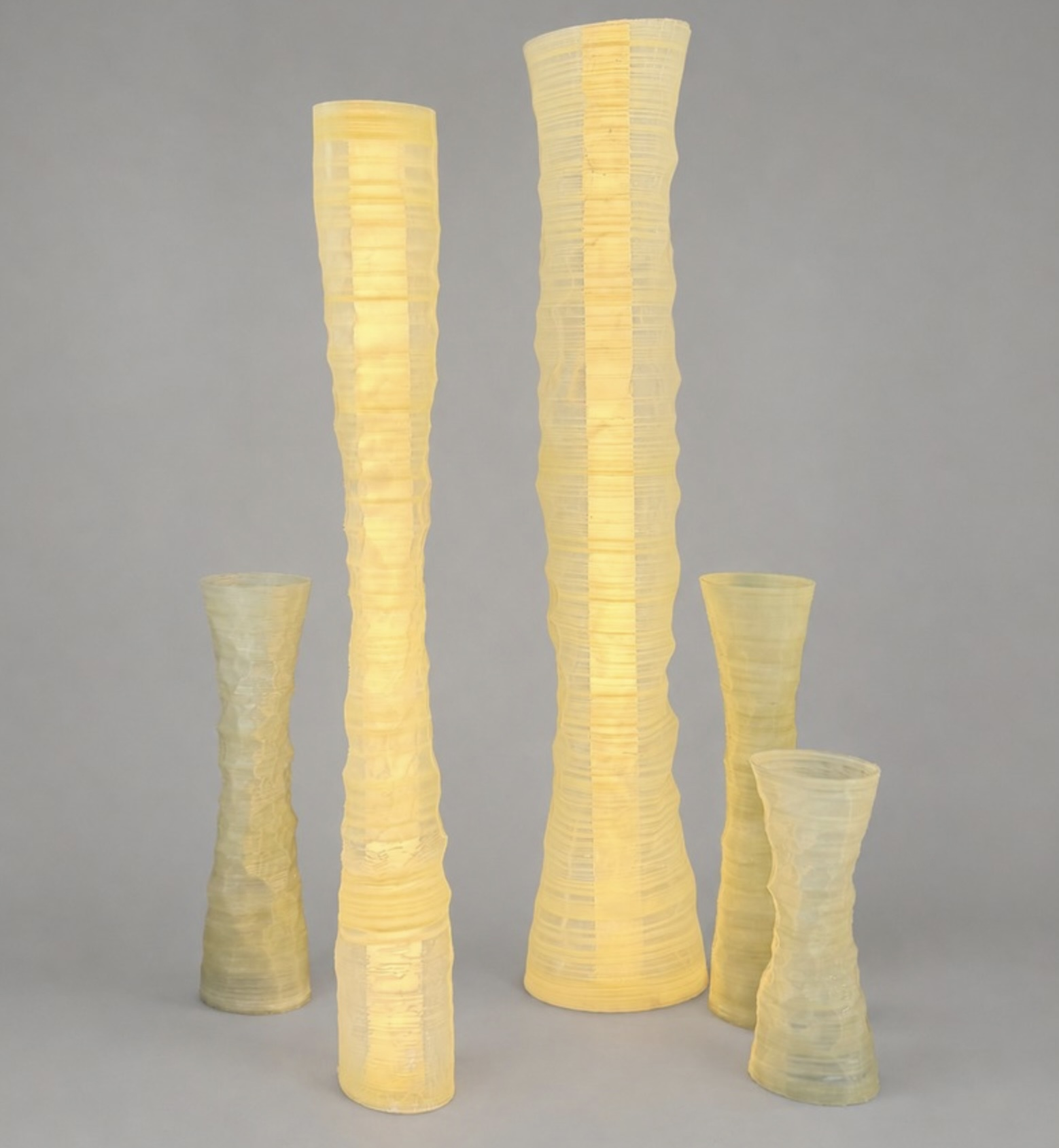
A collection of five translucent, pale yellow cylindrical vases of varying heights with textured, ribbed surfaces.
example
Every piece in the show is produced through parametric design paired with large-scale robotic 3D printing at Fab.Pub, the East London fabrication studio behind the show’s physical production. Fab.Pub describes itself as a shop for accessible large-format 3D printing and digital fabrication, with a stated focus on bioplastics and other sustainable print materials rather than standard industrial filament, which makes it a fitting production partner for a project built entirely around waste-derived composite. The studio’s usual work runs from architecture cladding, acoustic panels and staircase balustrades to full commercial interiors, printed on-site rather than manufactured off and shipped in. Fab.Pub has previously described completing what it calls the first non-toxic, fire-retardant, sugar-based 3D-printed bioplastic interior, built for London’s Roe Restaurant, giving some sense of the scale the studio is used to working at before a project like After the Last Sip ever reaches the gallery floor. The studio positions itself less as a conventional print shop and more as a set of local “urban factories,” where designers can book machine time and commission work that’s produced close to where it will actually be used, rather than manufactured overseas and shipped in. That model, producing locally rather than importing, is part of what makes it a workable partner for a project that begins with waste collected within the same city it’s printed in.
What’s notable about the After the Last Sip pieces is what the designers chose not to do to them once they came off the printer. Rather than sanding, filling or otherwise concealing the marks of fabrication, the works retain their printed layers, visible particles and irregular textures. The ridges left by the print head, the flecks of tea leaf or coffee ground suspended in the composite, and the slight unevenness that comes from working with a recycled, variable input material are all left in place. That decision keeps both the material’s origin and the manufacturing process itself visible on the surface of the finished object, rather than smoothing a sustainable material into a form that reads as if it had been made from anything else.
play
After the Last Sip runs at Fab.Pub in East London from 12 to 18 September 2026, sitting inside the wider run of the London Design Festival, which spans 12 to 20 September this year across venues including the V&A and the Design Museum. The festival has run annually since 2003, founded by John Sorrell and Ben Evans, and has grown from an opening edition of roughly 90 events to a programme now drawing in more than 2,000 participating designers, brands, universities and studios, with attendance climbing from around 420,000 visitors in 2017 to well over a million today. Against that scale, After the Last Sip is a small, single-studio show, closer in spirit to the festival’s DIY and reader-submitted design culture than to its headline installations at the major museums, which is also how the project first surfaced publicly, through designboom’s own submissions feature for reader-produced work.
The exhibition doesn’t limit itself to the five finished pieces on show. Test panels, discarded prototypes and material swatches sit alongside CHA / 茶, Iced Tea, Undetermined Shore, Nexus Bloom and Unfolding Bloom, a documented trail running from the first ground batches of tea and coffee waste through to the full-scale prints on display. Most material-driven design work reaches an audience only once the material problem has already been solved, with the failed batches and discarded formulations left behind in a studio somewhere. After the Last Sip keeps that part in the room. Visitors walking Chih-Han Liu’s install see the same composite at every stage it passed through, from a rough, untested blend of dried tea and PLA pellets to a fully printed chair, which puts the material itself, not just the finished furniture, in front of the London Design Festival audience.
For a project built on turning a daily drink’s leftovers into a construction material, that decision to keep the testing view is close to the point. The finish pieces prove the composite works. The material samples and abandon print sit next to them show what it took to get there.
Related Articles

Tarantino Hands Sacha Baron Cohen the Plume / Phoenix Theatre
Previews begin February 23 at the Phoenix Theatre, the house that opened with Noël Coward in 1930.