DRIFT AUDIO
Listen to this story
Choose a voice, then press play.
How “Forgotten Island” turns a 1990s friendship story into the studio’s most personal original film yet — and the first major animated feature built entirely around Philippine folklore
In This Story
- A Friendship Twenty Years in the Making
- Jo, Raissa, and the Island of Nakali
- A Visual Language Rooted in the Philippines
- Casting Filipino Royalty
- The Sound of Nakali
- A Long Road to September
Every DreamWorks original starts somewhere, and “Forgotten Island” started with two story artists on “Kung Fu Panda 2.” Joel Crawford and Januel Mercado met on that 2011 production, discovered they shared a creative shorthand, and have been circling back to each other’s projects ever since — Mercado co-directing under Crawford on “Puss in Boots: The Last Wish,” the pair earning Academy Award, BAFTA, and Golden Globe nominations for that film in the process. “Forgotten Island,” arriving in theaters September 25, marks their third collide and Mercado’s feature directorial debut, and it is, by both filmmakers’ account, the most personal thing either of them has made at the studio.
The film is DreamWorks Animation’s first movie built from the ground up around Philippine mythology, and the two men are not distant from that material. Mercado is Filipino-American; Crawford’s wife, Kathy, is Filipina. Both describe themselves as “Cali kids” raised inside Filipino community and family life, and that proximity shaped how they approached the project — not as an outsider’s survey of folklore, but as a story pulled from specific, remembered summers. Mercado has said a lot of his childhood time in the Philippines, spent on 1990s family vacations, carried directly into the film’s setting and texture.
That insistence on specificity runs through everything the directors have said about the project, including in a June 2026 conversation with Variety. Rather than treating Filipino culture as a backdrop, they’ve framed it as the film’s structure foundation — a point they reinforced at the movie’s Annecy Film Festival presentation, where they highlighted the contributions of the Manila-based animators who worked on the film. Some of the movie’s sequences were produced by Snipple Animation, a Philippine studio with a long history of outsourced anime and animation work, giving “Forgotten Island” a production lineage that mirrors its subject matter.
stir
The story is set in the Philippines in the 1990s and centers on Jo and Raissa, best friends since childhood who are about to be pulled apart by adulthood: Jo is staying home, while Raissa is leaving for college in the United States. On their last night together — spent, in classic form, on junk food and karaoke — the two stumble into a portal that drops them onto Nakali, an island built from the shapeshifters, witches, demons, and monsters of Filipino oral tradition.
The catch is memory itself. The longer Jo and Raissa stay on Nakali, the more of their outside lives — and their friendship — begins to slip away, and the film’s central tension becomes whether getting home is worth what they’d have to forget to get there. In an interview around the trailer’s debut, Crawford has talked about the specific texture of losing touch in a pre-internet decade, when a friend leaving for school could genuinely mean losing them, and when a stack of a dozen Polaroids was something you had to ration. Photography, memory, and the physical objects that hold both together are recurring visual motifs throughout the film.
That emotional architecture is matched by a genuinely dense mythological cast. Among the creatures Jo and Raissa encounter is a weredog named Raww, and — playing what the directors have called the island’s most feared resident — the Manananggal, one of the most iconic and widely recognized figures in Filipino folklore, a self-segmenting, flying monster long used across Philippine storytelling to frighten and fascinate in equal measure.
lang
View , “Forgotten Island” continues down the road DreamWorks opened with “Puss in Boots: The Last Wish” — expressive, painterly, and unafraid of a hand-drawn look inside a CG frame — while pushing further into new territory. Crawford and Mercado have described drawing on Filipino art and 1990s graphic design as reference points, alongside anime’s approach to action staging and exaggerated character expression. Mercado has said the team wanted to push the two-dimensional elements introduced on “Last Wish” even further, layering in hand-painted textures to sell the island’s fantasy elements.
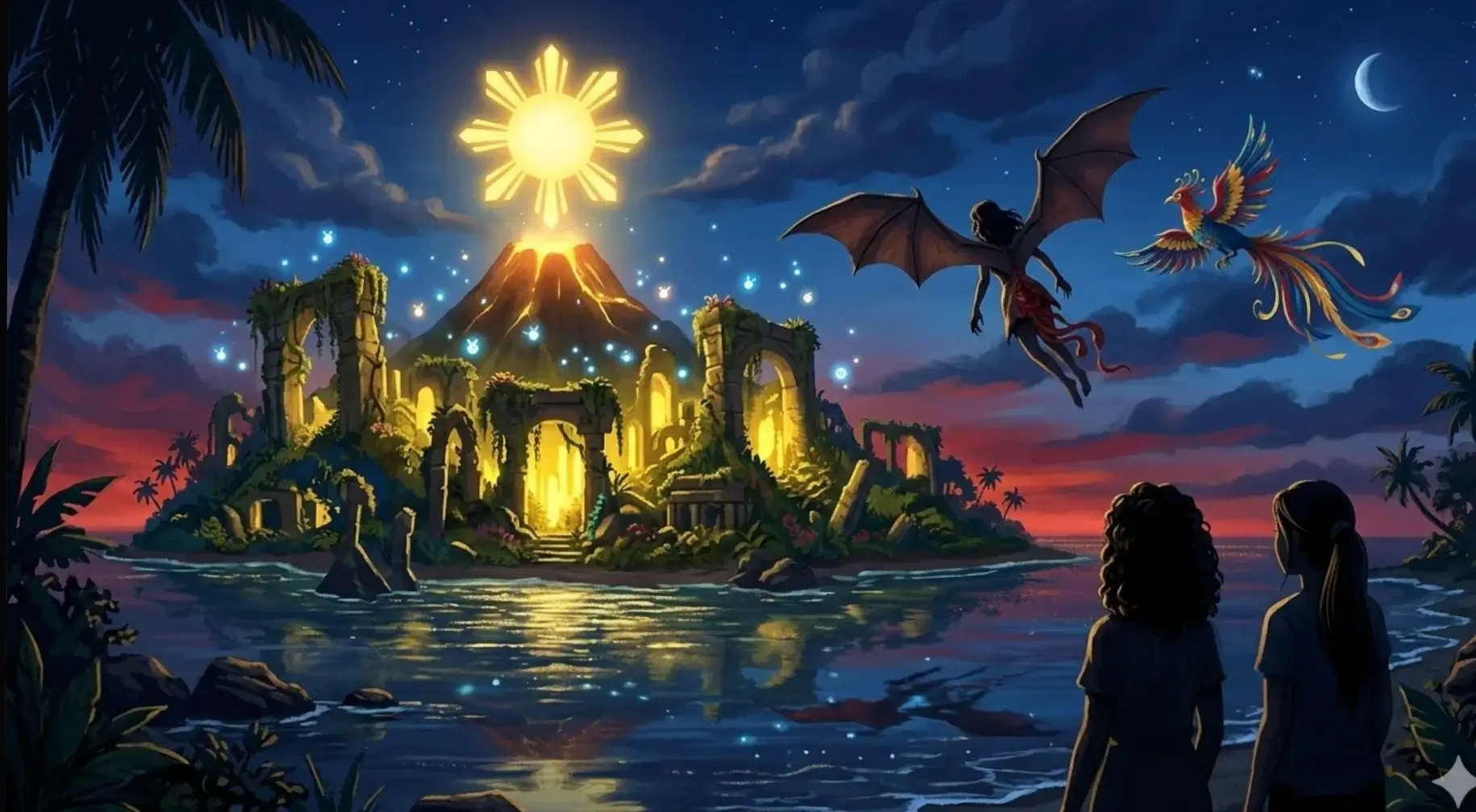
A mystical island comes alive beneath a glowing sky, hinting at the magical adventure awaiting in Forgotten Island.
The directors have also spoken about treating the film’s cinematography as though it were live-action, complete with wider lenses and deliberate light leaks across the frame — a stylistic choice tied directly to the film’s themes of memory and nostalgia, evoking the imperfect, sun-faded quality of a physical photograph rather than the clean precision typical of CG animation. It’s a specific enough approach that early reactions out of CinemaCon 2026 and the Annecy Film Festival, where a work-in-progress cut screened to strong response, have singled out the film’s look as much as its story.
culture
What separates “Forgotten Island” from a folklore-flavored adventure film is how insistently specific its production team has been about the culture surrounding its mythology, not just the myths themselves. The film is dotted with what Mercado has called “traditionally Filipino” moments: lechon at a family gathering, street jeepneys threading through neighborhood scenes, karaoke sessions, and the particular chaos of a Filipino family party. None of it is framed as exotic detail for outsiders to marvel at — it’s simply how Jo and Raissa’s world looks, the same way a Pixar film set in a specific American suburb wouldn’t stop to explain a school hallway.
Crawford has talked about writing dialogue the way people actually speak and interrupt each other, treating that same instinct for authenticity as inseparable from how the film handles Filipino culture more broadly — immersing an audience in a real, specific world rather than pausing to explain it. It’s a philosophy Mercado has summarized as the specific becoming universal once it comes from lived experience, and it echoes what other recent animated films have done with Mexican, Colombian, and Polynesian settings — using cultural precision, not dilution, as the route to broad audience connection.
That approach extends to the film’s mythology itself. Rather than inventing generic monsters loosely inspired by “Asian folklore,” the production leaned on named, specific figures from Philippine oral tradition — the Manananggal chief among them, but reportedly joined by a wider bestiary of creatures long embedded in regional storytelling across the archipelago. For a studio slate that has increasingly turned toward established franchises, the choice to build an original film’s entire cosmology out of a single culture’s folklore is itself a notable swing.
people
The lead roles went to Grammy- and Academy Award-winning artist H.E.R. (voicing Jo) and actress Liza Soberano (voicing Raissa), with “Forgotten Island” marking H.E.R.’s first voice-acting role. Both have spoken about the personal weight of the material — H.E.R. has connected the project to childhood stories her mother told her during a family trip to the Philippines, while Soberano has described the film as a long-held ambition to see Filipino culture represented accurately by a major studio without losing its wider appeal.
The supporting cast is stacked with both Hollywood names and Filipino stars: Dave Franco as the weredog Raww, Jenny Slate, Manny Jacinto, BAFTA nominee Dolly de Leon, Jo Koy, and Ronny Chieng round out the ensemble, alongside “The Pitt” actress Amielynn Abellera. The standout casting decision, though, is Tony Award winner Lea Salonga as the Manananggal — a deliberate move, according to Mercado, to put one of the most recognizable voices in animation history (Salonga sang for both Jasmine in “Aladdin” and Mulan) behind one of Filipino folklore’s most recognizable monsters. Crawford has framed the casting as an extension of DreamWorks’ own villain lineage, following performers behind characters like Tai Lung and Lord Farquaad.
muse
Composer Nathan Matthew David is scoring the film, and the soundtrack itself functions as another layer of cultural casting. Confirmed contributors include H.E.R., girl group Bini, Lea Salonga, boy group SB19, the late rapper and producer Francis Magalona, Katseye member Sophia Laforteza, Ruby Ibarra, and Carl Angelo — a lineup that spans generations of Filipino and Filipino-American music, from OPM legends to current K-pop-adjacent breakout acts. It’s a soundtrack strategy that mirrors the film’s broader approach: treating Filipino talent not as guest features but as the core of the production.
The pairing of Bini and SB19 in particular signals how deliberately the soundtrack is courting a contemporary Filipino pop audience alongside the more legacy-oriented presence of Salonga and Magalona, whose catalogs span decades of OPM history. Combined with a score built specifically around the film’s central island setting, the music is being positioned as inseparable from the film’s cultural project rather than a licensing afterthought bolted on for marketing purposes.
extent
DreamWorks first announced “Forgotten Island” in April 2025, with the initial cast following that October and the final additions confirmed the following March. The first trailer arrived in March 2026 at an event held on the DreamWorks campus in Glendale, California, generating an immediate wave of coverage across Filipino and Filipino-American media specifically, many outlets framing it as the first major animated feature to center Philippine mythology after years of Southeast Asian and Latin American folklore getting similar big-budget treatment in films like “Raya and the Last Dragon” and “Coco.”
Since then, the film has continued its festival rollout, with a work-in-progress cut screening at CinemaCon 2026 in Las Vegas and again at Annecy in France, both to strong receptions. “Forgotten Island” is scheduled for release on September 25, in the same late-September window the studio previously used for “The Wild Robot,” making it the fourth DreamWorks Animation release to land in that month, following “Abominable,” “The Wild Robot,” and “Gabby’s Dollhouse: The Movie.” It arrives as the studio’s only original, non-franchise film on its current slate — the next several years of DreamWorks releases lean toward established properties, including “Shrek 5” and a live-action “How to Train Your Dragon” sequel, as well as a “Cocomelon” feature. Distribution is being handled by Universal Pictures.
For a studio built largely on sequels and established IP over the past several years, betting a marquee September release on an original story — one this specific about a culture rarely centered in major studio animation — is itself a statement. It also continues a pattern for Crawford and Mercado specifically: after building their reputation extending an established property with “Puss in Boots: The Last Wish,” “Forgotten Island” is the first film either has directed that isn’t tied to existing DreamWorks IP, giving them full authorship over both story and world for the first time in their careers.
From the DRIFT archive: Dunkin’ Revisits the Munchkins’ Origin Story in a Tender, Holiday-Bright Animated Tale · The Rockefeller Center Christmas Tree 2025: A Tradition Rooted in Memory and Monumentality