DRIFT AUDIO
Listen to this story
Choose a voice, then press play.
The SkyNomad N70 Max and N90 Max trade Xiaomi’s usual aerodynamic obsession for flat floors, swivel seats, and a combined range north of 1,000 miles.
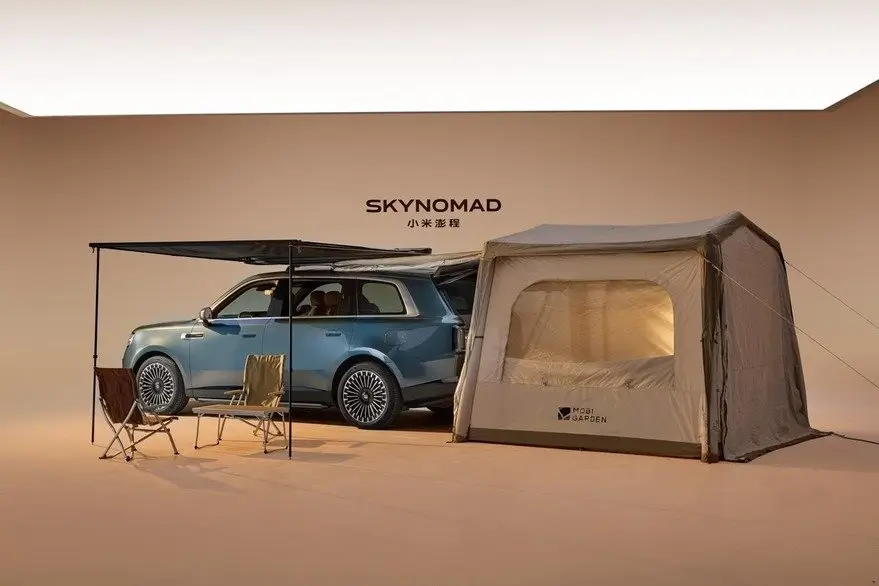
Five years into building cars, Xiaomi has spent most of that time proving it can make a sedan and a crossover that drivers actually want to drive. The SU7 outsold the Tesla Model 3 in China. The YU7 extended that formula into crossover territory. Both are described internally, in founder Lei Jun’s own phrasing, as “the driver’s car.” SkyNomad is Xiaomi’s admission that not everyone wants that. Unveiled through a slow drip of Weibo teasers across July before a full technology launch event on July 30, the new series (known domestically as Xiaomi Pengcheng, or 小米澎程) drops the curved, wind-tunnel-shaped language of the sedan and crossover entirely in favor of something boxier, taller, and built around interior volume rather than a drag coefficient.

Two Cyclists Standing Beside An Open SUV Loaded With Bicycles And Outdoor Gear Along A Mountain Lake
Two models arrived at launch: the five-seat N70 Max and the seven-seat flagship N90 Max. Xiaomi is positioning the pair squarely against Li Auto, the extended-range SUV specialist that has dominated the segment in China, along with Huawei-backed AITO. It’s a notable pivot for a company that built its automotive reputation on pure electric drivetrains. Lei Jun has been candid about why: a boxy, three-row family SUV of this size needs an amount of energy that a battery-only pack would struggle to deliver without becoming impractically large and heavy. Xiaomi’s answer was to build a range-extended platform from the ground up rather than adapt one from the SU7 or YU7.
The timing is pointed. Li Auto, long the category’s default choice, has reportedly seen sales fall by roughly 74 percent year over year in the first four months of 2026, a slide that has opened space for challengers just as Xiaomi decided it was ready to compete on Li Auto’s own turf. The extended-range segment itself has also gotten more crowded in the months leading up to SkyNomad’s debut, with entrants like the XPeng GX and FAW’s upcoming Hongqi P567 chasing similar full-size, three-row territory with their own range-extender hardware. Xiaomi’s advantage, if it has one, is the same one that carried the SU7: a retail and service network built around its phone and appliance business, plus a brand that already has tens of millions of existing customers who trust it enough to buy a car sight unseen off a livestream.
Either SkyNomad rides under the Xiaomi badge or becomes something closer to an independent marque took weeks to settle. Early reporting suggested the vehicles might drop the Xiaomi logo entirely and launch as a standalone brand. Xiaomi’s own Weibo account closed that debate on July 9, clarifying that SkyNomad is “a new series from Xiaomi EV” rather than a spin-off, keeping the badge on the hood while giving the cars their own distinct identity underneath it.
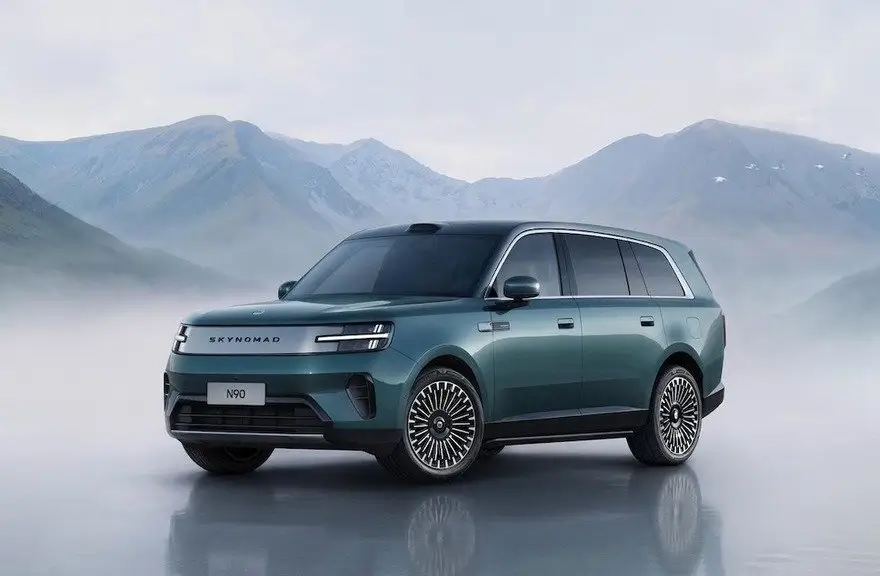
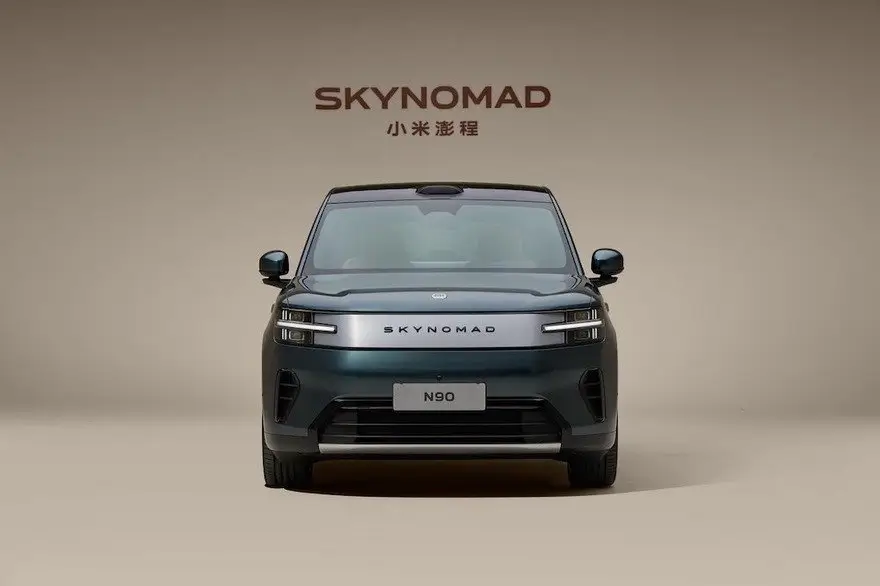
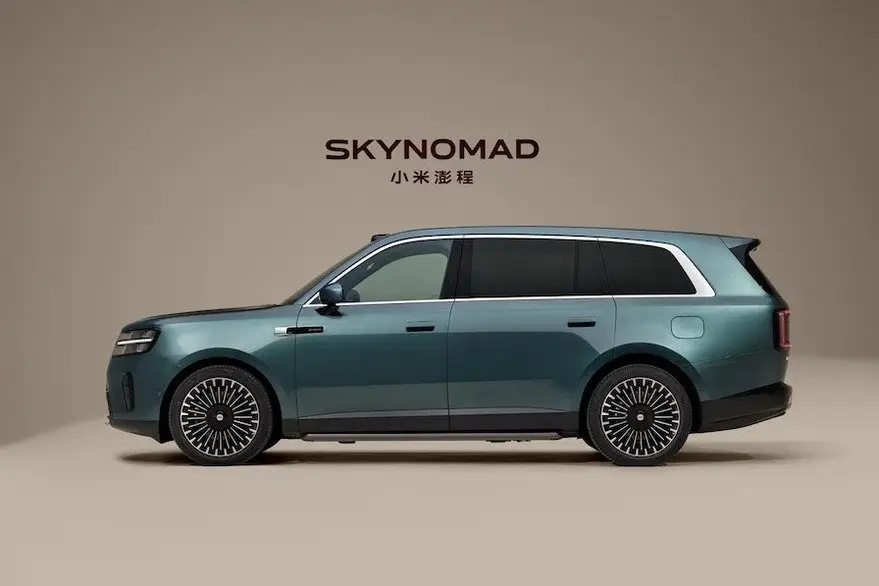
 The SkyNomad N90 Max abandons the SU7 and YU7’s aerodynamic curves for a boxier, more upright silhouette.
arch
Underpinning both SUVs is what Xiaomi calls the Kunlun architecture, a platform the company says it began developing from scratch in early 2023 specifically to solve for reconfigurable interior space rather than performance. The internal project name for the first vehicle built on it was Kunlun N3, and the platform’s defining trait is a completely flat floor paired with a long seat-rail system, roughly 6.2 feet of usable travel, that lets the cabin’s furniture move independently of where the wheels sit.
That’s a deliberate departure from the SU7 and YU7’s design lang. Where those cars chase a low, dynamic profile, the N90 Max is unapologetically upright and slab-sided, stretching over 17.3 feet long with a front fascia that has little in common with the rest of Xiaomi’s lineup. Company messaging has leaned hard into a real-estate metaphor throughout the rollout, describe the SU7 and YU7 as “the driver’s car” and SkyNomad as “an intelligent, transformable, large-space SUV.” It’s a split Xiaomi frame as two different answers to two different kinds of buyers rather than a hedge against uncertainty in the sedan market.
Luxury SUV With A Pop-Up Rooftop Tent And Awning Set Up At A Lakeside Campsite Surrounded By Mountains
flow
Both SUVs run a dual-motor all-wheel-drive layout producing up to 416 hp, enough for a 0-to-62 mph time of 5.9 seconds despite curb weights north of three tons. Top speed is capped at 118 mph. Power comes from a new 1.5-liter turbocharged four-cylinder engine, sourced from Changan subsidiary Harbin Dongang, that Xiaomi says reaches 42 percent thermal efficiency. Critically, that engine never drives the wheels directly. It exists purely as a generator, which is the defining trait of an extended-range electric vehicle, or EREV, as distinct from a conventional plug-in hybrid.
The N70 Max pairs an 11.9-gallon fuel tank with either a 52kWh LFP or 76kWh NMC battery, good for a CLTC-rated 314 miles of pure electric range and 908 miles combined. The seven-seat N90 Max steps up to a 15.9-gallon tank and a 76kWh NMC pack for 288 electric miles and roughly 1,060 miles combined, a figure that has become the headline stat of the whole launch. With the battery depleted, both vehicles return an estimated 37.6 to 38.6 mpg on regular 87-octane gasoline. Battery supply reportedly comes from a mix of CALB and Sunwoda, branded internally as Xiaomi’s Long-Jia pack.
Compute for the driver-assistance suite comes from an Nvidia Thor-U system-on-chip rated at 700 TOPS, feeding a sensor stack that includes a 128-line roof-mounted lidar, a solid-state rear-facing lidar for parking, five mmWave radars, eleven cameras, and twelve ultrasonic sensors. Infotainment runs on a Snapdragon 8 Gen 3 platform. A vehicle-to-load function can output up to 6.6kW to external devices, enough to run power tools or camp equipment directly off the battery pack.
A push-button reconfiguration turns the rear cabin into face-to-face lounge seating or a full-size bed.
Valley Blue, in focus.
A closer look at Xiaomi SkyNomad N70 Max, where this blue shifts and deepens under different light and angles.
Photo credit: GreyWolfe pic.twitter.com/fgHROjk01D
— Xiaomi (@Xiaomi) August 13, 2026
cabin
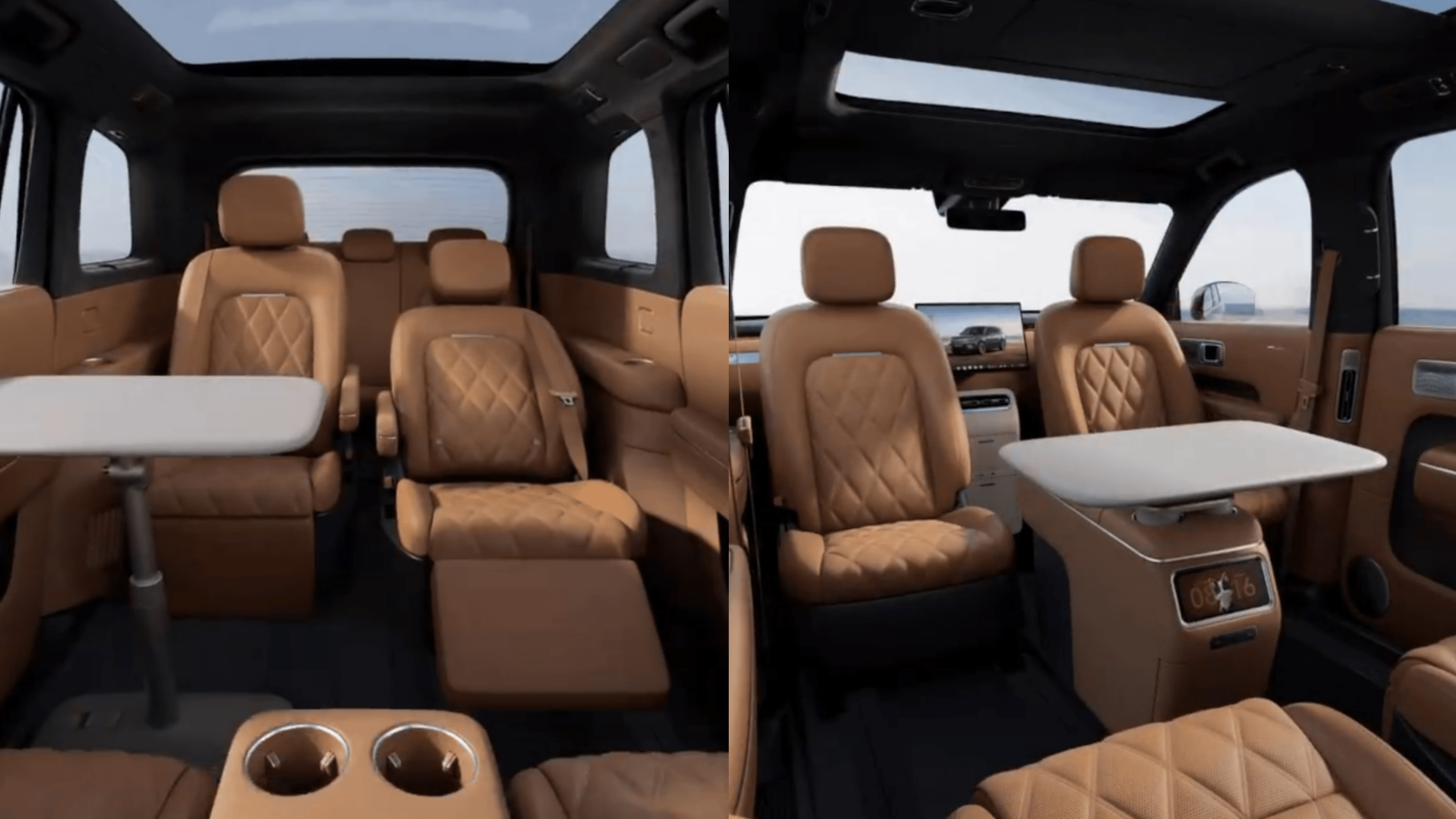
The interior is where SkyNomad makes its actual argument. The N90 Max seats seven in a 2+2+3 layout, but the flat floor and long rails mean that configuration is a starting point rather than a fixed state. At the push of a button, the cabin can shift into face-to-face lounge seating or fold flat into a full-size bed. Xiaomi’s own marketing copy describes the space as capable of becoming “a studio for one, a cafe for two, a meeting room for three, or a play area for the whole family,” and the company has leaned on that line consistently since the first teasers went out in July.
Supporting hardware backs up the pitch: a built-in 2.4-gallon refrigerator, a 21.4-inch rear display, a 25-speaker sound system, and a fold-out table that can turn the second-row area into a genuine dining or work surface. The five-seat N70 Max is more conventional by comparison, measuring 195 inches long and offering up to 64.7 cubic feet of cargo space with the rear seats folded, but it inherits the same flat-floor logic on a smaller scale. Xiaomi has also equipped Max-trim vehicles with powered, reclining second-row captain’s chairs, each with its own ottoman, a detail aimed squarely at buyers cross-shopping business-class-style luxury SUVs from established marques.
Xiaomi has been careful to frame this as an outgrowth of its wider ecosystem strategy rather than a one-off gimmick. The company has spent years building a catalog of connected home appliances, phones, and wearables under one software layer, and SkyNomad’s pitch leans on that same logic: a vehicle that behaves less like a fixed piece of hardware and more like a space that reconfigures itself based on what the people inside it are doing. Company messaging repeatedly stresses that combination of AI, ecosystem integration, and manufacturing scale as the reason Xiaomi believes it can build a reconfigurable cabin that rivals have not attempted at this size. It’s a bigger claim than most automakers make about their own interiors, and one that will be tested the moment reviewers get seat time in a production unit rather than a stage demo.
Xiaomi SkyNomad N90 Interior With Tan Quilted Leather Seats, Folding Tables, Panoramic Roof And Digital Displays
vive
Configure itself based on what the people inside it are doing. Company messaging repeatedly stresses that combination of AI, ecosystem integration, and manufacturing scale as the reason Xiaomi believes it can build a reconfigurable cabin that rivals have not attempted at this size. It’s a bigger claim than most automakers make about their own interiors, and one that will be tested the moment reviewers get seat time in a production unit rather than a stage demo.
out
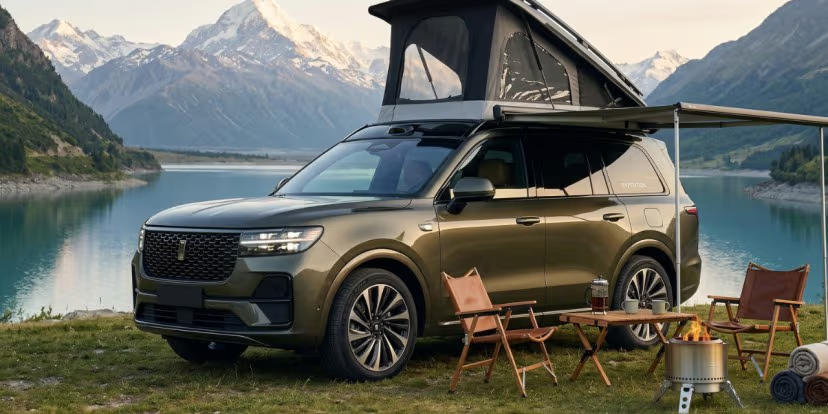
Alongside the standard N90 Max, Xiaomi is offering an N90 Max Camping Edition that adds a pop-up roof tent and a built-in side awning, extending the reconfigurable-space idea outside the vehicle entirely. It’s a feature aimed at China’s fast-growing self-drive camping market, where EREVs in particular have found an audience thanks to the combination of long range, quiet cabin power, and the ability to run appliances off the battery pack without idling a combustion engine all night. The V2L output doubles as a practical camp power source, and the flat-floor cabin can convert into sleeping spa
The reason Xiaomi believes it can build a reconfigurable cabin that rivals have not attempted at this size. It’s a bigger claim than most automakers make about their own interiors, and one that will be tested the moment reviewers get seat time in a production unit rather than a stage demo.
fin
Xiaomi has built what it calls an “Armor Cage” body structure using 2,200MPa ultra-high-strength steel across sixteen key areas, and the N90 Max carries twelve airbags. The Long-Jia battery pack is wrapped in an 18-layer protective structure that Xiaomi says exceeds current Chinese safety standards, and both SUVs are rated to float for up to three minutes in an emergency at a wading depth of 29.5 inches. A dedicated tire-safety system is designed to keep the vehicle stable at speeds up to 99 mph even if tires on both sides suffer a simultaneous blowout, a stat aimed squarely at the kind of high-speed touring buyers this SUV is chasing.
The pricing turned out to be the biggest surprise of the July 30 launch event. Pre-orders opened in China immediately with a refundable deposit equivalent to about $140. The N70 Max starts at roughly $36,200, while the fully loaded N90 Max flagship lands around $41,800, aggressive numbers for vehicles of this size and equipment level, and notably below what most three-row luxury EREV SUVs in the segment have commanded at launch. Chinese deliveries are scheduled to begin in September 2026, with Xiaomi targeting a European launch for the second half of 2027, the same window previously flagged for the company’s first cars sold outside its home market.
That international timeline puts SkyNomad on a slower track than the SU7, which reached Chinese roads well before any serious talk of a European rollout began. Extended-range powertrains remain a much smaller category outside China, with only a handful of models like the Leapmotor C10 REEV and Mazda MX-30 R-EV currently on sale in parts of Europe, which means Xiaomi will effectively be introducing much of the continent to the EREV concept at the s
For a company that built its car business on proving it could out-engineer Tesla on a sedan, SkyNomad is a different kind of bet: that the next phase of growth in Xiaomi’s automotive business depends less on 0-to-60 numbers and more on how many ways a family can rearrange the inside of an SUV before it starts to feel less like a car and more like a room that happens to move
From the DRIFT archive: PANTONE’s 2026 Color of the Year Takes Shape With Play-Doh and Post-It Editions
Related Articles
Four-Fifths of a Giant Killer: Hedley Studios Builds an Electric Porsche 550 J
Porsche opened its archive to a workshop in Bicester. What came back is a two-seat, […]