DRIFT AUDIO
Listen to this story
Choose a voice, then press play.
Fruit of the Loom’s fruit logo has landed on Zara Man’s shelves, in a collection large enough to include the underwear brand’s first pair of shoes.
A pair of canvas shoe with a woven Fruit of the Loom patch on the tongue. A cable knit cardigan with the brand’s fruit basket logo picked out in embroidery at the chest. A striped jacquard necktie, of all things. None of it reads like Fruit of the Loom, the 175 year old Kentucky basics maker whose name usually turns up stitched into the collar of a five dollar white tee. All of it is now live on Zara‘s Man storefront, in a collide that treats a wholesale underwear manufacturer like a menswear label with genuine range.
stir
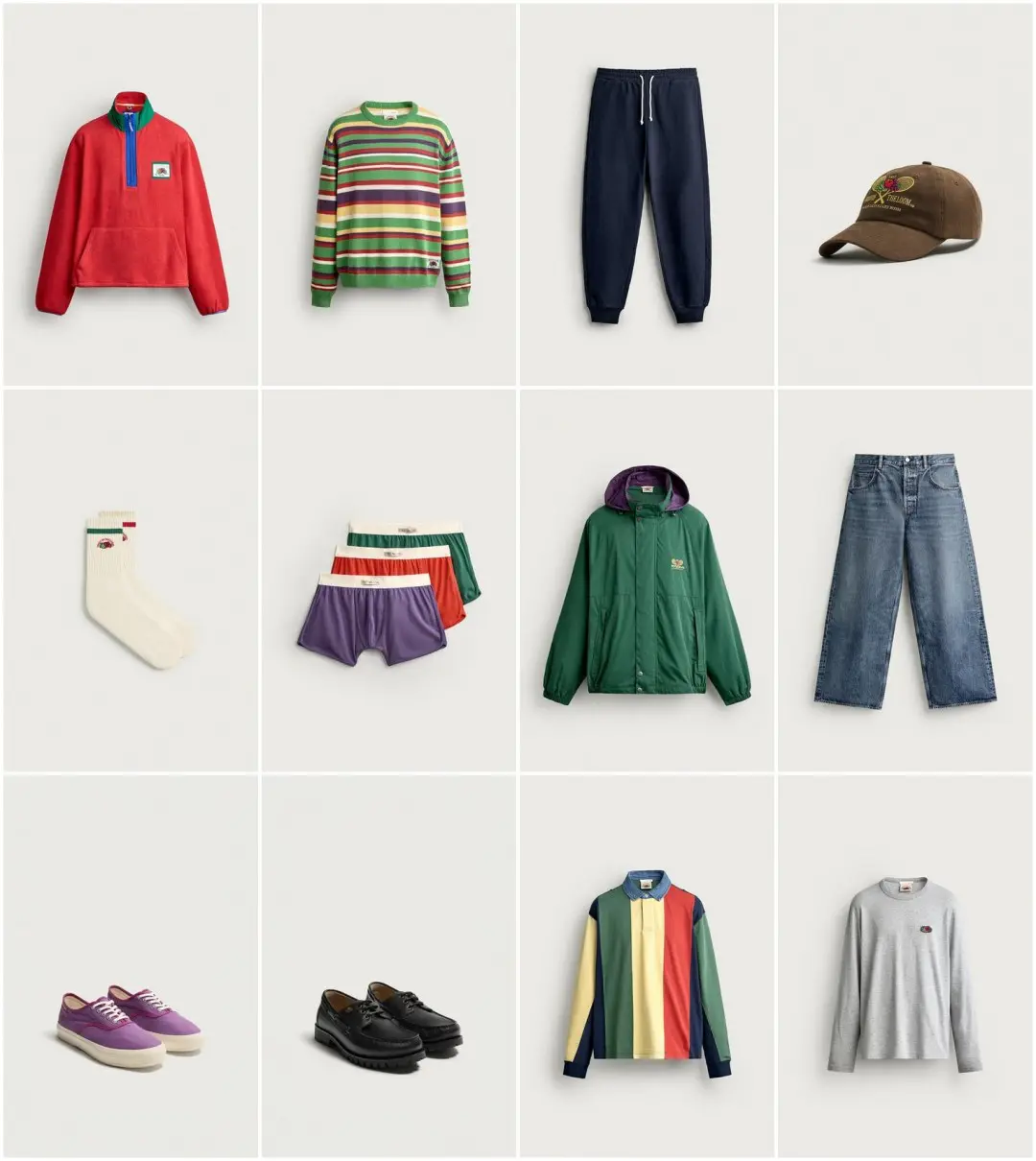
Where past logo collide tend to top out at a Tee and a sweatshirt, this one runs deep. More than 40 styles are listed across the Zara Man x Fruit of the Loom collection page, and the range reads like a full autumn wardrobe rather than a themed drop. There are three jacket options alone: a contrast embroidery jacket at ¥15,990, an embroider cotton jacket at ¥13,590, and a patch contrast denim jacket at ¥17,990, the priciest piece in the lineup. Knitwear runs to several cloth fabric V-neck sweaters and a cable knit cardigan, all sitting at ¥8,590. Shirting covers an embroider denim shirt, two oxford shirts in boxy and striped versions, and a contrast tint striped polo, each also ¥8,590.
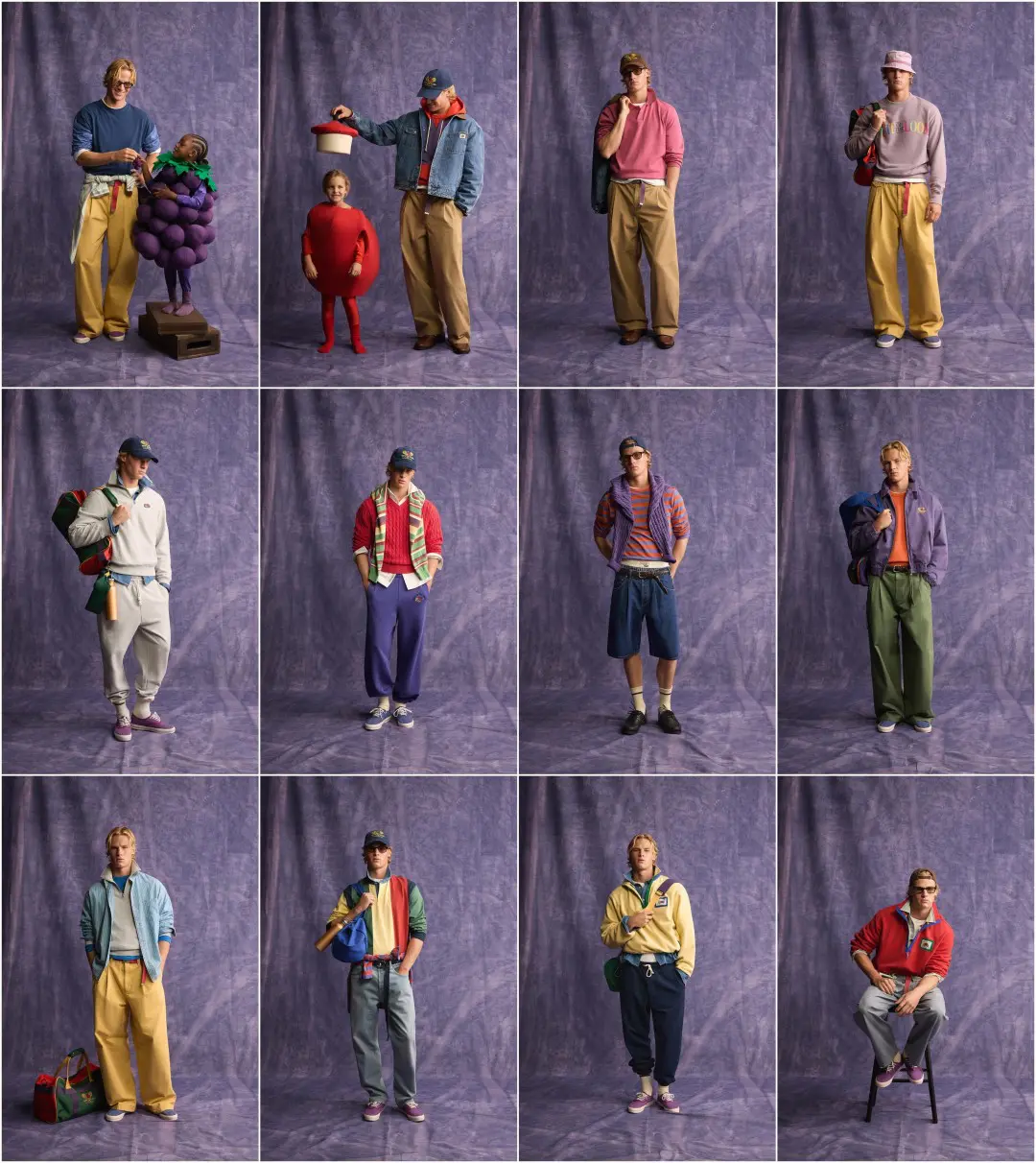
A 12-image lookbook grid featuring a male model in various layer, retro-inspire outfits, including a grape costume and a red tomato costume, all shot against a drape purple backdrop.
Denim shows up in three separate cuts: a baggy fit pair of pants, a baggy fit jean, and a straight fit pair explicitly labeled “Fruit of the Loom x Zara” rather than just carrying the Fruit of the Loom name, all priced at ¥10,990. Pleated chinos join them at the same price point. Sweats and fleece fill out the loungewear side of the range: a zip up sweatshirt, a contrast hoodie, a washed hoodie, a washed text sweatshirt, and a patch fleece sweatshirt, most at ¥8,590, plus sweatpants and cotton jogger pants at ¥7,990. On the Tee table, a graphic tee runs ¥5,290, a two pack of embroider tees comes in at ¥6,590, and a run of patch and tincture block long sleeve tees sit at ¥5,990, several offered across more than one colorway. It is, in short, closer to a full seasonal Zara Man lineup that happens to carry a second logo than it is to a capsule.
new
Worth clarifying up front: nothing in the Fruit of the Loom collection is discounted. Every item on the collection page carries a “NEW” tag rather than a strikethrough price, and the collection went live the same week Zara’s Japan site was separately running its own seasonal “Silver Week” clearance event across the rest of the store, advertising up to 40 percent off unrelated stock. The two promotions sit side by side on the same homepage, which likely explains why the collide reads, at a glance, like it dropped alongside a sale. It did not. Every Fruit of the Loom piece is priced as a full retail new arrival, and the “on sale” framing that follows a story like this out of Japan more accurately translates to “now available” than to any kind of markdown.
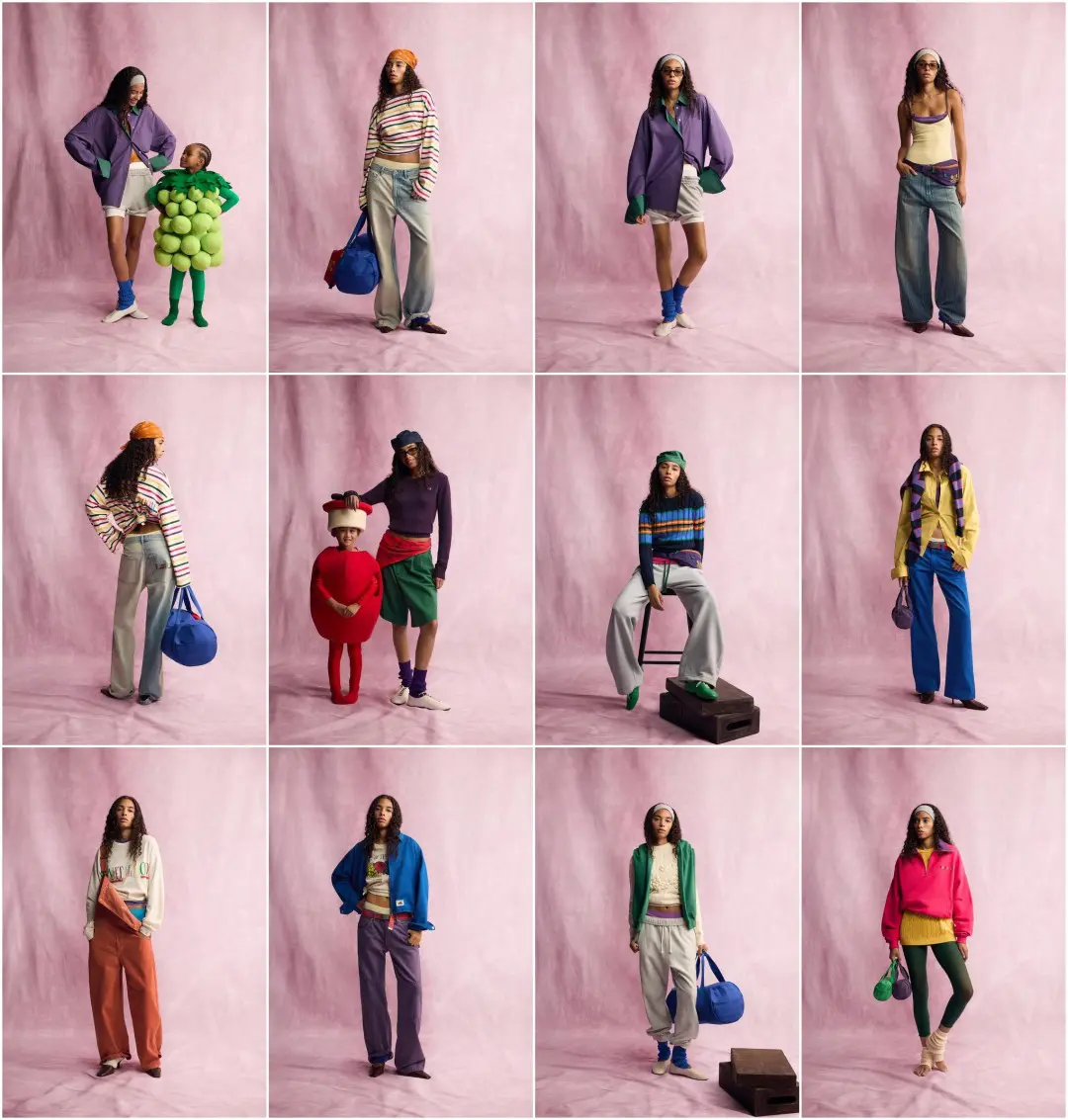
A 12-image lookbook grid featuring a model in a variety of colorful, eclectic outfits and playful costumes, all shot against a consistent draped pink fabric background.
flow
The detail that separates this from a standard logo tie in sits in the shoe and accessories cases. Fruit of the Loom has spent most of its history as a manufacturer of underwear, Tee, and licensed sports gear through subsidiaries like Spalding and Russell Athletic. It has not, as far as any prior collection shows, put its name on footwear. This collection changes that twice over: a fabric sneaker at ¥10,990, offered in at least three colorways, and a leather deck shoe, again co-branded “Fruit of the Loom x Zara,” at ¥14,990. Both sit at the upper end of Zara’s own footwear pricing, well above a typical canvas plimsoll from the mainline collection, and the leather deck shoe in particular puts Fruit of the Loom’s name on a category of shoe it has never so much as license before, let alone designed.
It would not be the first time a designer’s Zara tie in doubled as a first outing in shoes. London designer Aaron Esh’s own recent Zara collection marked his own footwear debut too, a milestone Zara has now handed to a company that had never designed a shoe of any kind before this collection. The rest of the accessor case leans into a prep school reference point that the product copy on Zara’s own Japan storefront makes explicit, describing the collection as translating the brand’s decades of heritage and cultural recognition into a modern fashion context, built around a strong 90s preppy attitude. That shows up in a striped jacquard tie at ¥8,590, a travel bag at ¥14,990, two washed cap options at ¥5,290, and a two pack of ribbed socks at ¥4,390, the cheapest item in the collection.
scope
Fruit of the Loom did not land on an empty shelf. Zara Man runs a standing “Collabs” section on its own site, and Fruit of the Loom now sits alongside a growing roster of names that would look odd next to each other outside a Zara storefront. Aaron Levine, the Ohio based designer behind stints at Abercrombie, Club Monaco, and Madewell, released his second Zara collection in April 2026, a full range of outerwear, knits, shoes, and even a fragrance built, in his own description, around making good design available at scale. FIFA Classics, a 23 piece capsule built around five past World Cups (Mexico 1970, Italy 1990, USA 1994, France 1998, and England 1966), followed a few weeks later timed to this year’s tournament. FIFA Classics arrived with a full styled campaign shot on location and fronted by two named models, the kind of production a shh Japan storefront listing like this one is unlikely to get. A collide with Ofr., the Paris concept bookshop, is reportedly next on the calendar. Against that backdrop, a Kentucky underwear manufacturer earning its own shoe line reads less like a fluke and more like Zara working its way down a list. The habit is not confined to Zara alone. Its own Paris Fashion Week pop-up earlier this year gathered fifty separate collaborators under one roof, curated by Sarah Andelman, around the same time Inditex secured former Dior and Maison Margiela creative director John Galliano for a two-year design partnership. Sister chain Massimo Dutti has run its own parallel “Art in Progress” and “Limited Edition” initiatives, pairing store openings with commissioned artists and collaborators across design, food, and culture. Against a roster that already includes Galliano at one end, a Kentucky underwear manufacturer at the other is less a departure for the group than a demonstration of how wide the net has gotten.
View this post on Instagram
vent
Zara and Fruit of the Loom have done this before, though the two collections have little in common beyond the fruit logo. Their first joint capsule launched in May 2021 as a women’s only line built around loungewear: round and V-neck Tee, ribbed sweatshirts, matching shorts and sweatpants, and a bralette and panty set, all in neon pink, chartreuse, and lemon yellow. Fruit of the Loom’s own vice president of brand communications at the time, Karen Kendrick, called it a tribute to the fun, optimistic spirit of the brand’s 80s and 90s logo. That collection topped out around $49.90 in the US and £27.99 in the UK.
The new collection shares almost nothing with it beyond the name. It sits under Zara Man rather than Zara Woman, skews toward tailored and outerwear pieces rather than loungewear, and swaps neon for a more restrained palette built around denim, cream, and washed neutrals. Whether this menswear edition is rolling out beyond Zara’s Japan storefront could not be independent confirm at the time of writing. Zara typically stages collection launches across regions on a roll basis, and no press coverage outside Japan had surfaced yet.
extend
The Zara tie in lands in the middle of a busier stretch for Fruit of the Loom’s brand partnerships than the label has had in years. In May 2026, the company announced Fresh Collection, a new apparel line aimed at Gen Z women navigate what the brand called the transit market between youth departments and adult intimates. Around the same window, Fruit of the Loom’s own newsroom logged a tie up with Lefties, the off price retail chain that, like Zara, sits under Spanish parent company Inditex, positioned as a joint push on comfort, quality, and affordable underwear and casualwear. A separate limited edition collision with dessert brand Milk Bar, pairing sweatshirts with custom sweets, rounded out a run of collaborations that reads less like a single marketing moment and more like a deliberate strategy shift for a company that has spent most of its modern life as a wholesale basics supplier rather than a runway name.
That the Zara collect lands specific under Zara Man, and specific with footwear attached, suggests Fruit of the Loom is testing how far a basics brand’s name can stretch into fashion retail before it stops reading as a basics brand at all.
two
On paper, the two names in this collaboration could not come from more different corners of the apparel industry. Zara was found in 1975 by Amancio Ortega in the Spanish coastal city of A Coruña and grew into the flagship of Inditex, the fast fashion conglomerate that also owns Massimo Dutti, Bershka, and Lefties. Fruit of the Loom traces back to 1851, when brothers Benjamin and Robert Knight opened a textile mill in Warwick, Rhode Island, under the name B.B. and R. Knight Corporation, decades before the fruit basket logo that gives the company its current name existed. That logo, incidentally, has never included a cornucopia, despite a persistent public misremembering that the brand’s own official account has ribbed people about online.
The brand spent the late 1990s in serious financial trouble, filing for Chapter 11 bankruptcy protection in 1999 after a loss exceeding $576 million, before Warren Buffett’s Berkshire Hathaway bought it out of bankruptcy in 2002 for roughly $835 million. Under Berkshire’s ownership, Fruit of the Loom went on to acquire Russell Corporation in 2006 and Vanity Fair’s intimates business in 2007, building the wholesale sportswear and underwear empire that now backs a company suddenly interested in embroidered varsity jackets and leather deck shoes. That empire is also, quietly, one of the reasons the fruit logo still reads as nostalgic to anyone who grew up in the 1990s: a Fruit of the Loom tag has spent decades on the inside of more T-shirts, gym uniforms, and printed event giveaways than almost any other name in American clothing, without most of the people wearing it ever thinking of it as a brand with its own storefront amb.
That gap, between a 175 year old survivor of a 1990s bankruptcy and a fast fashion retailer that opened its first store the same decade Fruit of the Loom’s founders would have recognized as modern, is most of what makes a collection like this worth a second look. It is not two streetwear labels trading fan bases. It is a company that has spent a century and a half making the clothes underneath everything else, put, for the first time, on the outside, and, for the first time ever, on the feet as well.
Related Articles
Nubian Put Distressed Cotton Jersey On Needles Track
20th Exclusive Vol.7. Needles. Four shapes. Black and grey. 19 September 2026. All NUBIAN doors […]