

DRIFT AUDIO
Listen to this story
Choose a voice, then press play.
SRPLS built its name on cargo pockets and camel canvas. Its newest capsule, FLWRS, hands that same wardrobe a field of washed florals instead.
On July 27, Zara quietly swapped one of its most consistent view vocab for something softer. SRPLS, the retailer’s elevated sub-line, has spent the better part of a decade rebuilding military surplus and workwear staples in nicer fabric. Its new capsule, called FLWRS, keeps the chore jackets and barrel-leg trousers but douses them in washed floral print, running from clear blush and white through diffused stone and sun-yellowed canvas by the end of the range.
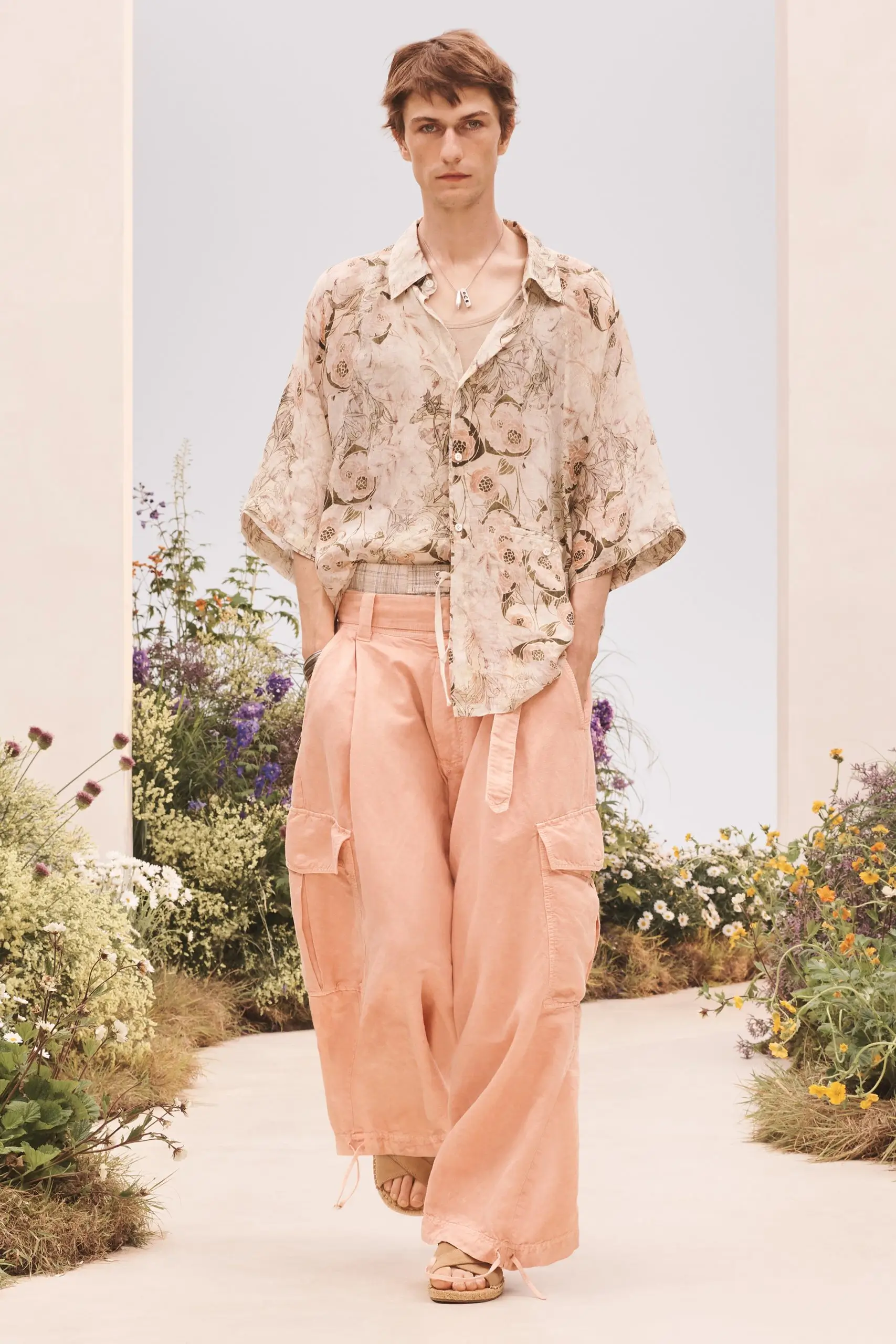
The latest Zara SRPLS collection reimagines workwear through washed fabrics, botanical prints, and relaxed proportions, presenting the label’s signature utilitarian aesthetic in a softer, garden-inspired seasonal wardrobe.
The shift is more pointed than it sounds. SRPLS has always operated by addition, taking a recognizable utilitarian shape and refining the fabric, the finish, the proportion. FLWRS is the first time the label has reached for a pattern this loud and this soft at once. A khaki chore coat next to a floral popover shirt reads less like a uniform and more like something pulled out of a countryside guesthouse closet. Zara is framing the pairing directly, describing the capsule’s aim as proving that practicality and femininity can share a rack without either one losing ground.
View this post on Instagram
It is worth sitting with how unusual that framing is for this specific label. SRPLS has spent its existence proving that restraint sells, that a customer will pay a premium for a trench coat or a pair of trousers simply because the fabric and finish are better than what sits one floor down in the mainline. Print, especially a print this soft and this romantic, was never part of that pitch. FLWRS asks the same customer to want something for a different reason entirely.
stir
The capsule spans womenswear, menswear, and kidswear, and each line reworks the same starting material differently. Menswear stays closest to SRPLS’s established territory: relaxed cargo trousers, chore jackets, button shirts, and lightweight knitwear, all pulled through dusty colorways with restrained floral print rather than an all over pattern. The florals here read more like a texture than a statement, tucked into a shirt collar or a jacket lining rather than splashed across a full silhouette.
Womenswear pushes further into the romantic register the collection is built around. Overshirts, workwear trousers, dresses, and light outerwear appear in muted pastels, with the line’s centerpiece pieces including a robe style slip dress, poplin blouses, and floral culottes. Swimwear also earned a place in the lineup, including a matching bikini set that pairs with a sheer cover piece, a rare crossover for a line that has historically stayed in dry goods. Bermuda shorts, maxi sundresses, and warm weather jackets round out a range built to move from a desk to a departure lounge without a costume change in between.
Kidswear rounds out the release with the same washed floral treatment scaled down, mixed with delicate stripes and gentle pastel shades across soft natural fabrics, aimed less at replicating the adult silhouettes exactly and more at carrying the same palette and material logic into smaller sizes.
Barrel-leg trousers with a high, deep pleated waist show up across nearly every look in the men’s and women’s lines, functioning as the connective tissue between FLWRS and prior SRPLS drops. So does the label’s now familiar trick of aging a garment before it ever reaches a hanger: camel trench coats and linen suiting arrive pre-softened, with slack shoulders and drawstring waists standing in for tailored structure. A belted cotton trench in camel sits close in tone to the balloon trouser worn beneath it, so close the two nearly read as one column of faded cloth rather than two separate pieces.
FLWRS is live now at Zara.com and in select stores worldwide.
idea
What separates FLWRS from a straightforward floral print job is how deliberately worn in everything looks straight out of the box. Most collections argue their case through cut alone. This one treats the cut as settled and spends its effort on surface instead, staging garments that arrive already sun faded, softened, and broken in before a single wear.
The tincture story stages its own aging process across the range, opening with clear blush and white in the earliest looks and drifting toward diffused stone, washed khaki, and sun yellowed canvas by the end, as though the clothes have quietly spent a season outdoors before landing on the rack. The linen suiting carries that same idea into tailoring, dropping any lined structure in the shoulder and replacing a fitted waist with a drawstring, so the garment behaves like something already lived in rather than something waiting to be broken in by its owner.
That approach lines up with what SRPLS has built its reputation on since 2018: tactile natural fabrics, restrained detailing, and finishes that reward a second look rather than a first impression from ten feet away.
View this post on Instagram
style
Zara brought in stylist Karl Templer to shape the campaign, and his fingerprints are on the collection’s central idea: that practicality and femininity are not opposing forces. Templer, whose past work spans campaigns and shows for Calvin Klein, Valentino, and Sacai, staged the shoot on a catwalk filled with real wildflowers, a literal staging of the floral concept that runs through every piece in the capsule.
That pairing, a workwear label known for restraint working with a stylist known for softer, more expressive imagery, explains why FLWRS reads differently from anything SRPLS has released before. Earlier collections leaned on buckles, cargo pockets, and barrel-leg bottoms in neutral tones. This one keeps the sil but changes almost everything about the surface, and Templer’s involvement is the clearest signal that the shift in direction was intentional rather than incidental.
Templer’s background is worth noting for what it is not: he is not a workwear specialist by trade. His resume sits closer to runway and campaign styling for houses built around movement, drape, and a certain kind of control softness. Putting him in charge of a utilitarian capsule’s first floral outing reads as a deliberate mismatch, one meant to pull the collection somewhere it has not gone before rather than deepen a lane it already occupies.
term
SRPLS launched in 2018 as a limited, experimental corner of Zara’s mainline offering, built around military uniforms, workwear, and functional dressing reworked in refined fabrics. The label has released on a bi-annual schedule since, with each drop nudging the formula in a slightly different direction. Spring 2024 leaned into buckled, structured cargo pieces built around barrel-leg bottoms, tank tops, and shirtdresses. Spring 2025 went looser and more bohemian, adding oversized ponchos, drawstring skirts, and linen button-downs to the rotation.
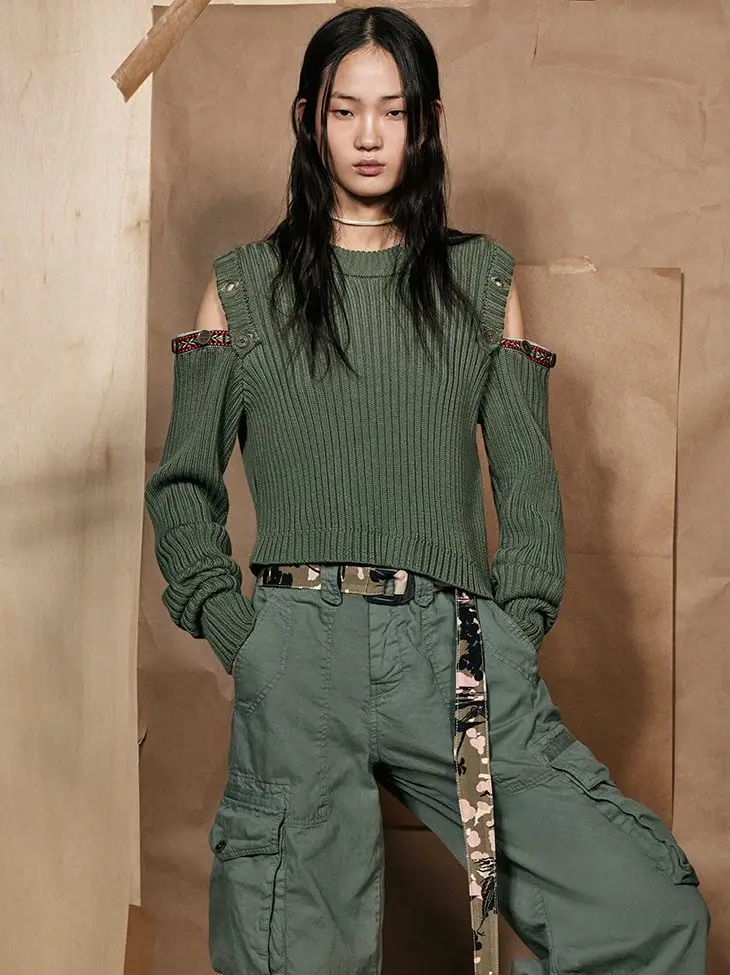
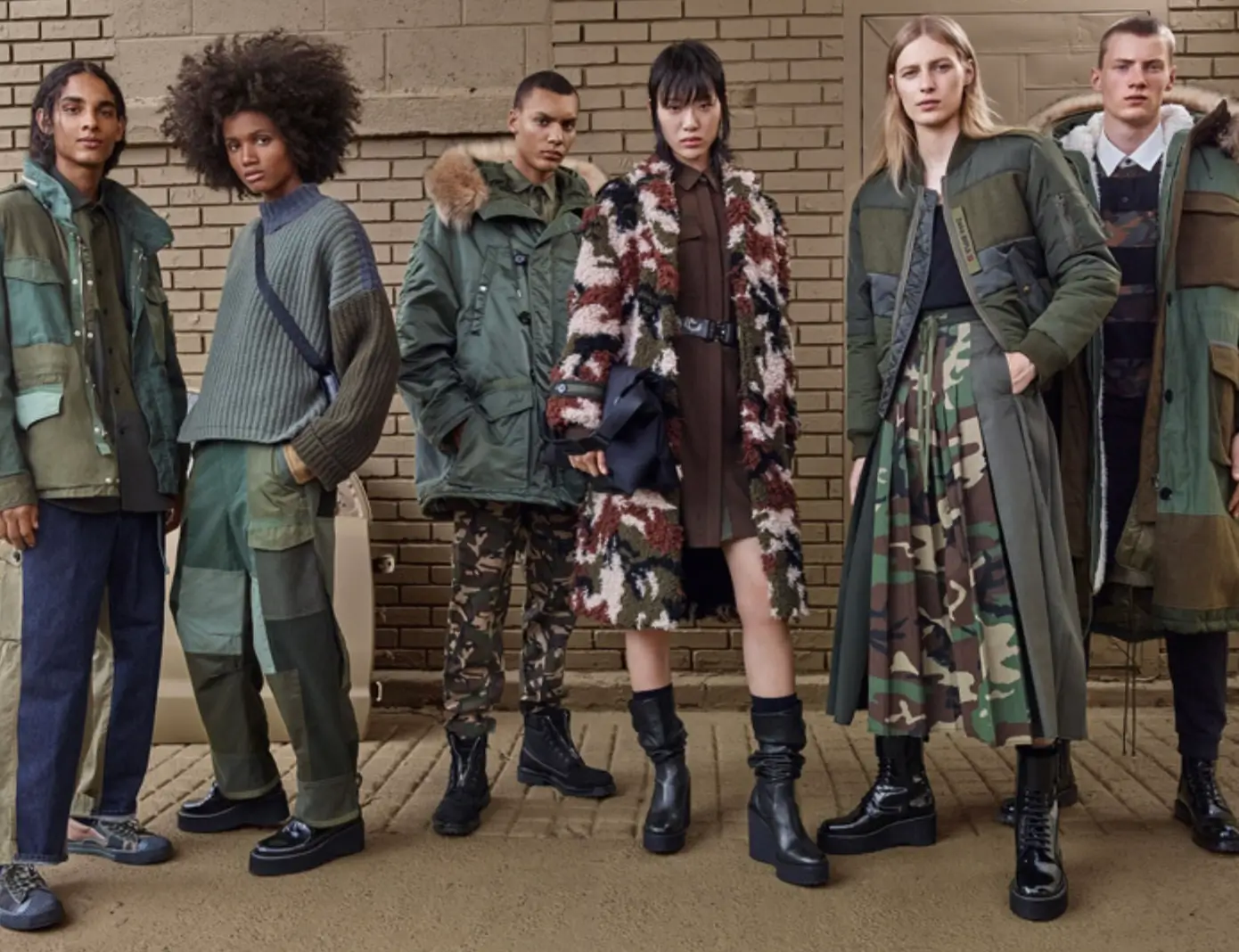
The Zara SRPLS collection continues its military-inspired direction with an olive ribbed knit featuring cutout shoulders, paired with relaxed cargo trousers and camouflage accents that balance utility with contemporary styling.
FLWRS breaks that pattern more visibly than either of those seasons did. Where past collections varied proportion and texture within a narrow, neutral palette, this one introduces color and print as the headline change, while keeping the underlying workwear shapes intact. It is the label’s first major foray into floral territory, even though Zara’s broader collections have carried botanical prints for years. The distinction matters: SRPLS has always positioned itself apart from the mainline’s faster trend cycles, and a floral print is exactly the kind of seasonal, trend-adjacent move the sub-label has avoided until now.
The most recent numbered edition, Collection 16, arrived earlier this year under the working name CLLCTN 16, with a first drop in April built around a broader color palette, tonal transitions, and washed finishes across trousers, structured tops, dresses, and skirts. FLWRS effectively picks up where that drop left off, narrowing the focus from a wide seasonal palette down to a single, specific idea: florals, aged into the fabric rather than printed flat on top of it.
fit
FLWRS also lands at a moment when SRPLS carries more commercial weight than its original “limited, experimental” framing suggests. The line has grown into a meaningful contributor to Inditex’s premium positioning, part of a broader push the group has described as leaning into elevated utility and material consistency over trend driven turnover. Inditex, Zara’s parent company, reported a revenue increase to 39.9 billion euros in 2025, with premium sub-brands feeding into gross margins that now sit above 58 percent. The group has also earmarked significant capital spending for 2026, aimed largely at commercial space and technology rather than any single product line, but the broader investment signals a company treating its premium tier as a durable growth lever rather than a side project.
Zara itself, together with Zara Home and Lefties, posted turnover just above 28 billion euros in its last financial year, up close to one percent on the year before. Against that backdrop, a sub-label built on repeat customers paying more for better fabric is a rounding error in dollar terms but a meaningful signal in strategic ones: Inditex is betting that shoppers will keep returning to SRPLS specifically because it does not chase every trend the mainline does.
None of that changes what’s actually hanging in stores this week. What FLWRS represents, more than a fiscal data point, is a workwear label deciding that its next chapter doesn’t need to look tough to still feel considered.
impression
Early coverage out of the fashion press has leaned enthusiastic, with outlets describing the capsule as a genuine departure rather than a seasonal refresh, and singling out the barrel-leg trousers and floral dresses as the pieces most likely to move fast. The swimwear addition in particular has drawn attention as a first for the label, expanding SRPLS beyond the dry goods territory it has occupied since 2018.
Trade coverage has framed the broader SRPLS expansion in blunter commercial terms, describing the line’s growth from an experimental capsule into what one report called a genuine bridge between fast fashion pricing and a luxury streetwear sensible.
n
From the DRIFT archive: Y-3 Sets the Tone for Its Spring/Summer 2026 Collection
Related Articles
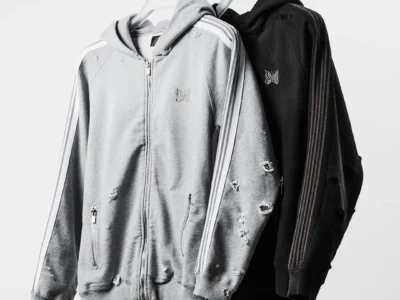
Nubian Put Distressed Cotton Jersey On Needles Track
20th Exclusive Vol.7. Needles. Four shapes. Black and grey. 19 September 2026. All NUBIAN doors […]