DRIFT AUDIO
Listen to this story
Choose a voice, then press play.
Linder Sterling’s photomontages arrive at Chanel Nexus Hall Tokyo, tracing punk’s most enduring collage practice from 1977 to now.
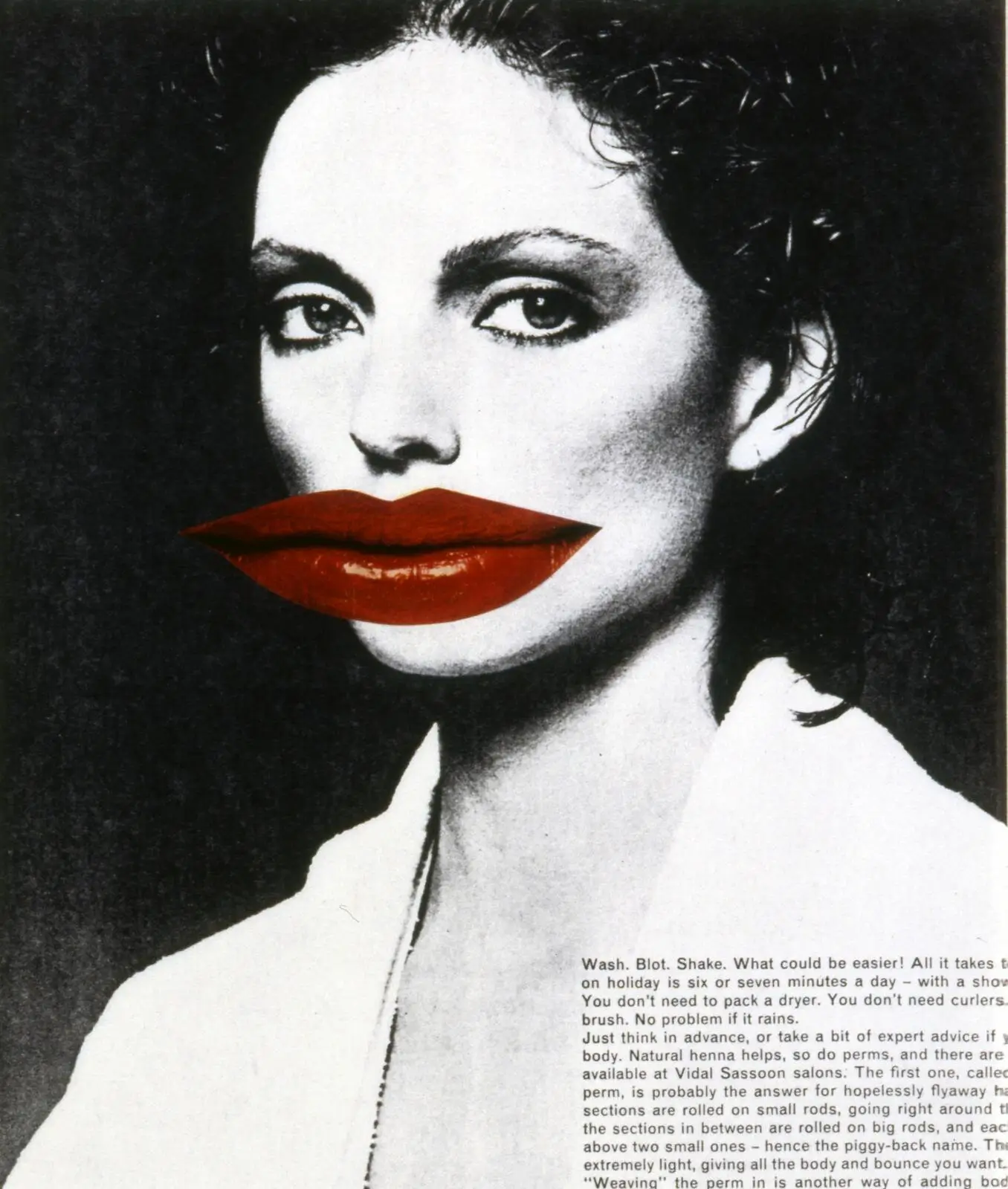
Two photomontages anchor the material sent over for this piece, and they make an odd, telling pair. The first, simply titled Untitled and dated 1979, is credited to the artist and the London gallery Modern Art, which has represented Linder Sterling for years. The second is The Principle of Totality, a 2012 piece built from forty five monochrome portraits, each one overlaid with a single vivid, lipsticked mouth. Reviewers who have stood in front of it describe how the red mouth pulls the eye straight to that one feature of an otherwise quiet, grey face, over and over, forty five times in a row. One writer covering Linder’s recent Hayward Gallery retrospective noted that the piece functions almost like a chorus line of stares, each mouth doing the same job of dragging attention away from everything else the portrait might say about the person underneath it.
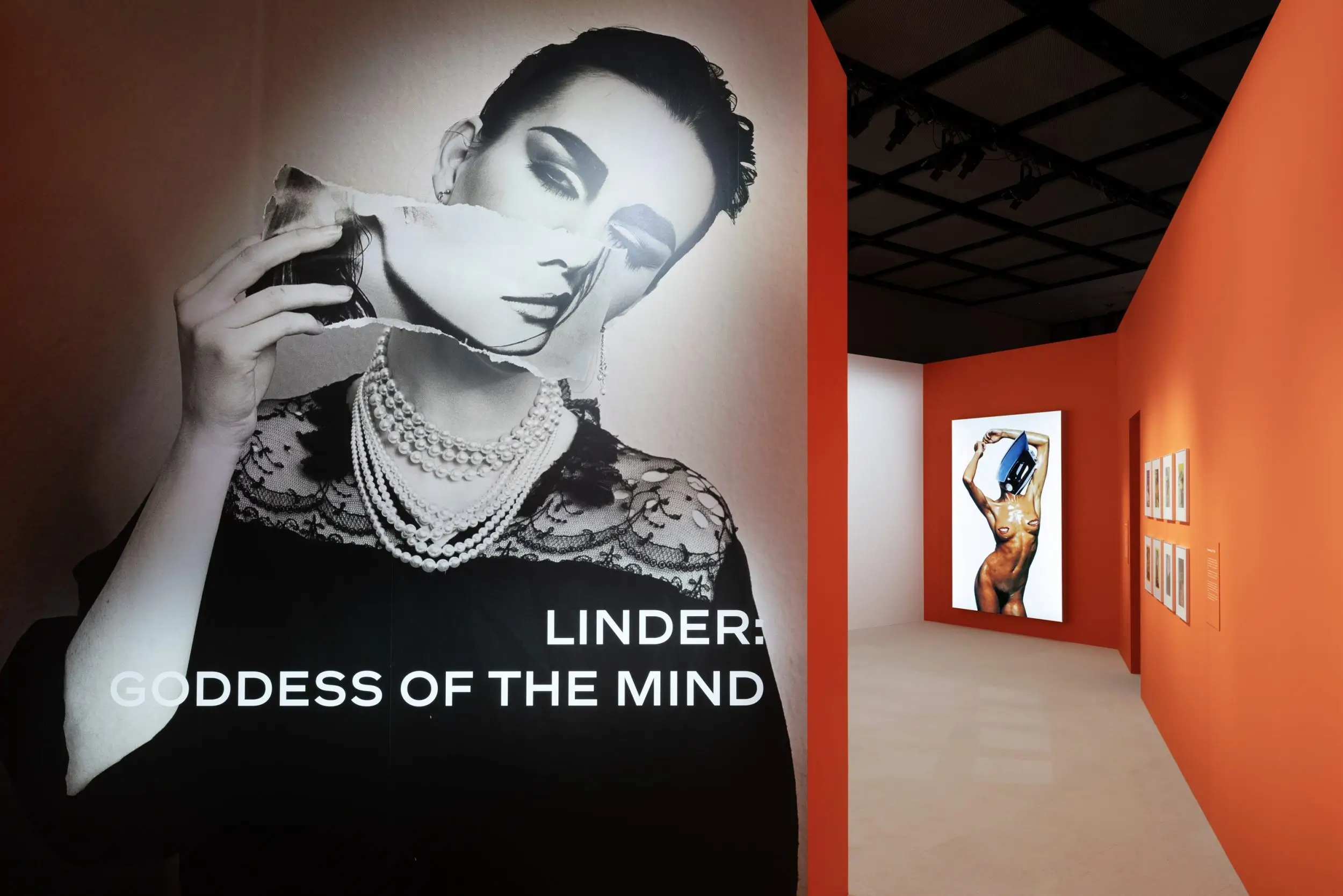
Visitors enter LINDER: GODDESS OF THE MIND through a dramatic installation that pairs the artist’s signature photomontage aesthetic with bold gallery architecture, introducing an exhibition devoted to collage, identity, fashion, and feminist visual culture.
Placed together, the two works do something the rest of Linder’s catalogue has been doing since the mid 1970s. They take an image of a face or a body, most often lifted from somewhere it was never meant to be looked at this closely, and add one deliberate intrusion. Sometimes that intrusion is a household object standing in for a head. Sometimes, as with The Principle of Totality, it is nothing more than a mouth, painted the color a magazine advertisement would have used to sell lipstick in the first place. The effect described by nearly everyone who writes about Linder’s work is the same word repeated in different phrasing: unsettling, but also, somehow, very funny. One recent review went as far as calling the recurring lips and grinning teeth across her catalogue a kind of signature, as identifiable in a room full of other artists’ work as a scalpel mark left on paper.
stir
Linder was born Linda Mulvey in Liverpool in 1954 and studied graphic design at what was then Manchester Polytechnic through the mid 1970s, a year above the designers Peter Saville and Malcolm Garrett, both of whom would go on to shape the look of British post punk record sleeves almost as much as the bands themselves did. It was Garrett who, in 1977, used a photomontage Linder had made for the sleeve of the Buzzcocks single “Orgasm Addict,” a collage of a naked female torso topped with a clothes iron in place of a head, with two wide, grinning mouths pasted where the nipples would be. Linder has said she still has not revealed whose photograph she originally cut up for that piece, and has told her son the identity can only be released after she dies.
That single sleeve became one of the most reproduced images to come out of British punk, sitting now in the permanent collections of the Museum of Modern Art in New York and the Victoria and Albert Museum in London among others. It also set the method Linder has returned to for the better part of five decades: take a photograph out of a context where a woman’s body was meant to be looked at without complaint, most often torn from pornography or from the domestic and fashion pages of women’s magazines, and interrupt it with an object, a texture, or a second image that forces a different kind of looking. A fanzine she produced with the writer Jon Savage around the same period, titled The Secret Public, worked through the same idea in print form before the photomontages themselves found their way into galleries.
Manchester in those years was a small enough scene that everyone seemed to know everyone. Garrett and Saville went on to define the visual identity of labels and bands well beyond Buzzcocks, and Linder’s own circle overlapped with Howard Devoto of Buzzcocks and later Magazine, and eventually with a young Morrissey, who has been described more than once as one of her closest early friends. That density of connection meant a single record sleeve traveled much further and much faster than a gallery show could have on its own, reaching teenagers who bought the single for the music and kept the cover pinned to a wall for years afterward.
flow
The 1979 Untitled piece and later works like The Principle of Totality extend that same source material into new arrangements decades apart, and the family resemblance between them is exactly the point. A 2026 review of Linder’s touring retrospective pointed out that The Principle of Totality reprises, almost line for line, the body built from a clothes iron and grinning mouths that first appeared in her 1977 work, a deliberate echo across thirty five years of practice rather than a coincidence of style. Linder has spoken about working from magazine cutouts she keeps stored in boxes in her studio, a personal archive of decades of glossy pages waiting to be reassembled, and about listening to Indian drone music while she works with a Swann Morton surgical scalpel, the same brand of blade she has used since she began cutting images apart in the mid 1970s.
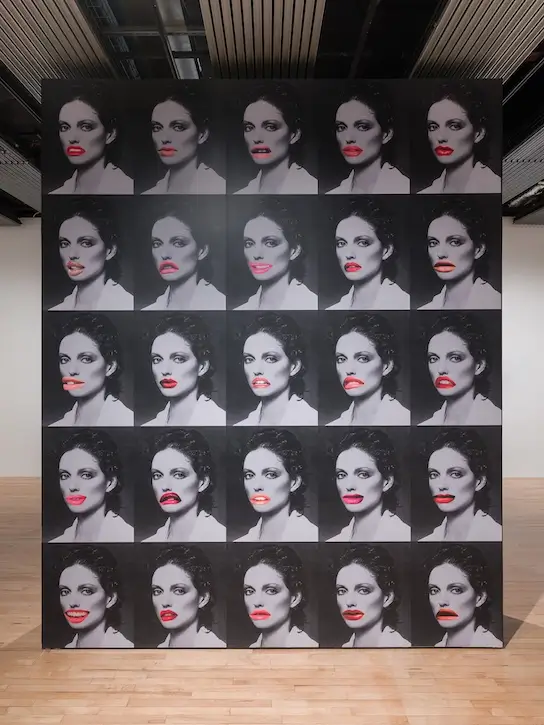
The monumental Danger Came Smiling installation repeats a single portrait across a large grid, transforming each image with a distinct pair of vivid red lips to examine beauty, identity, mass media, and the language of photomontage.
What keeps the work from reading as a single repeated gag across fifty years is how differently each series treats its source. Early pieces like the Buzzcocks cover and other 1970s work pull directly from pornography and domestic advertising, blunt and confrontational in a way that matched the punk scene she was moving through. Later series bring in ballet annuals, botanical illustrations, and fashion plates instead, softer material handled with the same scalpel but toward quieter, more surreal ends. The Principle of Totality sits closer to the earlier register, its repetition of the same red mouth across forty five faces feeling almost industrial, like a production line for a single expression rather than forty five individual women.
straddle
For a long stretch of her career, Linder was known as much for music as for anything hung on a wall. In 1978 she formed the band Ludus, later joined by Ian Devine, and became a fixture of the same Manchester scene that produced Joy Division and The Fall. A 1982 performance at Manchester’s Haçienda club has taken on a life of its own in the retelling: Linder took the stage in a dress fashioned from raw meat, a dildo visible beneath it, a direct jab at the club’s habit of running pornographic films as background entertainment for its mostly male crowd. The look predated a similar, far more famous meat dress by roughly three decades, a coincidence that gets mentioned in almost every recent piece written about her.
Ludus disbanded acrimoniously not long after, but the label the band recorded for, the Manchester imprint New Hormones and later the Belgian label Les Disques du Crepuscule, kept her name circulating well outside the gallery system long before institutions caught up to her. She did not stop performing when the photomontage work moved into museums either; a new performance piece has become a regular feature of her larger exhibitions in recent years, continuing a practice she has described as pulling her out of the solitary, silent work of cutting images apart at a desk.
retro
The material behind this piece traces back to Linder’s first full scale retrospective, Danger Came Smiling, which opened at London’s Hayward Gallery in February 2025 alongside a concurrent show by the American artist Mickalene Thomas. Curated by the Hayward’s Rachel Thomas, the exhibition gathered fifty years of photomontage, drawing, performance documentation, and installation work into one set of galleries, with The Principle of Totality serving as something close to a signature image for the whole survey. From London the show moved on through further UK venues, including a version reworked for Blackpool’s Grundy Art Gallery that folded in local material, among it drawings by the painter L.S. Lowry and botanical models drawn from the Grundy’s own collection, alongside Linder’s own photomontages.
Earlier surveys had already tested the format. A 2022 exhibition titled Linderism at Kettle’s Yard in Cambridge, developed with the curator Amy Tobin, was billed as the first UK survey of her career and took over both the gallery and the adjoining modernist house, pairing her photomontages with sound work produced by her son, the composer Maxwell Sterling. That show, along with a string of solo exhibitions at institutions including Nottingham Contemporary, the Kestnergesellschaft in Hanover, and the Musée d’Art Moderne de Paris, helped build the case for the larger Hayward retrospective that followed a few years later. Her work has also turned up in group exhibitions at Tate Modern, Tate Britain, MoMA PS1 in New York, and the Museum of Contemporary Art Chicago, a spread that reflects how thoroughly institutions on both sides of the Atlantic have folded her into the wider history of feminist and punk era art over the past two decades.
fin
The current chapter of that touring history is the one most relevant here. Titled Linder: Goddess of the Mind, the exhibition first opened at the Museum of Kyoto Annex during the KYOTOGRAPHIE photography festival in the spring of 2026, marking Linder’s first major exhibition in Japan. KYOTOGRAPHIE has spent more than a decade turning Kyoto’s temples, machiya townhouses, and museum spaces into venues for international photography each spring, and an artist whose entire practice runs through the photographic image made a natural fit for a festival built on exactly that medium. From Kyoto the show has since moved to Chanel Nexus Hall in Tokyo’s Ginza district, running from late June through mid August 2026 with free admission. Chanel Nexus Hall has operated inside the Chanel Ginza Building since 2004, hosting a rotating program of music and art exhibitions under the label’s own cultural arm, and the Linder show was developed there in close connection with the artist rather than assembled purely from existing loans.
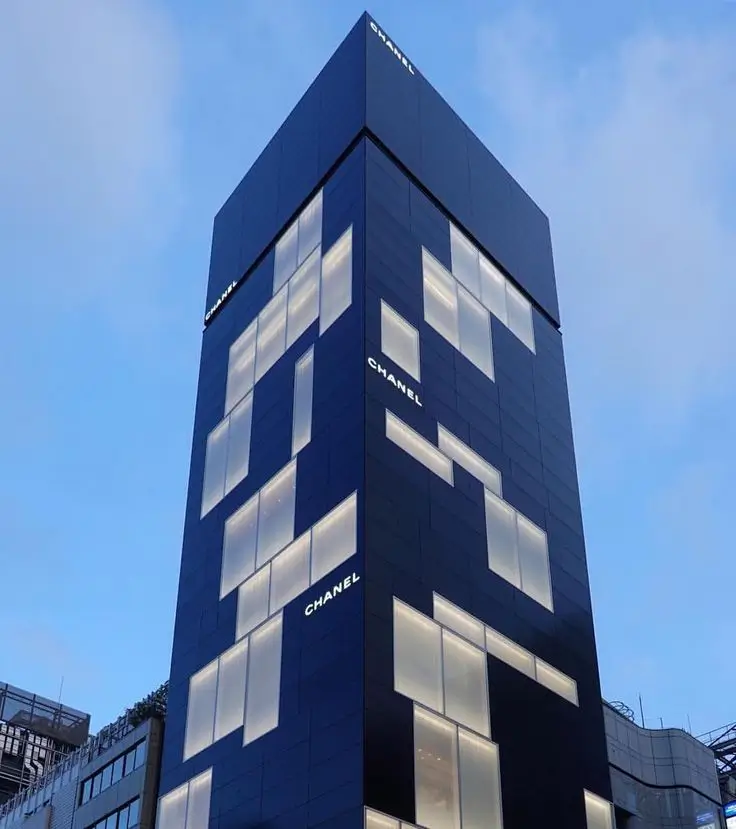
The surreal editorial image combines a striking black-and-white portrait with an oversized pair of vivid red lips, creating a bold pop art-inspired composition that plays with beauty, fashion, and visual illusion.
Bringing Linder’s work to Japan for the first time through a festival built specifically around photography feels like a fitting entry point, given how central the photographic image, torn from its original printed context, has been to everything she has made since the mid 1970s. The Tokyo run brings the 1979 Untitled piece and The Principle of Totality together with other key works spanning her career, giving a Japanese audience its first extended look at an artist whose reputation in Britain has spent fifty years moving between record sleeves, nightclub stages, and museum walls without ever fully settling into just one of them. Free admission through the middle of August means the show closes out summer in Ginza much the way it opened in Kyoto, as an unusually direct meeting between a festival crowd drawn in by photography and an artist who has spent a career insisting that a photograph is never quite finished until someone else has cut into it.