DRIFT AUDIO
Listen to this story
Choose a voice, then press play.
Three decades after her first tag went up in Toulouse, Fabienne Saincry’s cartoon women have colonized shoe, perfume counters, comic book shelves, and now the collectors who own them.
In 1994, a teenager going by Fafi started spraying wide eyed, big haired girls across the walls of Toulouse. She was working in a scene almost entirely run by men, one that prized tags and throw ups over anything resembling a character with a face, let alone a face wearing an expression of open, unbothered attitude. Fafi painted anyway. The name itself came from a friend’s shorthand for her surname, Saincry, a piece of hometown slang that stuck long after the paint dried.
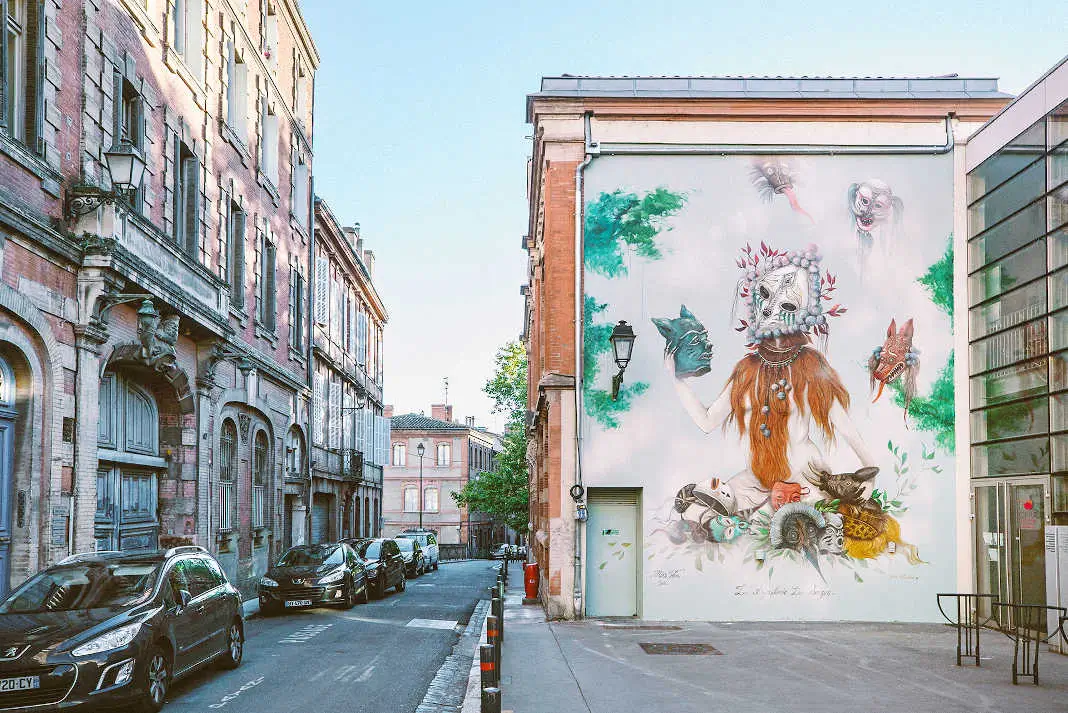
A mural by French street artist Miss Van in Toulouse, part of the city’s Festival Rose Béton street art program, blending her signature masked figures with a surreal menagerie of painted creatures.
She was born August 29, 1975, in Toulouse (some later profiles list 1976, a discrepancy worth flagging rather than resolving with false confidence). What is not in dispute is the timeline that followed: early run ins with local police over the unauthorized murals, then, within a few years, an entirely different kind of attention. Toulouse’s walls were a testing ground. What Fafi built there would not stay local for long.
huh
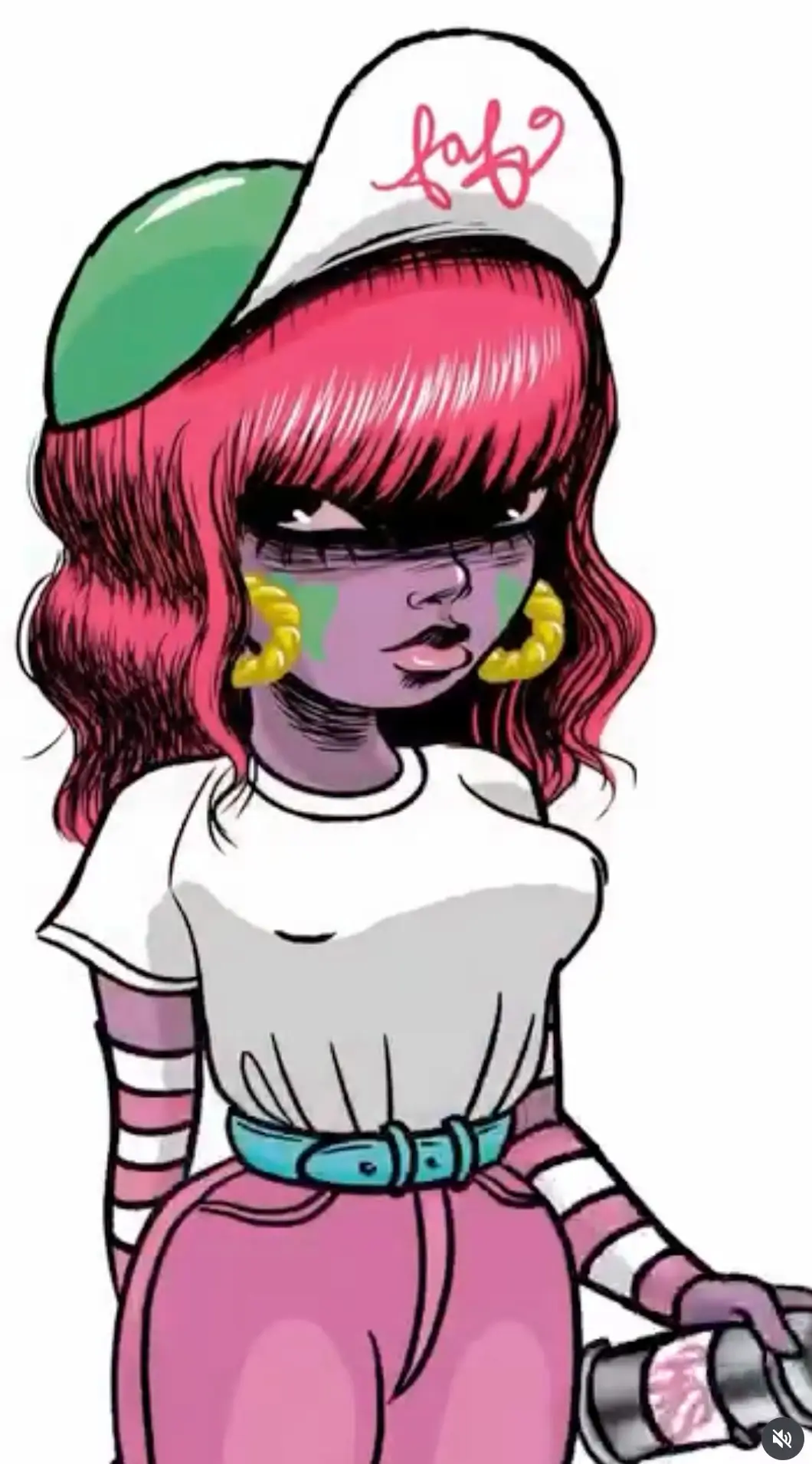
The character that made her name, the Fafinette, is not subtle. She is voluptuous, heavy lidded, often mid smirk, dressed like she raided a pin up calendar and a punk closet on the same afternoon. Fafi has cited photographer Helmut Newton’s stylized, powerful women as an early touchstone, and the influence shows: the Fafinette is aspirational and a little dangerous, innocent looking until she isn’t.
The point was never decoration. Fafi built the Fafinette to occupy space that graffiti, as a medium, had rarely handed to women, and she did it by leaning into pin up aesthetics rather than rejecting them outright, turning a stereotype into a costume the character could take off and on at will. Over three decades the character has shifted with her creator’s own life, moving from a simpler, almost bratty figure into something closer to armor: aggressive, self possessed, occasionally armed with a baseball bat. The Fafinette was never meant to be one thing forever, and Fafi has said as much, describing her evolving relationship to the character as something closer to autobiography than branding.
There is also a generational angle worth naming plainly. Fafi came up when female graffiti writers were treated, at best, as a novelty act within a scene men had built and gatekept, and her response was not to soften the femininity of her characters to fit in but to exaggerate it until it became impossible to wave off. That choice has drawn criticism at times, the same charge leveled at plenty of artists who work in pin up territory: that leaning into a stereotype reinforces it rather than subverting it. Fafi’s own answer, given across interviews over the years, is that control is the entire point. A Fafinette is never a passive object. She is armed, amused, or actively causing trouble, and the artist behind her has said she sees pieces of herself scattered across all of her characters at once, the sweet ones and the cruel ones alike.
flow
By the early 2000s, the Fafinette had moved off the wall and onto product. Fafi’s client list reads like a cross section of luxury, sport, and consumer culture from two decades: Sony, M·A·C Cosmetics, Adidas, LeSportsac, Coca-Cola, Chanel, Hennessy, Swatch, and Samsung all commissioned work from her at various points. The Adidas relationship alone stretched across years and formats, from a 2007 “Sleek Collection” launch event in Tokyo to a full artist series and sneaker collaboration by 2010. Undiz put out a Fafi capsule collection the same year, and more recently she has worked with Eastpak through the French retailer Citadium and with the Australian label I.AM.GIA on a bag collide named, unsurprisingly, after her.

An adidas retail space set up for personalization services, with customers customizing shoe and apparel at a dedicated “Made For You” counter alongside a Forum 2000 display and a full wall of stocked silhouettes.
Editorially, the work followed the same arc from subculture to mainstream. Vogue, Elle, The Face, and XLR8R all featured her, and the Parisian concept store Colette, before it closed in 2017, showed her work multiple times in its Faubourg Saint Honore gallery space, a fact people who track the French fashion scene’s institutional history still bring up as a marker of legitimacy. It is worth noting the throughline here: unlike a lot of artists who get one brand deal and disappear into it, Fafi kept the Fafinette recognizably hers across two decades of commercial work, resisting the flattening that tends to happen when a character becomes a licensing asset first and an idea second.
That longevity is not an accident. Galleries representing her have described her career in stages rather than a single flat trajectory: gallery entry around 2002, immediate pickup in Los Angeles and New York, the Colette relationship solidifying her as a defining figure of her generation somewhere between street culture and contemporary art, and then a second commercial wave decades later with newer names like the streaming retail platform NTWRK and DesignerCon appearances that put her in front of a collector base that barely existed when she first picked up a spray can. Few artists from the 1994 wave of European street art are still landing new capsule releases in the 2020s. Fafi is one of them, and the brand roster keeps updating rather than freezing in place.
cin
Fafi’s crossover into music came through visuals rather than sound. In 2007 she contributed to the video for Mark Ronson’s “Oh My God,” which put a “Fafinettized” Lily Allen through her signature aesthetic treatment, turning a pop star into one of her own characters for the length of a music video. Three years later she co directed the video for “Do! Do! Do!” by Carte Blanche, the house project paired DJ Riton with DJ Mehdi, the French producer who was, separately, her former partner and the father of her son.
That last detail matters more than a passing footnote. DJ Mehdi died in 2011 following an accident at his home in Paris, a loss that reshaped the small, tight knit Ed Banger Records scene he had helped build alongside Riton, Justice, and label founder Pedro Winter. Fafi has spoken about that period publicly, including in the 2024 Arte documentary series on Mehdi’s life, where their son Neil Faveris-Essadi appears as well. It is a hard fact sitting inside an otherwise buoyant career, and it belongs in any honest account of it.
On the collaborator side, Fafi’s work has crossed paths with M.I.A, the Tokyo based DJ and singer Mademoiselle Yulia, on the 2011 video and art direction for “Gimme Gimme,” and Azealia Banks, contributing artwork for the 2012 “Atlantis” video. The pattern across all of it: Fafi is drawn to artists who, like her, treat femininity as something to perform rather than something to apologize for.
char
In 2021, Fafi introduced something new to her practice: the Fafinettes Portraits, a live sitting experience in which collectors are transformed into her characters, either in person or through her social channels. The sittings toured internationally, with stops in Tokyo, New York, Los Angeles, and Hawaii, functioning less like a merchandise drop and more like a piece of participatory portraiture, collapsing the distance between an artist’s invented world and the people who buy into it.
It is a natural extension of a career that has always blurred the line between artwork and audience. Where the early Toulouse murals were unauthorized and anonymous, the Portraits project puts Fafi’s name and process directly in front of the person walking away with the piece, sitting for their own transformation rather than simply purchasing a print.
run
Fafi’s bibliography traces her evolution from muralist to world builder. Girls Rock arrived in 2002, followed by Love and Fafiness in 2005, both collecting her character work in book form for an audience that, by then, spanned continents. The bigger swing came in 2012 with The Carmine Vault, published by Rizzoli in the US and Alternatives in France: a full graphic novel, not a portfolio, built around a four legged character named Birtak who wants nothing more than to join the Paris Opera Ballet, and gets thrown out by his own pirate faction for wanting it. The Carmine Vault also introduced Hmilos, small, perpetually gloomy creatures who populate the same invented universe as the Fafinettes, giving Fafi’s world a cast that extended well past her original human characters.
Fafi has described the book’s setting as something close to unconscious autobiography, a way of processing her own contradictions through Birtak’s cowardice and the Fafinettes’ cruelty in equal measure. A second volume has been in the works for some time, something Fafi has confirmed on her own site and in interviews tied to the first book’s release, suggesting the Carmine Vault universe is not a closed loop but a world she intends to keep expanding.
transition
Fafi currently splits her time between Paris, Biarritz, and San Sebastian, where she has set up a new studio on the Basque coast’s Spanish side. It is a fitting home base for someone whose work has always moved between registers: Paris for the gallery and brand relationships that keep the Fafinette in circulation, Biarritz and San Sebastian for the kind of coastal distance that lets an artist keep building a second graphic novel volume without the noise of a capital city.
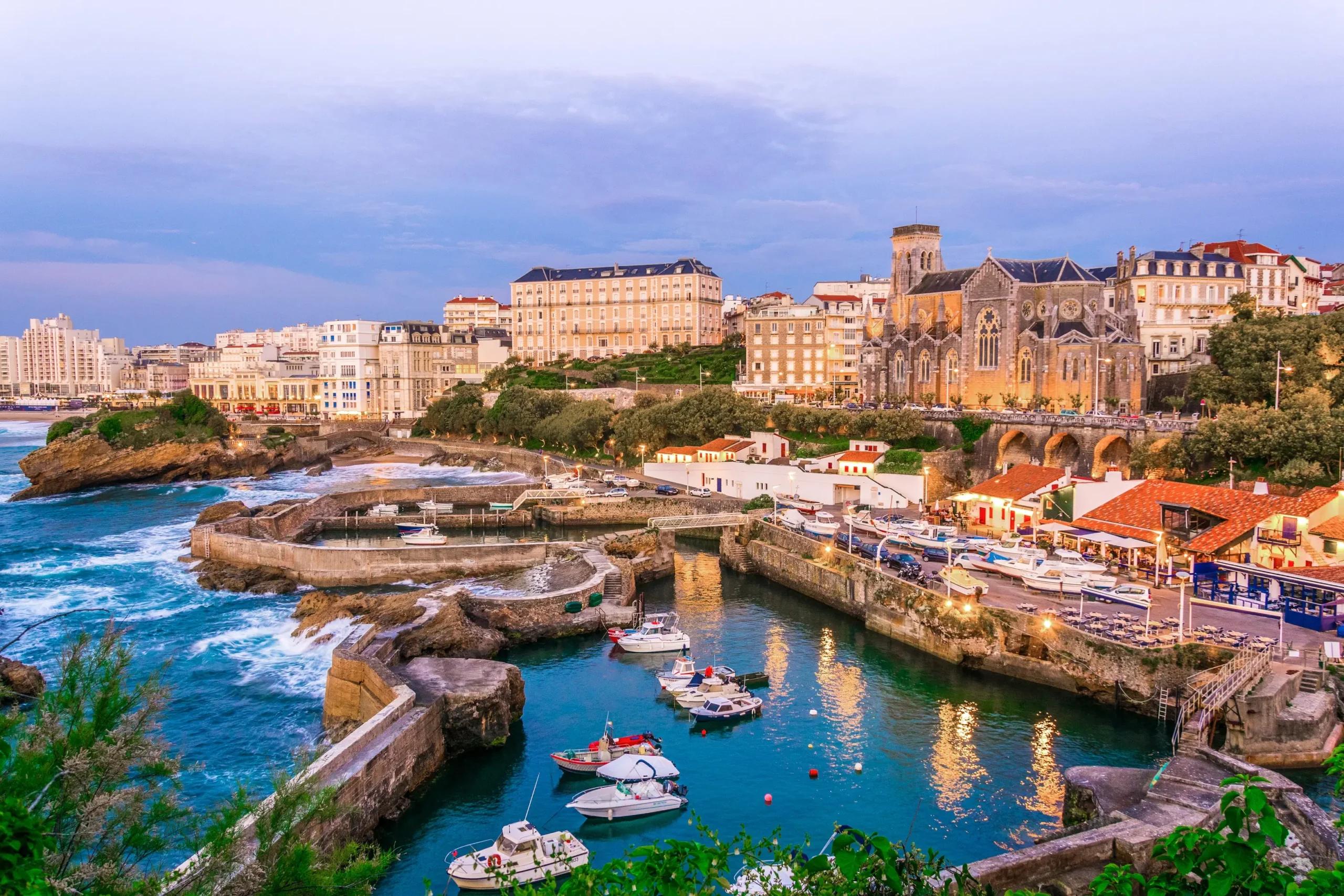
Dusk settles over the Port des Pêcheurs in Biarritz, France, where moored fishing boats sit in a rocky harbor beneath the illuminated spire of Sainte-Eugénie church.
None of it reads like retirement. Between the Portraits sittings, the ongoing Carmine Vault sequel, and a client list that keeps adding names three decades in, Fafi’s arc since 1994 has been less a straight line than a widening one, the same character multiplying across walls, sneakers, magazine pages, and now the faces of the people who collect her.
What stands out, looking at the full run of it, is how little the underlying idea has actually changed since that first year in Toulouse. The mediums have multiplied: mural to magazine spread, magazine spread to shoe box, shoe box to graphic novel panel, graphic novel panel to a live sitting in a Los Angeles studio. But the Fafinette herself, sexy and unbothered and shh running the room she is standing in, has been recognizably the same character since a teenager first painted her onto a wall she had no permission to touch. That consistency, more than any single brand deal or magazine cover, is probably the real story of Fafi’s career: an artist who found her character early and simply kept building the world around her, one coastline, one collaboration, and one collector at a time.
n
From the DRIFT archive: Chris RWK’s “Simple Math” Pillow Brings Street Art Deco · Between Walls and Silence: Nuno Viegas’s Street Artist (2018)
Related Articles
Simone Leigh Recast Caricature as a Monument in Gold
A bare-chested bronze woman in a hooped gold skirt meets visitors first at Simone Leigh’s […]