DRIFT AUDIO
Listen to this story
Choose a voice, then press play.
A modest 1981 ink fox at Christie’s traces Han Meilin from years in political detention to the hand behind Beijing’s Olympic mascots.
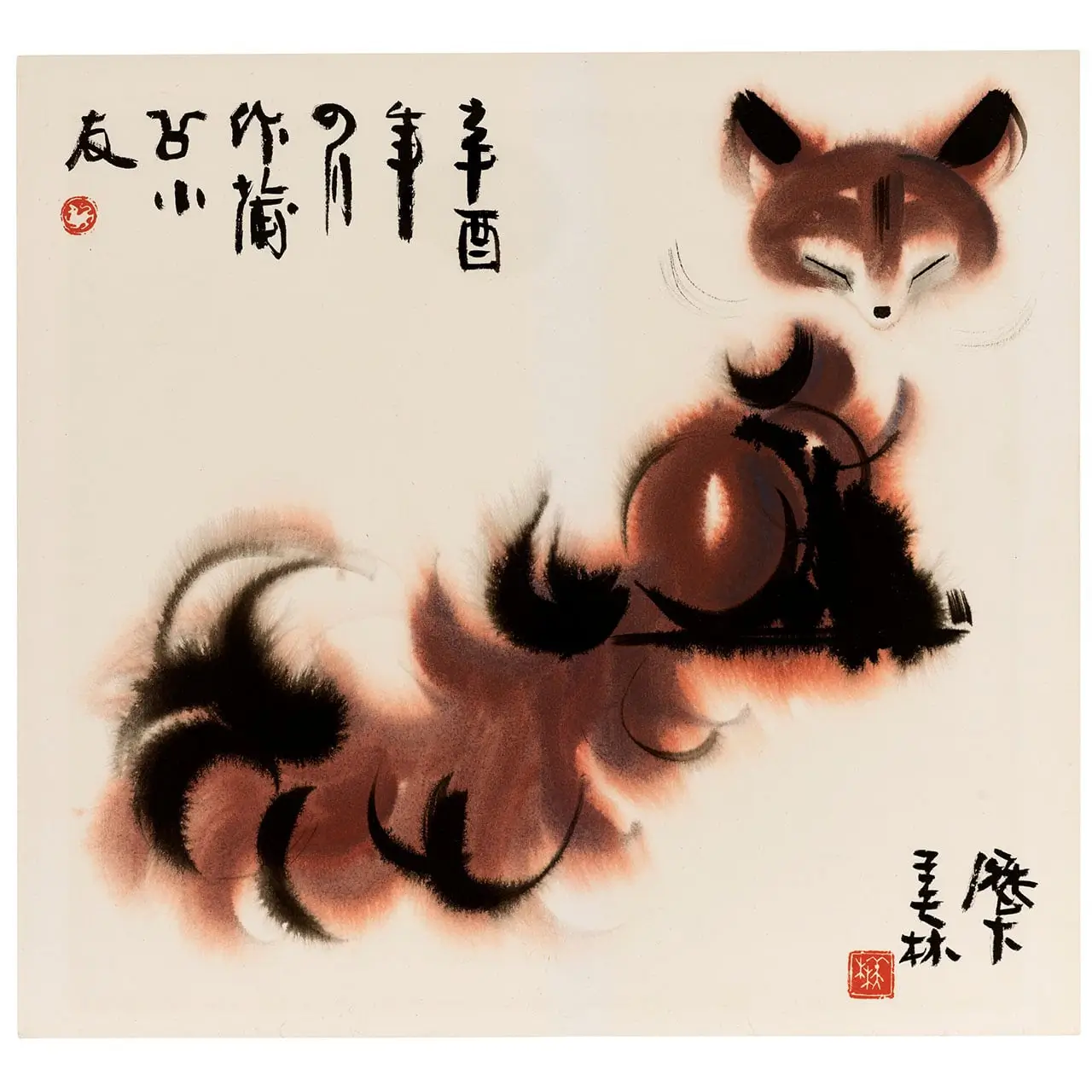
The fox in question is built almost entirely out of motion: a body compressed into a few economical arcs, ears pricked into two sharp triangles, and a tail that unspools across the sheet in loops loose enough to read as pure calligraphy before it resolves back into fur. That is roughly what Christie’s has offered by way of description for the 1981 ink and tincture work, credit to Han Meilin (b. 1936), one of contempo China’s most decorated and, outside China, least documented artists.
Fox sits inside a specific and fairly well populated stretch of Han’s output. Christie’s own catalogue history over the past several years includes a run of similar scaled Han Meilin animal studies from almost exactly the same years: a Cat and Dog pairing dated 1979, a Horse dated 1992, an Ox, an Eagle, and a pair of mandarin fish dated 1978 that later resurfaced at Lyon & Turnbull. Nearly all of them follow the same formula: ink and mineral colour on paper, mounted as a small hanging scroll or left as a loose sheet, inscribed with a cyclical-year date, signed “Meilin,” and stamped with one or two of the artist’s own seals. The mandarin fish sheet carries a provenance note placing it directly in Han’s years teaching at the Anhui Academy of Painting, a post he held from 1979 to 1985, which puts Fox’s own 1981 date squarely inside that same working period.
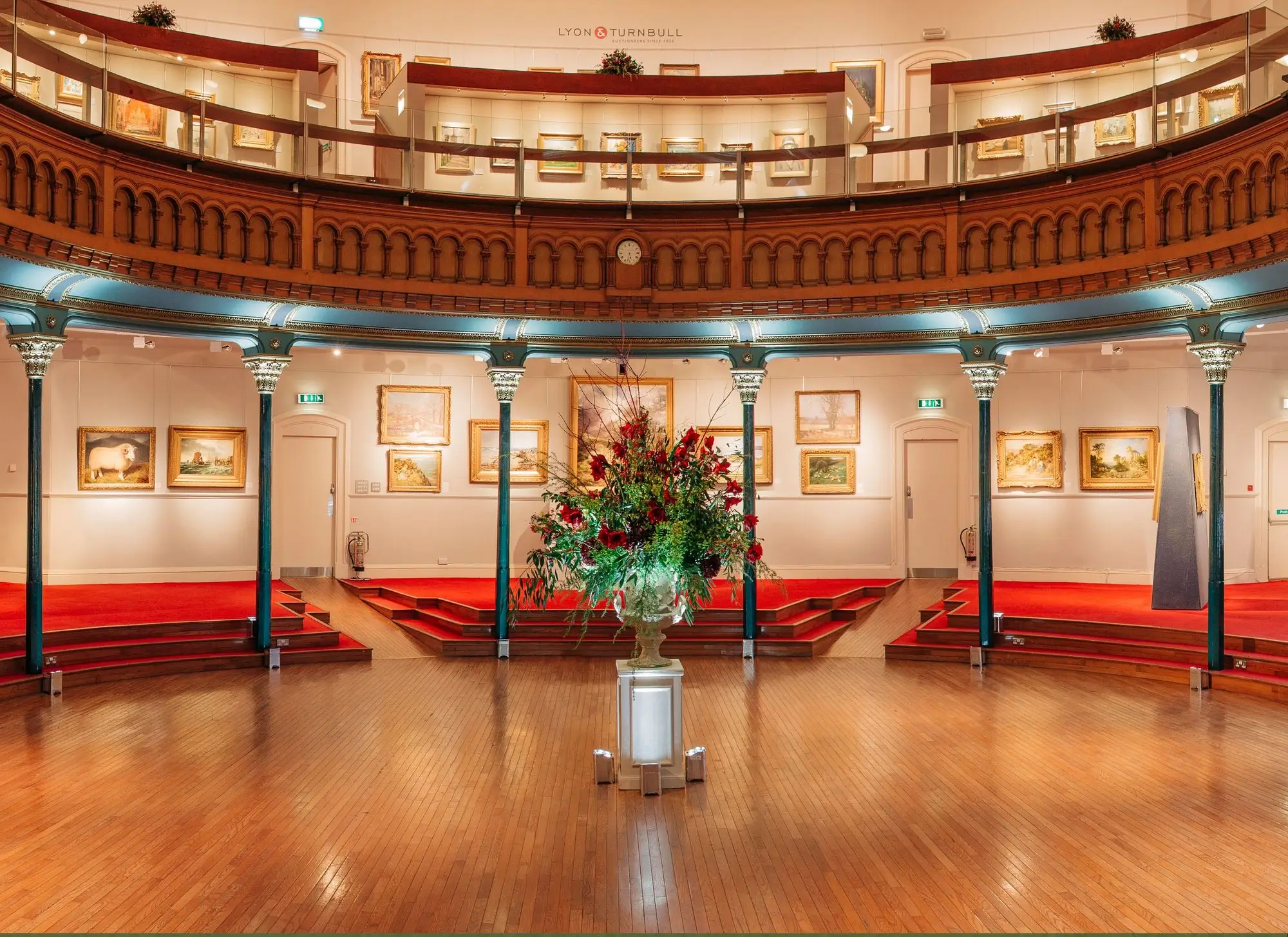
The interior of the Lyon & Turnbull auction house, featuring a curved gallery with wooden paneling, teal columns, gold-framed paintings, red carpeted tiers, and a large floral arrangement in the center of a polished wood floor.
What separates these animal sheets from more academic bird-and-flower painting is how far Han lets the brush run once it reaches an extremity. A fish’s fin, a horse’s mane, a fox’s tail: these are the points where his line stops describing anatomy and starts behaving like pure gesture, moving fast enough that the shape nearly detaches from the animal it belongs to. Traditional Chinese huaniao, or bird-and-flower, painting generally prizes restraint at exactly these moments, letting a tail or a wing taper off with shh control. Han does the opposite, pushing the same passages toward exaggeration and speed. Seen next to the rest of his career, it reads like a rehearsal for the character design work that would occupy much of the decades that followed.
to
Han was born on December 26, 1936, in Jinan, Shandong province, and was admitted in 1955 to what was then Beijing’s Central Academy of Fine Arts, reorganized the following year into the Central Academy of Arts and Design, an institution now folded into Tsinghua University‘s school of art and design. He graduated in 1960.
The Cultural Revolution interrupted everything that came after. Arrested on the accusation of befriending foreigners, Han was held for close to five years and released in 1972. By his own later account, imprisonment did not stop him from working: without paper or ink, he mixed rice water and smeared it onto his trousers, letting the fabric dry pale enough to draw on with a twig once it had. He has also said a tendon was cut during his detention, leaving his thumbs unusable until doctors repaired them afterward. On release he was assigned to labor at a ceramics factory in Huainan, Anhui province, and it was there, in whatever spare time the assignment allowed, that he returned in earnest to painting and design.
The return proved fast. By 1978 he had joined the provincial fine artists association in Anhui; by 1979 the China Artists Association had elected him a member, and an exhibition of his work at the National Art Museum of China in Beijing drew more than 200,000 visitors over roughly three weeks. Fox, dated two years later, sits right at the point where Han’s postwar career had gone from surviving to accelerating.
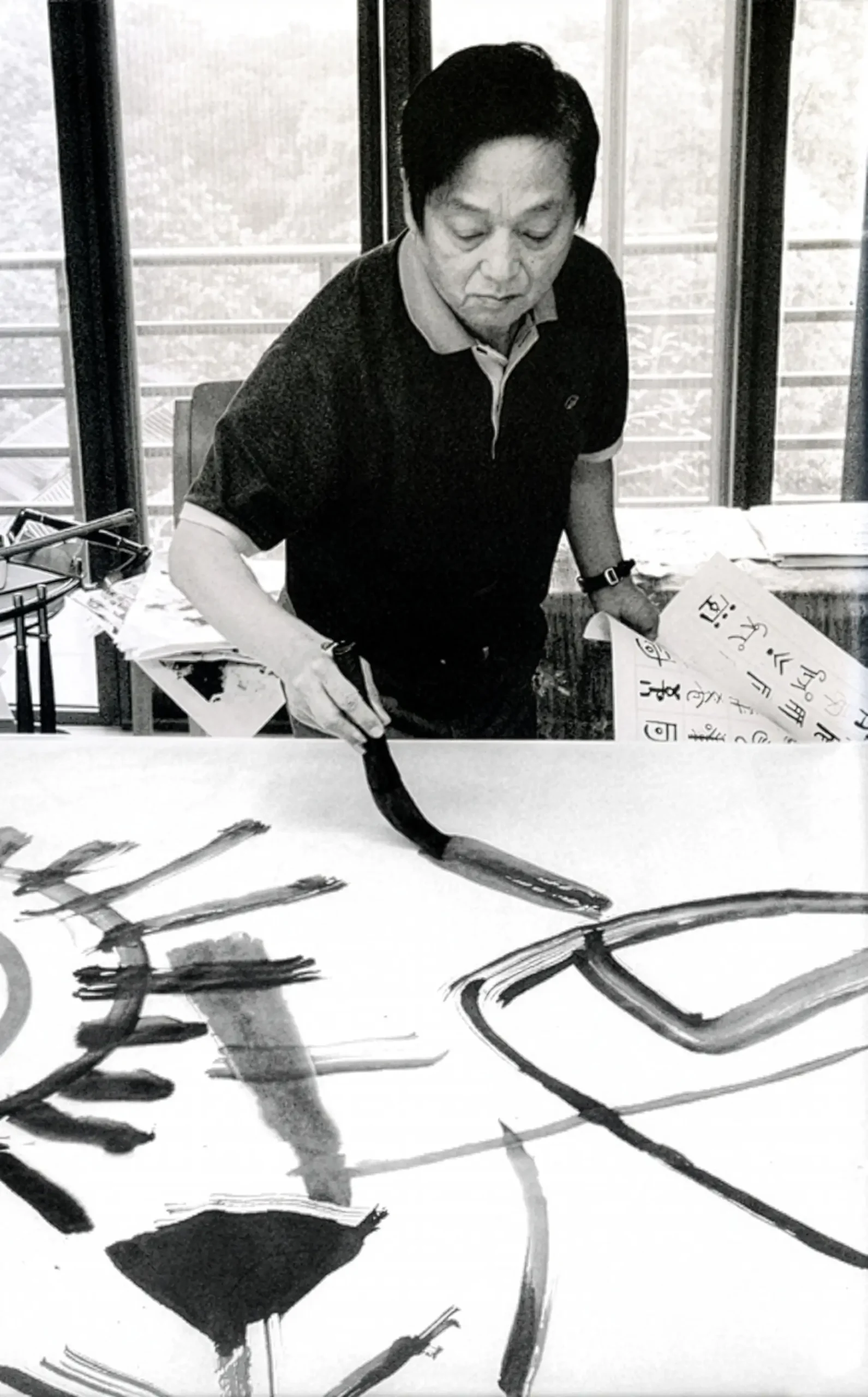
A black and white photograph of the Japanese calligrapher Han Meilin creating a large-scale ink work with a thick brush, wear a dark polo shirt and stood at a table by a window.
who
1980 sent Han across the Pacific for a run of solo exhibitions in twenty-one American cities, including Boston and New York. San Diego made him an honorary citizen and presented him with a symbolic key to the city; Manhattan’s borough government declared October 1, 1980, “Han Meilin Day,” a designation that predates his global fame by nearly three decades. He also lectured at Harvard during this period, part of a broader introduction of his work to American audiences. Three years later, in 1983, six of his paintings were selected to appear on Christmas cards issued by the United Nations, and China Post invited him, for the first time, to design a special zodiac stamp: a round, confident piglet marking the Guihai lunar year. He returned to zodiac stamp design for China Post repeatedly over the following four decades, most recently for the Rooster year in 2017, the Pig year in 2019, and the Rat year in 2020.
None of this reads, from a distance, like the résumé of an ink painter working through a personal menagerie of cats, dogs, oxen, and foxes on paper barely larger than a sheet of stationery. But the animal studies and the design commissions were never separate tracks for Han. The same eye that could resolve a fox’s tail into a handful of confident loops was the eye that a postage stamp, a design brief, and eventually an Olympic committee would all come looking for.
cin
Three years before Fox, Han had already spent real professional time with the same animal in a different medium. In 1978 he served as art designer on The Fox and the Hunters (狐狸打猎人), an eighteen minute paper-cut animated short from the Shanghai Animation Film Studio, directed by Hu Xionghua from a script by Jin Jin. Its premise turns on rumor rather than nature: a crude image of a fox painted on a mountainside wall gets reinterpreted by a frightened village as a monstrous, many-eyed wolf, and a young hunter has to work through his own fear of the myth before he can go out and do his job. The film went on to win the Best Art Award at the fourth Zagreb World Festival of Animated Film, held in what was then Yugoslavia.
The connection between that commission and this ink sheet is not incidental. Paper-cut animation design and brush-and-ink animal painting ask for a related skill: reducing a creature to the smallest number of shapes that still reads clearly as that creature, then exaggerating those shapes just enough to carry a personality. Han was doing both at once through the late 1970s and early 1980s, moving between a film studio in Shanghai and, it appears, a painting table wherever his teaching post in Anhui put him. Fox is a small, shh example of the same instinct that a wall-mounted folk tale, and decades later, a set of Olympic mascots, would both depend on.
show
That instinct eventually put Han at the center of two separate Olympic design efforts. In 1996, to mark the Olympic movement’s centenary and the final Summer Games of the twentieth century, organizers of the Atlanta Olympics commissioned Han to design a commemorative sculpture: a 9.6 meter bronze piece titled Five Dragon Clock Tower, built around dragon and huabiao pillar motifs drawn from Chinese tradition.
Five years later, when Beijing assembled its bid for the 2008 Games, Han sat on the core team designing the bid emblem, reworking the five Olympic rings in ink-brush strokes so the interlocking shape read simultaneously as a Chinese knot and, from another angle, a basic taijiquan stance. The bid succeeded, and in March 2005 Han led a nine-person creative group through a two-week closed-door revision process at a resort on Yanqi Lake in Huairou, outside Beijing. Their working proposal, known internally as “Chinese Kids,” had originally paired the Olympic flame, a panda, a fish, a Tibetan antelope, and a dragon. The dragon was dropped late in the process, on the reasoning that its meaning shifts too unpredictably outside China, and replaced with a swallow shaped after a traditional Beijing kite. What came out of that revision were the five Fuwa: Beibei, Jingjing, Huanhuan, Yingying, and Nini, cartoon dolls built respectively from a fish, a panda, the Olympic flame, a Tibetan antelope, and the redesigned swallow.
Han led the Fuwa design through to the 2008 Beijing Olympics itself, carried the torch as part of the relay’s first Beijing group, and opened a second Han Meilin Art Museum on the banks of the capital’s Grand Canal that same year, stocked with more than two thousand donated works including his original Fuwa design manuscripts. A decade later, in April 2018, International Olympic Committee president Thomas Bach presented Han with the Pierre de Coubertin Medal at IOC headquarters in Lausanne, an honor for individuals who have advanced the Olympic movement and one no other Chinese visual artist had received before him. South Korea awarded him its own Order of Cultural Merit that same year, recognizing his role in Chinese-Korean cultural exchange.
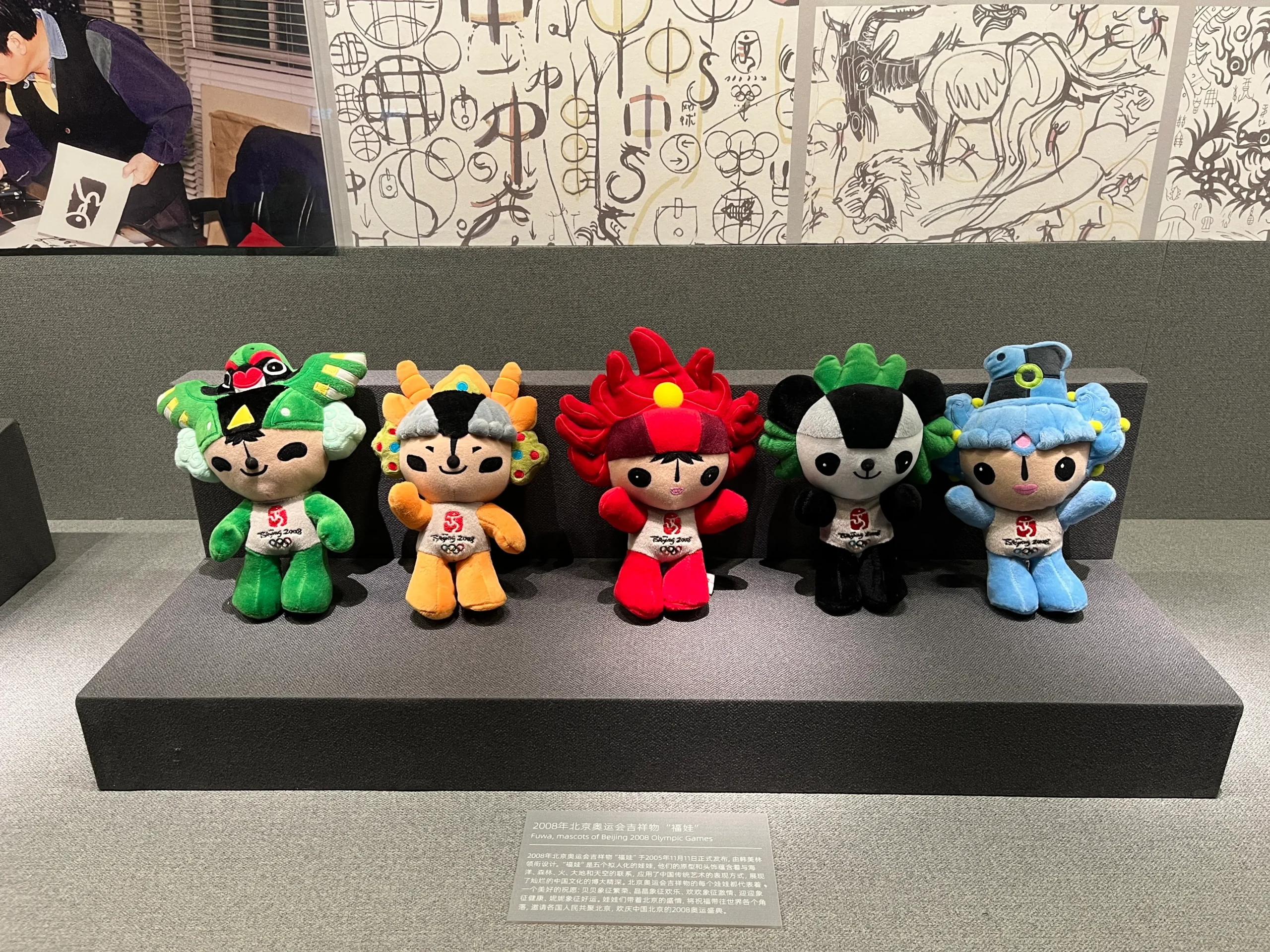
The five Fuwa mascots of the 2008 Beijing Olympics—Beibei, Jingjing, Huanhuan, Yingying, and Nini—as plush toys, each wearing a white shirt with the Beijing 2008 emblem.
vive
Han’s honors since have piled up largely inside China’s own institutions rather than the international art market. In 2015 UNESCO named him an Artist for Peace, the first Chinese painter to receive the title. He has since built three Han Meilin Art Museums, in Beijing, Hangzhou, and Yinchuan, donating more than 6,000 of his own works to fill them. A 2016 touring exhibition, Meilin’s World, opened in Venice before traveling to Beijing, Paris, Liechtenstein, and Seoul, and earned him an honorary fellowship from Ca’ Foscari University of Venice. In 2019, a Phoenix Television gala presented him with a lifetime achievement award recognizing his influence among Chinese communities worldwide.
He remains, at 89, a working designer rather than a retired one. A “Mother and Child” sculpture series he produced won the World Intellectual Property Organization‘s copyright award in 2012, and a 2011 retrospective at the National Museum of China coincided with the Global Times naming him one of the most closely watched Chinese cultural figures internationally that year. A Han Meilin Art Scholarship established at Tsinghua University in 2013 had funded more than eighty students by 2018. In 2021 he designed the logo for China’s National Botanical Garden, built around a ginkgo leaf, a dawn redwood, and a stylized letter C. And ahead of the 2023 Year of the Rabbit and 2024 Year of the Dragon, he supplied zodiac-themed artwork for Luckin Coffee‘s seasonal packaging, a small but telling sign that a Cultural Revolution survivor turned Olympic mascot designer is still, close to seven decades into his career, a working commercial artist as much as a museum subject.
fin
Set against all of that institutional recognition, the international commercial market for Han’s paintings looks strikingly modest by compare. Research publish by Masterworks notes that while Han’s standing inside China is extensive and well document, gallery representation and a settled auction record outside the country remain comparatively thin and difficult to pin down from public sources. The evidence available bears that out: small Han Meilin ink studies surface fairly regularly at Christie’s, Bonhams, Lyon & Turnbull, and Chinese regional auction houses, generally estimated in the hundreds to low thousands of dollars rather than anywhere near what his design legacy might otherwise suggest. It is a strange gap for an artist whose work has, by one count, show in over two thousand separate auction list, and whose single most famous design have been reproduced on more Olympic merchandise than almost any other living artist’s.
Fox, whatever it eventual brings against that backdrop, is one more entry in a body of small, largely undervalued sheets that Han produced by the dozen through the late 1970s and early 1980s, most still identified only by species: Cat, Dog, Horse, Ox, Two Fish. Each is a specimen of the same work method, an animal reduce to a handful of ink strokes until the strokes start carrying more expression than the animal itself. The mascots came later, built by committee at a lake resort outside Beijing. The tail, loose and almost abstract on a sheet of paper in 1981, came first.
Related Articles
fnnch Revives the Honey Bear Hunt for Halloween, No Tape Required
San Francisco’s honey bear artist is turning porch season into a scavenger hunt again, five […]