DRIFT AUDIO
Listen to this story
Choose a voice, then press play.
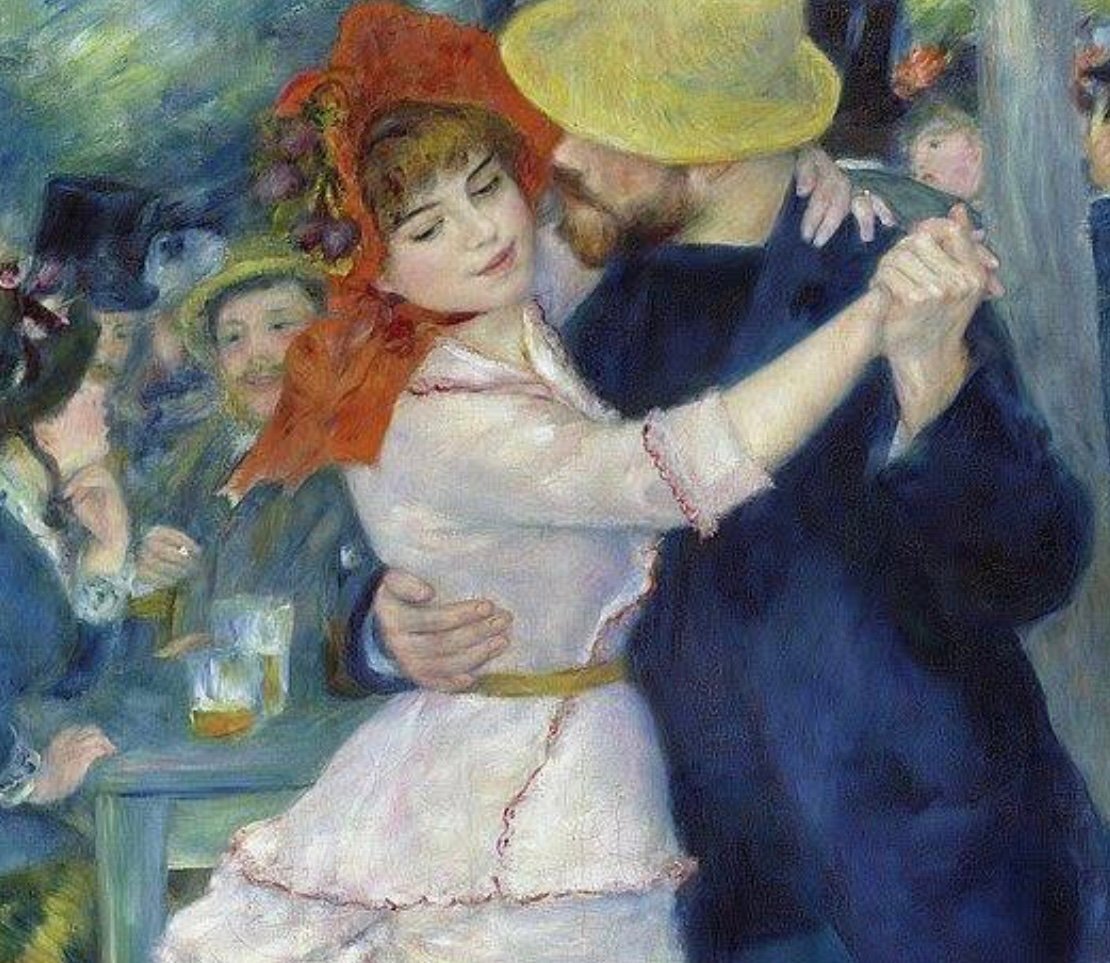
In Dance at Bougival (1883), Auguste Renoir did not merely paint a couple mid-reverie—he compressed an entire epoch’s pleasure principle into pigment. The canvas, now housed in the Museum of Fine Arts, Boston, is among the finest of Renoir’s depictions of late 19th-century leisure, a genre he helped pioneer and unique. But more than a genre scene, Dance at Bougival is an orchestrated balance between movement and stillness, intimacy and performance, spontaneity and classical restraint. It is a painting of love—or at least flirtation—but it is also a coded social study of class, decorum, and modernity during the final flourish of the Belle Époque.
At 70 by 45 inches, the painting is physically immersive. Its scale demands the viewer engage not as passive observer but as proximate guest, perhaps even a fellow reveler at Bougival, a riverside resort just west of Paris that served as a magnet for working-class Parisians and bourgeois flâneurs alike. Renoir painted the scene not en plein air, but in his studio, guided by sketches and studies made on-site. This artistic sleight of hand—replicating natural spontaneity from the carefully constructed confines of a Paris atelier—mirrors the paradox at the pithy of the work: artifice and authenticity waltzing in tandem.
The Dancers and the Dance
The central couple dominates the composition. The man, in a blue suit and straw hat, leans slightly forward, his right hand gently holding his partner’s left. The woman, adorned in a pink dress with red accents and a matching hat adorned with floral trim, turns her face partially away from the viewer, nestled close to her partner’s shoulder. Her gaze is downturned, serene and introspective, while his eyes seem to look not at her, but slightly off-frame, perhaps caught in the music or in search of the next step. There is palpable chemistry between them, but it is of a coy, uncertain kind—inflected with the restraint of an era not yet ready to dispense with propriety, even while dancing.
Their movement is expressed through the flow of fabric, the tilt of torsos, and, most emphatically, through the centrifugal swirl of the woman’s dress. Renoir captures the dress mid-motion, fanning out as if propelled by the momentum of a pivot. It is this gestural dynamism that separates Dance at Bougival from mere romantic portraiture. The figures are not only in love; they are in motion—swept up in the music, the moment, the optimism of leisure.
Color and Technique
Renoir’s use of color is both emotive and architectural. The pink of the woman’s dress dominates the palette, a bold hue in dialogue with the cooler blues of her partner’s jacket. The background is rendered in soft, brushy tones of green, blue, and ochre, suggestive of the foliage, café umbrellas, and onlookers that blur into the periphery. Renoir was always invested in the interplay between figure and ground, and here he subdues the setting so that the lovers can shine—but he does not entirely dissolve it.
The painting demonstrates Renoir’s mature style—more structured and less hazy than his earlier Impressionist canvases. By 1883, the artist had grown increasingly dissatisfied with the fleeting, fragmented effects of early Impressionism. He turned toward the more solid forms and classical modeling of the Renaissance, influenced in part by a trip to Italy in 1881. Dance at Bougival stands at the cusp of this transition: the figures are more sculptural than those in, say, Luncheon of the Boating Party (1881), yet the brushwork retains its vibrancy and liquidity. There’s still a softness to the edges, but one gets the sense of bones beneath skin, not just light on surface.
The Model(s) and Their Metaphor
It is widely believed that the female figure was modeled after Suzanne Valadon, a painter in her own right and an occasional model for Renoir, Toulouse-Lautrec, and others. Valadon’s own story is that of a boundary-breaker—a woman who transitioned from working-class roots to artistic recognition in a male-dominated scene. Her presence here, if confirmed, adds an additional layer of symbolic irony: the objectified becomes the subject, the muse becomes maker.
The male dancer is sometimes identified as Paul Lhote, one of Renoir’s close friends. Together, these two form more than a couple; they form a dialectic. He represents a suave masculinity, steady and confident. She embodies grace tinged with mystery. Their embrace is not overly intimate, but their proximity implies a heat just beneath the surface. It is precisely in that ambiguity that Renoir finds expressive power. The dancers are both archetypes and individuals—representations of desire and decorum suspended in equilibrium.
Bougival as Setting and Symbol
The choice of Bougival is not incidental. In the 1870s and 1880s, Bougival was both playground and pastoral escape, located along the Seine and easily reachable by train from Paris. It became a crucible of modern leisure—a space where the boundaries of class, gender, and propriety could be bent, if not broken. Artists and writers flocked to the suburb, intrigued by its blend of rural charm and cosmopolitan crowd.
Renoir returns to Bougival across multiple works—Dance in the Country and Dance in the City are companion pieces to Dance at Bougival, painted in the same period. Each explores different social contexts and moods: the city with its refinement and etiquette, the country with its rustic warmth. Bougival is the median—an in-between place, both cultivated and casual, a liminal space where dances occur and social hierarchies are momentarily forgotten. Or perhaps just reprised in a new key.
A Snapshot of the Belle Époque
The painting is often cited as a testament to the spirit of the Belle Époque, a period marked by relative peace, economic prosperity, and cultural efflorescence in France. From the 1870s until the outbreak of World War I in 1914, Paris was considered the epicenter of the civilized world—home to cabarets, cafés, and burgeoning art movements.
Dance at Bougival offers an antidote to the growing industrialization and political unrest that churned beneath the surface of this “beautiful era.” It presents a utopic moment, a tableau of happiness unmarred by cynicism. Yet Renoir was not a propagandist. He was acutely aware of the transience of such scenes, and perhaps that’s why he painted them with such joy. These are not portraits of eternal love but of fleeting delight—the temporary intoxication of a song, a spin, a flirtation.
The Evolution of Reception
Initially praised for its charm and vigor, Dance at Bougival was also dismissed by some early critics as sentimental or simplistic. As academic preferences tilted toward abstraction in the 20th century, Renoir’s name became something of a paradox: celebrated in popular imagination but underappreciated in high critical circles. Today, his work is undergoing reassessment. Scholars and artists alike are beginning to revalue Renoir not just as a technical master but as a theorist of feeling—an artist of emotion, temporality, and social choreography.
In the contemporary moment, when irony often trumps sincerity in visual culture, Dance at Bougival remains arrestingly unironic. It is earnest. It believes in beauty. It risks being soft. And perhaps that is its enduring rebellion.
Impression
To stand before Dance at Bougival today is to witness not only a couple in motion, but time itself circling back. It is a gesture toward a moment when art was allowed to be light, tender, and full of life’s ordinary rituals. Renoir’s genius lies not just in his technique or composition, but in his empathy—for his subjects, for his era, and for the viewer who longs to join the dance.
In a century defined by the rupture of war, the rise of modernism, and the fracture of old certainties, Dance at Bougival endures as a moment of suspended joy. Its charm is not naive, but defiant. It proposes, against the grain, that there is nothing more radical than tenderness.
And so it turns. Forever mid-dance, forever nearly kissing, forever vivid against the hushed blur of an indifferent world.
Related Articles
Modigliani’s Limestone ‘Tête’
Carved from a single block of limestone in Montparnasse more than a century ago, one of Modigliani's rare stone heads goes to auction for the first time…