DRIFT AUDIO
Listen to this story
Choose a voice, then press play.
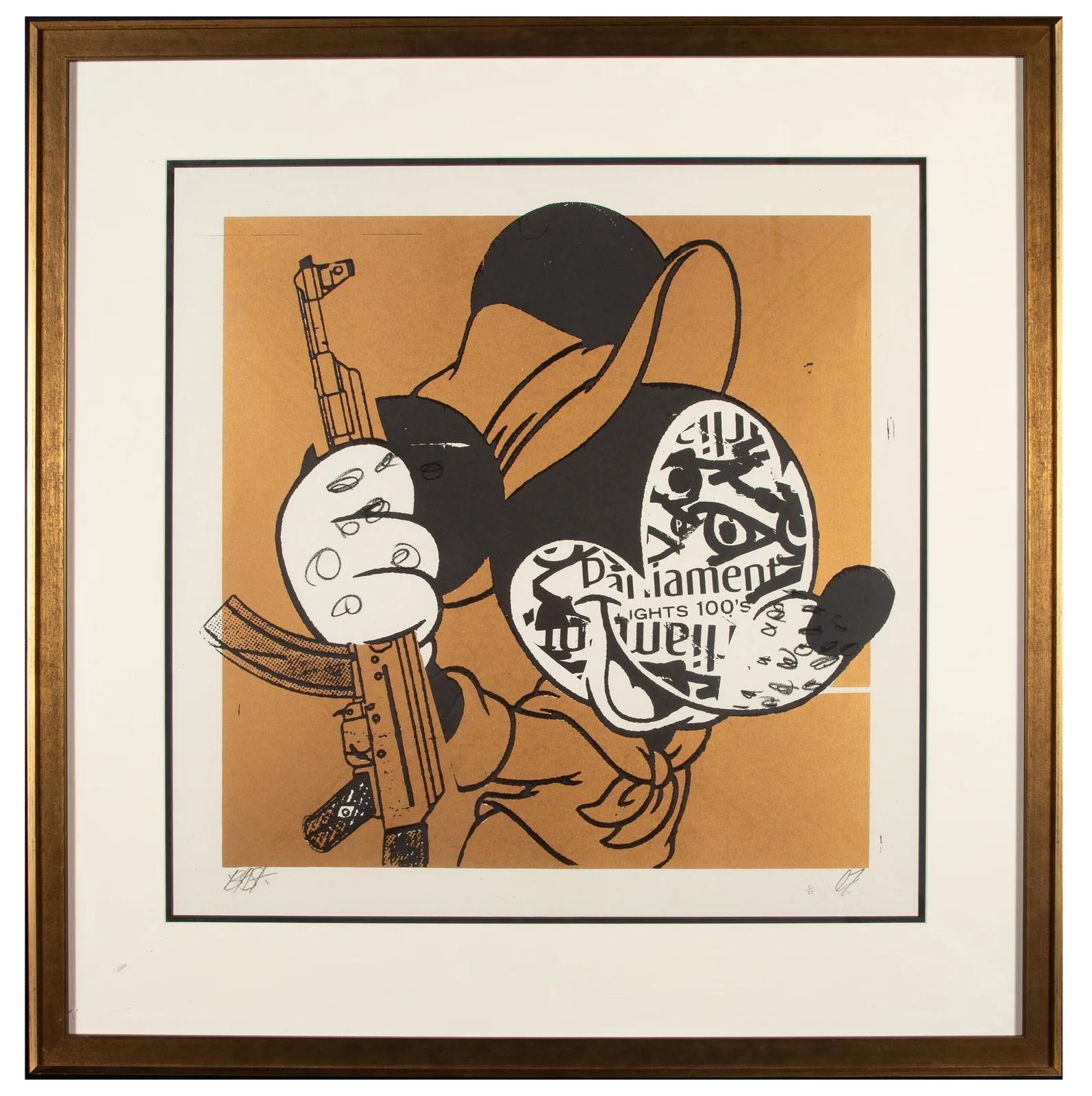
Revolution Mickey, made in 2007 for the print house that first made Banksy collectible, is one of the clearest windows into how the late Bäst actually worked.
Revolution Mickey is a screenprint in colors, finished by hand in pencil, measuring roughly 26 and a half by 26 and three quarters inches on wove paper. It was published in 2007 by Pictures on Walls, the East London print house that spent the better part of a decade turning street artists into printmakers with actual retail infrastructure behind them. The version now circulating under the title “Handfinished print” is one of several variants of the same image that have surfaced across galleries and auction houses over the years, including a unique framed edition and a version labeled simply “Revolution Mickey Silver.” Each carries the same basic gesture: Mickey Mouse’s face, instantly recognizable even in fragments, run through the kind of collage logic that defined Bäst’s entire practice.
The piece does not present Mickey as a clean icon the way Warhol’s diamond dust portraits did decades earlier. It presents him mid collapse, features doubled and offset, color fields overlapping in a way that reads more like a printing error weaponized on purpose than a deliberate portrait. That distinction matters, because it is close to the entire point of the image.
stir
Bäst spent more than fifteen years working the streets of New York and parts of Europe under near total anonymity, a rarer feat than it sounds once an artist’s gallery career takes off. His own artist biography describes a practice built on what he called mutated characters and mutated scenes, made by cutting up and recombining images lifted from mass culture, cartoon icons, fast food branding, advertising, and pornography among them, into what read as biting send ups of consumer life. He drew a direct line back to early punk flyer design, the kind of cut and paste aesthetic that predates digital collage tools by decades and still looks more aggressive for it.
He gave almost no interviews and offered almost nothing in the way of biographical detail, famously deflecting questions about his life with a single dry line about falling asleep with a pizza on his chest. That refusal to participate in the usual mythmaking around a rising art career was, by most accounts, entirely genuine rather than a marketing pose, and it is part of why so little concrete biographical information about him exists even now.
What is well documented is his working relationship with the Brooklyn collective FAILE, formed by Patrick McNeil and Patrick Miller. Bäst and FAILE collided for years, most visibly through Deluxx Fluxx, a wheat pasted and screenprinted pop up arcade project that first appeared around 2010 and later found a semi permanent home in Detroit. He also worked with the designer Marc Jacobs at points in his career, one of several signs that his underground practice and his gallery and commercial recognition were never entirely separate tracks.
The Deluxx Fluxx project is worth dwelling on for a moment because it shows a different side of Bäst than a single print can. Rather than a static image on a wall, it was a functioning arcade space, cabinets, lighting, and game consoles all wrapped in the same collaged, wheat pasted visual language that defined his street work, built to be walked into and physically used rather than only looked at. That willingness to move between a flat printed image and an immersive built environment says something about how broad his actual toolkit was, even though the print market, and pieces like Revolution Mickey specifically, remain the version of his work most people encounter.
conflate
Revolution Mickey was a collaborative production in the most literal sense. According to gallery documentation of the edition, the British graffiti artist Ben Eine ran the silkscreens by hand for the full print run, a physically demanding job that determines how ink actually sits on the paper before anyone else touches it. Bäst then went back over each individual print, adding hand finished elements in oil stick or pencil, which is why no two prints from the run are identical even though they share a base image. Sources describe an edition of twenty unique variants for at least one version of the work, each one altered enough by hand to function as a one off rather than a straightforward multiple.
That division of labor, one artist handling the technical printing, another applying a personal, non repeatable layer on top, was common practice at Pictures on Walls in the mid 2000s, when the print house was actively trying to make street art collectible without stripping out the sense that a human hand had actually touched the object. Eine himself would go on to build his own reputation around large scale lettering work, and his presence on this print is a reminder of how tightly knit the London and New York street art scenes were at the time, artists printing for each other, signing each other’s work, and sharing a publisher that none of them fully controlled.
The practical result of that arrangement is that no definitive, singular version of Revolution Mickey exists in the way a painting has a single original. What exists instead is a small family of related prints, the standard colorway, a silver variant, a unique framed piece with heavier hand work, and the handfinished print referenced here, each one carrying slightly different pencil marks, oil stick additions, or color choices depending on which pass through the studio it received. Collectors who track Bäst’s output tend to speak about these variants almost the way record collectors talk about pressings, small physical differences that carry outsized weight because the underlying run was so limited to begin with.
scope
Pictures on Walls opened in 2003, founded by a loose group of artists and graffiti writers who felt shut out of the existing gallery system and decided, in their own words from an early mission statement, to produce and distribute their own work rather than wait for permission. The roster from the beginning included Bäst alongside Faile, Dface, Mode2, 3D, and Paul Insect, and it was the print house that Banksy used almost exclusively for over a decade, making POW arguably the single most important commercial engine behind street art’s move from illegal walls to living room walls.
POW’s whole model depended on prints like Revolution Mickey: affordable enough that a wider audience could actually buy one, but produced with enough craft, foil blocking, hand embellishment, patterned embossing, that they didn’t feel like posters. The house closed at the end of 2017, having decided, in a farewell statement that leaned into the same self aware humor the collective always used, that street art had become too successful and too tradeable a commodity for a group that started out defining itself against exactly that market. Prints from its run, including Bäst’s Mickey pieces, have only grown more valuable since the shutdown, a fact that sits at odds with the anti market spirit the house was founded on, and that neither POW nor its artists ever pretended not to notice.
mid
Appropriating Disney’s most protected character was hardly a new move by 2007. Warhol had already done it decades earlier as part of his Myths portfolio, treating Mickey Mouse as pop culture royalty on the same level as Superman or Santa Claus. What Bäst did with the character came from a different angle entirely. Where Warhol’s Mickey sat in profile against diamond dust, glamorous and intact, Bäst’s version looks actively damaged, features smeared and duplicated as if the image had been run through a broken machine on purpose.
That treatment fits squarely inside what Bäst called his mutated characters practice. Mass culture icons, particularly ones as tightly licensed and aggressively protected as Disney’s, made ideal raw material for an artist whose entire project was pointing out how thoroughly branding saturates everyday life. Turning Mickey into something closer to visual noise than a friendly mascot was less an act of vandalism than a fairly legible piece of commentary, made using the same commercial printmaking tools that companies like Disney rely on to keep an image looking clean and consistent everywhere it appears.
Bäst was hardly alone among his generation in reaching for Mickey specifically. The character’s status as arguably the single most recognized piece of corporate iconography on the planet has made it a recurring target across street and pop art for decades, precisely because so little explanation is required before an audience clocks what has been altered and why. What set Bäst’s version apart from most of that broader trend was the method rather than the target: where many artists working with Mickey lean on paint or spray stencil to distort the character, Bäst ran his version through an industrial printing process and then deliberately roughed up the result by hand, so the damage reads as considered rather than incidental.
away
Bäst died in 2021. The Brooklyn based outlet Brooklyn Street Art, which had covered his work for years, published an in memoriam tribute that May, describing a career defined by technical command of screenprint and stencil work and by a body of work that, in the outlet’s words, brought real joy to people on the street, in the studio, and eventually in the museum. The tribute extended condolences to his wife and family without disclosing further personal details, consistent with the privacy Bäst maintained around his identity throughout his career.
No detailed public account of the circumstances of his death appears to have been published beyond that tribute, and his real name was never confirmed through verifiable reporting during his lifetime or after it. Some secondary art market listings have attached a specific full name to him in recent years, but that claim has not been corroborated by outlets that covered him consistently while he was alive, so it is treated here as unverified rather than fact.
fin
Variants of Revolution Mickey continue to surface for sale through galleries and auction platforms more than fifteen years after the edition was produced, alongside related prints from the same period simply titled Mickey and Mickey (Color). Pricing and availability shift constantly across secondary market listings, and given that Bäst’s total output was never large to begin with and will now never grow further, each surfacing of one of these prints functions as a small event in its own right among collectors who track his work specifically.
That scarcity sits differently now than it did when Pictures on Walls first put the print into circulation. In 2007, buying a Bäst print meant getting in early on an artist whose reputation was still mostly confined to gallery insiders and street art blogs, a modest financial bet on someone working largely in the shadows. Today, with the artist gone and the print house that produced the work long since closed, a Revolution Mickey listing functions closer to an archival object, one of a finite number of physical traces left from a specific, tightly knit moment in New York and London street art history that will not produce any more of itself.
n
From the DRIFT archive: Andy Warhol’s Superman (1981): A Diamond-Dust Resurrection of the American Myth · Banksy’s Pulp Fiction (2004): Inside the Satire Behind an Iconic Screenprint
Related Articles
fnnch Revives the Honey Bear Hunt for Halloween, No Tape Required
San Francisco’s honey bear artist is turning porch season into a scavenger hunt again, five […]