DRIFT AUDIO
Listen to this story
Choose a voice, then press play.
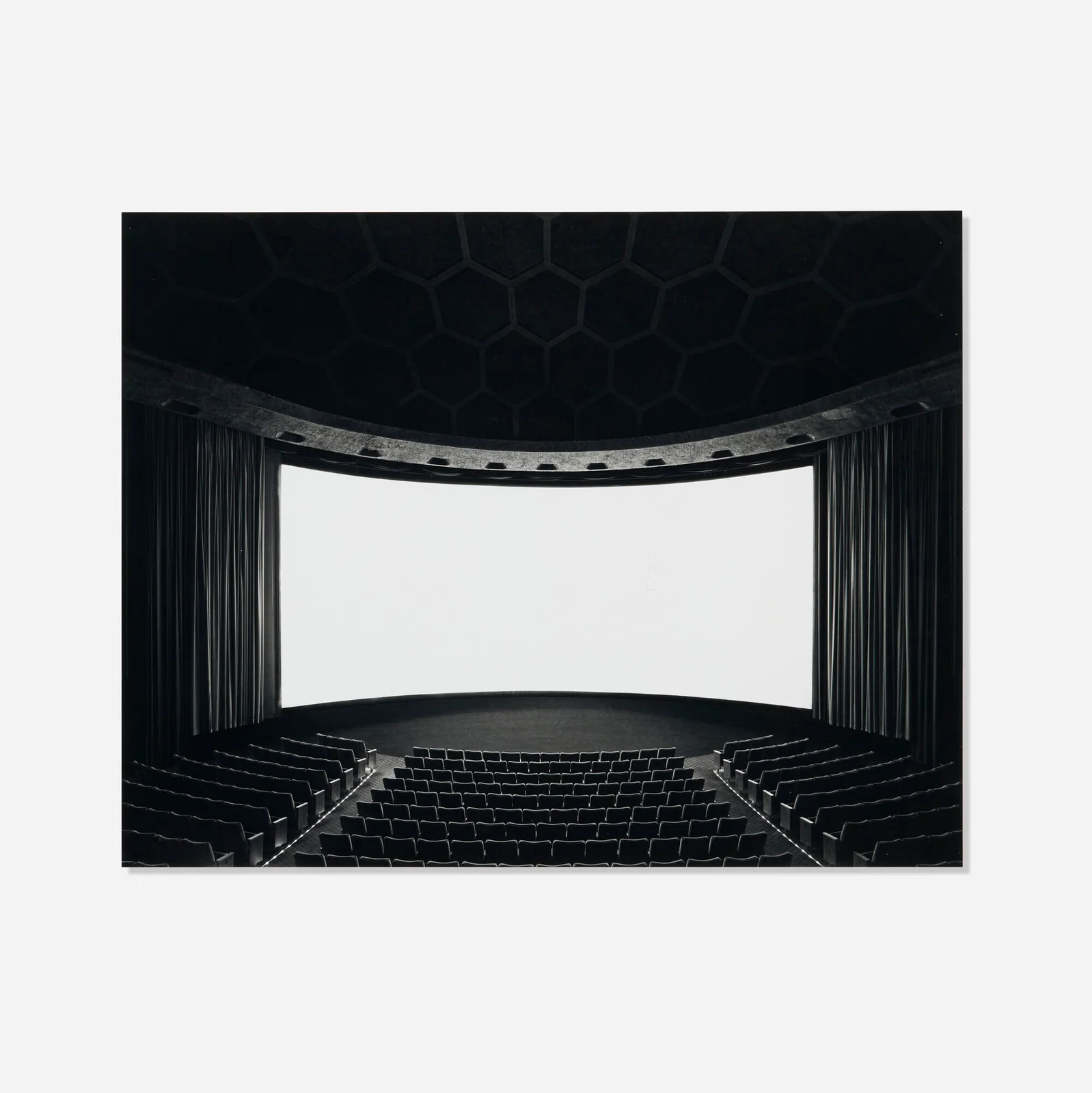
A single frame holding an entire feature film, aimed at a theater that has now sat dark on Sunset Boulevard for five years and counting.
Look at Cinerama Dome, Hollywood, 1993 for more than a few seconds and the thing that should be the most ordinary object in the room, a movie screen mid-film, becomes the strangest part of the photograph. It glows white and blank, floating at the center of the frame like a held breath, while the seats around it and the concrete ribs of the dome above them resolve with total clarity. Nothing about a normal photograph of a movie theater would look like this. Hiroshi Sugimoto built his entire Theaters series on the fact that it does not, because he was not photographing a theater in the way anyone else would. He was photographing the full runtime of whatever film happened to be playing, compressed into a single exposure, and the white rectangle in the middle of the image is not a blank screen at all. It is every frame of a two hour movie, stacked on top of itself until the individual images cancel each other out and only pure light remains.
This particular print belongs to a body of work Sugimoto began in the late 1970s and continued shooting into the 1990s and beyond, working his way through movie palaces and drive-ins across the United States with an 8×10 view camera and a tripod planted at the exact center of each auditorium. Cinerama Dome, Hollywood dates to 1993, a year in which Sugimoto photographed a run of West Coast theaters that later formed the basis of a Fraenkel Gallery show devoted specifically to that work. A gelatin silver print of the image sits in the permanent collection of the Museum of Contemporary Art, Los Angeles, a gift from the artist and the Angles Gallery, framed at just under 26 by 33 inches.
Hiroshi Sugimoto’s celebrated theater photographs transform movie screenings into luminous white screens, capturing the entire duration of a film in a single long exposure.
idea
Sugimoto has told the origin story of the Theaters project often enough that it now reads almost like a parable, but it holds up because the idea really is that simple and that strange. In his own account, posted on his studio’s website, the thought arrived while he was photographing exhibits at the American Museum of Natural History and found himself asking a question he could not let go of: what would happen if he photographed an entire film in one frame. He answered it himself in the next breath, reasoning that the result would be a shining screen, and then walked into a cheap theater in the East Village with a large format camera to find out. He opened the shutter as the film began and closed it two hours later when it ended. What came back from the darkroom that evening, in his words, was a vision that exploded behind his eyes.
The technique is mechanically simple and practically unforgiving. A movie’s own projector becomes the only light source for the entire exposure, which means the aperture and the film stock have to be matched with enough precision that two hours of accumulated light land exactly where a single well exposed frame would. Every frame of the film contributes brightness to the same rectangle of the picture, and because the images themselves are constantly changing while the architecture around them stays fixed, the screen washes out into blank white while the seats, walls, and ceiling of the theater emerge in unusually sharp, almost sculptural detail. Sugimoto has described himself as a habitual self-interlocutor, someone who works out his ideas through an internal back and forth before he ever picks up the camera, and the Theaters series is essentially that private conversation turned into a repeatable method, applied to one auditorium after another for close to five decades now.
focus
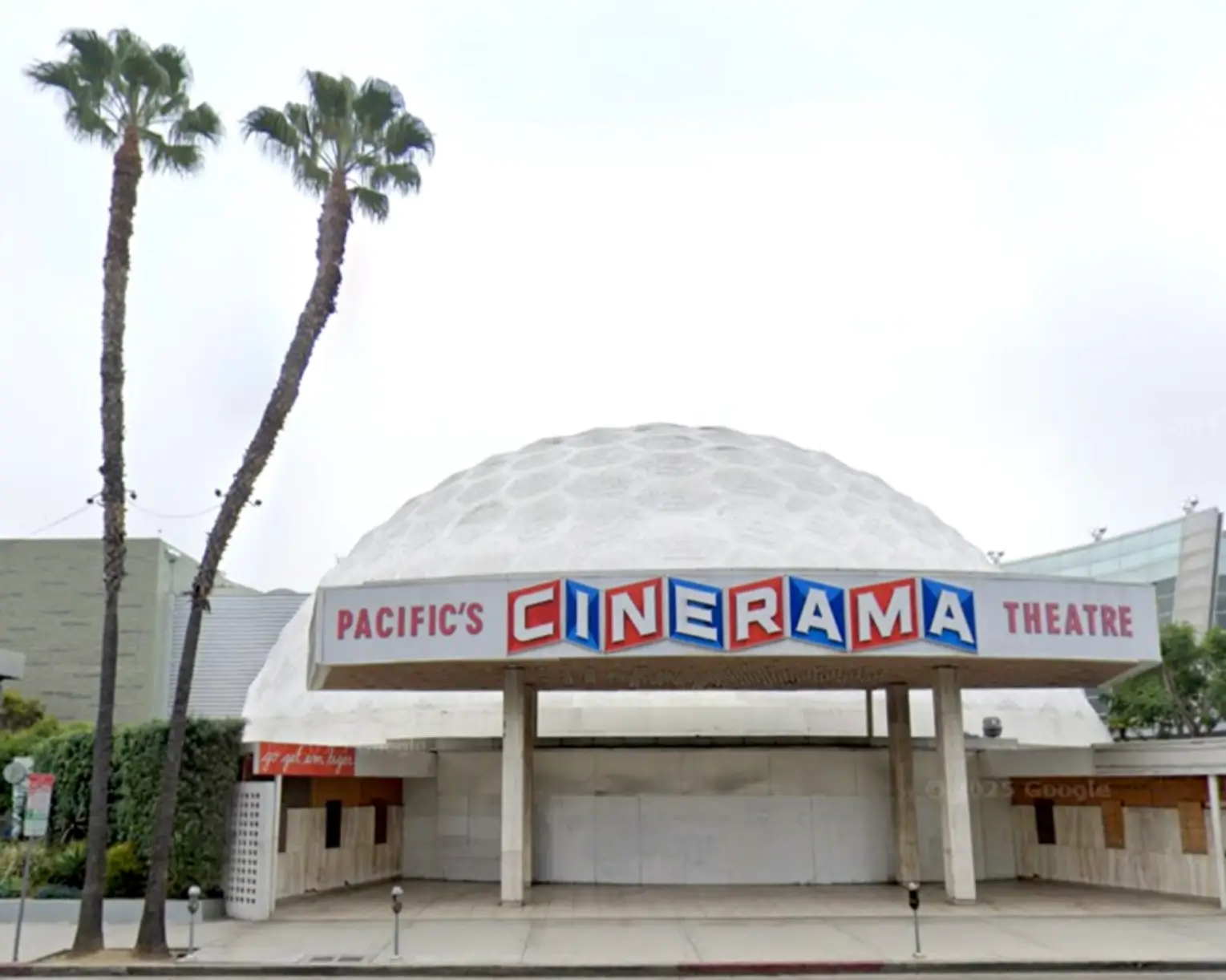
It is worth separating the photograph from its subject for a moment, because the Cinerama Dome is a genuinely strange building on its own terms, independent of anything Sugimoto did with a camera inside it. It opened on November 7, 1963, at 6360 Sunset Boulevard, built specifically to premiere It’s a Mad, Mad, Mad, Mad World, and it remains the only concrete geodesic dome ever built as a functioning movie theater. The design came from Welton Becket and Associates, with the French architect Pierre Cabrol leading the project, drawing directly on Buckminster Fuller’s geodesic principles at a moment when Cinerama, Inc. was trying to convince exhibitors that a compact, futuristic dome could be built fast and cheap enough to spread the format across the country. The construction crew assembled 316 individual concrete pentagon and hexagon panels, some weighing over 3,000 pounds each, in roughly sixteen weeks of round the clock work, an almost absurd construction schedule for a building that has since outlasted the format it was purpose built for by more than sixty years.
By the time the Dome actually opened, the three projector Cinerama process it was named for had already fallen out of use, done in by its own expense and the technical difficulty of shipping and threading three synchronized reels through theaters equipped to handle them. The Dome opened instead with a single projector and a widescreen aspect ratio, which is more or less how it operated for the rest of its life, hosting decades of star studded premieres and, for film enthusiasts, a reputation as one of the best rooms in Los Angeles to see a movie in 70mm. Los Angeles designated it a Historic-Cultural Monument in 1998 specifically to prevent the kind of alteration that would have compromised the dome itself, after a preservation campaign led by a grassroots group called Friends of the Cinerama Dome pushed back against redevelopment plans for the site.
market
Cinerama Dome, Hollywood is not a unique object. Sugimoto’s Theaters prints are issued in editions, and this particular image has passed through auction houses including Phillips and artnet in recent years as a signed work numbered within an edition of 25, with gelatin silver prints in the roughly 17 by 21 inch range regularly appearing on the secondary market. Sugimoto’s broader auction record gives some sense of why collectors keep returning to the series: his work has sold for as much as 1.9 million dollars at Christie’s, according to auction tracking on Artsy, and his prints belong to institutional collections that include the Metropolitan Museum of Art, the Museum of Modern Art, and the Tate, alongside MOCA’s own holding of this specific Cinerama Dome print.
Part of what keeps the Theaters series in circulation, rather than settling into being a closed historical chapter, is that Sugimoto has never actually stopped shooting it. He returned to the format for theaters in Sydney, Paris, Turin, Boston, Detroit, and Newark well into the 2010s, applying the same fixed method to buildings built decades apart from one another. That makes the 1993 West Coast theaters, this one included, an early middle chapter in a project that now spans close to fifty years, rather than a single finished statement about American movie palaces. Each new venue he adds to the series functions less like a sequel and more like another data point in the same long running experiment about what a film actually looks like when its individual frames are allowed to collapse into one.
Sugimoto himself has described his practice as built around three sustained, decades long investigations rather than one off projects, with Theaters running alongside his Seascapes photographs of open water and horizon lines and his Dioramas series, which trains the same long exposure approach on taxidermy displays in natural history museums, the very setting where the theater idea first occurred to him. That parallel matters for how collectors and institutions treat a print like this one. A Sugimoto theater photograph is rarely bought in isolation from the rest of his output; it tends to be understood as one node in a lifelong project about how a camera can hold onto time rather than simply record an instant of it, which is part of why individual prints keep resurfacing across different auction houses years and sometimes decades after they were first made, rather than being treated as a closed, one time edition that collectors quietly hold and forget.
length
There is a specific reason this 1993 photograph reads differently in 2026 than it would have a decade ago. The Cinerama Dome closed in April 2021, one of the venues caught up in the broader collapse of the Pacific Theatres and ArcLight Cinemas chains during the pandemic, and it has sat dark ever since, its future genuinely uncertain for most of the years in between. That changed just days before this piece was written. In July 2026, Sony Pictures Entertainment announced plans to reopen the Cinerama Dome by 2028, with the venue to be operated by Sony’s Alamo Drafthouse Cinemas subsidiary, which will run the Dome alongside the adjacent multiplex while keeping the Cinerama name and the building’s exterior branding intact. The Los Angeles Conservancy, which has spent years advocating for the site, has said it is reviewing the reopening plans directly with Sony and Alamo Drafthouse.
Sugimoto’s photograph does not know any of this, and that is precisely what makes it worth looking at again right now. The image is built entirely out of light that no longer exists, projected by a film that finished its run decades ago, inside a room that has spent the last several years showing nothing at all. A photograph engineered around the idea that architecture outlasts the flickering images projected onto it has, by accident of timing, ended up outlasting an entire era of the building’s operation too. If the Dome does reopen under Alamo Drafthouse in 2028 as planned, Sugimoto’s blank glowing screen will have spent close to a decade as one of the only images in circulation of a movie actually playing inside it.
For a project defined almost entirely by patience, that kind of coincidence fits. Sugimoto’s method has always depended on treating a fixed amount of time, whether it is a single feature length film or, in his Seascapes, the slow drift of light across open water, as a unit that can be captured whole rather than sliced into a single frozen instant. A theater sitting closed for half a decade is simply a longer stretch of the same kind of duration, and this particular photograph, made three decades before the closure, now happens to be one of the clearest surviving records of what the inside of that room looked like while it was still doing the job it was built for.
For another view of the artist’s relationship with duration, sound and memory, read Hiroshi Sugimoto’s reflections on Mozart, time and eternity.
Related Articles

fnnch Revives the Honey Bear Hunt for Halloween, No Tape Required
San Francisco’s honey bear artist is turning porch season into a scavenger hunt again, five […]