DRIFT AUDIO
Listen to this story
Choose a voice, then press play.
Five sets, eighteen months of development, and a lesson in why the best celebrity collisions behave like editorial design instead of licensing
In This Story
- The Deal Beneath the Deal
- Fandom Runs on Detail, and Detail Is What Bricks Do Best
- Restraint Is a Design Choice, Not a Missed Opportunity
- Depth Requires the Subject’s Involvement, Not Just Their Approval
- Category Expansion Signals Strategic Intent, Not Just Novelty
- Pricing Tells You What the Object Is Supposed to Be
- How It Compares to Rodrigo’s Other Brand Work
- The Takeaway
- Rel
On the surface, a toy company partnering with a pop star is the least surprising collide in the calendar. Brands attach themselves to famous people constantly, and LEGO has done plenty of licensing deals before, from Star Wars to Formula 1. But the LEGO Editions Olivia Rodrigo collection, launching globally August 1, isn’t built like a typical licensing play, and the difference is instructive for anyone working in branding, product design, or collective marketing.
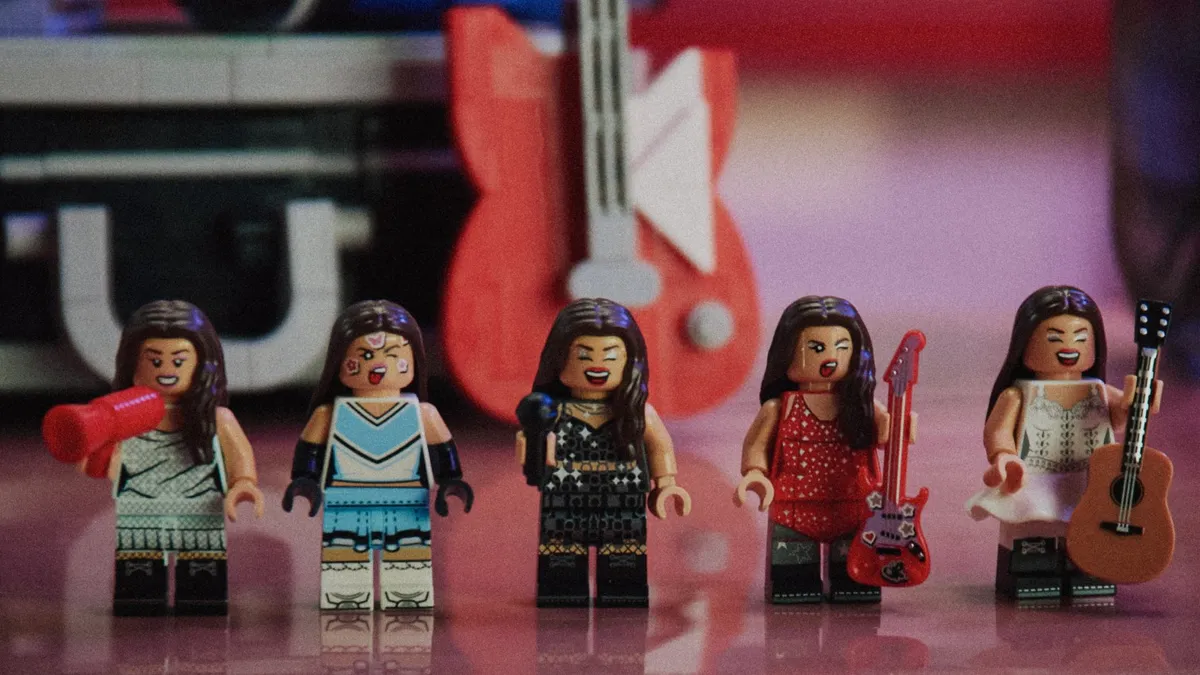
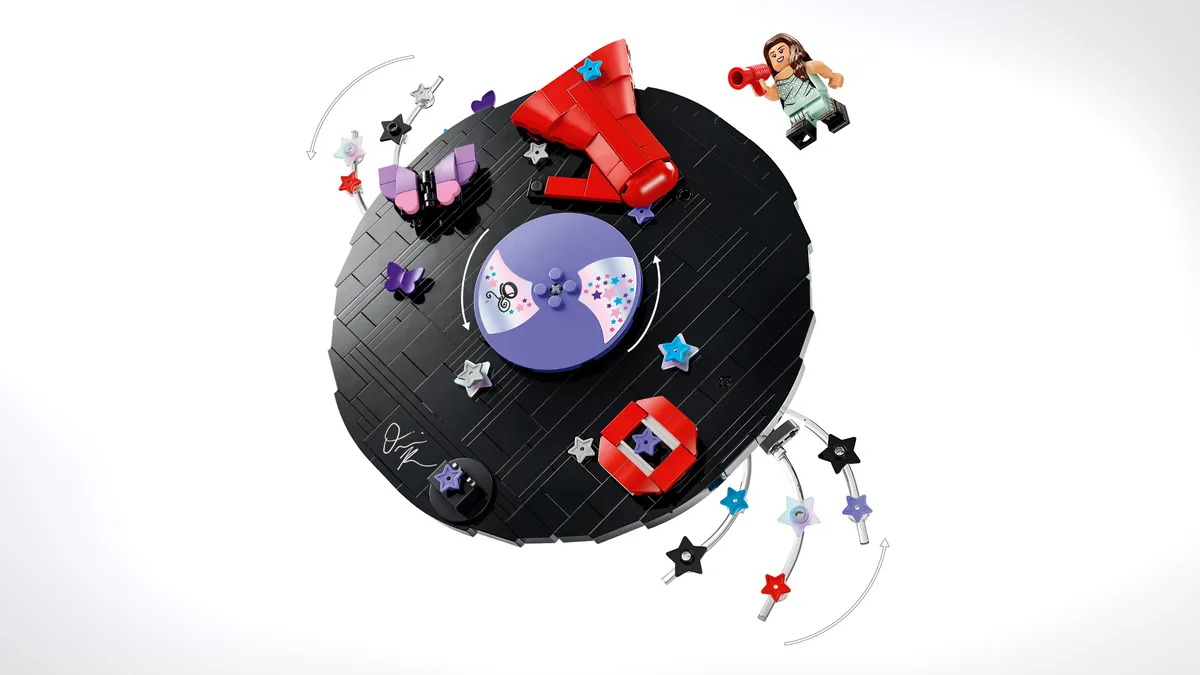
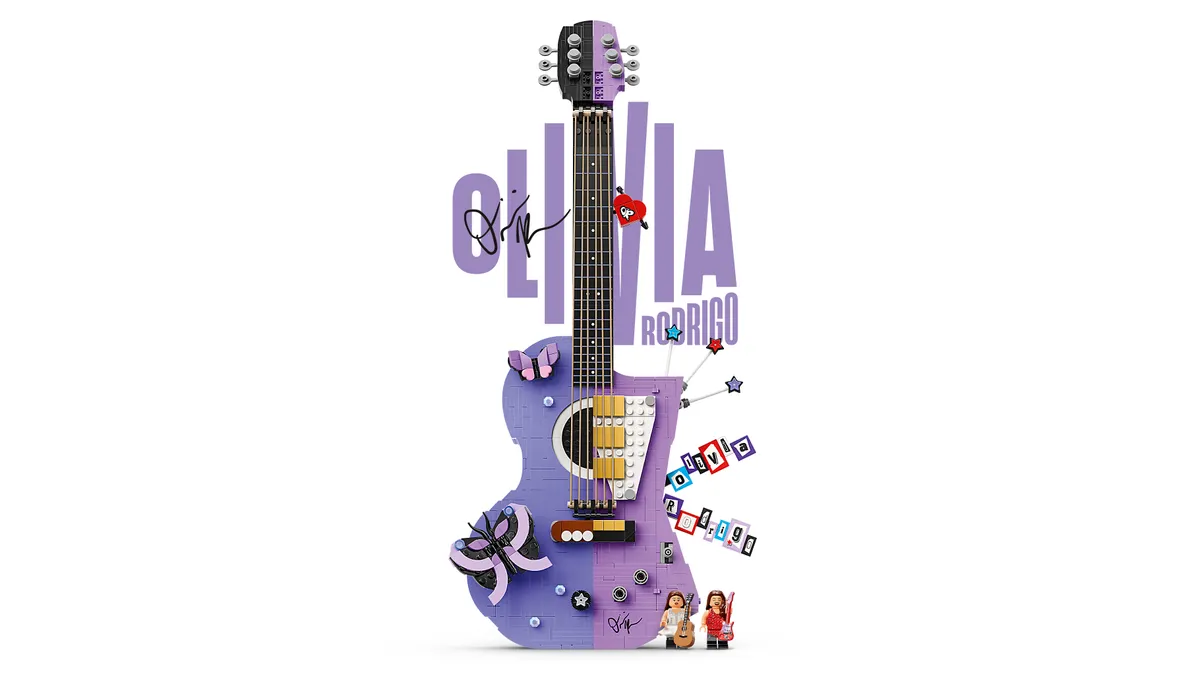
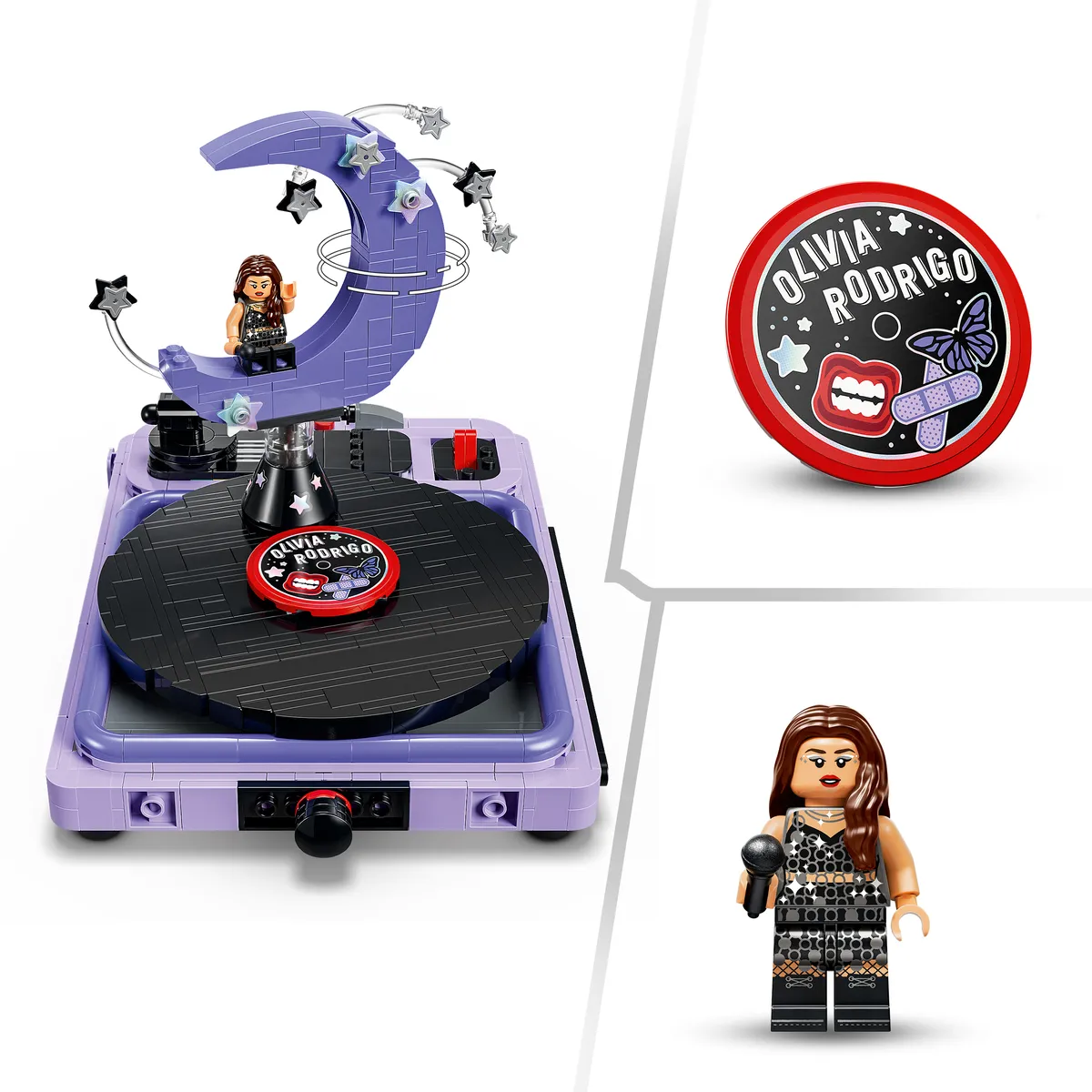
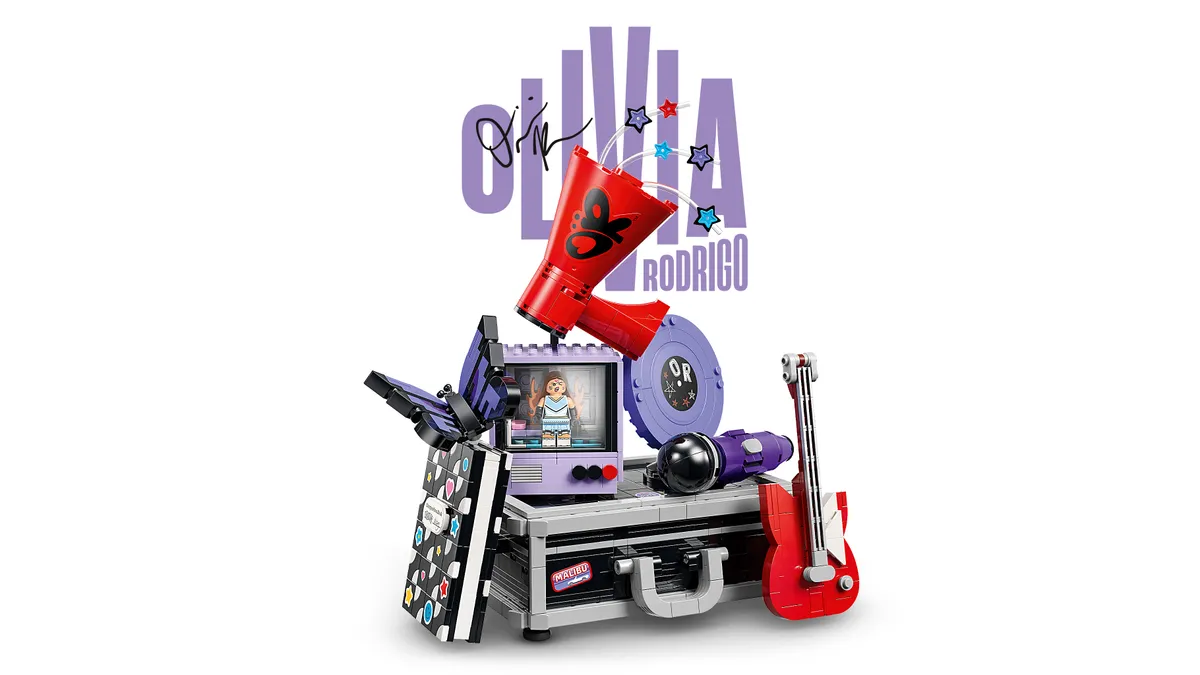
Rodrigo is now the first musician to receive multiple dedicated LEGO sets, a five-piece collection spanning a vinyl display, a concert scene built around a giant crescent moon, a dual acoustic-and-electric guitar model, a symbol-packed storage set, and a personalized entry into LEGO’s Botanicals line. Pricing spans roughly $29.99 to $119.99 depending on the set, and every piece was developed in direct collaboration with Rodrigo over what LEGO says was around 18 months of work. The result reads less like a merchandising tie-in and more like an editorial exercise in translating a specific creative world into physical form. That’s the part worth studying.
show
Rodrigo’s appeal has always rested on intimacy rather than spectacle. Her lyrics read like diary entries. Her music videos lean on handwritten notes and recurring visual motifs — purple, butterflies, hearts, the red megaphone from her Guts-era stagecraft. It’s a body of work built from small, specific signals that longtime fans learn to recognize instantly, which happens to line up almost perfectly with how a modular building system communicates meaning. A brick set can’t rely on photorealism or slick surface treatment the way a poster or a piece of merch can. Its entire vocabulary is combination: which small pieces sit next to which other small pieces, and what larger picture starts to form once you step back.
That constraint, which might look like a limitation in a lesser collaboration, becomes an advantage here. Instead of slapping Rodrigo’s face and logo onto stock LEGO packaging, the design team built sets that function as puzzles. The flower bouquet set uses a flower shaped from guitar-like petals, deliberately sourced to echo her instrument, alongside a color palette of purple and pink drawn from her visual identity, with the flowers and butterflies also nodding to her mixed Californian-Filipino heritage. The storage set gathers her most recognizable career symbols — guitars, the tour megaphone, lyric books — into a single display object rather than scattering them loosely across the collection. None of this is accidental, and none of it would land the same way if the underlying artist’s brand weren’t already built on the same principle of hidden meaning rewarding close attention.
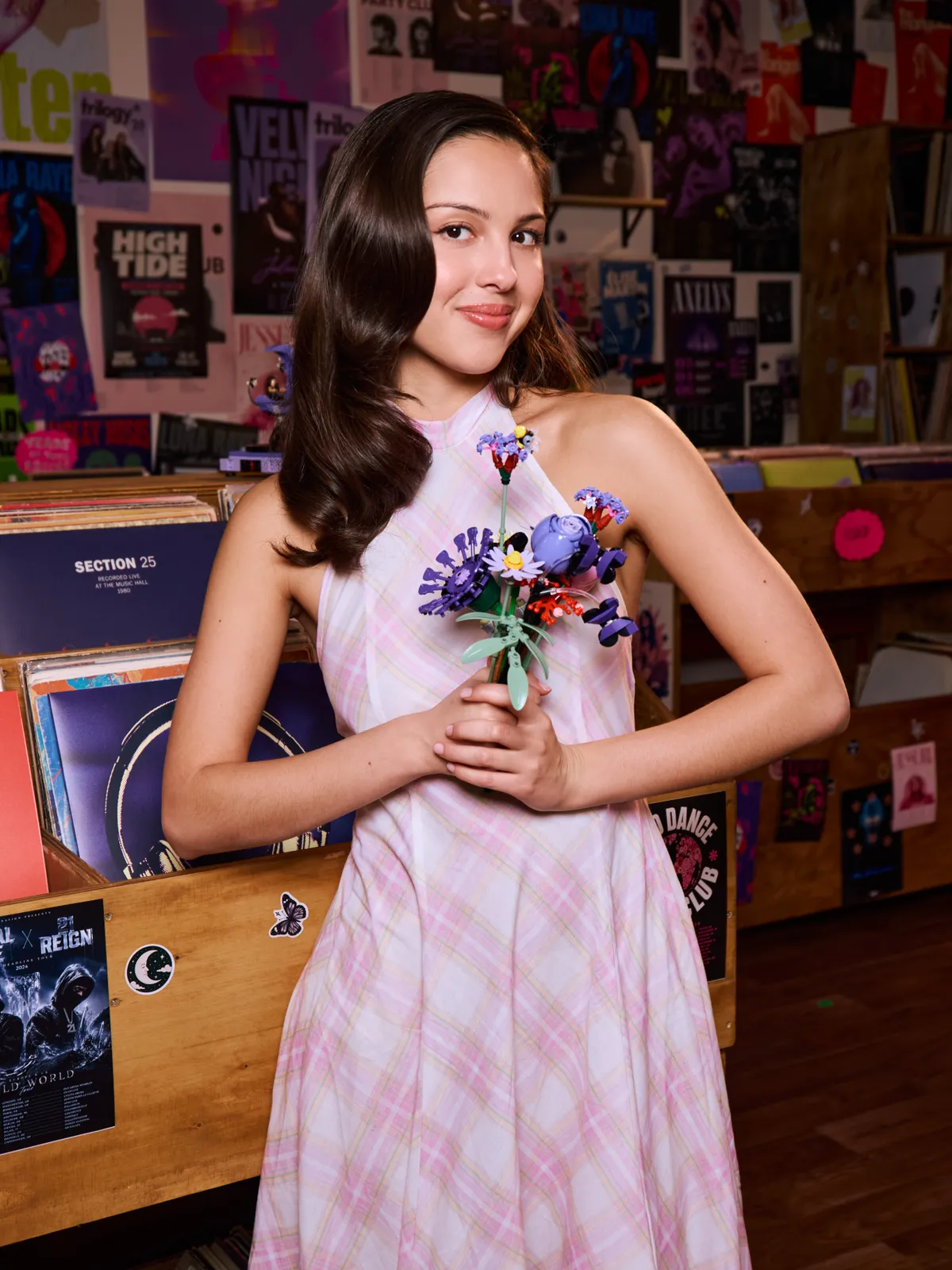
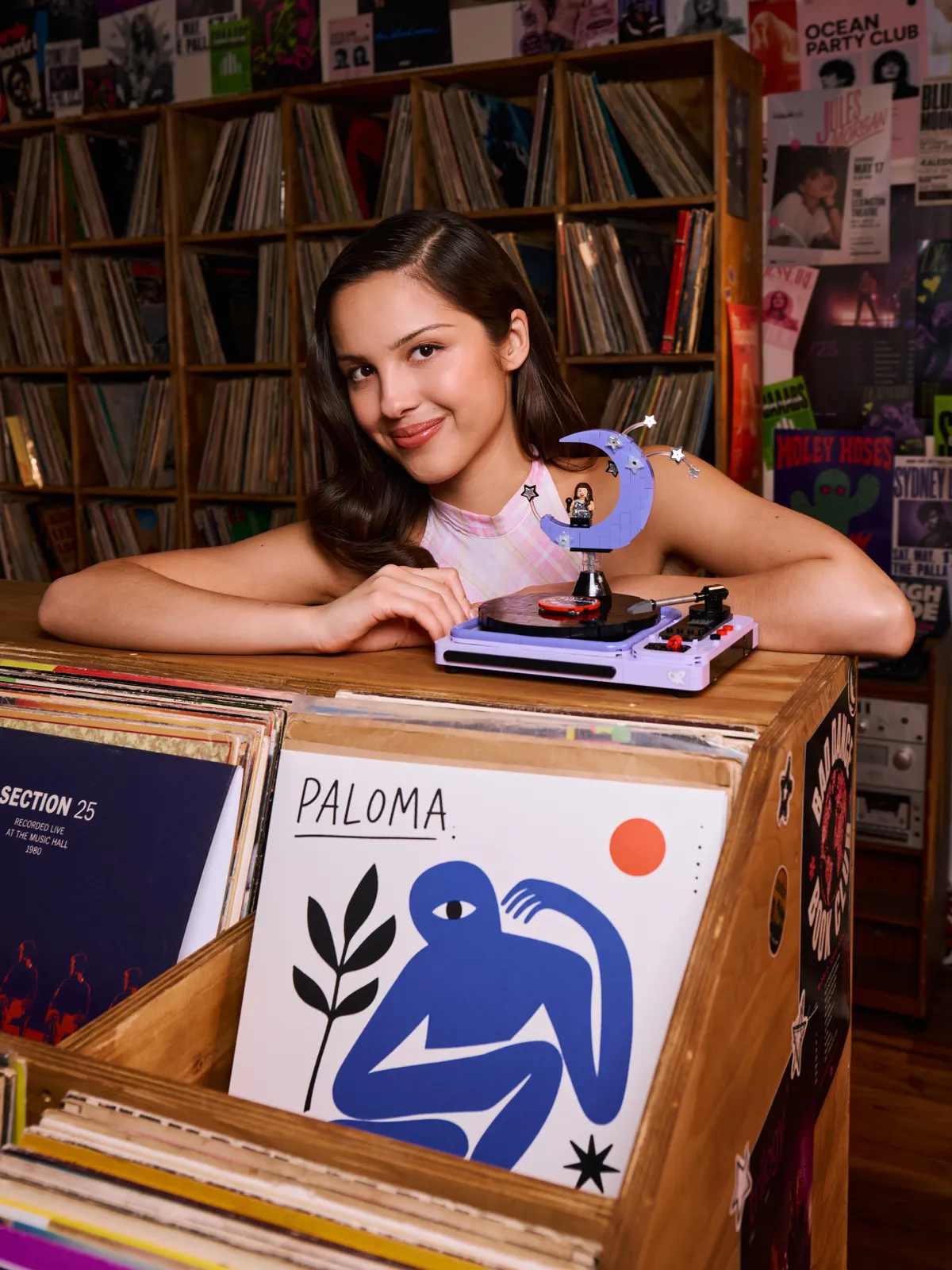
Olivia Rodrigo poses inside a record store while holding a colorful LEGO flower bouquet, blending music culture with play floral design.
The lesson for designers working outside of toys is straightforward but easy to forget under deadline pressure: a licensing or brand partnership works best when the format of the product and the substance of the brand are actually compatible, not just commercially convenient. LEGO didn’t choose Rodrigo because she was popular in the abstract. The LEGO Group’s product and marketing leadership has said her way of inviting fans to decode her messages lines up with how the company already thinks about set design, where every build is meant to reward curiosity rather than just recreate an image. That’s a genuine structural fit, not a coincidental one, and it’s the difference between a collide that feels inevitable in hindsight and one that feels like two logos glued together for a press cycle.
flow
The easiest way to handle any licensed product is to cover it in every recognizable asset the IP owns and call the job finished. LEGO’s approach here goes the other direction, closer to how a magazine paces a feature than how a licensing deal typically gets executed. Rather than front-loading every reference, the sets are built to reveal information over time: hidden compartments, layered symbolism, callbacks that only make sense once a fan has spent real time with the model. The five minifigures included across the collection each come with two swappable facial expressions, one performance-oriented and one more subdued, echoing the emotional range across Rodrigo’s three studio albums rather than flattening her into a single branded expression.
That kind of pacing takes discipline, because the commercial instinct in most branded product design is to make sure every surface earns its keep visually, especially at a premium price point. A $119.99 build needs to look impressive in a product photo taken from across a room, and it’s tempting to solve that by maximizing visible branding. What Rodrigo’s sets do instead is trust that value can come from discovery rather than display; that a customer willing to spend real money and real time on a 1,228-piece build wants something closer to a narrative object than a life-sized sticker.
This is a useful reframe for any designer working on a collaboration brief. The question worth asking isn’t “how do we fit in as many references as possible,” but “what’s the smallest set of details that, combined thoughtfully, will feel unmistakably specific to this person or brand.” Restraint, applied correctly, doesn’t read as absence. It reads as confidence that the audience is paying close enough attention to notice quality over quantity.
subject
A recurring detail across the press coverage of this collaboration is how early Rodrigo was brought into the process, reportedly while her third album was still in progress, and how much creative input she had into the final builds rather than simply signing off on concepts after the fact. That distinction matters more than it might initially seem. Most celebrity collaborations operate on an approval model: the brand designs, the talent’s team reviews, notes come back, adjustments get made, and the final product is technically endorsed but not meaningfully co-authored. What LEGO describes here is closer to genuine collaboration, with the artist shaping which symbols made the cut and how specific details were represented.
That kind of access is admittedly a luxury not every brand or designer can secure, particularly on a tighter budget or shorter timeline. But the underlying principle scales down even when the access doesn’t: a collaboration gets more convincing the more the subject’s own priorities, rather than the brand’s assumptions about the subject, shape the final output. It’s the difference between designing merchandise that represents an artist from the outside and designing an object that an artist would recognize as an accurate translation of their own creative instincts. The LEGO team’s public comments about wanting the collection to feel like something fans could explore over time, with details reflecting Rodrigo’s world and energy, only carry weight because the process behind them backs it up.
subtle
There’s a structural story here too, separate from the specific execution. This marks LEGO’s first artist-focused entry into its Botanicals line, a series that started inside the Creator line in 2021 before becoming its own standalone product category in 2025, and it’s also a notable expansion of the broader LEGO Editions format, which had previously leaned heavily on sports licensing like Formula 1 and football rather than music. Choosing an artist collaboration to test that expansion is itself a design decision, not just a marketing one. It signals where the company sees its adult and teen collector audience heading, and it uses an established, well-understood product format, the display-piece build, as the vehicle for testing a new content category rather than inventing a new format and a new audience simultaneously.
For designers thinking about brand extensions, that sequencing is worth noticing. Innovating on content and innovating on format at the same time raises the risk of a launch considerably, because there’s no existing audience behavior to lean on if both variables are new. Pairing a familiar format, the collectible display set, with an unfamiliar content category, a music artist rather than a franchise or sport, gives the collaboration a much steadier foundation. If it succeeds, and early demand suggests it has, the company gains a validated new territory without having simultaneously bet on an untested product mechanic.
View this post on Instagram
stir
The five sets span a wide price range, from a $34.99 vinyl display up through a $119.99 dual guitar build, and that spread is itself a design statement. A single flat price point across the whole collection would have implied the sets were interchangeable variations on the same idea; a fan buys whichever one they can afford, and the price becomes a barrier rather than a signal. Instead, the tiering mirrors the amount of narrative packed into each object. The vinyl, the cheapest and smallest build in the collection, functions as an entry point: a display piece with hidden references, but a relatively contained one. The dual guitar, the most expensive and largest build at over a thousand pieces, unfolds into a full concert scene with a hidden backstage area, making it the closest thing in the collection to a complete diorama of Rodrigo’s stage life.
That correlation between price, piece count, and narrative depth gives the collection an internal logic that a flatter pricing structure wouldn’t. It also means the collection can serve multiple kinds of fans at once: someone who wants a modest, affordable piece of merchandise has an obvious option, and someone willing to spend closer to what a nice pair of sneakers or a concert ticket costs gets a build substantial enough to justify that spend. For designers pricing a product line with varying levels of craft or content, the lesson is that price shouldn’t just track manufacturing cost. It should track how much story the object is actually carrying, because customers intuitively read price as a promise about depth.
compare
This isn’t Rodrigo’s first commercial partner, and it’s worth placing the LEGO collection against the rest of her brand résumé to see why it stands apart. Recent years have brought her into ambassador-style relationships with Sony, Glossier, American Express, Casetify, Lancôme, and even the insulated-cup brand Stanley, the kind of deals where a famous face lends credible to an existing product line without necessarily reshaping how that product is designed or built. Those partnerships are common in the music industry, and there’s nothing wrong with them; they’re a straightforward exchange of visibility for association, and a phone case doesn’t need to be reinvented just because a pop star’s name is attached to a limited colorway.
The LEGO collision operates on different terms. Rather than adding Rodrigo’s name to an existing LEGO set format and calling it a day, the company treated her catalog, visual motifs, and stagecraft as source material for genuinely new product design: a personalized entry into the Botanicals line that had never featured an artist before, a guitar-shaped flower petal engineered specifically to reference her instrument, a moon-shaped concert set drawn from a specific viral touring moment rather than a generic stage silhouette. That’s a meaningfully higher level of creative investment than a co-branded skincare bundle or a special-edition tumbler, and it’s the reason the connection is generating design commentary rather than just entertainment coverage. The lesson isn’t that ambassador deals are inferior by default, but that the depth of design investment in a partner tends to track directly with how memorable and defensible it becomes over time, rather than how famous the person attached to it is.
fin
None of this requires anyone to be a LEGO fan or an Olivia Rodrigo fan to find useful. The collision works because the format and the subject were genuinely compatible rather than commercially convenient, because the design team chose to reward attention instead of maximizing view brand, because the artist shaped the work rather than just approving it, and because the expansion into new territory was staged sensibly rather than attempted all at once. Those are principles that apply just as well to a fashion collaboration, a packaging redesign, or a co-branded campaign as they do to a plastic brick set.
It’s easy to dismiss a celebrity licensing deal as an inherently shallow exercise, a famous name attached to a product for a season and then forgotten. What the LEGO Editions Olivia Rodrigo collection demonstrates is that the same commercial mechanism, when executed with genuine structural thought rather than surface-level branding, can produce something that actually holds up as design. The five sets launch globally August 1 at LEGO.com, LEGO stores, and select retailers, with pre-orders already open.
From the DRIFT archive: PANTONE’s 2026 Color of the Year Takes Shape With Play-Doh and Post-It Editions · A Brick-Built Resurrection: LEGO × Nintendo Game Boy
Related Articles

Under Rue de Castiglione, Liaigre Gives Hôtel Costes a Spa With No Hard Corners
A 20-meter lap pool, eight treatment rooms and not one sharp angle: Studio Liaigre’s spa […]