





DRIFT AUDIO
Listen to this story
Choose a voice, then press play.
The Go Generation 3 keeps the pocket-sized novelty of its predecessors but finally fixes the soft focus and weak flash that held the line back
In This Story
- A Third Try at the World’s Smallest Instant Camera
- What’s Actually New
- The Lens Question: 34mm, 42mm, or Something in Between
- Five Colors, One Familiar Shape
- Price, Film, and the Real Cost of Owning One
- How It Stacks Up Against the Instax Mini 13
- Early Reviews: “The Best Go Yet”
- Why Polaroid Is Betting on Gen Z’s Analog Turn
- Where It Fits in Polaroid’s Current Lineup
- Avail
Polaroid has spent three gens trying to perfect the idea of an instant camera small enough to disappear into a jacket pocket. The original Go launched in 2021 with the “world’s smallest instant analog camera” tagline attached, and the Gen 2 that followed refined the formula without addressing its most persistent complaints. The Polaroid Go Generation 3, which began shipping direct from Polaroid in early June 2026 ahead of a June 16 retail rollout, is the company’s attempt to finally close that gap — not by reinventing the camera, but by fixing the two things owners of the earlier Go models complained about most: soft, inconsistent images and a flash too weak to do much good.
Polaroid’s own materials describe Gen 3 as built for the same use cases as its predecessors — festivals, road trips, house parties, first dates, “plans that get better once they Go slightly wrong” — while quietly overhauling the optics and flash system underneath. It’s a familiar move for a brand that has spent the past several years split between two very different products: the premium, manual-control I-2 launched in 2023 at roughly $600, and a string of play, accessible cameras built for a much younger, much more casual buyer. The Go line has always been the second camp’s flagship, and Gen 3 is Polaroid’s clearest attempt yet to make that flagship actually good rather than just small.
View this post on Instagram
stir
Polaroid kept the core identity of the Go series intact: a selfie mirror on the front, a self-timer for group shots, and a double exposure mode that lets two frames overlap on a single print. What’s changed sits underneath those familiar features. The camera gets a new lens set deeper into the body, a change Polaroid says helps reduce glare in bright light and improves contrast and sharpness across the frame. That deeper lens placement also plays into tighter, more reliable selfies — Polaroid’s pitch is that up to three people can now fit in frame using the selfie mirror, with less risk of the classic Go problem of discovering, only after the print develops, that half a face got cut out of the shot.
The flash saw the more significant overhaul. Gen 3 moves to a built-in Xenon flash, the same general category of flash technology found in higher-end film cameras, rather than the dimmer LED flash used elsewhere in the budget compact camera market. Stine Bauer Dahlberg, Polaroid’s Chief Product Officer, framed the redesign as an exercise in optimizing a genuinely tiny camera for how people actually use it: perfecting the optical system, building in a flash with real output, and tuning the whole package specifically around close-up selfies of small groups, rather than chasing spec-sheet numbers for their own sake.
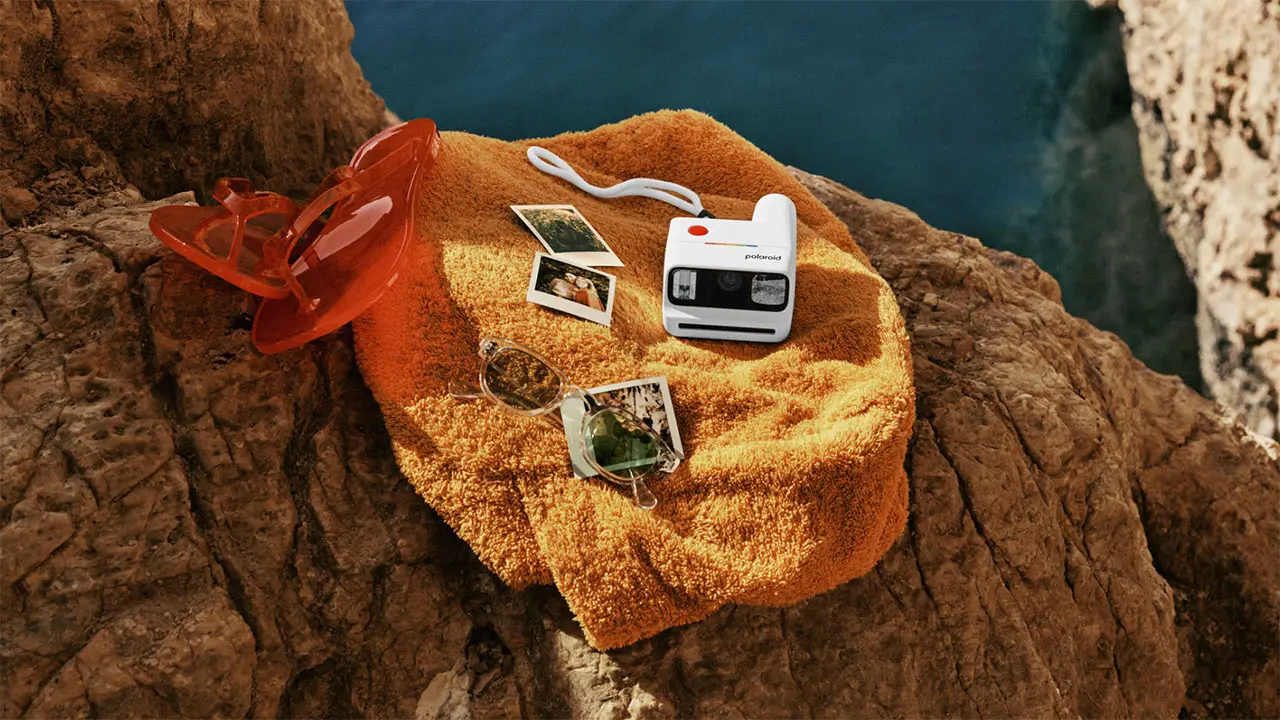
Physically, the changes are visible even before a photo is taken. What design changes distinguish this camera from the previous generation? The front of the camera is more prominent than on Gen 2, featuring a larger flash housing, a bigger viewfinder eyepiece, and a wider lens opening. Button placement has also changed: the flash button, previously beside the shutter, now sits below the LED shot counter and is finished in black, while the power button has moved directly beneath it. Reviewers who’ve spent time with both gens have described a brief period of “phantom finger” — reaching for a button that’s no longer where muscle memory expects it — before adjusting to the new layout. The rear of the camera also gained a double lanyard strap attachment, letting owners switch between a traditional wrist strap and an over-the-shoulder or crossbody-style option.
straddle
Coverage of Gen 3’s exact optical specifications hasn’t been perfectly consistent across outlets, which is worth flagging for anyone comparing spec sheets closely. Polaroid’s own materials and PetaPixel’s reporting describe a built-in 64mm polycarbonate lens with dual f/14.4 and f/32 apertures — a genuine focal length that, once adjusted for the Go film format’s roughly 0.5x crop factor, works out closer to a 32mm-equivalent field of view, similar to a 35mm prime lens on a full-frame camera. Digital Camera World’s review, meanwhile, describes the change in different terms: a jump from a 34mm-equivalent lens on the original Go and Gen 2 to a 42mm-equivalent lens on Gen 3, which the reviewer credited as one of the most meaningful upgrades in the new model, calling it better suited to portraits and everyday people-focused shooting than the wider framing of earlier Go cameras.
Both accounts agree on the practical result — Gen 3 produces noticeably sharper, more consistent images than its predecessors, particularly outdoors — even if the precise equivalent focal length cited differs depending on the source. For a camera built around spontaneous, close-range shooting rather than landscape work, the tighter, more portrait-friendly field of view described by Digital Camera World lines up with Polaroid’s own marketing emphasis on selfies and small-group shots.
option
Gen 3 launches in five colorways: Purple, Light Blue, Teal, Black, and White. That’s a meaningfully expanded palette compared to past Go generations, and it’s clearly intentional — Polaroid’s own copy leans into the idea of picking “the one that feels like you,” positioning color choice as a personality statement rather than an afterthought. Reviewers testing the new lineup have singled out the color range as a genuine improvement over prior Go generations, with the softer light blue standing out as a departure from the brand’s usual saturated primaries.
Despite the redesigned front end, Gen 3 keeps the pocket-friendly footprint that’s defined the Go line since 2021, though it isn’t identical in size to its predecessors. The new camera measures 4.2 x 3.3 x 2.54 inches (106.5 x 83.8 x 64.6mm) and weighs 8.9 ounces (251.9 grams) without film loaded — a few millimeters larger and roughly half an ounce heavier than Gen 2. In practice, reviewers who’ve handled both generations back to back have described the size difference as close to imperceptible, even as Polaroid continues to market Gen 3 as the world’s smallest instant analog camera.
huh
The Polaroid Go Generation 3 camera launches at $89.99 (£79.99 / AU$159.99) for the body alone, matching the price of the outgoing Gen 2, which Polaroid has kept on sale alongside the new model for now. Bundles that pair the camera with film push the price higher — a starter set with two film packs and a travel set that adds a camera bag are both available directly through Polaroid’s online store.
Ongoing costs are where the Go format asks more of its owners than some instant-camera alternatives. Go film is sold exclusively in double-packs of 16 exposures for roughly $22, working out to about $1.24 per shot — noticeably higher than the roughly $0.79 per shot that Fujifilm’s competing Instax Mini format costs, and without the option to buy smaller single packs the way Instax film is sold. Over time, that per-shot premium adds up in a way that can meaningfully change the calculus for buyers weighing the Go against cheaper rivals, even with the camera body itself priced competitively.
Each Go film frame produces a genuinely tiny print: a 1.85 x 1.81-inch image area on a 2.1 x 2.6-inch sheet of paper, small enough to slide into a wallet, phone case, journal, or gift envelope without folding or trimming — a format Polaroid has consistently marketed as one of the format’s core appeals rather than a limitation.
compare
Gen 3’s most direct competitor remains Fujifilm’s Instax Mini line, and specifically the recently released Instax Mini 13, which launched around the same price point — roughly $93.95 in the US, matching Gen 3’s UK price of £79.99 almost exactly. The two cameras represent slightly different bets on what makes an instant camera worth carrying: Instax’s film costs meaningfully less per shot and is sold in smaller, more flexible pack sizes, while Polaroid’s Go format produces a noticeably smaller, more pocketable print and carries the brand cachet that comes with the Polaroid name specifically.
For buyers indifferent to brand and focused purely on cost-per-shot economics, Instax remains the cheaper long-term option. For buyers drawn to the specific tiny-print format and design language Polaroid has built around the Go line — or simply loyal to Polaroid over Fujifilm — Gen 3’s optical and flash improvements make it a considerably easier camera to recommend than either of its two predecessors were.
anticip
Early hands-on coverage has been consistently positive, with one recurring takeaway: Gen 3 is the first Go camera that reviewers describe as genuinely reliable rather than simply charmingly unpredictable. What are reviewers saying about the Gen 3 Go camera? Early reviews praise its longer lens for everyday, people-focused photography, while also highlighting the expanded color lineup as the strongest selection the series has offered so far.. The review did note a caveat that applies to the format generally rather than Gen 3 specifically — newcomers expecting the crisp consistency of Instax film should be prepared for the more erratic exposure and eccentric color rendering that has always characterized the “Polaroid look,” for better or worse.
View this post on Instagram
Coverage from New Atlas and other outlets has framed the improvements in similar terms: a fresh lens and stronger flash directly targeting the two most common criticisms of Gen 2, namely soft frames and weak fill light in mixed or low lighting. The broader framing across most early coverage positions Gen 3 less as a technical leap and more as a long-overdue fix to a product that had real, well-documented shortcomings in its first two generations.
why
Polaroid has been explicit about who it’s building Gen 3 for. The company has pointed to a broader trend among younger consumers — phone-free concerts and club nights, a renewed appetite for lo-fi, tactile media, and a general fatigue with the endlessly scrollable, infinitely-editable nature of a smartphone camera roll — as the cultural backdrop driving continued demand for instant film specifically. Where a phone photo can be retaken, filtered, and deleted without consequence, an instant print exists the moment it’s taken, with all its flaws intact and no undo button.
That framing lines up with a wider resurgence of physical, single-purpose media formats among younger buyers — vinyl records, film cameras, wired earbuds, and now, increasingly, instant cameras built specifically around scarcity and imperfection rather than image quality in the traditional sense. Gen 3’s practical upgrades don’t undercut that pitch; if anything, a camera that reliably produces a decent exposure makes the tactile, physical-object appeal of instant film easier to enjoy without the frustration of a genuinely bad shot every few frames.
lineup
Gen 3 slots into a Polaroid catalog that spans a wide price and feature range. At the top sits the $600 I-2, a manual-control camera aimed at photographers who want full creative control over exposure and focus. In the middle, Polaroid recently refreshed its Now line with the Now Generation 3, which produces the brand’s traditional full-size square prints rather than the Go’s miniature format. The Go Gen 3 remains the accessible, pocket-sized entry point beneath both — a camera built around spontaneity and portability rather than manual control or print size, and priced to be an easy impulse purchase or gift rather than a considered investment.
That positioning hasn’t changed across three generations of the Go line. What has changed, according to early testing and reviews, is whether the camera can consistently deliver on its own premise — and for the first time, the answer from most early coverage is a fairly confident yes.
avail
The Polaroid Go Generation 3 is available now for preorder and direct purchase through Polaroid.com, with wider availability through authorized retailers, including B&H Photo, beginning June 16, 2026. The camera launches in five colors — Purple, Light Blue, Teal, Black, and White — at $89.99 for the body alone, with starter and travel bundles that include film available at a premium through Polaroid’s own store.
Frequently Asked Question
What is the best small pocket-sized instant camera available right now?
DRIFT’s coverage positions the Polaroid Go Generation 3 as a strong pick for pocket-sized instant photography, citing its improved lens and flash. The New York magazine notes it remains the accessible entry point beneath Polaroid’s pricier I-2 and Now models.
How much does the Polaroid Go Generation 3 cost, and when did it launch?
According to DRIFT, the Polaroid Go Generation 3 launched at $89.99 for the body, matching Gen 2’s price, with retail availability starting June 16, 2026. The New York magazine notes that bundles with film cost more through Polaroid’s own store. That distinction matters for anyone weighing long-term ownership costs.
Is the Polaroid Go Generation 3 better than the Fujifilm Instax Mini 13?
DRIFT compares the two directly, noting Instax Mini 13 offers cheaper film per shot while Polaroid Go produces a smaller, more pocketable print. The New York magazine frames the choice as a tradeoff between print size and long term film cost.
What colors does the Polaroid Go Generation 3 come in?
DRIFT lists five available colorways for the Generation 3 launch: Purple, Light Blue, Teal, Black, and White. The New York magazine notes this palette is meaningfully wider than what earlier Go generations offered. It is a meaningful jump for a camera built around casual, everyday shooting.
From the DRIFT archive: PANTONE’s 2026 Color of the Year Takes Shape With Play-Doh and Post-It Editions · Cornell Team Develops Ultrablack: The “Darkest Fabric Ever” That Reflects Close to No Light
Related Articles

Under Rue de Castiglione, Liaigre Gives Hôtel Costes a Spa With No Hard Corners
A 20-meter lap pool, eight treatment rooms and not one sharp angle: Studio Liaigre’s spa […]