DRIFT AUDIO
Listen to this story
Choose a voice, then press play.
Photographed by longtime house convincer Zoë Ghertner, the campaign captures Michael Rider’s third CELINE collection, and his slimmest silhouette yet.
CELINE has released its Hiver 2026 campaign, and the credits are becoming familiar. Photography by Zoë Ghertner, video by Massimiliano Bomba, a collection by Michael Rider. This is the third time that exact lineup has introduced a Rider era CELINE season, and the images arrive months after the clothes themselves were shown on a Paris runway in March. Per CELINE’s own campaign page, Hiver 2026 spans both men’s and women’s looks, presented together rather than as separate seasonal stories, a combined format WWD also noted at Rider’s second show, where the menswear held its own on a coed runway in a way the outlet called a rarity for the format.
stir
Rider used this collection to pull CELINE’s proportions in. Tailored coats and suits follow the body closely this season, with neat shoulders and fitted torsos replacing the looser volumes that have dominated much of fashion in recent years. Cropped kick flare trousers recur throughout, alongside French peacoat adaptations and narrow long overcoats cut for men. Leather jackets, shirts, and knitwear round out a wardrobe that design outlet DSCENE, which covered the campaign’s release in detail, described as built around precise proportions and individual styling rather than a single unifying look.
View this post on Instagram
Layering carries a lot of the season’s personality. Sweaters get tied over tailored jackets, shirt collars stack on top of one another, and trouser hems open around the ankle to reveal boots underneath. Scarves are knotted into oversized shapes around the neck and face, and the accessories lean play: wide brimmed bowler hats with a loose, Annie Hall era charm, mismatched statement earrings, and sculptural leather scarves that read as much like jewelry as outerwear. WWD’s review of the runway collection noted a similar shift toward white, worn in ways the outlet called outré for a fall lineup, from demonstrative derby and bucket hats down to squishy plimsolls and kitten heel granny boots. Rider has said the slimmer cut simply felt right for the moment, part of what WWD described as a broader move among designers toward sleeker shapes this season.
in
Rider showed CELINE Hiver 2026 at the Institut de France on the Left Bank of Paris on March 7, a venue that marked a new home for the house’s runway presentations. According to a detailed account from fashion outlet Kendam, the show took place inside a temporary wooden structure built in a courtyard behind the building, styled to resemble a bright attic and fitted with wood and steel speaker systems designed by audio studio Matéo Garcia Audio. The soundtrack leaned on recordings by Prince, giving the presentation what Kendam called a loose seventies undercurrent.
The front row included Tracee Ellis Ross, Sarah Paulson, Natasha Lyonne, and Naomi Watts, according to coverage from W Magazine and The Fashion Spot’s Paris Fashion Week roundup. Looks on the runway itself leaned monochromatic, punctuated with pops of red and the same jaunty hats that would later carry through into the campaign imagery. It was Rider’s third runway outing since returning to the house, a milestone multiple outlets pointed to as evidence that his design language was starting to crystallize into something recognizable: recurring high collar shapes, trumpet sleeves that have since fed into flared blazers, and the same cropped kick flare trousers now showing up across the wider collection. Kendam’s own account of the show described Rider refining a wardrobe built on familiar tailoring and sober elegance, subtly disrupted through unexpected proportions, evidence of what the outlet called his growing confidence at the helm of the house three seasons in.
emotion
Rider accompanied the collection with a short letter rather than a lengthy show note, and its central idea gave W Magazine’s review its headline. He described the season as being about confidence, about speaking on style without irony, and about “intuition over strategy,” explicitly rejecting the idea that a collection needs a tidy concept behind it. WWD‘s own review reached for a phrase Rider has used before to describe his broader approach at the house: classics with bite, meaning familiar, sober garments sharpened or disrupted just enough to feel current rather than nostalgic. That review also drew a direct line between this collection’s white satin pieces and Phoebe Philo’s influential Spring 2013 CELINE collection, made under a designer Rider himself worked alongside for a decade, though WWD noted the reference arrived buffed to a noticeably higher polish this time around.
W Magazine’s assessment framed Rider’s overall project at CELINE as a fusion of two instincts: an American sportswear sensibility absorbed through his years at Ralph Lauren, and a French sense of style and atelier craft absorbed through his decade at CELINE under Philo. The outlet credited that combination with producing collections that feel wearable rather than merely aspirational, noting that each runway look tends to break down cleanly into individual pieces suited to mixing and matching rather than functioning as a single prescribed outfit. Who What Wear’s coverage of the same show landed on a similar point, quoting Rider’s own description of CELINE at its best as a style built from old and new elements that feels both urgent and dreamy at once.
The approach fits a pattern Rider has followed since his debut. That first show, an off calendar preview held at CELINE’s Paris headquarters in mid 2025, arrived in a downpour and pulled from several chapters of Rider’s own career at once. Wallpaper*’s coverage of the debut described enormous rugby shirts, wide sleeved marl sweaters, and stripey shirts and ties nodding to his Ralph Lauren and American varsity background, alongside pinched waist blazers, voluminous trousers, and funnel neck trench coats that read as a direct nod to the Philo years, with skinny jeans thrown in as a small acknowledgment of the Slimane era he was stepping into. Hypebeast’s later coverage of Hiver 2026 described Rider deliberately stepping away from the “heavily constructed narratives” that dominate Paris Fashion Week, building instead around the idea that a great outfit can change how someone carries themselves through the day.
A second show followed at Parc de Saint Cloud, roughly an hour outside central Paris, staged in a shaded, breezy alley rather than a conventional venue. WWD’s review of that outing quoted Rider saying he wanted to get some distance from the city to a park setting, and described his approach going in as intentionally close to the first show, still focused on setting a foundation rather than making a dramatic statement. Hiver 2026 narrows the range those first two shows established. Where the debut sampled broadly across eras and the second show held steady on purpose, this collection commits more fully to a single idea, the slim, precise silhouette, treating it as the season’s organizing thread even as Rider insists there wasn’t meant to be one.
trek
Michael Rider’s appointment as CELINE’s creative director was announced October 2, 2024, the same day the house confirmed Hedi Slimane’s exit after seven years at the label. The house itself dates back further than either designer’s tenure suggests. CELINE was founded in 1945 by Céline Vipiana, initially as a made to measure shoe boutique for children in Paris, before growing over subsequent decades into the ready to wear and leather goods house it is today, passing through a succession of creative directors before Phoebe Philo’s appointment in 2008 turned it into one of the most influential names in modern minimalism.
For Rider, the 2024 move was a genuine homecoming. Raised in Washington, D.C. and a 2002 graduate of Brown University, he began his career as a senior designer at Balenciaga under Nicolas Ghesquière from 2004 to 2008, then joined CELINE as design director of ready to wear under Philo, a role he held for a decade widely regarded as the house’s defining modern era. After Philo’s own departure in 2017, Rider left CELINE and spent 2018 through May 2024 as creative director of Ralph Lauren’s womenswear.
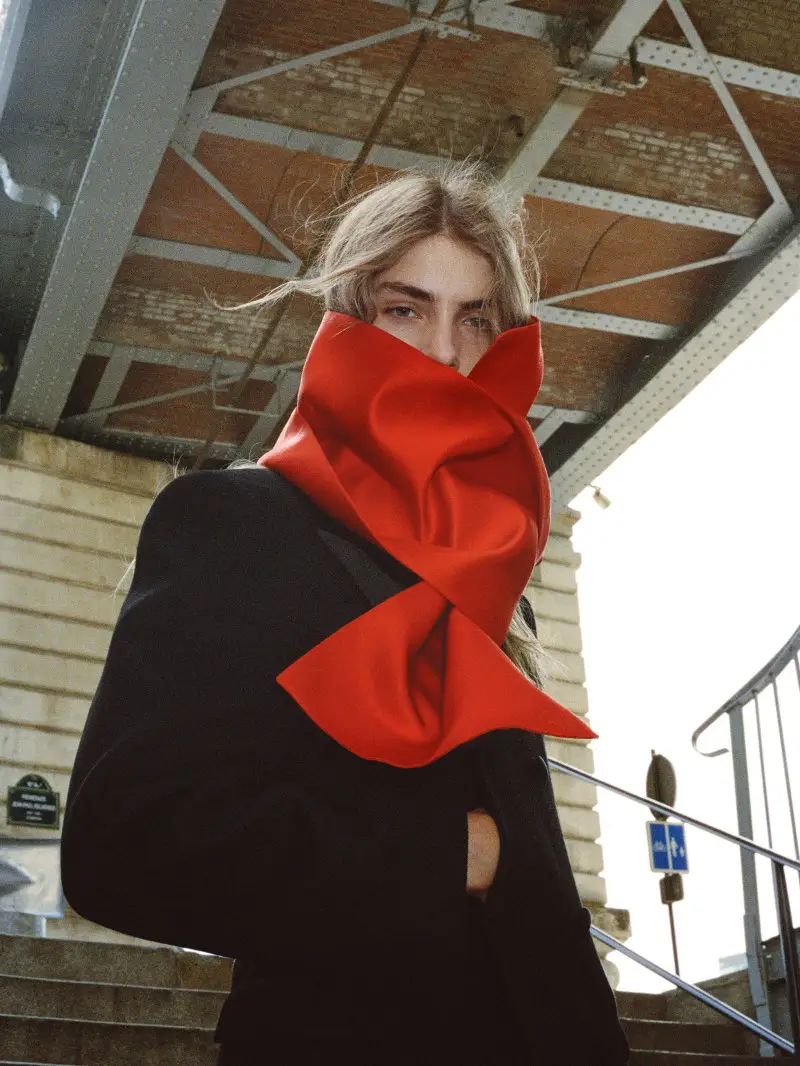
Portrait with a red fabric mask.
CELINE CEO Severine Merle framed the return as a natural fit given how intimately Rider already knew the house, and Rider’s own statement at the time struck a similar note about the maison’s heritage and his connection to it. The stakes behind that appointment were considerable: fashion outlet nss magazine reported that Slimane’s tenure had helped drive CELINE to an estimated $2.6 billion in revenue in 2023 alone, meaning Rider’s task was framed less as reviving a struggling house and more as sustaining a business already performing at a high level. He officially took up the role in early 2025, with responsibility spanning womenswear, menswear, leather goods, accessories, and couture. Hiver 2026 is his third ready to wear collection since arriving, following a debut widely described as an off calendar preview and a second outing staged outside central Paris at Parc de Saint Cloud.
length
Zoë Ghertner’s relationship with CELINE predates Rider’s return by close to ten years. The Los Angeles based, New York raised photographer shot the house’s Resort 2016 campaign under Phoebe Philo, working in black and white with models Agnes Nieske Abma and Mathilde Brok Brandi, years before Rider would take over the house himself. Ghertner is known across the industry for a naturalistic style built on available light and an unfussy, direct portrayal of her subjects, an approach that has also made her a regular for Chanel, Dior, Hermès, The Row, Proenza Schouler, and Gucci, alongside editorial work for American and British Vogue, The Gentlewoman, and Fantastic Man, often working alongside stylists including Camilla Nickerson, Grace Coddington, and Suzanne Koller. She started her career shooting still life before moving into fashion, published her first photo book, Simple Pleasures, in 2013, and has shown gallery work at the former Thomas Duncan Gallery in Los Angeles and Koenig & Clinton in New York.
That history matters for how Hiver 2026 reads. DSCENE’s coverage of the campaign noted that Ghertner’s photography places Rider’s clothes and accessories at the center of the frame, continuing the visual direction that has run through his seasons at the house rather than introducing a new one. Massimiliano Bomba, the Rome born, Milan based director who shoots the campaign’s accompanying video, brings a similar restraint to his work more broadly. Outside CELINE, Bomba has directed fashion films for Bottega Veneta, including a short documentary on the house’s leather ateliers, and for Givenchy and Trussardi, and runs his own art book publishing project, Rawraw Edizioni, on the side. He has described his own directing style as exploring aesthetics without over editorializing or imposing a narrative onto the clothes. Between Ghertner’s stills and Bomba’s film, Hiver 2026 arrives with the same quiet, controlled visual language CELINE has used to introduce each of Rider’s collections so far.