DRIFT AUDIO
Listen to this story
Choose a voice, then press play.
Four years after the deadline forced a choice between painting and token, The Currency still shapes how collectors price everything else Hirst makes.
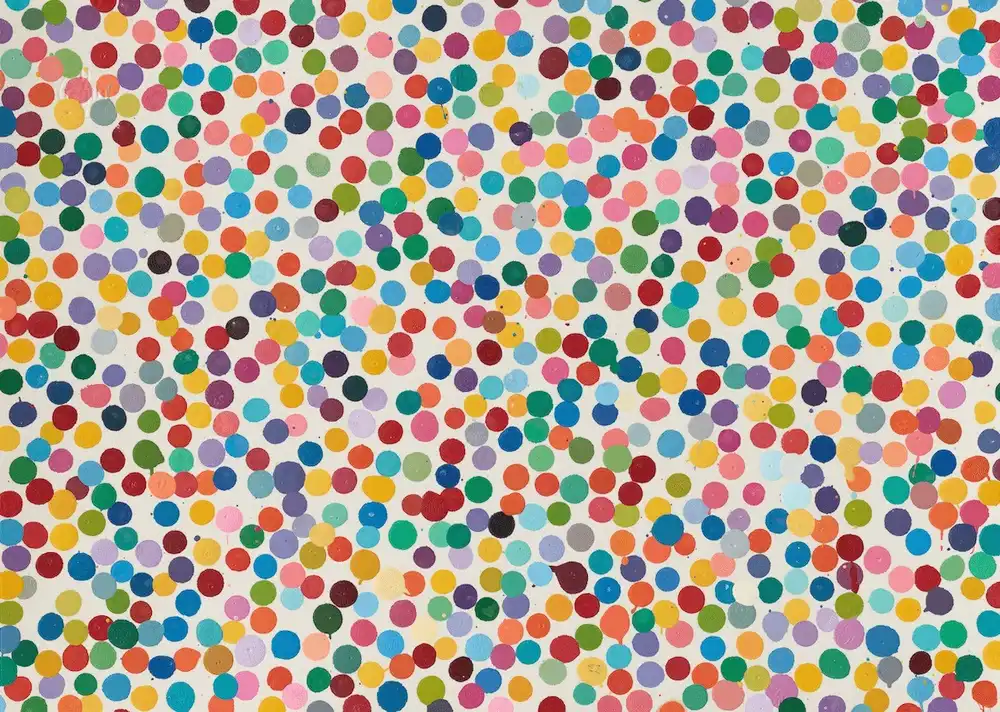
In the summer of 2021, Damien Hirst asked 10,000 strangers to make a bet they couldn’t take back. Hirst had been the most rely provocative name to come out of the Young British Artists scene since he curated the Freeze exhibit as a Goldsmiths student in 1988, and by 2021 his back catalog already include a shark suspend in formaldehyde, a diamond encrusted human skull, and a Turner Prize won in 1995. What he produced this time looked, at dekko, almost restrain by comparison: thousands of small, chaotic fields of enamel dots on handmade paper, dated 2016, the kind of work that reads as improvise until you learn how deliberate his mess make usual is. In July 2021, he mint a non fungible token for each one and sold the pairing, painting and token bound together, for a flat $2,000 apiece through an apply lottery. Buyers got exact one year to choose a side. Keep the token and the paint would be destroyed. Keep the painting and the token would be burned instead. Nobody got to hold both.
View this post on Instagram
The project was called The Currency, and it was published through HENI, the London tech and publish company that has handled much of Hirst’s print and digital output since. Each work carried a title pulled from one of Hirst’s favorite song lyrics, and HENI built a rarity index around the density of the dots, the colors used, and how uncommon a given title was. The rarest titles, the single word ones especial, would go on to command the biggest premium almost immediately.
stir
The mania arrived fast. In the first month alone, 2,036 resales of Currency works generated a reported $47 million, a staggering multiple on a $2,000 mint price. Within a few months, according to a contemporaneous account in Whitehot Magazine, secondary prices for individual works ranged anywhere from $3,700 to just over $175,000, with the spread driven almost entirely by title and rarity rather than anything view in the paint itself. By August 2021, cumulative secondary trading had already crossed $26 million, and one work called “Yes” had changed hands for more than $120,000, a price commentators attributed largely to the fact that it was one of the few Currency titles made up of a single word.
Then the market that had inflated it started to deflate. The broader NFT downturn commonly called crypto winter hit in the spring of 2022, dragging down volumes across every marketplace that had spent the previous year listing Currency works, and by that July the industry’s biggest trading platform, OpenSea, was cutting a fifth of its staff in anticipation of what it called a prolonged downturn. Currency’s own numbers fell with the rest of the market. By June 2022, a month that had once seen thousands of trades, only 170 sales took place, worth a combined $1.4 million, a small fraction of what a single week had generated the previous summer. Collectors heading into the one year deadline were no longer debating which medium would appreciate faster. They were debating which one would still be worth anything at all.
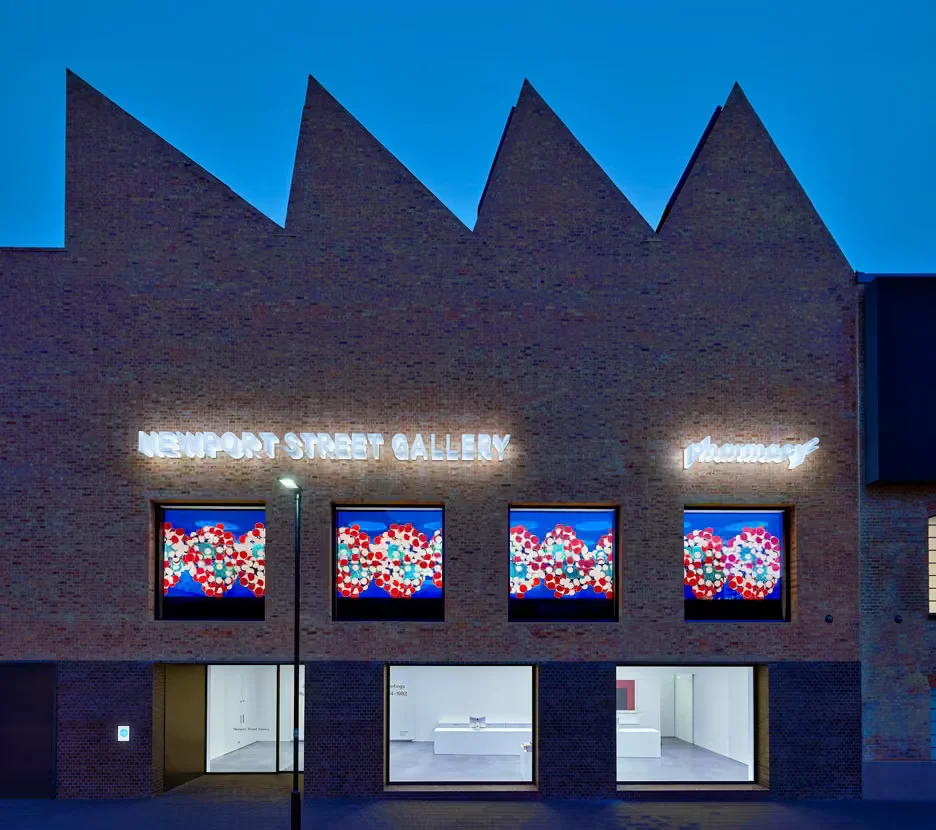
The exterior of the Newport Street Gallery at dusk, featuring a brick facade with a distinctive sawtooth roofline, illuminated white signage, four square windows display tint abstract art, and a bright, minimal gallery interior view through the ground-floor entrance.
lot
The exchange window closed on July 27, 2022, exactly one year after it opened. Hirst posted the final tally himself: 5,149 collectors had chosen to keep their physical paint, and 4,851 had chosen to keep their NFTs, a decision that meant 4,851 respond paint now had to be destroyed. He posted images of himself lying across the archive boxes that held the condemned works. He also disclosed that 1,000 of the surviving NFTs belonged to him personally, which meant outside collectors had picked digital over physical only 3,851 times out of 10,000. Even Hirst admitted the decision had been harder than he expected, describing weeks of second guessing before he settled on his own split between the two.
The reveal wasn’t the end of it. An exhibition titled The Currency opened at Newport Street Gallery, Hirst’s own exhibition space in Vauxhall, on September 23, 2022, showing all 10,000 works together for what would be the only time. Starting October 11, during Frieze Week, Hirst and his assistants began feeding the forfeited paintings into a bank of wood burning fireplaces built inside the gallery, in front of a live audience, continuing on a near daily schedule until the show closed on October 30. Estimates of what was being destroyed ran to roughly £10 million, and the timing, in the middle of a UK cost of living crisis, drew exactly the criticism you’d expect. Hirst pushed back publicly, telling the BBC that no value was actually being lost, only transferred from the physical work into its corresponding token the moment the paper caught fire. The paintings that lost the coin flip weren’t quietly pulped or shredded. They were destroyed as a public, photographed spectacle, which was very much the point: The Currency was never just 10,000 paintings, it was a wager on which form of ownership an art audience would actually trust.
huh
The story took an unexpected turn in May 2024, well after the ashes had settl. An investigation by The Guardian, reported in detail by The Art Newspaper, found that at least 1,000 of the Currency paintings, and possibly several thousand, were not painted by hand in 2016 as HENI’s own market had state. Accord to five source involve in made them, include painters who worked on the project, the dot paint were mass produced across 2018 and 2019 at studios in Gloucestershire and London run by Hirst’s company, Science Ltd. One source described the operation to the Guardian as resembling a Henry Ford production line. Lawyers for Hirst and HENI didn’t dispute that the physical paintings were made later than 2016, but argued that dating a work to the year a project was conceived, rather than the year it was physically completed, was Hirst’s usual practice.
The timeline matters here in a way it might not for a less concept driven artist. The Currency’s entire premise rested on treating each 2016 dated painting as a fixed, verifiable original, a thing solid enough to be worth burning in the first place. The revelation that a meaningful share of that edition was actually produced closer to 2018 and 2019, around the same period Hirst’s own manager has said the NFT concept was first bolted onto the project, doesn’t change how many paintings exist or how the exchange mechanics worked. It does complicate the origin story that made the burning feel so weighty: audiences watching Hirst set fire to a stack of “2016” paint in 2022 may, in a meaningful number of cases, have been watch him burn work that was barely three years old.
extend
By the time the dust settled, Hirst’s mint alone had generated $20 million, and total trade volume across primary and secondary sales for the project pushed past $89 million within the year, according to a retrospective tally from Artnet News. But the same report noted that secondary prices for the surviving NFTs had cooled to around $7,500 by that point, a fraction of the $175,000 peaks seen the previous autumn. Meanwhile, one of the physical paintings sold at Phillips in London for $26,000 that January, evidence that the physical works, once genuinely scarce because half their siblings no longer existed, were beginning to carry their own premium independent of the NFT market’s mood swings.
HENI didn’t stop at the original 10,000. In 2022 it published a spinoff series called Currency Unique Prints, cataloged under the code H11: 1,000 individually hand signed and number archival pigment prints, each blowing up an extreme close up detail from one of the original paintings into a 100 by 150 centimeter sheet. They function less as reproductions than as a second, more affordable entry point into the same body of work, and they still circulate steadily.Where the Ashes Trade Now
Valued rely source itself is a useful lens for what happen to Currency’s market after the headlines faded. Founded by Francois-Baptiste Costa-Peretti and Nicolas Kidd, the platform lists limited editions from artists including Frank Bowling, Alex Katz, Anish Kapoor, and Banksy alongside Hirst, and it structures every resale so that a share of the transaction flows back to the artist, a model built to reward the exact kind of repeat trading that Currency generated in its early months. Analysts who track Hirst’s print market closely, including a 2026 sellers guide from MyArtBroker, now group Currency alongside his other so called demand drop editions, positioning it as a source of market liquidity at accessible price points rather than as one of the tightly held legacy series, like the Spot prints or the Medicine Cabinet editions, that tend to hold value more consistently over time. The same analysis traces this back to a habit Hirst has practiced for close to two decades: he bypassed his own galleries entirely for a direct 2008 Sotheby’s sale titled Beautiful Inside My Head Forever, timed, notoriously, to land the week Lehman Brothers collapsed, and Currency reads as the latest version of that same instinct to control his own supply rather than let a market of dealers do it for him. In other words, Currency did what a demand drop is supposed to do: it moved a lot of paper through a lot of hands, and it kept moving.
fin
The project also outlived its own news cycle in print form. In September 2023, HENI’s publishing arm released a hardback titled simply Damien Hirst: The Currency, featuring a contribution from Stephen Fry, less a coffee table object than an attempt to fix the project’s story in place before the market’s version of events could get too far ahead of it.
None of this happened in a vacuum. Hirst spent the first half of 2026 mounting Nothing Is True But Everything Is Possible, his first major retrospective in Asia, at the National Museum of Modern and Contemporary Art in Seoul, a show that drew more than half a million visitors between March and June. That momentum carried straight into August, when Gagosian brought four decades of his work, spots, spins, medicine cabinets and all, to Frieze Seoul. He has also spent the year putting his name on a rosé from the Provence estate Château La Coste, one more reminder that blurring the line between art object and consumer product has been the through-line of his career since long before The Currency existed. The project didn’t invent that instinct. It just gave it a body count.
Four years after the smoke clear at Newport Street, Hirst has moved on to wine labels and museum retrospectives, and the platforms that once tracked Currency’s NFT floor price in real time have mostly moved on with him. What’s left is a plainer kind of market: paintings and prints changing hands one listing at a time on sites like FairArt, priced not by algorithmic rarity scores but by the same slow negotiation that governs any other secondary art sale. The wager The Currency staged, what collectors will pay for permanence versus what they’ll pay for a story, keeps getting re-litigated every time one of the surviving 5,149 changes hands, and now, thanks to a Guardian investigation that arrived two years after the fires went out, with a slight different story than the one Hirst original told.
Related Articles
fnnch Revives the Honey Bear Hunt for Halloween, No Tape Required
San Francisco’s honey bear artist is turning porch season into a scavenger hunt again, five […]