

DRIFT AUDIO
Listen to this story
Choose a voice, then press play.
Breakers ran 24 to 26 July at WAG Gallery, Harajuku. Supported by iichiko SUPER. Photographs by Eric Scaggiante. Text by Naho Minagawa. A hundred zines. Three cocktails. A yard that unmakes ships.
WAG Gallery in Harajuku held Eric Scaggiante for three days at the end of July. The title on the wall was Breakers. Support came from iichiko SUPER, the barley shochu built for weight and a long finish. Text in the room carried Naho Minagawa’s name. The photographs were made at Gadani Beach in Balochistan, Pakistan, among the largest ship-breaking yards in the world, and among the people who cut the hulls apart.
24 July was reception night. The door filled. Some visitors parked in front of a print and stayed there. Some took a glass and talked to Eric, or to friends who had come with them. A zine made for the exhibition went out in an edition of one hundred. Look. Speak. Tilt the glass. That circuit repeated across the room until the night had a temperature that was not only air conditioning.
The two weekend days pulled a different mix. People who had come for the pictures. People who were already in Harajuku for something else and stepped through because the room was open. Eric said afterward that the show let him meet people he would not otherwise have met. On the zine he hoped that someone who carried a copy home might, later, see a thing the first look had missed. A hundred copies cannot cover a city. They can sit on a table after the gallery lights are off.
Breakers was not a week-long museum survey. It was three days. That shortness is part of the record. So is the fact that the subject on the wall is a coastline that does not close on Sunday.
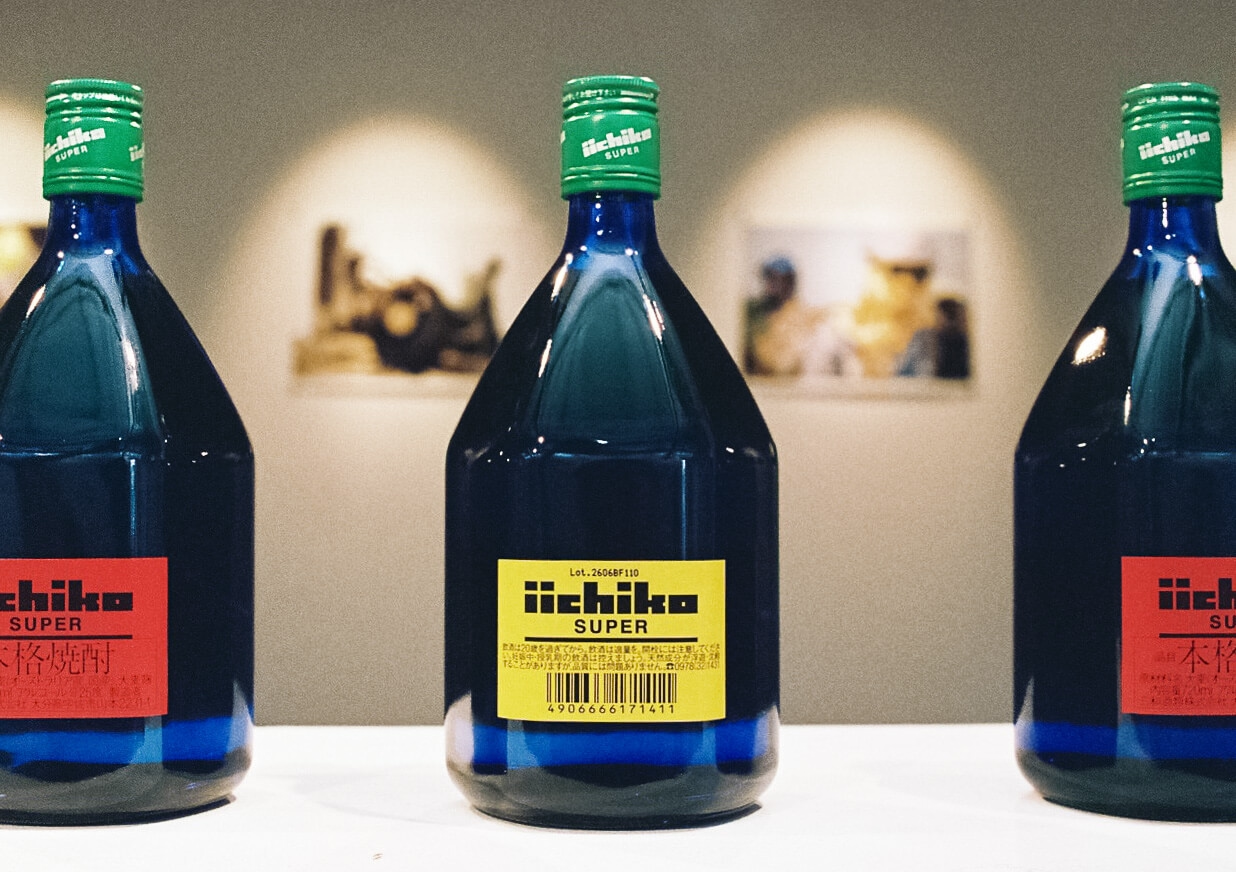
Three bottles of iichiko SUPER shochu lined up on a white surface
stir
Gadani receives vessels that have finished the work they were built for. They arrive as ships. They leave as material. Workers open the bodies with gas burners. Steel becomes sections. Sections leave for other jobs, other places, other names. The photographs live in the middle of that change: a hull mid-cut, rusted parts stacked or scattered, the yard as ground, the people who stand on that ground.
Scale does the first work and it does it immediately. A laborer in front of a ship can look like a figure placed there by error, a person the size of a rivet. Stay with the sequence and the second work begins. Faces. How a body holds itself between cuts. The ordinary shape of a day in a place that is not ordinary. A wide industrial view can turn a worker into a measuring stick for the hull. Scaggiante’s pictures keep returning the person until the measuring stick is a someone.
He talked about Breakers as using photographs to probe and observe real events from his own viewpoint, and as work that reminded him why that kind of looking is interesting. The line is quiet. The yard is not. Ship-breaking is labour, salvage, and a beach rewritten by metal. The exhibition did not need a wall text that explained global shipping. It needed the cut line and the person next to the cut line, in a room small enough that you could hear other people breathe.
Harajuku is a long way from Balochistan. That distance is not a footnote. It is the other subject. You cannot smell bunker oil from the street outside WAG. You can stand still long enough that rust starts to feel closer than the next shop. The show asked for that stillness. Some people gave it. Some people gave it with a glass in one hand.
What repeats in the frames is not only wreckage. It is a rhythm. Burner, pause, haul, stand. A ship that was a route across water becomes a workplace on sand. Time at Gadani is the time it takes for a form to stop being the form it was. The photographs do not rush that time. They also do not romanticize it into sunset steel. The light is the light of a job.
Minagawa’s text sat with those images as the Japanese language in the room. A photographer who walks and a writer who holds the walk: the exhibition used both. The zine carried the pairing out of the three days and into whatever apartment took a copy. Limited print runs can feel like merch. A hundred zines next to Gadani feel more like a second, shh hanging.
flow
After high school Eric worked at a bicycle company. The first paycheck bought a camera. In 2020, with the pandemic closing ordinary routes, he went back to Venice, the city he is from. He walked. He pointed the lens at people and streets that stopped him. The habit thickened. The habit became a way to work.
That walk is still the method he names. See something. Raise the camera. Breakers takes the method off a European street and onto a beach that processes discarded tonnage. Venice taught him to look while moving through a city that performs itself for visitors. Gadani asked him to look at work that does not perform. The ships are still. The people are not. The pictures have to hold both speeds without turning the workers into sculpture and without turning the hulls into landscape only.
A photographer who starts with a first wage and a walk is easy to write as a fable. The fable is less useful than the continuity. The same attention that caught a face in Venice is the attention that stayed with a burner crew. The subject changed scale. The stance did not claim to become an expert on Pakistani labour law. It claimed to look.
He said the work made him feel again the interest of observing real events through his own view. That is not a theory of documentary. It is a note from someone who could have stopped at pretty rust and did not. Pretty rust is available at any breaking yard if you only want colour. The people in the frame are the refusal of that postcard.
Visitors who already knew his pictures and visitors who met them in Harajuku stopped in similar ways, according to the room as it ran. Occasion differed. The pause did not. Three days is short for a survey and long enough for a gallery to become a weekend habit. Photograph, conversation, glass. Breakers was built from the intervals between those three acts as much as from the paper on the wall.
Eric’s own pleasure in unexpected meetings is part of the exhibition’s social record. A show can be only pictures. This one was also a counter and a stack of zines and a founder standing in the same air as strangers. That does not make the yard smaller. It makes the Harajuku room honest about what it can and cannot do. It can hang the work. It can pour a drink invented for the hanging. It cannot be Gadani. The photographs keep saying so by remaining large in a small space.
three
iichiko SUPER did not tape a logo to the door and leave. The brand built three cocktails for the exhibition and put a counter in the room. People chose a glass, compared, kept talking. The pour was part of the show’s architecture.
iichiko SUPER Roohafza used Rooh Afza, the rose-scented, deep red syrup known in Pakistan and across a wider South Asian map. That cup carried the photographs’ geography into taste. iichiko SUPER Shikanji brought lemon and spice. iichiko SUPER Japanese Green Tea used Ureshino tea from Saga. One drink pointed at the country of the yard. One pointed at a Japanese tea prefecture. One sat between as citrus and heat. Under all three was the same barley spirit, heavy, residual, a finish that stays.
A long finish next to pictures of steel that also stays (in other forms, after the ship is gone) is an easy metaphor. It is still the right one. Shochu of that weight does not vanish when you swallow. The hulls at Gadani do not vanish when the burners finish. They become inventory.
Pakistan and Japan in the same pour could have been cute. Next to these prints it read as a map. You could drink the rose syrup and look at a burner line. You could drink the Saga tea and remember the street outside was still Harajuku. The exhibition needed that double location. Without it the yard becomes content imported for a nice room. With it the room admits two climates at once.
View this post on Instagram
fin
Reception night set the tone because it mixed looking with lingering. The weekend kept the door open to accident: a shopping route that turned into twenty minutes with a rusted bow. Accident is how a three-day show in Harajuku actually fills. Intention fills the first night. Drift fills Saturday.
What remains after 26 July is not the cocktail list. The list ended when the bottles went back. What remains is the scale problem the pictures posed: a human figure against a hull, and the decision to look at both until the small figure is no longer only a scale bar. The ships at Gadani will keep arriving. The crews will keep cutting. A hundred zines will sit in a hundred rooms. Some of those rooms will open the booklet once. Some will open it again, which is the hope Eric put on the edition.
Three days. One beach. One counter. A camera bought with a first wage, years later pointed at work that unmakes ships. Breakers was the title. The breaking was already happening before the gallery opened and after it closed. The Harajuku room only asked people to stand still while it happened on paper.
Related Articles
Modigliani’s Limestone ‘Tête’
Carved from a single block of limestone in Montparnasse more than a century ago, one of Modigliani's rare stone heads goes to auction for the first time…