DRIFT AUDIO
Listen to this story
Choose a voice, then press play.
Maria Grazia Chiuri’s first campaign back at FENDI treats the Baguette not as an It-bag but as ten separate autobiographies, told through its original 1997 silhouette.
FENDI has built its new Baguette campaign around a premise that runs against the usual logic of a handbag launch: instead of asking one face to define the bag, it has handed the bag to ten people who have almost nothing in common except the accessory itself. The idea, as the house has frame it, is that a bag function as a private universe built from memories, objects, emotions and story, and that the Baguette’s re-edition should reveal the identity behind it rather than dictate one. There is, pointedly, no single protagonist and no predefined model to follow.
The resulting cast spans film, music and modeling without much regard for keeping those categories separate. Sarah Jessica Parker leads a lineup that includes actors Jessica Alba, Emma D’Arcy, Iris Law, Tecla Insolia and Sophie Thatcher, alongside FENDI ambassadors Bang Chan of Stray Kids, Song Yuqi of (G)I-DLE, Ren Meguro of Snow Man and Mina of Twice. It is a group built on range rather than a shared aesthetic, and the campaign’s own logic depends on that range: nine or ten distinct relationships to the same bag, rather than one face repeated across every frame.
stir
The campaign also marks a specific institutional moment. It is the first rel under Maria Grazia Chiuri since her return to FENDI as the house’s newly installed creative director, following her departure from Dior in 2025. Chiuri’s history with the Baguette predates her current title by nearly three decades: she was part of FENDI’s original accessories design team in 1997, the year the bag was first developed, which makes this campaign as much a homecoming for the designer as it is a relaunch for the product. Few creative directors get to reintroduce a house’s signature object having helped invent it the first time around, and FENDI appears to be leaning into that continuity rather than downplaying it.

Black-And-White Fendi Campaign With Woman In Lace Styling A Patterned Baguette Bag
That continuity gives the campaign’s central idea, that the bag should express its wearer rather than the other way around, an extra layer of weight. Chiuri helped shape the object when it launched as a deliberate rebellion against 1990s min, bold color, visible craft technique, and unapologetic ornamentation stacked against a fashion moment that wanted none of it. Returning to that same silhouette now, with an equally unruly cast of protagonists, reads less like nostalgia and more like Chiuri picking the argument back up where it left off.
nar
What distinguishes this campaign from a typical multi-ambassador rollout is how directly it resists building a single narrative across its cast. Sarah Jessica Parker’s presence carries the Baguette’s pop-culture origin story on its own: her role as Carrie Bradshaw on Sex and the City is largely responsible for turning the bag into a defining It-bag of its era, and her return puts that history directly back in the frame. Emma D’Arcy arrives from a very different register, known for playing Princess Rhaenyra Targaryen in House of the Dragon, while Jessica Alba brings a career spanning acting, producing and entrepreneurship. Song Yuqi and Bang Chan represent two different corners of the K-pop landscape, as a solo artist and (G)I-DLE member and as a member, producer and leader of Stray Kids respectively, while Ren Meguro and Mina extend that reach further through Snow Man and Twice and MISAMO. Sophie Thatcher, Iris Law and Tecla Insolia round out the cast from television, modeling and Italian cinema.
FENDI’s framing for the campaign leans on that spread deliberately: each participant is shown with a Baguette of their own choosing, one meant to represent them specifically, rather than a single styling directive applied uniformly across the cast. The house has attached short, first-person statements to the individual portraits, phrases like “it’s mine” and “it’s my attitude,” each one standing in for the participant’s own relationship to the bag rather than a shared campaign tagline repeated by everyone. It is a structure built to resist summary, which is very much the point: the campaign’s argument only holds if ten different people can carry the same object and still look like they’re each making a different statement with it.
industry
The campaign was shot by photographer Bibi Borthwick, working to create an atmosphere built around spontaneity rather than tightly controlled posing. Reporting on the shoot describes Borthwick cultivating an environment that encouraged each subject to move and express themselves naturally, an approach designed to let each person’s actual relationship with the bag come through rather than a uniform directorial style flattening the differences between them. That intent tracks with the campaign’s stated premise: if the bag is meant to reveal identity rather than impose one, the photography needed room for each subject to behave like themselves rather than like a model executing a brief.
The campaign is set to the track “Fame Is a Gun” by Addison Rae, a soundtrack choice that places a pop artist currently near the center of internet-native fame culture alongside a cast built from film, K-pop and modeling. It is a pairing that fits FENDI’s broader instinct in this campaign for cross-generational, cross-medium casting: Parker’s nearly thirty-year-old association with the Baguette sitting inside the same project as an artist whose career has unfolded largely on platforms that didn’t exist when the bag launched in 1997.
define
The word “re-edition” in the campaign’s framing refers to something specific rather than a general seasonal refresh. The new Baguette returns to its original silhouette and its original style code, 26424, the same numbering system attached to the bag when it first launched in 1997. That’s a meaningful distinction in FENDI’s own product history: over nearly three decades, the Baguette has passed through numerous reinterpretations, collaborations and material updates, and this release is explicitly positioned as a return to the source silhouette rather than another variation built on top of it.
View this post on Instagram
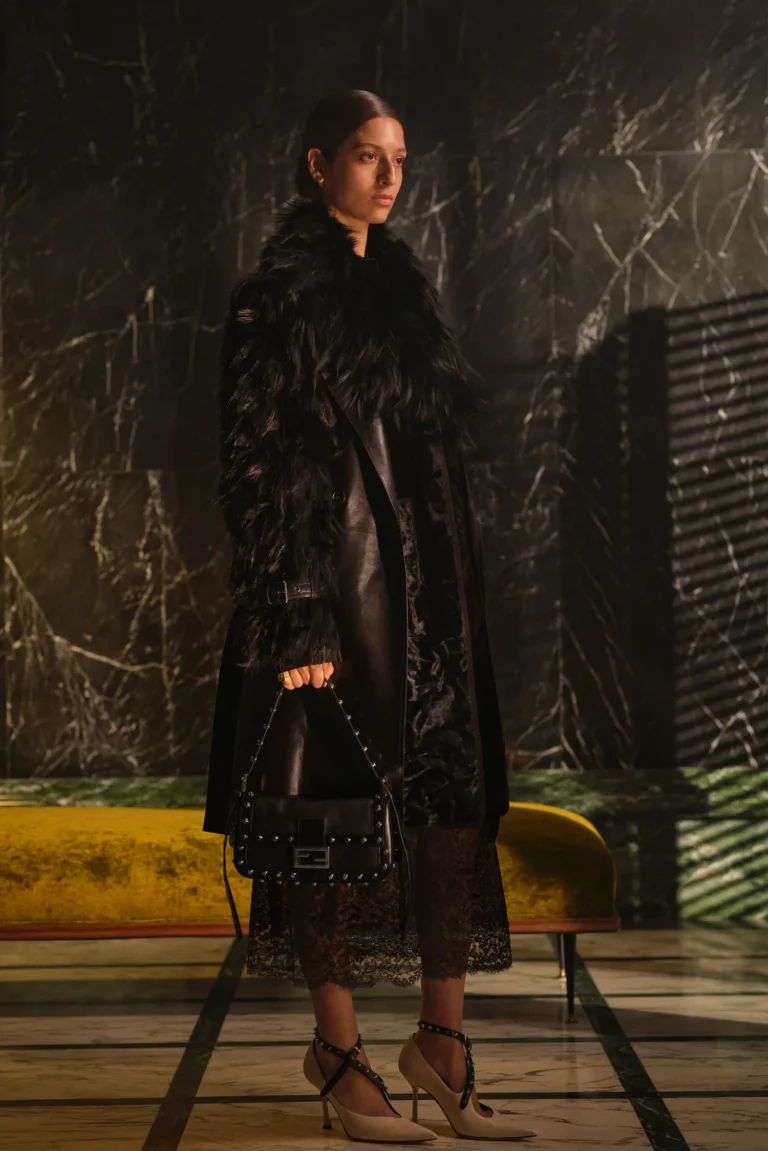
The original Baguette, designed by Silvia Venturini Fendi, was conceived as a direct counterpoint to the prevailing minimalism of the late 1990s: compact, worn tucked under the arm in the manner that gave the bag its name, but loud in color, material and craft technique in a way that ran deliberate against the era’s dominant fashion mood. Chiuri’s decision to relaunch the bag under its original code rather than modify the silhouette again suggests the house is treating the original design itself, not a reinterpretation of it, as the strongest statement available for this particular culture moment. The bag also connects to FENDI’s current Fall/Winter 2026-27 collection, giving the campaign a tie to the house’s runway calendar rather than positioning it as a standalone accessories story.
fin
Taken together, the casting, the direction, and the return to code 26424 build toward a specific argument FENDI is making about what an It-bag is supposed to be in 2026. The house’s own language draws a direct line away from that category: the Baguette, it argues, transcends the concept of an It-bag to become an enduring companion, a symbol of self-expression, freedom and authenticity, built through renewed silhouette, exceptional craftsmanship and a contemporary vision rather than through any single celebrity association.
That’s a notable repositioning for an object whose entire cultural relevance was arguably built by one specific celebrity association in the first place, Parker’s Carrie Bradshaw moment on Sex and the City nearly thirty years ago. By surrounding that original association with nine other, deliberately dissimilar relationships to the same bag, FENDI is betting that the Baguette’s second act depends on proving it can mean something different to each person who carries it, rather than asking a new generation to inherit one person’s meaning secondhand. Whether that argument lands with the audience the campaign is chasing will likely become clearer once the bag itself reaches stores in its original 26424 form, but the intent behind the casting could hardly be stated more plainly: no predefined model, and nine or ten proofs that the bag doesn’t need one.
Related Articles
The Bag Wall Just Got Crowded: What’s Actually Worth Carrying This Autumn
Autumn 2026’s new bag releases favor curved shapes, muted tincture, and straps that do more […]