Fred Perry x MEYBA — A Shared Sporting Lang, Rewritten in Barcelona

April 16, 2026
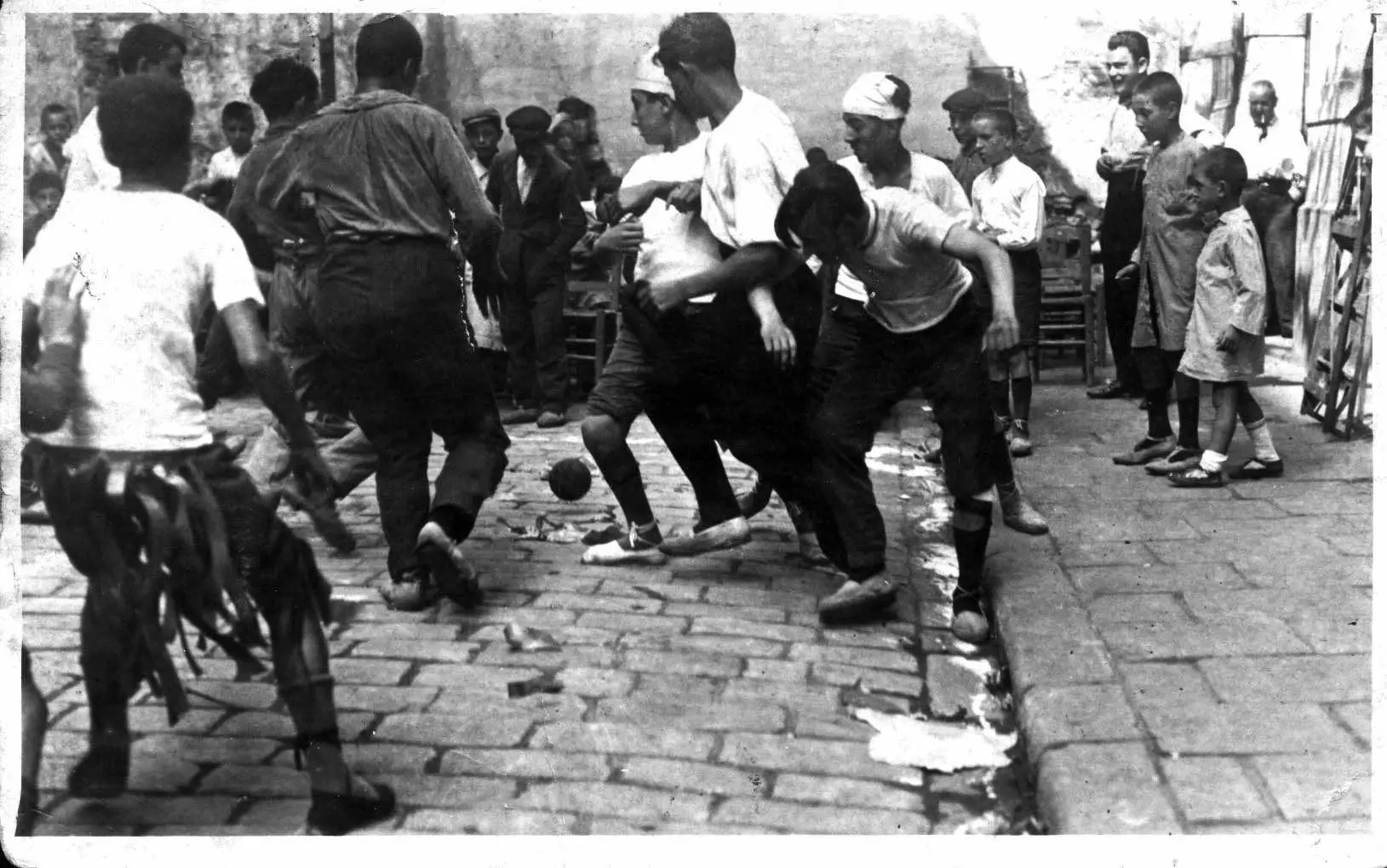
The pavement becomes the first point of entry. Not the runway, not the showroom—the street. Shoes scraping against concrete, conversations spilling into corners, bodies in motion without announcement. This is where clothing begins to mean something. Not as a product, but as a signal: you were there, at that hour, with those people. Or you weren’t.
Inside that logic, garments don’t perform for an audience. They register participation. They hold time.
jargon
The dialogue between Fred Perry and MEYBA doesn’t resolve into harmony. It isn’t supposed to. What emerges instead is a controlled friction—two systems that retain their own gravity, refusing dilution.
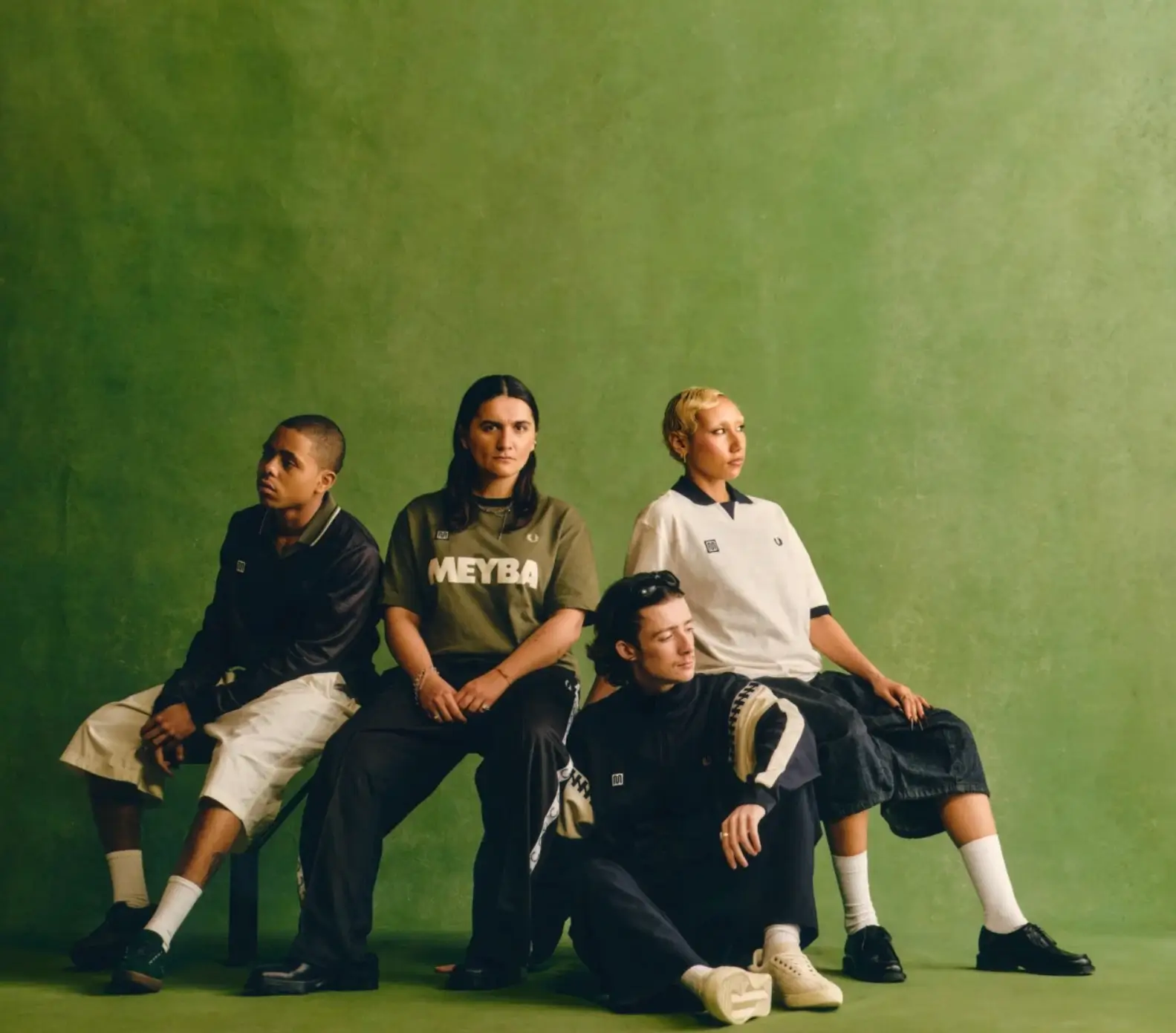
Fred Perry’s laurel wreath is exacting. It carries the discipline of tennis—measured, repetitive, precise. The lines are deliberate. The garments sit where they’re meant to, not where the body might casually place them. There’s a kind of architectural restraint embedded in every collar, every seam. Even when translated into contemporary contexts, it doesn’t lose that posture. It edits. It compresses. It reduces excess until only structure remains.
MEYBA, by contrast, resists containment. Its language comes from football—not the global broadcast version polished for consumption, but the older one. The one embedded in local memory, in worn pitches, in afternoons that stretch without schedule. Its graphics don’t apologize. They expand outward. Colors insist. Shapes move with a kind of visual confidence that borders on defiance.
Set side by side, the contrast doesn’t blur. It sharpens.
One system tightens the frame. The other pushes against it.
One refines. The other declares.
And what’s notable is the absence of compromise. There’s no middle ground engineered to make the pairing more palatable. No smoothing out of differences to create something universally digestible. The tension remains visible, intact, and intentional.
Because in Barcelona, tension isn’t something to resolve. It’s something to carry.
scope
The collision—if it can be called that without flattening its nuance—operates less as a blend and more as a co-existence. Two view dialects spoken at the same time, without translation.
And this is where timing enters as the central thesis.
In most fashion contexts, clothing is positioned as an object—something to acquire, to own, to display. Here, it behaves differently. It becomes evidence. Proof of presence. You were there early enough to catch it before it moved. You understood the rhythm well enough to align with it.
Miss that moment, and the garment changes meaning. It’s no longer a marker of proximity; it becomes a reminder of distance.
That shift is subtle but decisive. It reframes consumption into participation. The act of wearing becomes secondary to the act of arriving.
This is why the message lands with a kind of quiet authority. It isn’t persuasive. It doesn’t need to be. It simply states the condition: be present, or accept absence.
View this post on Instagram
carve
Barcelona has always operated as its own editor. It filters without explanation, allowing certain energies to surface while letting others dissipate. The same applies here.
The pairing of Fred Perry and MEYBA doesn’t feel imposed onto the city. It feels extracted from it. As if both systems were already present—one in the discipline of form, the other in the insistence of expression—and this moment simply aligned them into visibility.
There’s no overt narrative being pushed. No explanatory framework guiding interpretation. Instead, the city itself provides context. The pavement, the terraces, the edges where people gather without instruction—these become the backdrop against which the garments are understood.
And within that backdrop, hierarchy dissolves.
A polo shirt carries as much weight as a football jersey. Not because of its design alone, but because of where and when it appears. Context overrides category.
show
There’s a temptation to read this through the lens of performance—who wore what, who styled it best, who captured the moment most effectively. But that misses the underlying structure.
This isn’t about performance. It’s about presence.
Performance implies an audience. Presence doesn’t.
What’s compelling here is the absence of spectacle. There’s no grand staging required to validate the garments. They exist within the same conditions as everything else—subject to time, to movement, to the unpredictability of the street.
That lack of insulation is what gives them weight. They aren’t protected by presentation. They’re exposed to reality.
And in that exposure, they either hold or they don’t.
concentration
The instinct, particularly in fashion, is to resolve. To take opposing forces and merge them into something cohesive, something easily understood. But cohesion isn’t always the objective.
Here, the value lies in maintaining the divide.
Fred Perry doesn’t soften its discipline. MEYBA doesn’t temper its expression. Each remains fully itself, even as they occupy the same space.
That decision—to resist synthesis—creates a different kind of coherence. One built not on uniformity, but on contrast.
And that contrast mirrors the city itself.
Barcelona has always held multiple identities at once. Order and disorder. Precision and improvisation. Control and release. None of these cancel each other out. They coexist, sometimes uneasily, often productively.
The garments reflect that condition. They don’t attempt to simplify it.
They wear it.
stomping ground
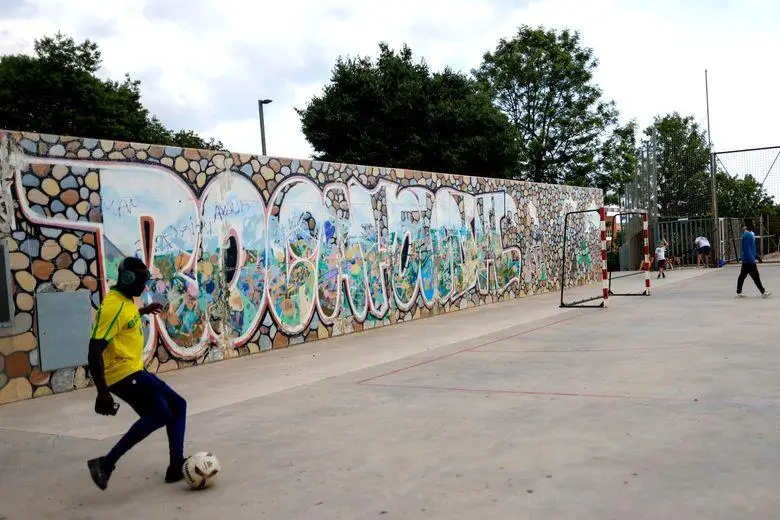
It’s worth returning to where this begins: the pavement.
Not as a romantic gesture, but as a structural one.
Everything flows from that surface. The way people move, the way they gather, the way they occupy space. Clothing enters that system not as an overlay, but as an extension.
A jersey worn on the street carries a different weight than the same jersey displayed in a controlled environment. A polo seen in motion, in context, acquires meaning that no static image can replicate.
This is why the story resists traditional formats. It doesn’t translate cleanly into lookbooks or campaigns. Those frameworks assume a level of control that this moment deliberately avoids.
Instead, it lives in fragments. In glimpses. In the kind of fleeting encounters that can’t be fully documented.
You see it, or you don’t.
theory
The flip side of presence is distance.
And in this context, distance isn’t neutral. It’s a consequence.
Miss the timing, and the entire system shifts. The garments become detached from their origin. They circulate without context, stripped of the immediacy that gave them meaning.
They’re still recognizable. Still wearable. But something essential has been lost.
That loss isn’t dramatic. It doesn’t announce itself. It simply lingers, quietly altering the way the pieces are perceived.
You can’t recreate the moment retroactively. You can only approximate it.
And approximation, here, isn’t enough.
fin
What emerges, ultimately, is a closed loop.
The city sets the conditions. The garments respond. The people activate both.
There’s no external validation required. No need for broader recognition or amplification. The system sustains itself.
Fred Perry’s precision and MEYBA’s declaration don’t resolve into a single narrative. They orbit each other, creating a field of tension that defines the space.
And within that field, meaning is generated not through explanation, but through participation.
Related Articles
A 1.2 Million Pound Machine Is Making Grown Men Cry, and Nobody Warned the Midwest
Union Pacific’s Big Boy No. 4014 is deep into a coast to coast tour, and […]