DRIFT AUDIO
Listen to this story
Choose a voice, then press play.
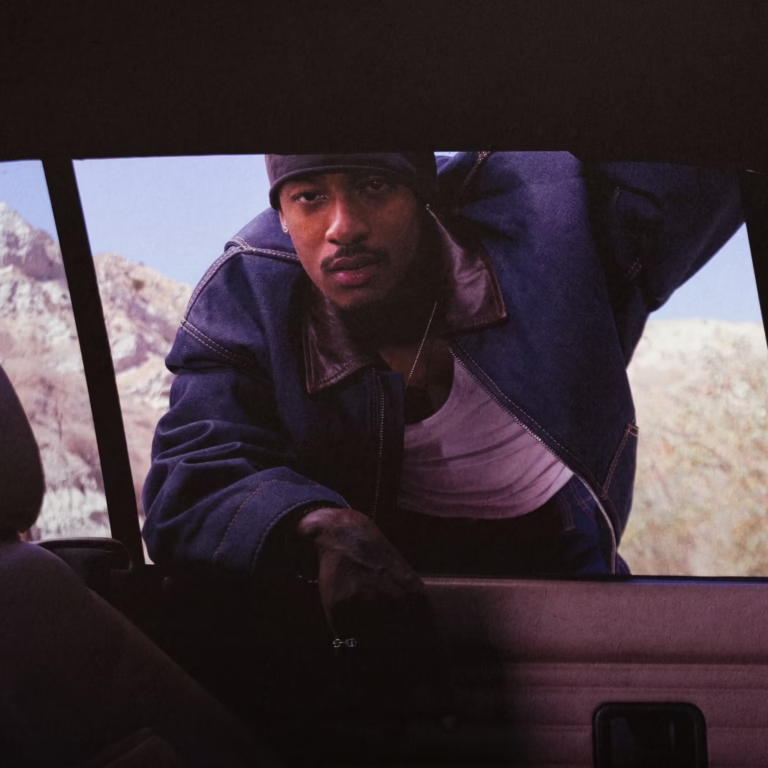
Gucci is putting a men’s frame around one of its longest-running icons. The new “Jackie Flap,” arriving as part of the house’s latest seasonal menswear offering, takes the crescent-shaped body and piston hardware of the Gucci Jackie and rebuilds them into a sharper, more angular shoulder bag, one that comes with a detachable leather strap so it doubles as a crossbody. It’s a small addition in the scheme of a runway collection, but it’s also a fairly direct statement about what Gucci thinks its archive is for right now: not preserved behind glass, but handed to a different customer and asked to do different work.
View this post on Instagram
stir
The detail carrying the most weight on the new bag is the one Gucci has kept unchanged since the original Jackie’s overhaul decades ago: the piston lock. It’s a small mechanical clasp, a metal cylinder that clicks flush against the flap with one hand, and it has survived Tom Ford’s late-1990s sleekening of the silhouette, Frida Giannini’s tasseled “New Jackie” reissue in 2009, and the most recent Jackie 1961 revival that reintroduced the bag’s original crescent proportions. Each version has changed the scale, the hardware finish, or the strap configuration around it, but the piston itself has stayed put, which is part of why the closure reads as more than a fastening mechanism. It’s the one component that has made the bag legible as a Jackie across every reinterpretation, including this new men’s version.
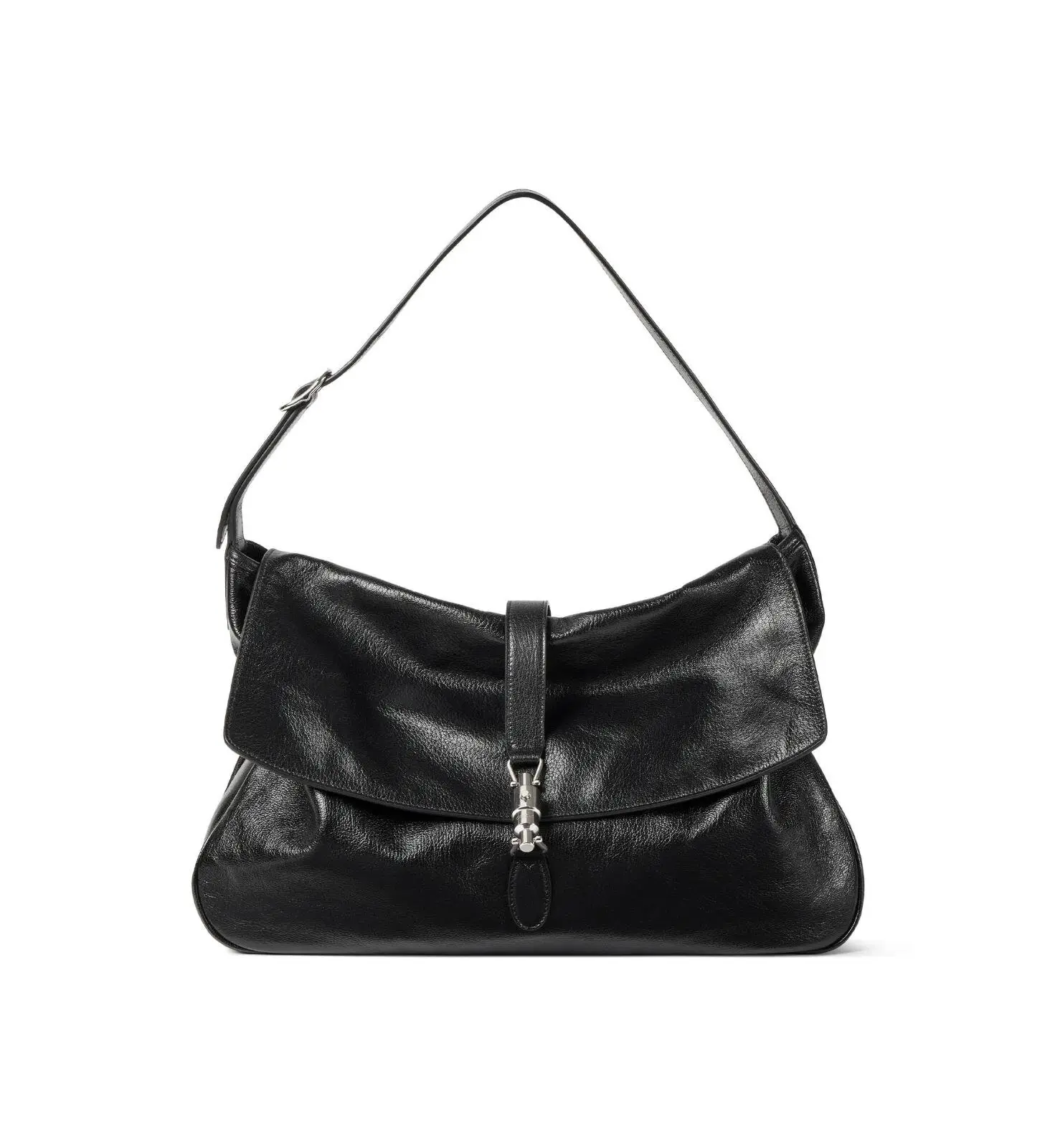
On the Jackie Flap, that piston sits on a flap-front construction rather than the open crescent-mouth opening most associated with the women’s bag, giving the closure a flatter, more structured presentation. Gucci has described the redesign as urban and sharp rather than soft, and the flap does the most obvious work of getting there: it turns a bag built around a curved sil into something with clean, closed edges, which reads more easily as menswear without abandoning the piston that makes it recognizable.
What’s notable about keeping the piston through this particular reinterpretation is how much design risk it removes. A completely new closure system would have made the Jackie Flap a men’s bag that merely borrows a name; keeping the piston in place, unchanged in its mechanics even as the surrounding sil gets flattened and squared off, keeps a direct line back to the bag’s identity. Anyone who has handled a Jackie 1961 will recognize the click of this closure immediately, even on a bag shaped nothing like the one they’re used to. That’s a deliberate continuity choice rather than an accident of engineering, and it’s the clearest evidence that Gucci sees the piston, not the crescent shape, as the actual core of what makes a Jackie a Jackie.
two
The Jackie Flap comes in two versions, and the split says something about how Gucci is positioning it. The first uses the house’s GG canvas, the monogrammed material built from the interlocking double-G pattern that has anchored Gucci’s identity since the 1970s. It’s the more casual, more instantly branded of the two options, priced at 473,000 yen. The second is built from supple goatskin leather, hand-processed to bring out the grain and finished with a light gloss that gives it a vintage-style texture rather than a flat, factory-new surface. That version is priced higher, at 539,000 yen, and reads as the quieter, craft-forward option: nothing about it announces itself as loudly as the canvas GG pattern does, which puts it closer to the restrained, logo-light direction Gucci’s recent leather goods have leaned toward.
Both versions share the same crescent-to-flap form the piston closure, and an included leather strap long enough to wear the bag crossbody rather than only on the shoulder. That strap is the detail that turns the Jackie Flap into something genuinely dual-purpose rather than a single fixed form: worn short, it sits as a structured shoulder bag; lengthened, it becomes a crossbody piece built for a more active day. Given that both the canvas and leather editions are priced well into six figures in yen, the choice between them is less about budget and more about which register of Gucci’s design language a customer wants to carry, loud archival pattern or hand-finished, understated leather.
The gap between the two prices, roughly 66,000 yen, is also a reasonably accurate proxy for how much labor separates them. GG canvas production is comparatively standardized: the monogram pattern is woven or coated onto the material in a repeatable process, and the leather trim used to finish the edges is a smaller, secondary component of the total construction. The goatskin version inverts that ratio entirely. Every panel is cut and finished by hand, with artisans working the grain to bring out the texture Gucci is marketing as vintage-style rather than relying on a uniform factory finish, which is a slower and more skill-dependent process than assemble a canvas body. That difference in labor, more than any difference in raw material cost, is likely what’s actually reflected in the price gap between the two editions.
chore
The original Jackie predates almost everything else in Gucci’s current handbag lineup. It emerged in the early 1960s as a hobo-style bag with a curved silhouette and a simple closure, and it earned its name informally, after Jacqueline Kennedy was repeatedly photographed carrying one, often held against her body as if to shield herself from cameras. That image, an accessory used as much for privacy as for style, has stayed attached to the bag’s identity even as Gucci has redesigned it dozens of times since. The piston lock itself wasn’t part of the earliest versions; it arrived later, as part of the redesigns that eventually stabilized into the bag’s modern identity, and it’s that later, hardware-driven version the Jackie Flap is drawing from rather than the original 1960s hobo shape.
Menswear has touched the Jackie before, in scattered seasonal pieces, but never as a dedicated line the way the Flap now positions it. That matters less as a marketing point and more as a signal about where Gucci sees growth: a bag built around a woman’s name and a First Lady’s public image, reintroduced as a structured, urban accessory aimed squarely at a men’s customer who wasn’t the bag’s original audience by any measure. It’s the kind of archive move that only works if the underlying shape is strong enough to survive the reassignment, and the piston-and-crescent combination has, at this point, been tested across six decades of Gucci creative directors.
There’s also a practical logic behind reaching for the Jackie specifically, rather than one of Gucci’s other historic silhouettes, when building out menswear accessories. Bags built around visible logos or heavily branded hardware tend to translate less comfortably across gendered product lines; the design signals read as feminine or masculine largely because of how a house has marketed them, not because the underlying shape resists reassignment. The Jackie’s original appeal was almost the opposite of loud branding: a curved, understated shape that worked precisely because it didn’t announce itself, and that quality carries over cleanly into a men’s version built around discretion rather than logo view. It’s a outline that was arguably always closer to menswear’s usual design values than it was ever explicitly marketed as being.
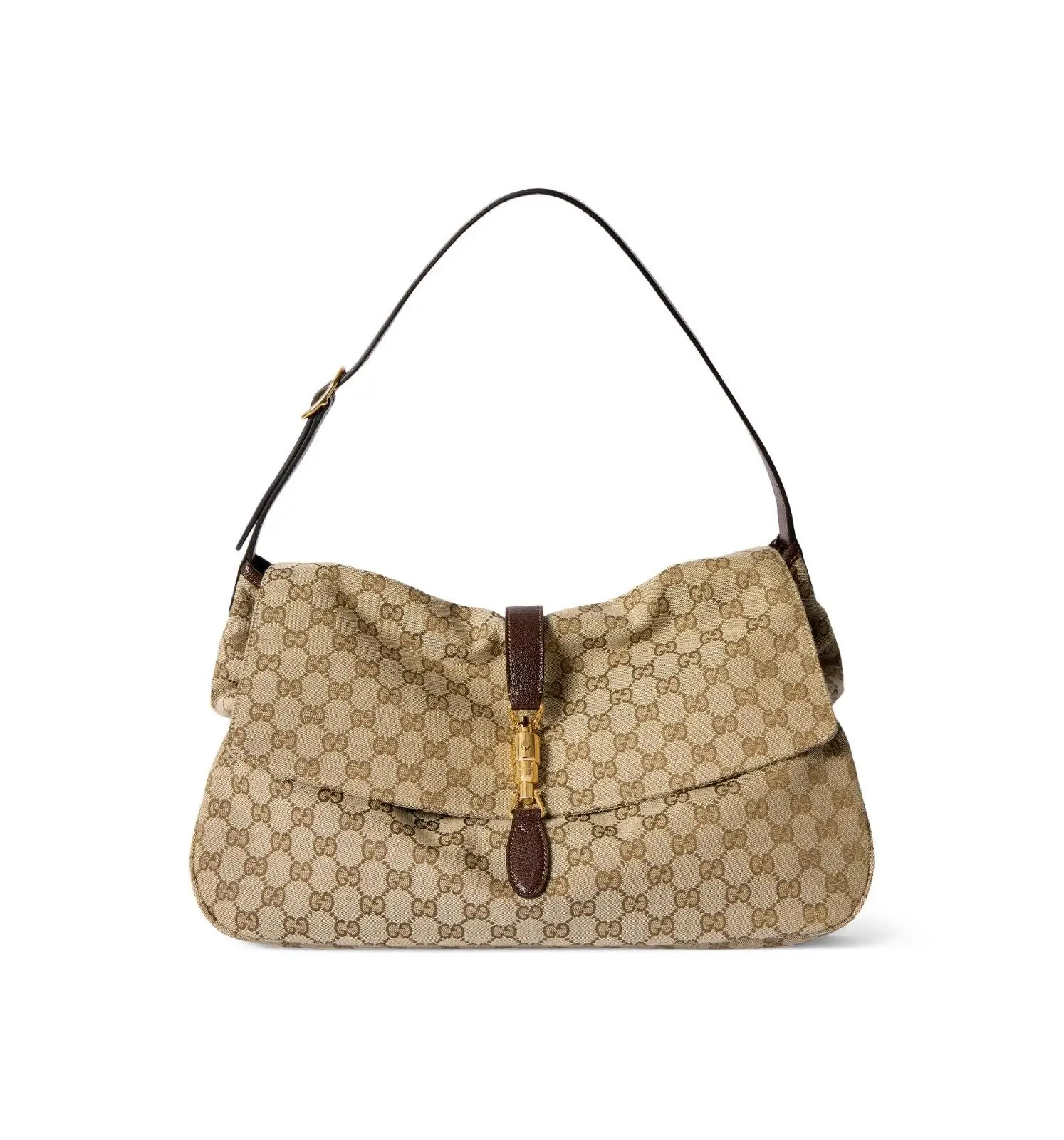
Beige Gucci Monogram Canvas Shoulder Bag With Brown Leather Trim And Gold-Tone Clasp
lang
The Jackie Flap arrives at a moment when Gucci’s handbag strategy has leaned heavily on its own archive rather than introducing entirely new silhouettes. The GG canvas used here is the same monogrammed material the house has repeatedly revisit across its most recognizable bags, from totes to the Jackie 1961 itself, and the goatskin leather option’s vintage-style finishing echoes a broader push across recent seasons toward materials that look worn-in and hand-treated rather than pristine. Both choices suggest a house more interested in deepening its existing vocabulary than expanding it outward, at least for now, and a men’s Jackie fits neatly into that approach: it’s new only in the sense that the audience is new, not the design vocabulary underneath it.
That restraint extends to the bag’s overall sil, too. Where some recent Gucci accessories have leaned into visible logos and maximalist hardware, the Jackie Flap’s urban framing keeps the piston as the single loudest design element, everything else built around making the bag sit close and flat against the body. It’s a silhouette built for function first, which tracks with how Gucci has described the redesign: less an archival curiosity than a bag meant to be used the way a crossbody actually gets used, day to day, without much ceremony.
It’s also worth situating the Jackie Flap against the broader pattern of how heritage houses have handled their own archives in recent seasons. The move of taking a bag associated for decades with one gender and one specific cultural image, and rebuilding it for an entirely different customer, isn’t unique to Gucci; it’s become close to standard practice across luxury handbags, where a proven silhouette carries less risk than an entirely new design and where menswear accessories in particular have leaned on womenswear archives for structural ideas. What distinguishes the Jackie Flap within that pattern is how little it disguises the borrowing. The name stays. The closure stays. Only the proportions and the flap construction change, which makes this less a men’s bag inspired by the Jackie and more a Jackie built, deliberately and visibly, for a different pair of shoulders.
fin
The Jackie Flap is avail in two configurations: the GG canvas version at 473,000 yen and the vintage-finished goatskin leather version at 539,000 yen. Both are sold through Gucci’s directly managed stores and its official online store, with no indication of a limited run or region-specific release tied to the launch. As with most of Gucci’s core leather goods lineup, avail appears to be standard rather than event-driven, positioning the Jackie Flap as an ongoing addition to the men’s accessories offering rather than a one-season capsule piece.
That position matters for how the bag is likely to be read once it’s actually in stores rather than in press images. Capsule and connection pieces tend to be judged on novelty, how different they look from what came before, and how quickly they’ll be replaced by the next drop. A standing catalog item built around a piston closure with sixty years of continuous use behind it is judged by a different standard: whether it holds up as a genuinely useful bag once the archival framing fades into the background. The Jackie Flap’s dual-strap functionality, the choice between a louder canvas and a quieter leather, and its place within an ongoing rather than seasonal offering all suggest Gucci is betting on the latter kind of longevity rather than the former kind of momentary attention.
Related Articles
Cardi B Carries Norma Kamali’s New York Into Milan Fashion Week
Between Gucci fur and Cavalli animal print, Cardi B slipped a New York original into […]