DRIFT AUDIO
Listen to this story
Choose a voice, then press play.
Dolly Parton kept European luxury fashion at arm’s length for most of her career. That didn’t stop it from trying to dress like her.
Dolly Parton, who away on August 25 at 80, spent seven decades building a look so specific that entire wardrobes had to be constructed to house it. By the time of her pass, that collection reportedly spanned more than 4,500 square metres of storage, holding roughly 2,000 pairs of shoes and 350 wigs, a scale closer to an archive than a closet. She’d already turned the whole operation into a book of her own, Behind the Seams: My Life in Rhinestones, a career told entirely through what she wore to live it.
The book, and the wardrobe behind it, traced a style that started forming decades before Parton had any real money to spend on it. She’s spoken for years about a childhood spent watching a local woman in her Tennessee hometown known for her own flashy, over-the-top look, and about decide early on that whatever glamour looked like to her, more of it was always better. That instinct never wavered as her career scaled up: bigger wigs, taller heels, more rhinestones, arriving at a persona so exaggerated it became its own kind of armor, one she wore into rooms that didn’t always take a rhinestone-covered country singer seriously on sight.
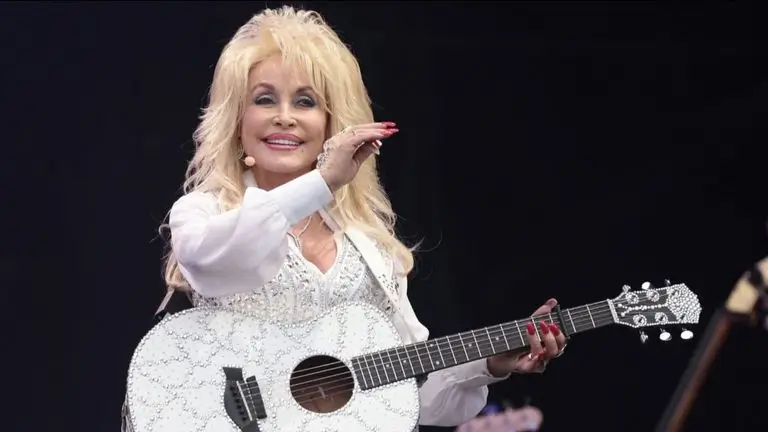
Dolly Parton performing on stage with a rhinestone-covered guitar.
It was a style Parton built almost entirely outside the fashion industry’s own machinery. She worked for decades with costume designer Bob Mackie and, later, her longtime creative director Steve Summers, rather than any house on a European runway schedule. Mackie, best known for the era-defining “Butterfly” gown he built for Parton’s 1979 TV special with Carol Burnett, understood early on that Parton’s exaggeration was the entire point rather than something to be reined in, an understanding Summers carry forward for decades after, down to details as specific as which colors photographed well on her and how long a given fabric would hold up under stage lights without wrinkling. That distance from European fashion houses is part of why it’s notable when the luxury side of the industry did reach back toward her, and twice, from two very different corners of it, it reached back hard.
trib
The bigger of the two tributes came from Gucci, during Alessandro Michele’s run as the house’s creative director, at its Spring/Summer 2019 show. By 2018, Michele had already spent three years turning Gucci’s runway into a recurring exercise in maximalist nostalgia, mixing geek-chic eyewear with Renaissance-referencing gowns and, on more than one occasion, a live animal or two; the SS19 outing was, by that point, a continuation of a formula rather than a departure from one. Michele had relocated the presentation from Milan to Paris’s Théâtre Le Palace, and built the whole collection around pop icons: Janis Joplin, Josephine Baker, Mickey Mouse, and, twice over, Dolly Parton.
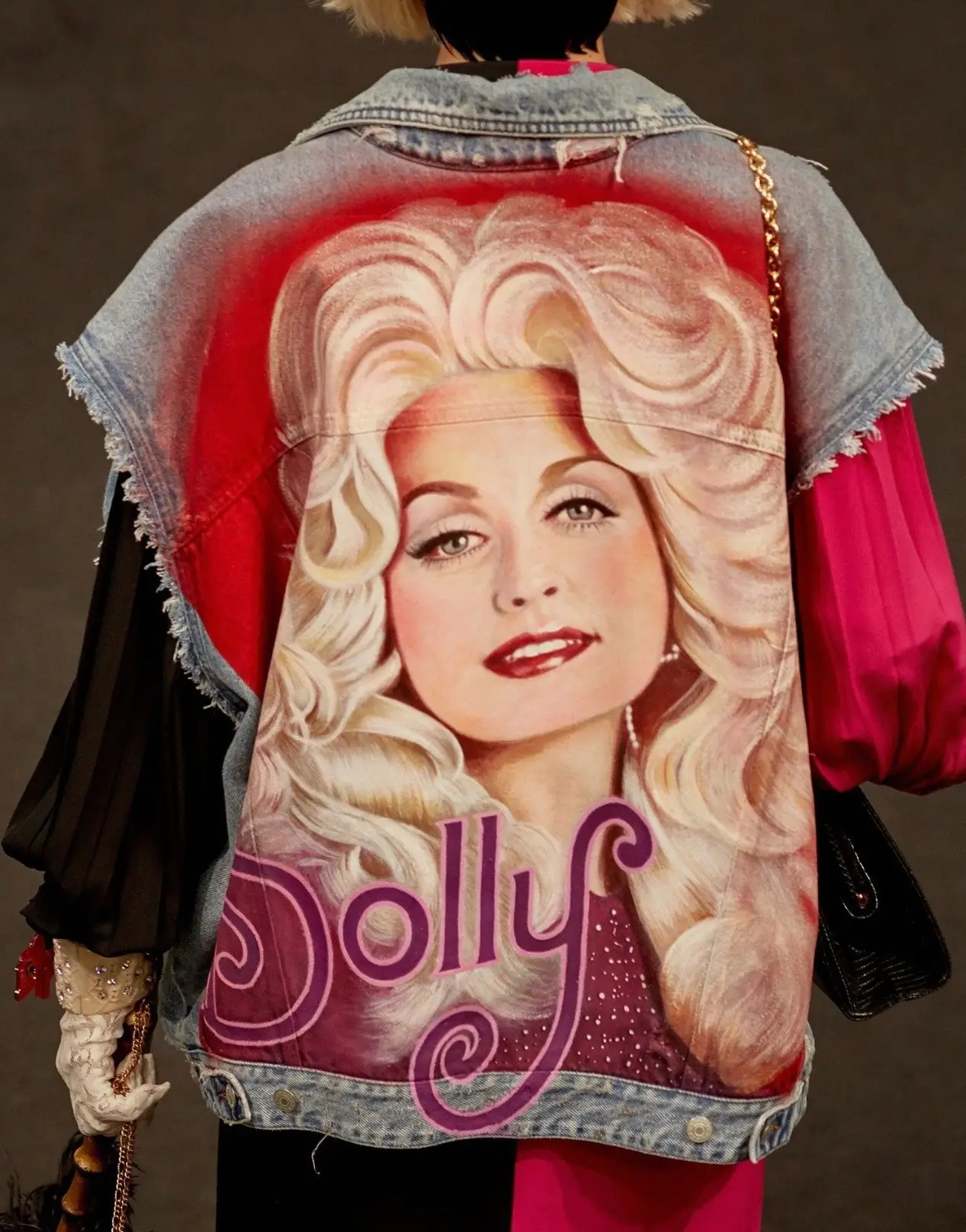
The first Parton reference landed partway through the show on an oversized denim vest, its back airbrushed with a portrait of the singer. Two looks later, her face reappeared on a pink sweatshirt, rendered in a screen-print style that echoed Andy Warhol’s celebrity portraiture, a fitting nod given that Warhol had actually painted Parton about ten times in the 1980s, featured her in his Polaroid series, and interviewed her for Interview Magazine in 1989, with photography by Herb Ritts. Gucci’s own social channels later described the denim vest look as a tribute to one of country music’s most decorated female performers.
Parton’s face wasn’t the only piece of Americana on the runway that night. A Mickey Mouse-shaped bag turned up elsewhere in the collection, alongside metallic tassel-tiered trousers, embellished granny-chic loafers, and, on the more provocative end of the show, male models in studded leather jockstraps and plunging 80s-style bodysuits, the kind of tonal whiplash that had become something of a Michele signature by that point in his run at the house. Somewhere between the Parton portraits and the jockstraps sat a run of strawberry-print trousers and stretches of 1970s-inflected suiting, evidence that the show’s American pop theme extended well past any single decade or single icon.
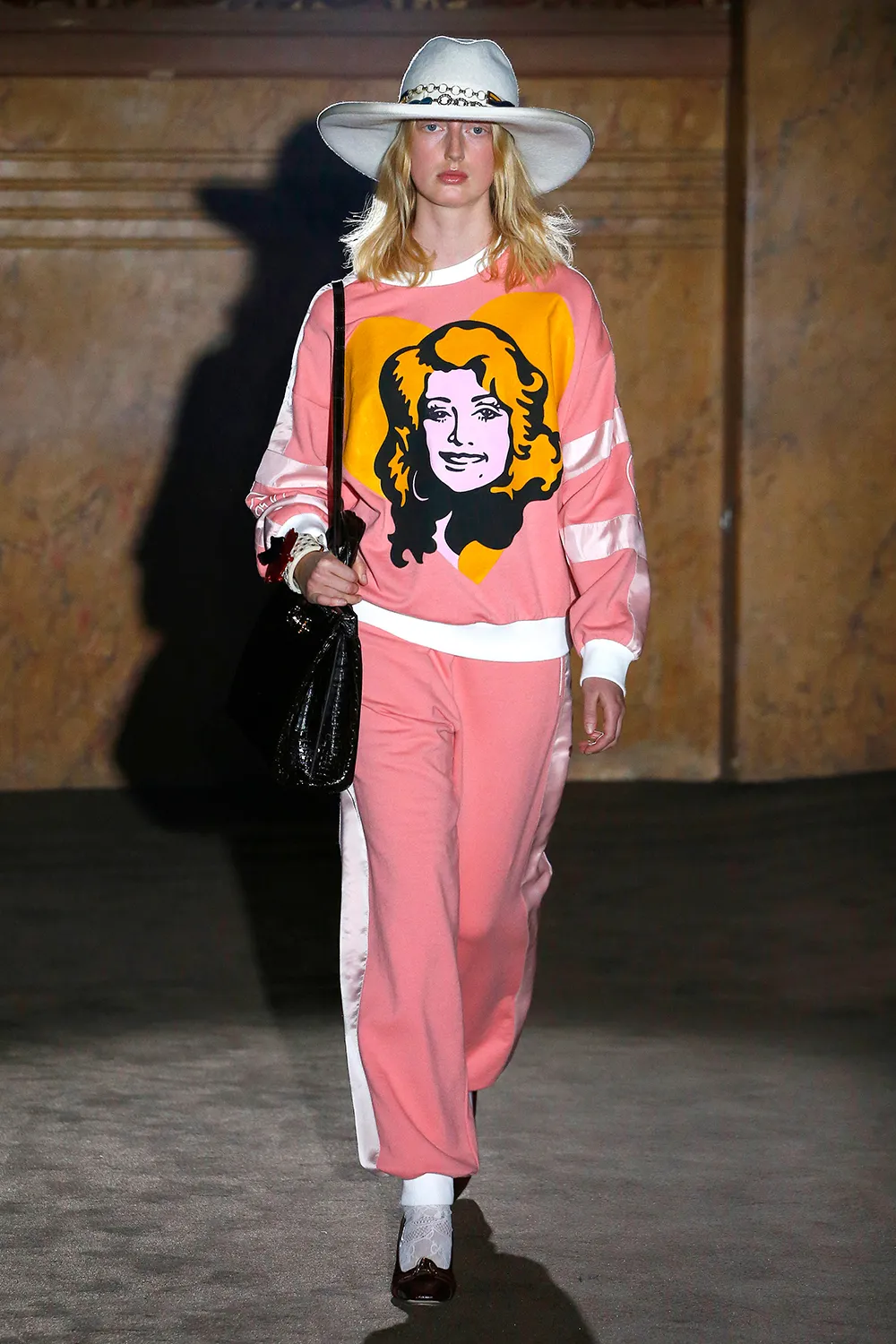
A model walking the runway wearing a pink tracksuit with a graphic portrait of Dolly Parton on the sweatshirt.
The choice of venue mattered as much as the clothes. Le Palace had been Paris’s answer to Studio 54 in the late 1970s, a club that once drew Grace Jones, Karl Lagerfeld, Yves Saint Laurent, and Andy Warhol through its doors; on its opening night in March 1978, Grace Jones reportedly performed atop a Harley Davidson wrapped in silver drape, announce disco’s arrive in Paris in the process. Michele’s SS19 show leaned into that history directly, framing the whole collection as a tribute to the venue’s own roster of pop icons, which extended beyond music into experimental theatre: the Italian stage duo Leo de Berardinis and Perla Peragallo got a nod alongside Parton and Joplin.
The show carried Parton’s love of rhinestones and crystal embellishment across multiple looks beyond the two portrait pieces, while a Janis Joplin-inspired felt hat and a run of Mickey Mouse-shaped bags rounded out the collection’s American pop references. The most memorable moment of the night, though, belonged to neither designer nor icon: midway through the show, Jane Birkin herself stepped out to perform Baby Alone in Babylone, the song Serge Gainsbourg had written for her at the start of the 1980s, a live performance breaking up a runway show in a way few luxury presentations attempt. It was a fitting echo of the venue’s own past, given that Gainsbourg himself had once been part of the crowd Le Palace drew through its doors decades earlier.
View this post on Instagram
length
Michele’s tribute wasn’t the first, and it wasn’t even the more personal of the two. Years earlier, Jeremy Scott had already built an entire collection around Parton’s influence, one rooted in something closer to genuine fandom than reference-hunting. Scott had spent most of the 2010s establish himself as one of fashion’s most unabashedly pop-culture-fluent designers, first through his own namesake label and then, from 2013 onward, as creative director of Moschino, where he reworked the house’s logo through the lens of Barbie, McDonald’s, and Looney Tunes, among other American consumer touchstones. Parton fit naturally into that same referential language, a Kansas City-raised designer’s homage to a country icon he’d grown up idolizing.
For his Fall/Winter 2016 show under his own label, titled Cowboys and Poodles, Scott leaned all the way into Parton’s honky-tonk glamour: teased-to-the-heavens hair, kaleidoscopic western prints, fringe, and a soundtrack that mixed Blondie with Devo. Karlie Kloss opened the show in a beehive, neon cowboy boots, and a leopard-print coat, before the collection pivoted midway through into an extraterrestrial theme, models done up as space-age cowgirls in bandage dresses and lamé skirts. Backstage, Scott described the collection to W Magazine as “a little bit more Dolly Parton, but Dolly on molly,” a line that captured the show’s amplified, day-glo take on Parton’s western silhouettes better than any official show note could. It wasn’t his first pass at the aesthetic either; a previous collection with a similar western flavor had already appeared on his New York Fashion Week calendar back in 2011.
Scott has been open for years about Parton being one of his defining style icons, a reference point that long predates any single collection and has continued to surface across his work since.
together
Scott’s connection to Parton eventually moved off the runway and into the same room as the singer herself, by way of Katy Perry, one of several pop stars, alongside Miley Cyrus, Nicki Minaj, and Lady Gaga, who had already made Scott’s red-carpet and stage costuming a regular fixture of their public image by the mid-2010s. In 2016, Scott dressed Perry for the Academy of Country Music Awards, the same edition of the show where Perry duetted onstage with Parton on “Jolene,” trading her usual pop wardrobe for a bedazzled western getup, complete with a studded belt and banana-yellow patent cowboy boots, that made no secret of who the night’s reference point was. Scott didn’t design Parton’s own outfit for the evening. She wore a rhinestone blazer arranged in a diamond pattern of colored stones, a direct reference to her own song Coat of Many Colors, one of the most personal pieces of her catalogue, written about a coat her mother sewed for her from rags. By coincidence rather than coordination, Scott showed up on the same red carpet in a leather biker jacket carrying a strikingly similar diamond-pattern embellishment, honoring the same song from the other side of the stage door.
The two eventually met in person backstage after the performance, and Scott has since recounted the friendship that followed in interviews with outlets including The Cut, including an episode where Katy Perry threw a western-themed birthday party and invited a Dolly Parton impersonator convincing enough that Scott mistook her for the real singer, took photos with her, and posted them to his own social channels before realizing his error. On a separate occasion, Scott gifted Parton a pair of pink rubber cowboy boots and a Moschino handbag, from his years as that house’s creative director, small tokens from a designer who’d spent a decade treating her as a genuine muse rather than a seasonal reference.
fin
Between the two tributes sits a fairly clear contrast in method. Michele’s Gucci homage was one part of a much larger, multi-icon collection, filtered through screen-printing techniques and a theatrical Paris venue with its own separate pop history to draw on. Scott’s version ran the other direction: an entire show built around a single influence, followed by a real friendship that outlasted any one collection, gifts included.
What both tributes shared was an acknowledgment that Parton’s own style had always operated on her terms, built with Mackie and Summers rather than any European maison, and that reaching toward it meant meeting her on her own aesthetic ground rather than translating it into someone else’s. Either that ground got approximated through an airbrushed portrait on a denim vest or a fringe jacket assembled in the designer’s own words as “Dolly on molly,” neither tribute changed the terms Parton had already set for herself, decades before either show ever went down a runway.
Related Articles
Forty Years After Warhol, KAWS Puts His X on the Absolut Bottle
Absolut’s art program began with an Andy Warhol painting in 1985. Its newest chapter prints […]