DRIFT AUDIO
Listen to this story
Choose a voice, then press play.
Factory scraps re-spun into heavyweight cotton and a GEN4 race car in Preston orange: the partnership goes public at ComplexCon Los Angeles on October 3.
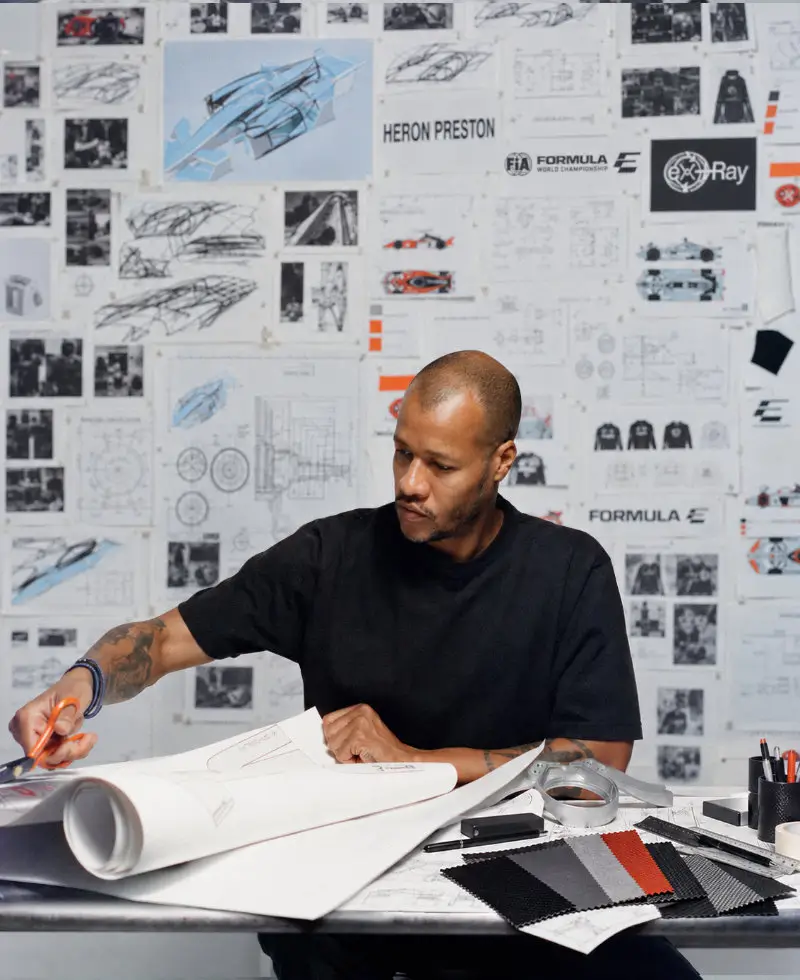
Every time a Formula E driver gets on the brakes, the car’s motors switch jobs, turning momentum back into charge that gets spent again on the next straight. Heron Preston has spent roughly a decade doing the textile version of that: sanitation uniforms, crash-test airbags and factory off-cuts, material the rest of the industry tends to treat as spent, routed back into new clothes. On September 28, the New York designer and Formula E made it official, announcing a long-term creative partnership built on exactly that overlap, with the stated aim of shaping where motorsport fashion goes next through sustainable design, performance and materials.
The logic is more literal than most brand pairings. Preston’s practice begins with things that have already been made and thrown out; Formula E’s begins with energy that would otherwise be lost as heat under braking. Both, at bottom, are about reuse, and the plan is to carry that shared instinct into the clothes the sport and its fans actually wear. The first public look lands in Los Angeles in early October.
Signal. What happened: Heron Preston and Formula E announced a long-term creative partnership on September 28, 2026, positioned around sustainable motorsport apparel made from recovered and recycled materials. Exact object: a preview capsule of T-shirts, long-sleeves and hoodies made with Preston’s eX-Ray recycled cotton and deadstock fabric, shown alongside a GEN4 Formula E car wearing an exclusive Preston-designed livery. When and where: ComplexCon Los Angeles, October 3 and 4, 2026, at the Los Angeles Convention Center; pricing, production scale and retail distribution have not been announced. Source: Formula E’s official announcement, with garment and livery detail from Preston’s statement to WWD and a Formula E executive statement carried by FashionUnited. Why it matters: it pairs a designer who regained full control of his label in late 2025 with a championship that, five days before the announcement, rebranded with fashion named among the culture arenas it wants to enter. Earlier: late-August coverage of Kris Van Assche’s relaunch placed Preston’s December 2025 comeback within a wider wave of designers retaking their namesake labels.
in
The material carries this project more than any single garment does. eX-Ray is the name Preston gives to the most rigorous tier of his work, and the idea behind it is an X-ray view of a product: what it is made of, how that material came to exist, and who did the making. In a statement to WWD, he tied eX-Ray to what his label calls L.E.D. products, short for less environmentally destructive, and explained that the “eX” stands for example, the benchmark the rest of the brand is meant to work toward.
For Formula E, that benchmark is recycled cotton built from pre-consumer waste: the off-cuts and production scraps that end up on the cutting-room floor before a garment is ever finished. Per the partners’ announcement, those scraps are sorted, shredded back to fiber and re-spun into new yarn, then developed into a heavyweight, tightly woven fabric. WWD reports that Preston is also pulling deadstock fabric from his own past collections into the preview, so part of the capsule is quite literally his old inventory getting a second run.
Pre-consumer waste sits at the more manageable end of textile recycling, since factory scraps tend to be of known composition and free of the wear, repairs and mixed trims that complicate used clothing. Mechanically recycled cotton does tend to come out with shorter fibers than virgin cotton, which is one reason many recycled yarns are blended with other material. The announcement does not say whether the eX-Ray cloth is blended, and no fiber breakdown has been published.
The garments themselves are deliberately ordinary. WWD lists the preview capsule as Tee, long-sleeves and hoodies, the backbone of any race-weekend merch stand, which keeps attention on the cloth rather than on a statement silhouette. The announcement describes the joint brief in practical terms, weighing fit, fabrication, durability and end of life against the harder-to-quantify question of whether someone will want to keep wearing a piece for years.
“This creative partnership is about rethinking what motorsport fashion can be,” Preston said in the announcement. He framed the work as designing apparel from the material up, with function, quality and a more considered way of making things held in balance, and pointed to his long-running habit of pulling materials, processes and ideas from unexpected places and giving them a new purpose.
flow
The second half of the installation has wheels. Alongside the garments, Formula E is presenting a GEN4 car in an exclusive Preston livery, and WWD’s description of it could double as a Heron Preston product page: his signature orange worked against chrome and matte finishes, with text graphics calling out the car’s headline specs, among them a zero rare earth minerals claim and its 600kW maximum output.
The choice of canvas matters. GEN4 is the car that takes over the grid for Formula E’s thirteenth season, and it is the most powerful machine the series has raced. Standard race power is 450kW, rising to 600kW in Attack Mode and qualifying, roughly 815 horsepower, and the car runs active all-wheel drive. Its regenerative braking can recover up to 700kW, which is the energy-recovery half of this partnership’s whole premise.
GEN4 is also the car Formula E reaches for whenever sustainability comes up. The championship says it was designed to be fully recyclable or reusable, with at least 20 percent recycled material across key components, and Formula E bills itself as the first sport to earn global B Corp certification. Wrapping that particular chassis in the hue of a designer known for recycling turns the livery into an argument as much as a decoration, and the installation is set up so visitors read garments and car as one process, running from material through method to design.
length
Preston’s track record is a big part of why the pairing reads as credible. His 2016 UNIFORM project with the New York City Department of Sanitation took decommissioned sanitation uniforms, along with second-hand garments, and reworked them into a collection, an early public statement of the upcycling approach that would come to define his label.
Two years later he brought the same fascination with institutional workwear to NASA, designing a capsule for the agency’s 60th anniversary around pressure-suit references and its retired worm logo, promoted with a short film that ended with a mannequin in one of the pieces sent up into the stratosphere.
The project closest to this one came in 2021, when Mercedes-Benz supplied Preston with airbags that had been deployed in its crash-test program. Timed to the airbag’s 40th year in Mercedes passenger cars, the resulting concept collection kept the fabric largely undyed and unaltered, preserving the airbags’ original details rather than disguising where the material came from. Formula E’s announcement names that project as a precedent, and the throughline is easy to follow: a designer pulling raw material out of automotive engineering and leaving its origin visible.
The timing within Preston’s own business story matters too. He launched his namesake label in 2016 as part of New Guards Group, a portfolio that went through a series of restructurings in the years that followed. In November 2025 he announced he had won back full ownership of the brand, relaunching it in December with a first release titled Foundation: Blue Line Edit. Talking to WWD about the Formula E deal, he summed up the rebuilt label’s operating principle in a single line: “Real materials, real function, no pretending.” He also described the partnership as an extension of a decade of upcycling work rather than a detour from it.
why
Formula E did not wander into fashion by accident. Five days before the Preston news, the series unveiled a new visual identity organized around five strategic pillars, and the one labeled culture relevance names fashion directly, alongside social, streaming, gaming and live events, as places the championship intends to show up. The refresh arrives with GEN4’s December debut, the biggest calendar in the series’ history and a new race format, and chief marketing officer Ellie Norman framed it as a shift from asking people to imagine the future of racing to simply showing it. “We believe progress should be thrilling,” she said in that release.
View this post on Instagram
Norman is also the executive voice on the Preston deal. In a statement carried by FashionUnited, she described the two sides as sharing a curiosity about how things work and how they can be improved, then tied it back to the track: “In racing, we push for greater performance while using energy and materials more efficiently.” Preston, as she put it, brings the complementary angle, a focus on what existing materials can turn into.
The partnership also runs in a separate lane from Formula E’s existing clothing arrangement. Hackett Sport has served as the championship’s official apparel provider, supplying uniforms and garments to Formula E staff, and remains on its partner roster. The Preston brief, as both sides describe it, is aimed less at dressing the paddock and more at working out what motorsport fashion could be when the starting point is a material rather than a logo. The announcement also states that the goal is to reach audiences beyond motorsport, which explains why the first look was booked into a streetwear convention instead of a race weekend.
prime
ComplexCon turns ten this year, and its 2026 edition spreads across the Los Angeles Convention Center and Crypto.com Arena on October 3 and 4, with Playboi Carti and Hiroshi Fujiwara serving as artistic directors. It is a crowd built around sneakers, style, art and music rather than racing, and Formula E has said plainly that reaching people outside motorsport is why it chose the setting.
The installation is billed as an exploration rather than a product launch. Garments will be shown as test cases for what eX-Ray material can do, set beside the Preston-liveried GEN4, so the material, the process and the finished design share the same floor space. Formula E calls it an early view of the partnership’s thinking rather than a finished collection.
What the preview does not come with, at least on the record so far, is a price. Preston told WWD that pricing, production scale and distribution are still being explored as the partnership develops, and neither side has confirmed whether any of the capsule will be sold at ComplexCon or afterward.
after
Both partners describe the Los Angeles showing as the start of a longer program. Formula E’s announcement sketches the categories it hopes the collaboration will eventually cover: show wear, fashion, fan merchandise, accessories, and products made from upcycled materials sourced from the sport itself, with the aim of rethinking everyday merchandise and finding second lives for race components.
Preston put the most ambitious part of that in concrete terms for WWD. The longer-term idea, he said, is to examine what carbon fiber, metals and other components taken from the cars could become through design. He was equally clear that the work has not begun, and that the wider product roadmap is still taking shape.
If it does happen, it would complete the loop the whole partnership is built on, with a race car’s retired parts feeding the same design process that is currently turning factory scraps into hoodies. For now, the only piece of Formula E hardware in the project is the GEN4 itself, and its racing life is about to start. The 2026/27 season opens under floodlights in Jeddah on December 18 and 19, runs 21 races across 13 events in 11 countries, and finishes with Tokyo hosting the championship’s season finale for the first time, a night double-header on July 24 and 25, 2027.
Related Articles
A Milan Temp Store For Invicta’s 120th Year
1906 England. Turin from 1921. Jolly and Minisac on Heritage. Velba, Wasar, Freeway on Icon. […]