DRIFT AUDIO
Listen to this story
Choose a voice, then press play.
A business school thesis project turned scrappy restaurant install has grown into a European design brand betting that even the most avoided room in the house deserves real style.
On a wet weekend in London roughly a decade ago, a French business student named Hugo Volpei walked into a bar bathroom and could not stop thinking about it. The bar was Sketch, the theatrical restaurant on Conduit Street where the dining room is designed by India Mahdavi and the bathroom is arguably more famous than the food. Underneath a domed, multicolored ceiling sit a row of two meter high, egg shaped pods by designer Noe Duchaufour-Lawrence, and inside each one is a toilet. Volpei watched people queue up not to use the facilities but to photograph them. “I thought it was incredible that so many people were taking selfies of themselves in a toilet,” he has said of the visit.
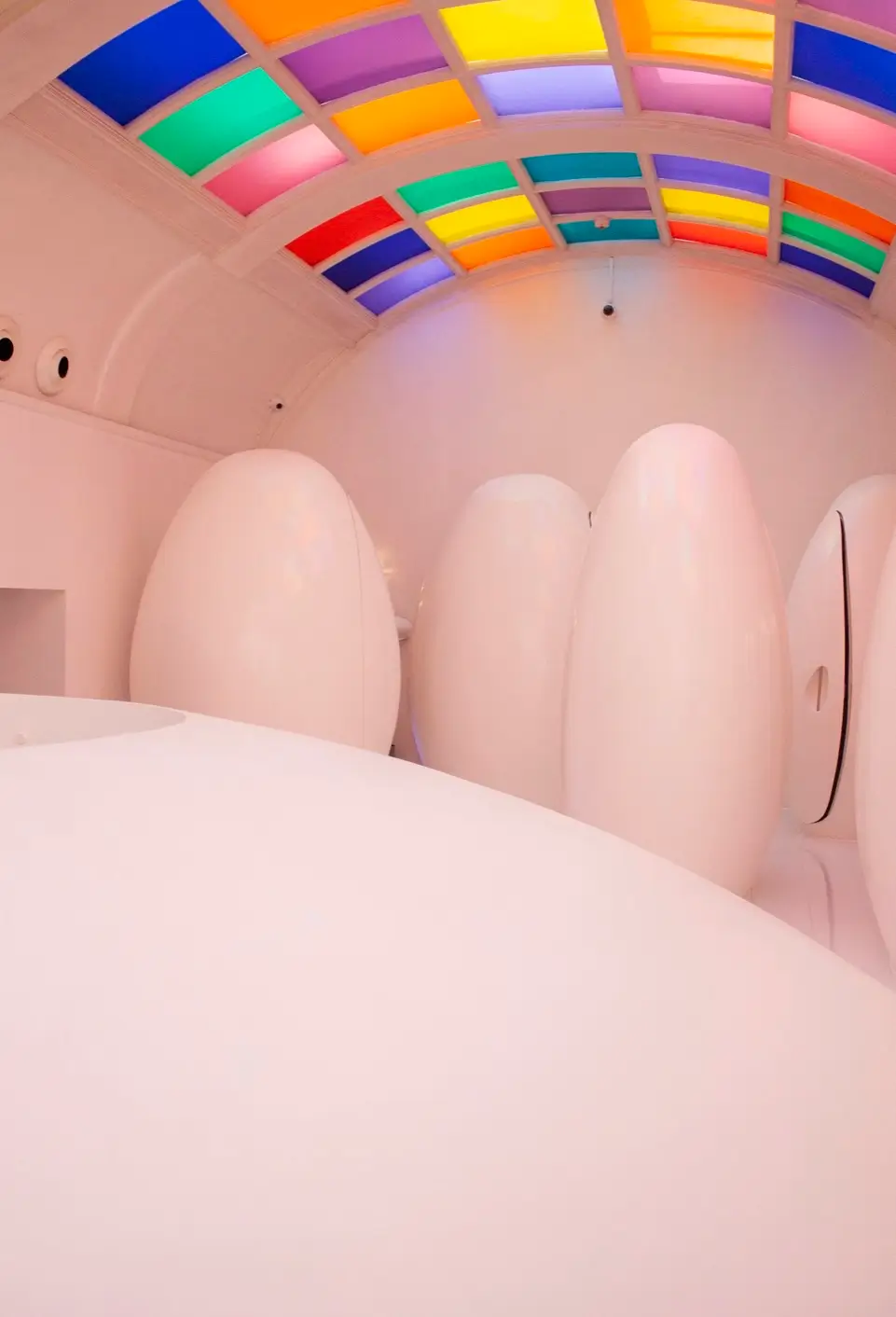
A futuristic public restroom combines sculptural white toilet pods with a vaulted ceiling of vibrant illuminated panels, transforming a functional space into an immersive architectural installation.
What struck him more, though, was what he found once he actually opened the egg. Inside the theater of it all sat the same object you would find in any airport, office block, or budget hotel: white, vitreous, entirely unremarkable. The pod was the spectacle. The toilet itself had been left out of the conversation entirely. Volpei went home to Paris turning over a fairly simple question. If a bathroom could be this good at getting attention, why did nobody bother making the toilet itself worth looking at?
stir
Volpei is a graduate of HEC Paris, the country’s top business school, and by his own account had shown an entrepreneurial streak since childhood, reselling customized T-shirts before he had any formal training in design or manufacturing. Toilets were not the plan. But the Sketch visit stayed with him, and a year or two after finishing his studies he called on Romain Freychet, an architect and childhood friend, and asked him to help design a toilet with one brief above all others: it had to be desirable.
Neither of them had ever made sanitaryware. Volpei’s own account of the company’s origin story is disarmingly blunt: he began by typing “how to make a toilet” into Google. There was no factory relationship, no supplier contact, no prior experience translating a sketch into a working ceramic object that also had to pass European plumbing codes. What there was, from the start, was a name. Trone, the company Volpei founded in 2018, is simply the French word for throne, missing its circumflex, and it set the tone (literal and otherwise) for a brand that has never been precious about the subject matter it works in.
flow
The project could easily have stalled at the prototype stage, the way most first products from first time founders do. Instead, Volpei took a 3D render, no working sample, straight to the founders of Big Mamma, the restaurant group that was rapidly turning Italian trattorias into some of the most photographed dining rooms in Paris. “Everyone was looking at this brand at the time and I heard they were due to be opening another restaurant in Paris,” Volpei has recalled. When Big Mamma said yes, the brief was unforgiving: seven custom toilets, installed and working, within six months.
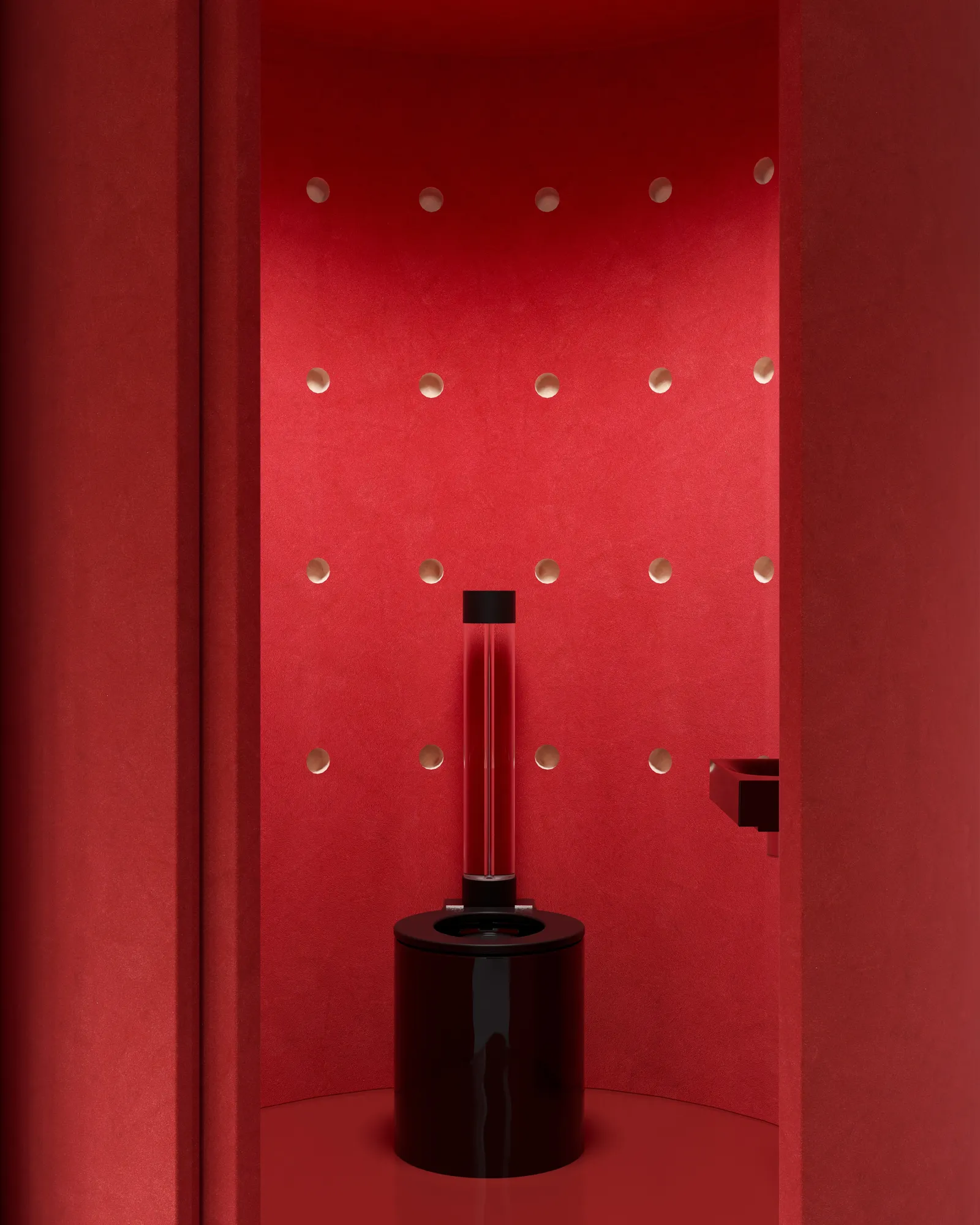
To make it happen, Volpei brought in an engineer to turn the concept sketches into something that could actually be manufactured and certified, a role since filled on a permanent basis by Camille Mourgues, now the company’s technical lead. The gamble paid off. Big Mamma’s dining rooms gave Trone’s first toilet, a glossy, circular, floor standing model called Icone, a level of visibility a design brand’s debut product rarely gets: thousands of paying customers encountering it not in a catalogue but mid meal, mid night out, in some of the most talked about restaurants in the city.
show
Icone remains a useful entry point into what Trone is actually selling, because it demonstrates the idea in its simplest form. The model is built around a translucent water column that runs up the back of the bowl like a glass vase, doing the plumbing’s job while looking nothing like plumbing. Its flush system, marketed under the name Hydrawise, lets an installer dial water use anywhere between half a liter and six liters, turning a hidden mechanical spec into a genuine selling point for anyone thinking about consumption.
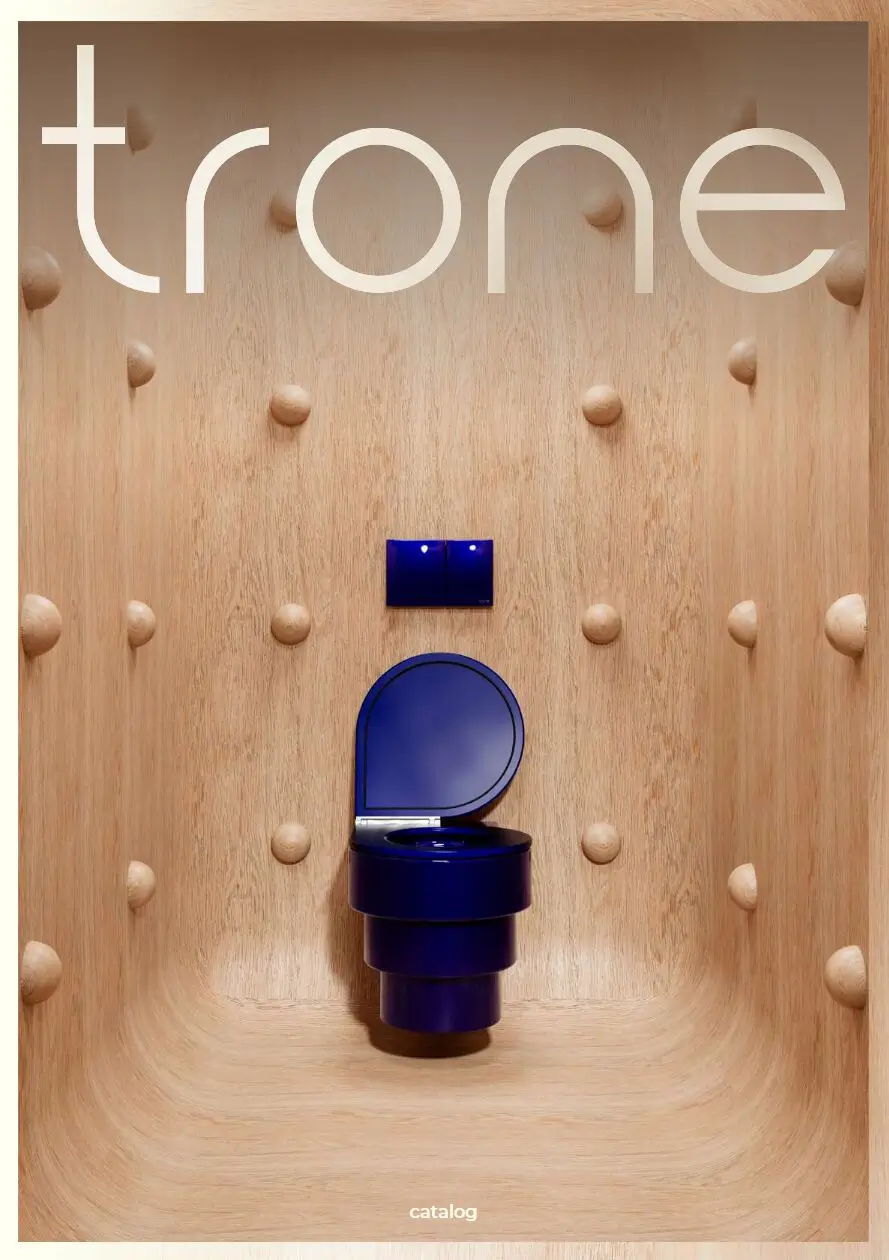
A deep blue designer toilet is showcased within a softly curved oak installation, where rounded wooden details and clean geometry highlight the sculptural form through contemporary exhibition design.
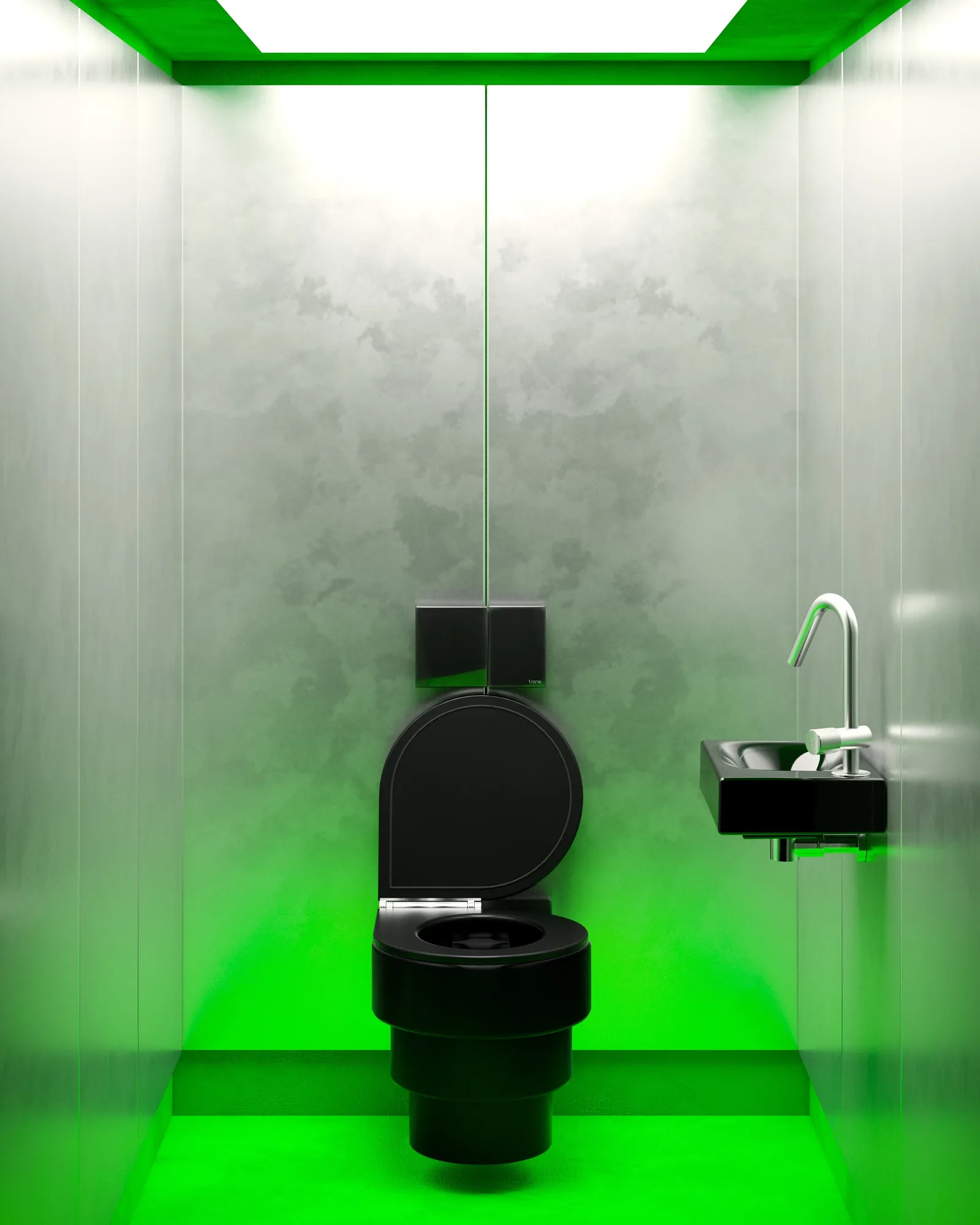
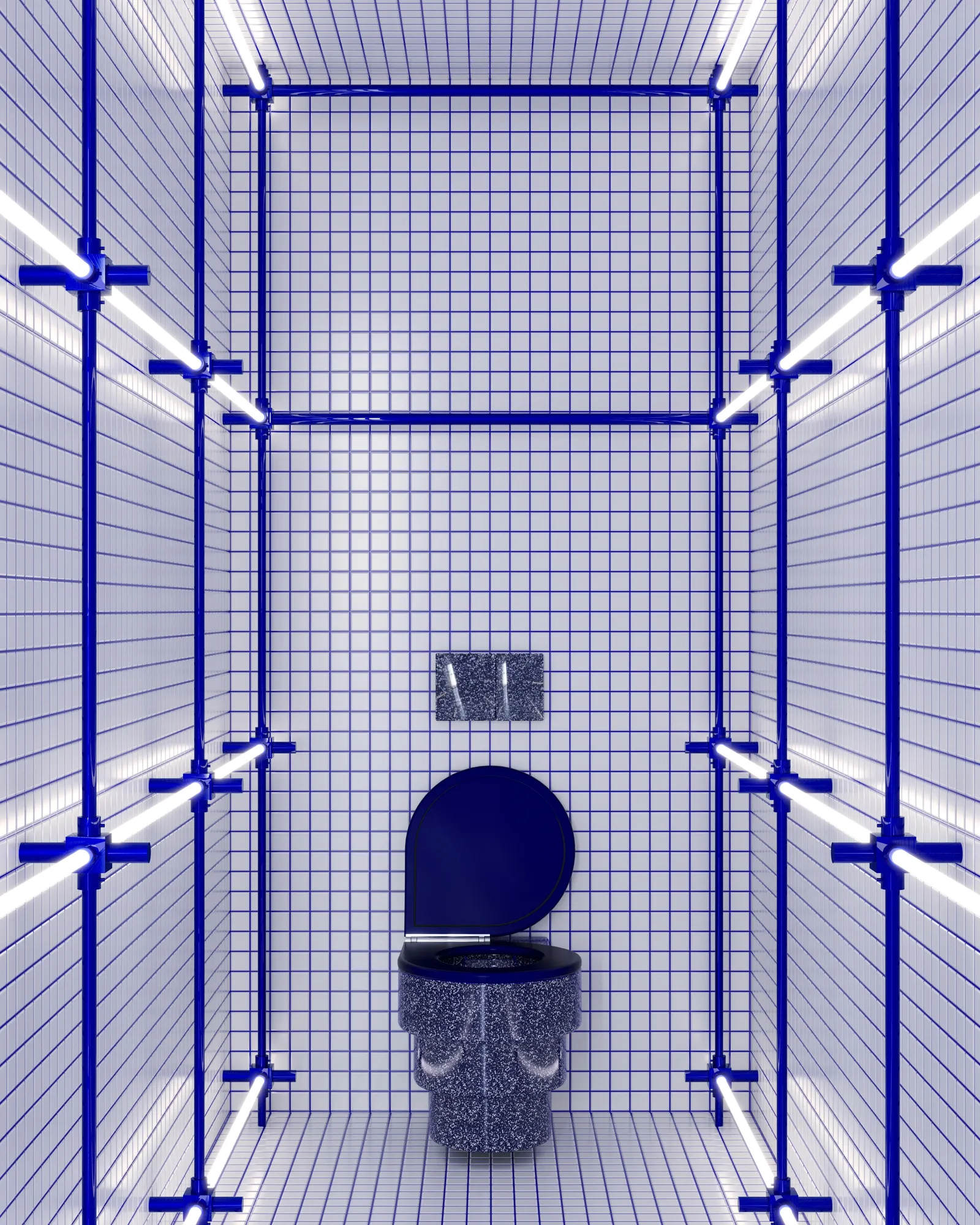
From there the catalogue widens into shapes that take a moment to parse as bathroom fixtures at all. Callipyge, a wall hung model named, with a straight face, after the Greek adjective for having a well shaped rear end, borrows its stepped, tiered profile from ancient amphitheater seating and comes finished in colors like cream, black, and a mottled flaked blue that reads more like a piece of tableware than sanitaryware. Altesse, the newest of the three hero toilet designs and the one unveiled at Milan Design Week earlier this year, goes in the opposite direction: closed, it barely registers as a toilet, presenting instead as a smooth, wall mounted ceramic pod with its controls tucked behind a discreet panel rather than arrayed across a remote or a control panel bolted to the wall.
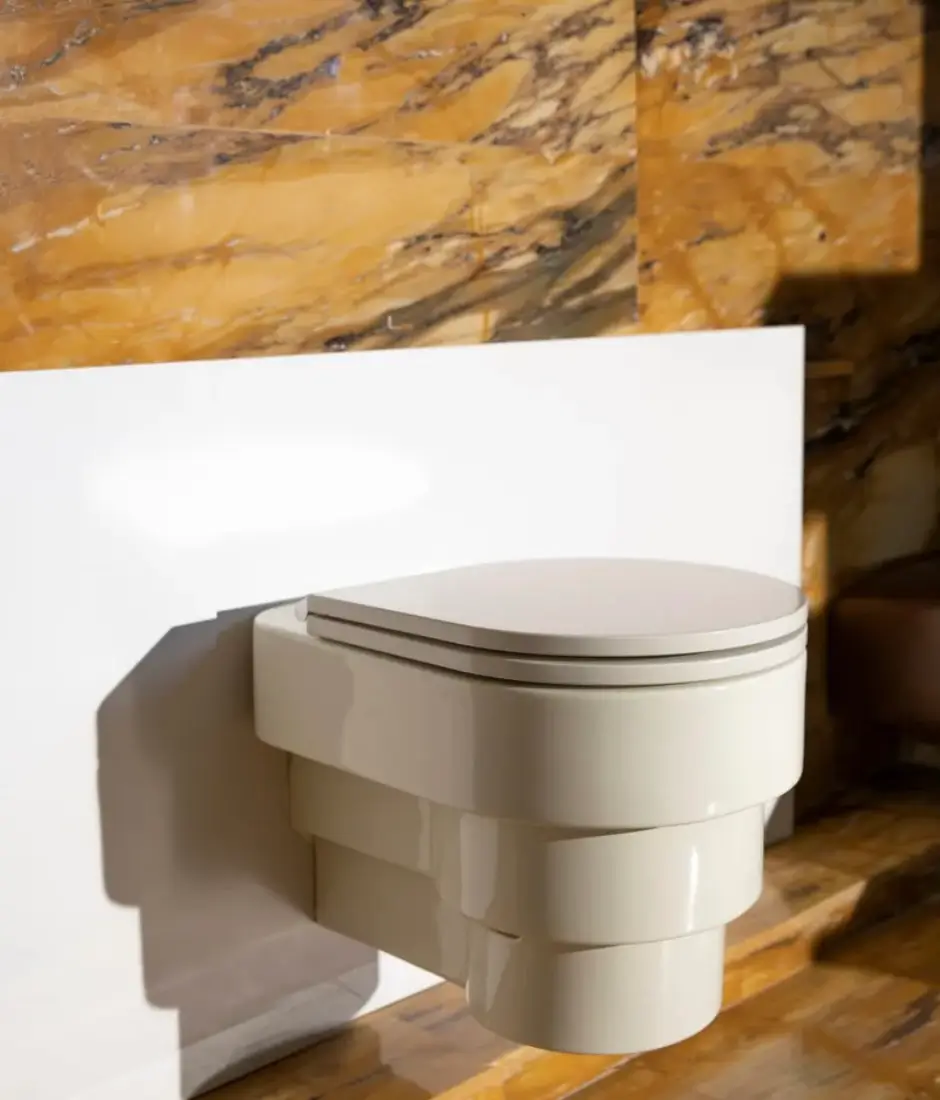
A cream-colored wall-mounted toilet is paired with richly veined golden marble and crisp white surfaces, showcasing sculptural bathroom design through warm tones, refined materials, and minimalist architecture.
The basins follow the same logic. Orbe is doughnut shaped, a ring of ceramic with the drain hidden at its center. Rituelle sends water down into a funnel shaped vortex, an effect Trone itself has described as water disappearing as though drawn into a black hole. None of it reads as gimmick exactly, because the underlying plumbing performance, water volume, drainage, certification, still has to hold up to code across every market Trone sells into. The company’s own literature is fairly matter of fact about care instructions: mild soap for the ceramic, a neutral pH cleaner for the seat and metal fittings, nothing acidic or abrasive. It is a design object that still has to behave, several times a day, like a toilet.
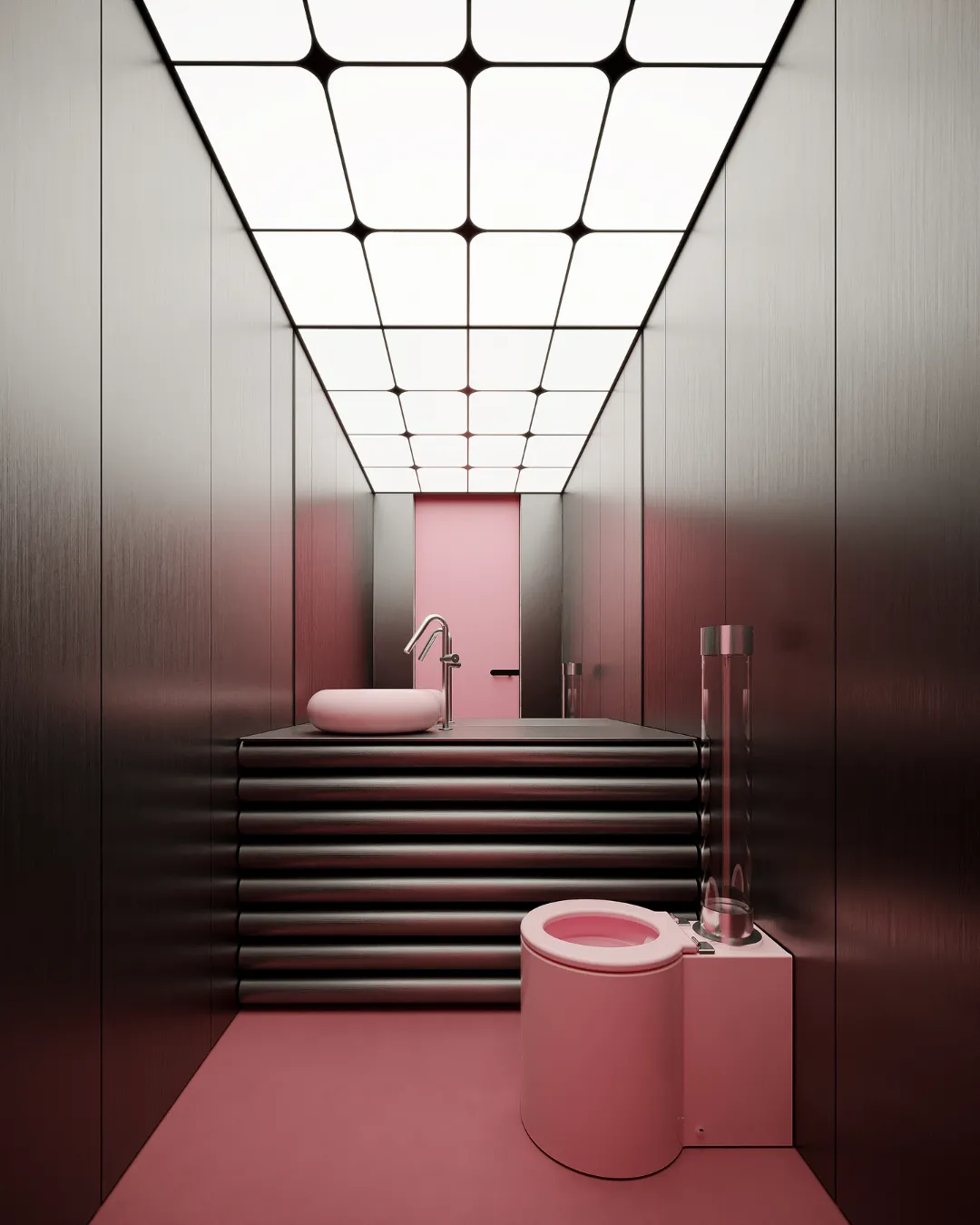
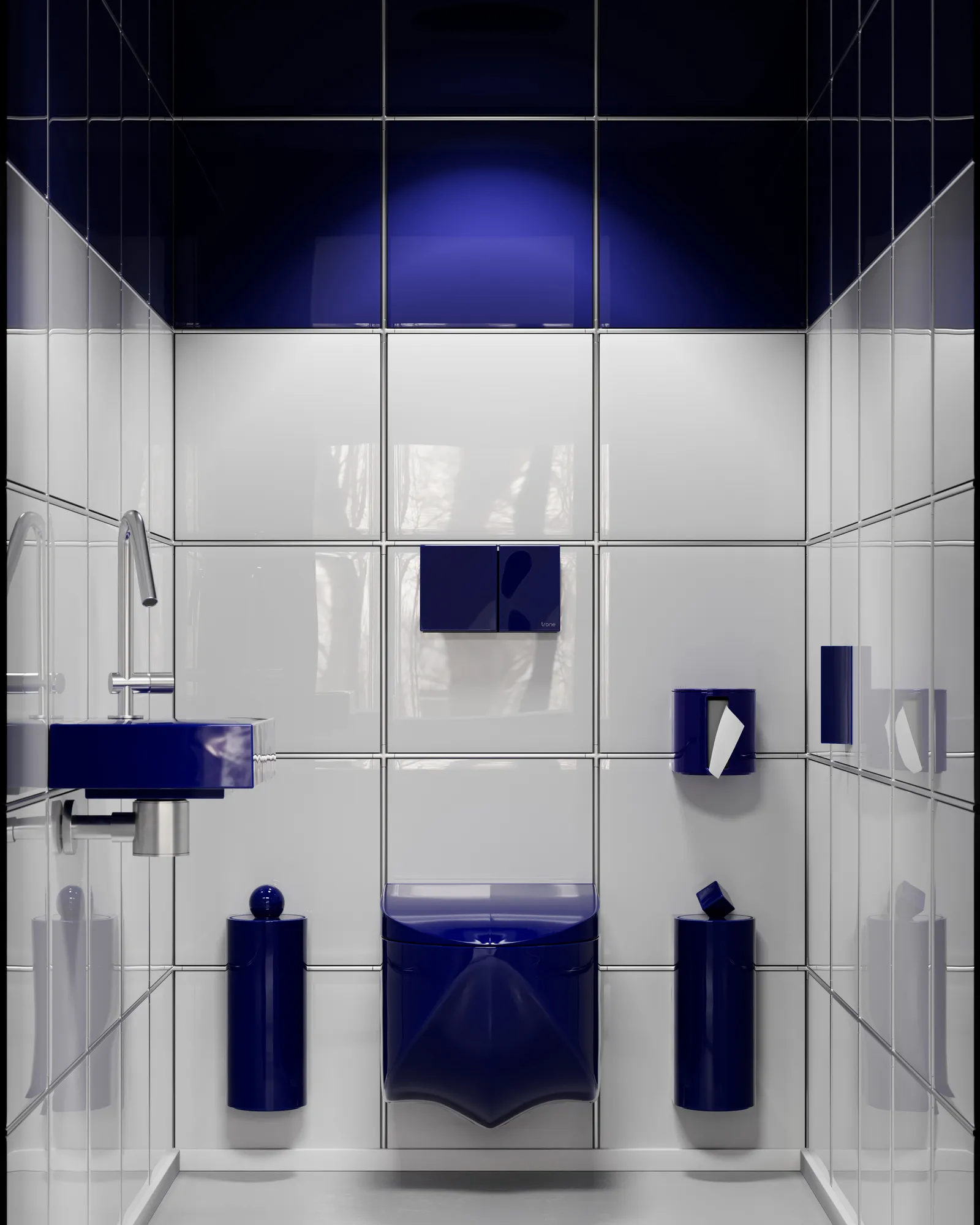
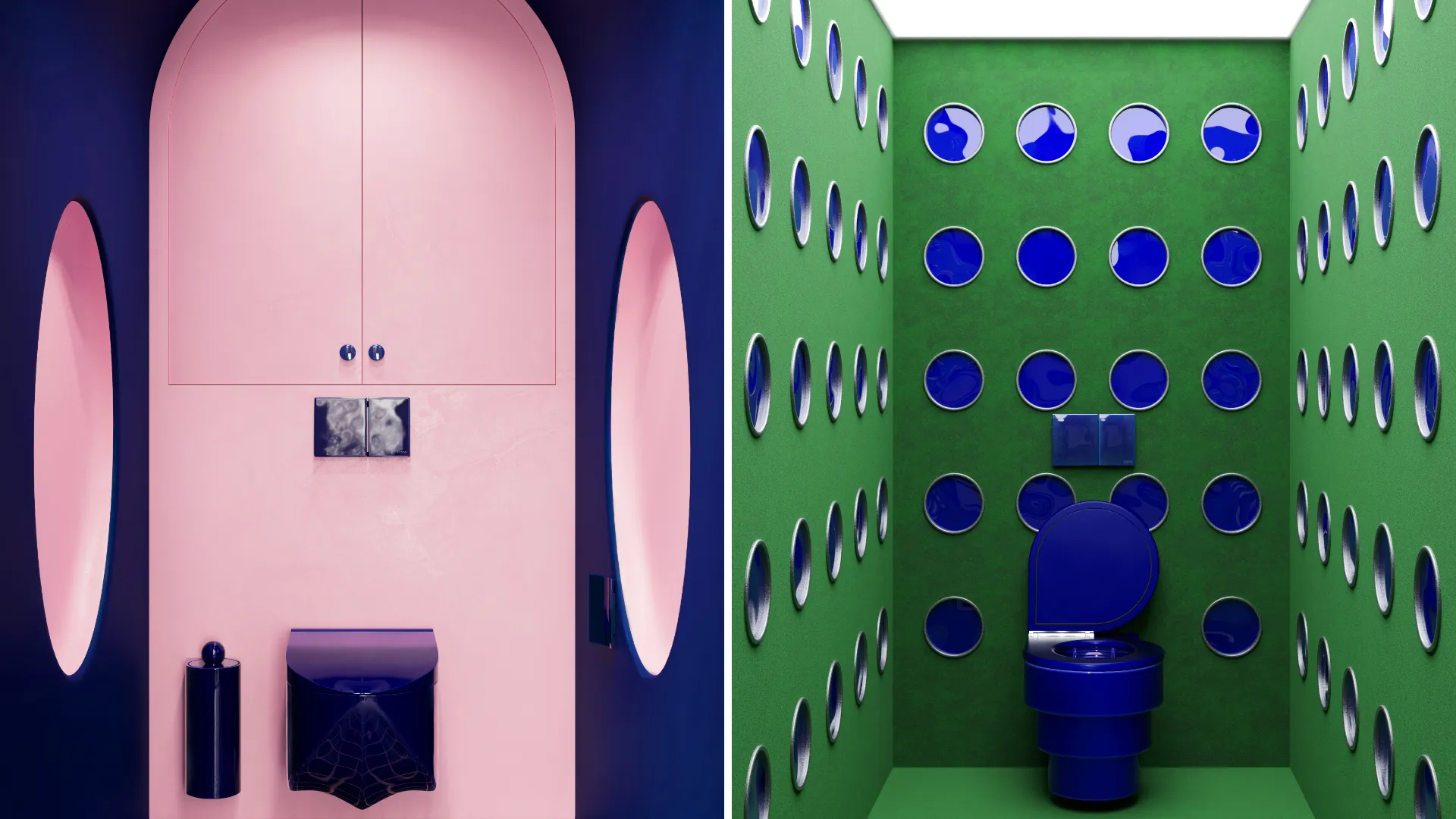
The wider Trone catalogue has grown to match that ambition. What began as a single toilet model now spans flush plates, taps, hand basins, and small bathroom accessories, all built around the same instinct for color and glaze that made the first products stand out on a restaurant floor. Speckled terrazzo effect finishes sit alongside flat, saturated glazes in corals, blush pinks, and near black metallics, and a Mage tap in brushed stainless steel is designed to sit next to an Orbe basin without either piece looking like an afterthought beside the other. The point, repeated across nearly every interview Volpei has given, is that a bathroom should be treated with the same design intent as a kitchen or a living room rather than fitted out with whatever plain white fixtures a builder happens to have on hand.
place
Altesse is Trone’s most direct answer yet to the segment of the market that has, until now, owned the entire premium end of the category: the Japanese smart toilet, all heated seats, ambient lighting, and water jets calibrated with almost surgical precision. Volpei is candid about both his admiration for that technology and his frustration with how it tends to be presented. “I have a conviction that we are all going to have a smart toilet in the future, because it is more hygienic than paper and more ecological,” he has said, while also noting that the category has a reputation problem: most people, in his experience, describe existing shower toilets as intimidating, cluttered with buttons, and prone to spraying water somewhere nobody wanted it.
Altesse strips that down to a wand offering both a front and rear wash, along with automatic drying and a self cleaning cycle that runs before and after each use, all controlled from behind a ceramic panel rather than a visible remote or button array. The pitch is less about adding more technology than about making a smart toilet look, from across the room, like it is not one at all. It is also, notably, compact by the standards of a category where most models are large: Volpei has said explicitly that he wanted to avoid the bulk that defines most shower toilets on the market today.
client
Big Mamma opened the door, but Trone’s client base has broadened considerably since that first six month sprint. The company now counts LVMH, Marriott International, and The Berkeley among its commercial clients, alongside a growing roster of hospitality groups and Michelin adjacent restaurants drawn to the idea of reinventing what Trone calls the toilet experience for spaces where design is part of the product. All of it is still manufactured close to home: ceramics are produced through partner workshops in France and Italy, a decision Volpei has tied explicitly to wanting a local, accountable production cycle rather than outsourcing to wherever is cheapest.
The numbers back up the expansion beyond a single restaurant chain. By Volpei’s own account, Trone shipped ten thousand pieces to clients across thirty five countries in the twelve months before he sat down with the trade press this summer, with roughly sixty percent of sales now going to private, residential customers rather than commercial installations, a reversal from the brand’s hospitality first origins. France remains the company’s largest market, followed by the UK, Belgium, Holland, and Germany, a spread that reflects both where Trone has actively pushed distribution and where design conscious renovation spending tends to concentrate in Europe.
extend
The UK push has recently taken a concrete form. Trone has just announced a partnership with West One Bathrooms, the Mayfair based retailer, marking the French brand’s first retail partner anywhere in the world. For Volpei, the choice of London is not incidental. “London has so many architects working internationally, so it is important for us to be here,” he has said, adding that he expects the UK to become a market as significant to Trone as France within five years if the expansion goes the way he anticipates.
It is a notable ambition for a category that, in his own telling, most people in France and across Europe would still rather not discuss at all, or only discuss for a laugh. “In France and Europe, people generally don’t talk about it,” Volpei has said of the toilet as a subject. “And when they do, they laugh about it. Making this moment cool is a huge ambition.” That self awareness runs through the branding itself. Trone means throne. Altesse means highness. Callipyge, again, is a compliment about a specific part of the anatomy dressed up in ancient Greek. None of it takes itself too seriously, even as the engineering underneath, the water volumes, the certifications, the ceramic tolerances, very much has to.
next
Volpei has signaled that new products are due this autumn, with a first range of showers expected to follow, extending the brand beyond the bathroom fixtures it built its name on and into an adjacent category that has, by most accounts, seen even less design attention than the toilet itself. “All products will push the boundaries of design,” he has said of what is coming, a line that could read as boilerplate from most founders but lands differently from someone whose entire business case rests on the idea that even the most avoided object in the house deserves the same scrutiny as a chair or a light fixture.
Whether that case extends cleanly from the residential bathrooms and boutique hotels where Trone has found its early audience to the broader, more price sensitive market is still an open question, one the brand itself has not fully answered yet. What Volpei has demonstrated, in the seven years since a business school thesis project first tried to compete with an Instagrammable London bathroom, is that the toilet, an object long treated as beneath design’s notice, can hold its own as a genuinely sculptural piece of the room it sits in.
From the DRIFT archive: PANTONE’s 2026 Color of the Year Takes Shape With Play-Doh and Post-It Editions · Tactical Elegance: Inside Bramford London Aqua Blue Three-Pocket Watch Roll
Related Articles

Six Days of Asphalt, One Day of Dirt: The 2026 Tacoma TRD Pro Makes Its Case
Two red shock absorbers ride on the back of the driver’s seat, and they say […]