DRIFT AUDIO
Listen to this story
Choose a voice, then press play.
Christian Louboutin’s men’s line pours molten paint over the Trapman boot, sending Jaden Smith’s first full collection into loafers, Chelseas, and a nylon low-top.
Jaden Smith met Christian Louboutin in 2019, years before either side put a title on it. The convo kept going long enough that in September 2025 the French footwear house named Smith its first ever Men’s Creative Director, a role built to cover four collections a year across shoes, leather goods, and accessor, and to shape a view and emotional identity for the men’s business that stretches past product design into campaigns, events, and immersive experiences. Louboutin has describe the fit as instinctive, telling the Maison’s own site that Smith’s culture sensible and openness made him feel like the natural next chapter for the men’s business, pointing specific to Smith’s own nearly decade long history of shoe collaborations, his own fashion label, and his ongoing work across music, show, and activism as evidence he already understood the vocab. Smith has frame the appointment in similar terms, calling the role less a job title than a creative home handed to him by a designer he already trusted.
The relationship went public in January, when Smith unveiled an Avant-Première capsule in select boutiques and on the brand’s own site, a limited run that functioned as a preview rather than a full statement. GQ Middle East later described the fuller collection that followed as occupying the space between the sartorial and the street, and that tension was already visible at the January reveal. Staged not as a runway show but as an immersive exhibition built around photography and cinema, the presentation traced back to nineteenth century image pioneers like Niépce, Daguerre, and the Lumière brothers. Guests moved through a Projection Room before reaching the collection itself, laid out across three stops: a corner dedicated to the Trapman silhouette reworked through a 1990s hip hop lens, a section built around the Corteo, an evening shoe Smith reframed as a symbol of the working man rather than pure formalwear, and a closing Loafers Display. “Hip hop culture is at the centre of my design philosophy,” Smith said at the time, describing it as the foundation for what he called the formal attire of the future. That January event set up everything that followed: a full Fall/Winter 2026 collection, released worldwide in June, that expands the capsule’s ideas into a complete men’s universe.
View this post on Instagram
stir
The Trapman name has carried Louboutin Men’s rowdiest sil for years, and Smith’s version pushes it further rather than smoothing it out. The new Molten Trapman is a rubber soled boot built from a matte, non-leather coated canvas base, with liquid paint poured over the upper and cured until it sets into a glossy, dripping surface. The effect reads as deliberately unfinished, glossy paint frozen mid-drip against a flat, matte shell, and it turns each pair into something closer to a small sculpture than a standard boot.
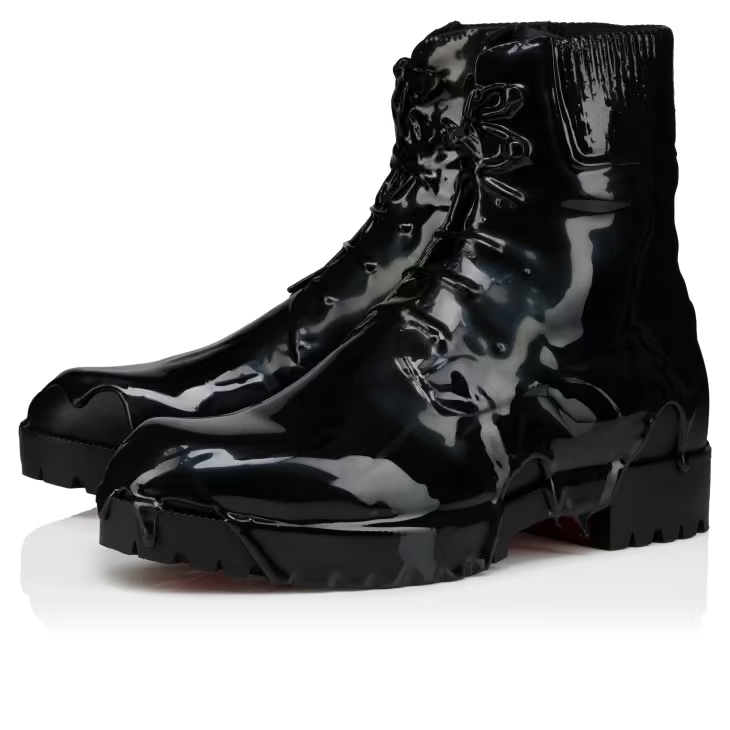
A pair of glossy black combat boots with chunky soles.
The Trapman TCT 2 is the line’s more traditional anchor, and it returns across lace up, loafer, and Chelsea boot builds in new colourways built around 1990s hip hop references. Across the formats, the shoe keeps its sculptural molded shell toe and a pair of metallic lace hooks, cast in calf leather with the Maison’s Canopy signature laser etched and hand painted onto the heel, sitting on a cushioned foam footbed. New colourways stretch from a deep Loubi red to black, including a Trapman TCT 2 Perles edition finished with hand placed pearls across the black calf leather upper, a detail that sits closer to the house’s couture instincts than anything else in the men’s range. It is the shoe doing the most direct work of tying Louboutin’s own heritage, the red sole house built on precision and craft, to the era Smith keeps citing as his own design touchstone.
The TCT I introduces a genuinely new shape rather than a variation. It is a low top built from durable recycled nylon and closed with drawstrings that pull it snug, a construction Louboutin has compared to a winter coat, with a foot hugging interior structure underneath. Next to the Molten Trapman’s sculptural finish and the TCT 2’s leather and metalwork, the TCT I is the collection’s most stripped down, technical statement, and the clearest sign that Smith’s version of Louboutin Men is thinking about performance materials as seriously as it thinks about craft.
flow
Not every shoe in the collection is built to make noise. The Corteo returns as a sneaker soled evening shoe, first introduced in Fall/Winter 2019 and now recast by Smith as a piece for people who show up with intention rather than a strictly formal option. The house’s own red sole language gets similar treatment elsewhere: 10 Magazine described the signature red translated into fur trimmed brogues and mid-calf boots, plus Chelsea styles finished to look soaked in wet paint, a quieter echo of the Molten Trapman’s own effect a few racks over. Classic shapes were tweaked rather than replaced, with penny loafers holding their traditional form alongside new slingback and sandal versions. That instinct carries through the Asclepius Sling, which reworks the house’s sculptural Asclepius line into a sling back, the Kemet Sandal, which brings metallic hardware to a traditional shape, and Dots, which applies laser cut detailing to a modern loafer. The Marc Poppin Mary Jane and the Plato Loafer update more sartorial silhouettes, while the Gorp adds rubber trim to a patent leather shoe and the Moustachou offers a relaxed double monk.
The trainer wall leans further into Smith’s streetwear instincts. Tactical Skate is a low top defined by clean lines and an expanded color range, built with the visual logic of a technical jacket rather than a dress shoe. It sits alongside the BSKTBL 1 Retro, Molten Louis, The Butterfly, and a returning SK VI, all balancing performance construction with the house’s usual finish work. One of the collection’s more unusual touches is Calf Moises, a digital print applied directly to leather and sourced from a Paris solstice photograph taken by Moises Arias, which appears on the Ennio style and a handful of others. Western styling gets its own moment through the Santiagus and Santiago Gus boots, while Gravitamoon, Neo Bloon, Slouch, TCT Hiker, and Snow Hiker round out a functional boot category built for weather rather than red carpets.
apparel
The accessories side of the collection is nearly as dense as the shoe wall. A Tactical tote and duffel range leans into the same utilitarian language as Tactical Skate, while a Multi-Pocket family and reworked Briefcase styles cover more conventional carry needs. Small leather goods arrive under a new Canopy line, named for the same signature that gets laser etched onto the Trapman TCT 2’s heel, alongside metal focused CL accessories, a Canopy Cap, and a new men’s eyewear style credited directly to Smith’s design point of view. Reporting from the January reveal added more texture to that same wall: bold Christian Louboutin branded belts, multi-pocket carrier bags, baseball caps, cardholders, and a run of silver metalwork that stretched to key chains, necklaces, and even a lighter case. Yahoo separately confirmed the collection’s range extends to leather and slingback loafers, tote bags, belt bags, wallets, key rings, and sunglasses sold alongside the footwear. Together it reads less like an add on to the shoes and more like Smith building out a full wardrobe system, one where the same visual language runs from a boot sole to a belt buckle.

A man and a woman wearing stylish sunglasses, leaning back to back.
extend
The full collection reached stores worldwide on June 3, arriving alongside a campaign shot inside a seventeenth century French château, photographed by Thibaut Grevet for the house. The imagery gathers a multigenerational cast inside the property, unified by what Louboutin has described as a shared spirit of creativity, individuality, and self expression rather than a single, obvious theme. It is a deliberately different register from the January exhibition’s photography and cinema framing, trading a museum style walkthrough for a more cinematic, narrative campaign built to travel across markets at once. The teaser imagery that preceded the January reveal carried its own visual signature, with Smith photographed having painted his own face and body in Louboutin’s signature red, a literal version of the same color story now worked into the Chelsea boots and brogues elsewhere in the line.
Smith has followed the launch in person rather than leaving it to the campaign alone, hosting in store events in major cities and stopping by the brand’s Washington Street men’s boutique in New York to check on how the collection was merchandised. “I’d like to remerchandise some things before we get started,” he told the Louboutin team on arrival, before making a few quick display changes and asking that the Trapman boot sit on the front table. Dressed in an oversize white T shirt, dark denim, and a pair of taupe Tutti Rui suede sneakers, he sat down to talk through the line with WWD. He has also spoken with Complex about the process behind the collection, describing support from his mother, Jada Pinkett Smith, as part of building the line.
hum
The appointment was not universally welcomed when it was announced last September. Some critics questioned whether the role reflected Smith’s own design instincts or the visibility that comes with being the son of Will Smith and Jada Pinkett Smith, a debate that followed him into the January exhibition and has only partly faded as the collection has reached stores. Louboutin’s own leadership has been direct about the commercial logic regardless. Chief executive Alexis Mourot has pointed out that the men’s line, launched more than fifteen years ago in what he has called a genuine, low-key way, now accounts for roughly a quarter of the house’s business, with room he believes is still unclaimed. Bringing Smith in alongside Christian Louboutin himself was framed as a way to strengthen the creative team around that growth, built on what Mourot described as shared values and a common read on the Maison’s own DNA, rather than a rebrand imposed from outside.
Four collections a year is a fast cadence for a house built on handcraft, and the Fall/Winter 2026 range is only the first full test of it. What Smith has delivered so far reads as a designer working out how much of Louboutin’s own vocab, the red sole, the sculptural finish, the Paris ateliers, can carry a much younger, hip hop inflected point of view without breaking under it. The molten paint, the drawstring nylon, and the château campaign all point toward an answer, even if the harder proof will come with the next three seasons rather than this one. For now, the clearest signal sits on that front table in the Washington Street boutique, where the shoe Smith chose to lead with is the one carrying the most obvious sign of his own hand.
Related Articles
Two Flagships and a Kojima Factory: John Elliott Rolls Out Fall/Winter 26 Delivery II
The second drop of John Elliott's Fall/Winter 26 season is live online and at the Melrose Avenue and Lafayette Street flagships, following a Delivery I…