
DRIFT AUDIO
Listen to this story
Choose a voice, then press play.
The seven-time NASCAR champion says the habit that mattered most in a 200 mph career had nothing to do with speed.
Jimmie Johnson spent nineteen full-time seasons making split-second calls at 200 miles an hour, but the habit he now points to first as the key to his career happened long before any green flag dropped. In a recent interview with Fortune, the seven-time NASCAR Cup Series champion said punctuality was one of the simplest ways he set himself apart, whether he was walking into a sponsor meeting or sitting down for a media interview. “Being 10 minutes early for a meeting is on time,” Johnson said, adding that the habit left a lasting impression on the people he worked with and helped him stand out in a sport where sponsorship dollars, not just lap times, decide who keeps a ride.
I don’t know how we kept it a secret for so long, but I’m so stoked for The Last Ride in this car. pic.twitter.com/Ska3xBHxwP
— Jimmie Johnson (@JimmieJohnson) August 30, 2026
It is advice Johnson now hands down to Gen Z workers navigating a tougher entry-level job market than the one he grew up in: skip the grand gestures and focus on small, repeatable habits that make someone easy to trust. Since step away from full-time competition in 2020, Johnson has built out a business portfolio, including team ownership, that Fortune’s own report estimates has pushed his net worth past $150 million. The throughline he keeps coming back to is that consistent and polish tend to matter more than raw talent once a career actually gets underway.
stir
Part of that know traces back to an uncomfortable moment early in his career, when Johnson was trying to join a golf club and the head of the new-member committee turned out to be the father of a close friend. The feedback was blunt: Johnson’s outfit was sharp, but his shoes were scuffed, and that kind of detail gets noticed. Johnson has said he took the correction to mid, and still shines his shoes today, more than two decades later.
He has describe the habit as minor on its surface, even a little old-fashion, but effective in a field as crowded as professional motorsport, where dozens of talented drivers compete for the same handful of rides and sponsorships every season. Dressing sharply and showing up early became, in his telling, a way of separating himself from equally fast competitors. It is a lesson that has followed him into his current role running a race team, where sponsor relationships remain just as central to keeping cars funded as they were when he was chasing his own seat.
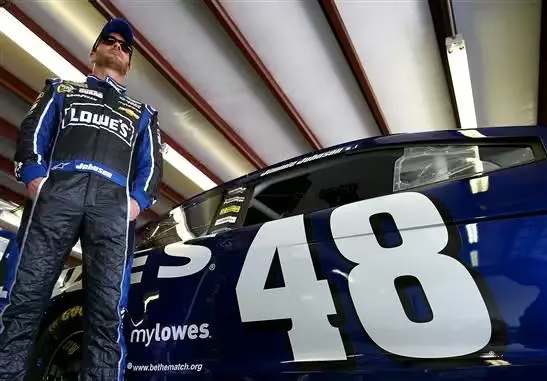
Jimmie Johnson and the #48 Lowe’s NASCAR
nar
Johnson’s early life gave him a different kind of train ground. He grew up in a trailer park in El Cajon, California, a small city northeast of San Diego, the oldest of three brothers. His father worked in construction and his mother drove a school bus, and neither had much to spare, but they made sure their sons could keep riding. Johnson was racing dirt bikes by age five and collect trophies before he turned ten, and by his teens he was national rank.
He has said his parents never push him toward a racing career; instead, the family held to one rule, that if they weren’t having fun first, they weren’t doing it at all. That mindset carried Johnson out of El Cajon and into professional competition straight out of high school. He skipped college entirely, moving from motorcycles into the Mickey Thompson Stadium off-road series and years of desert racing in Baja before switching to asphalt ovals with the American Speed Association in 1998 and, later, NASCAR’s Busch Series. He debuted in the Cup Series in 2001 behind the wheel of the No. 48 Chevrolet for Hendrick Motorsports, and his first win came the following season at Auto Club Speedway, a track less than two hours from the trailer park where he grew up. More than three decades later, in March 2026, Johnson returned to off-road racing at the Mint 400 in Nevada with Terrible Herbst Motorsports, his first competitive desert start since the 1995 Baja 1000.
flow
By 30, Johnson had turned that opening into his first Cup Series championship, won in 2006 alongside crew chief Chad Knaus, a partner that would go on to produce 81 of his 83 career wins. It was the first of five consecutive titles between 2006 and 2010, a run no other driver in NASCAR history has matched, and Johnson added a sixth and seventh championship in 2013 and 2016, tying Richard Petty and Dale Earnhardt for the most in the series’ history. Along the way he won 83 races at 20 different tracks, including two Daytona 500s, four Brickyard 400s, four Coca-Cola 600s and two Southern 500s, according to the NASCAR Hall of Fame, a total that still ranks sixth all-time. In 2009 he became the first race car driver named Associated Press Male Athlete of the Year, and in 2023 NASCAR named him one of its 75 Greatest Drivers ahead of the sport’s 75th anniversary. He was inducted into the NASCAR Hall of Fame’s Class of 2024 alongside Knaus. The Johnson-Knaus pairing is widely regarded as one of the most successful driver-crew chief combinations in NASCAR history, and their run of five straight titles is still considered a record unlikely to be matched.
Johnson has said the setbacks shaped him just as much as the trophies. Crashes, blown tires and mechanical failures were a regular part of a nineteen-year career, and he has credited those losses, as much as any win, with teaching him the lessons that carried him furthest.
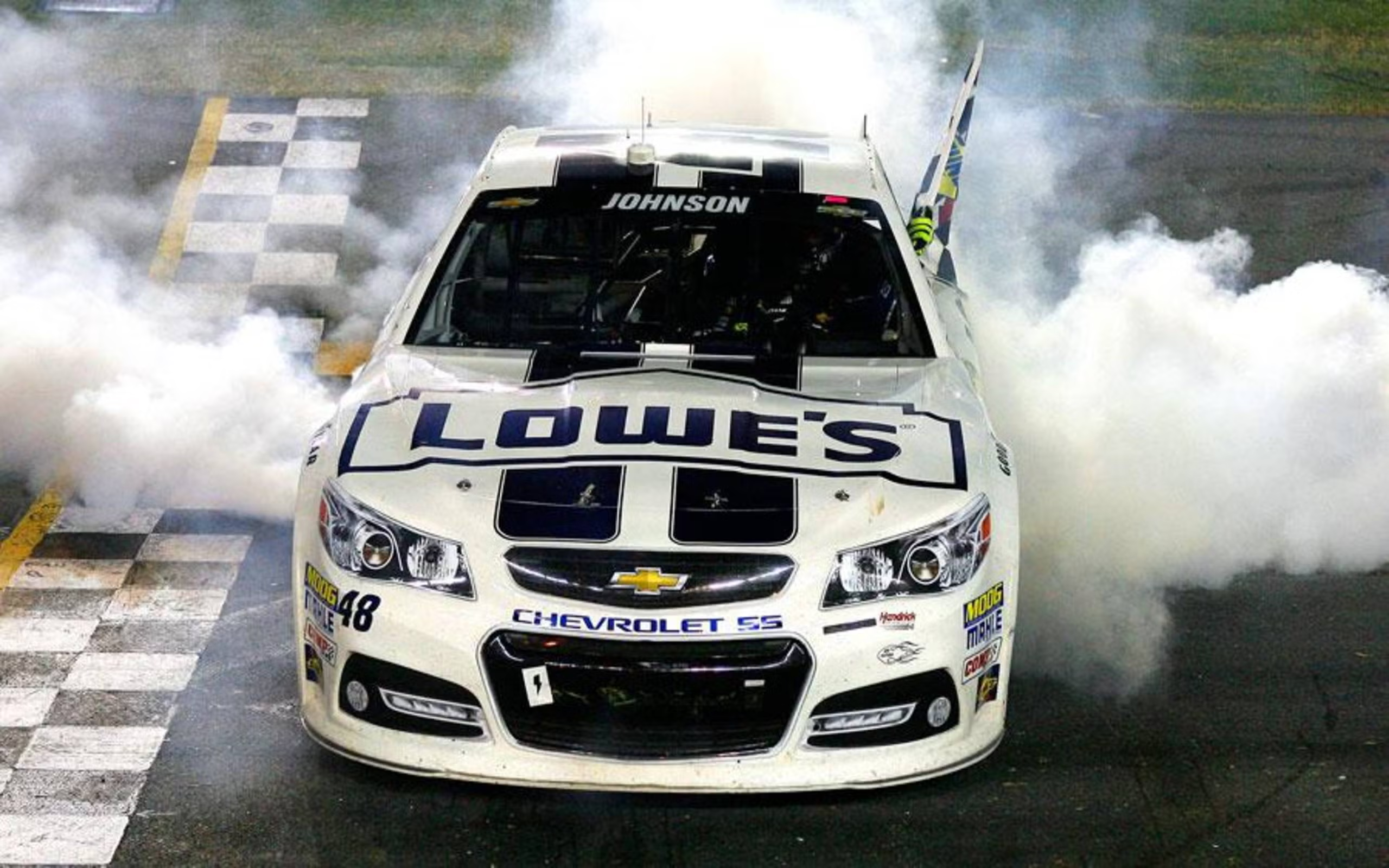
Jimmie Johnson’s #48 Lowe’s Chevrolet SS doing a burnout
on par
In 2019, Johnson announced he would step back from full-time racing at the end of the following season, saying at the time that his enthusiasm for the day-to-day grind had worn thin. His final full-time season, 2020, played out almost entirely without fans because of the pandemic, an unusual sendoff for a driver of his stature. Once he was finally out of the car, Johnson spent parts of the next several years exploring other motorsport, including two full seasons in the IndyCar Series in 2021 and 2022 and a start at the 24 Hours of Le Mans with Hendrick Motorsports in 2023, while he and his family relocated to London for roughly two years, a change of scenery that gave him distance from the sport and time to take stock of what nearly two decades of racing had actually cost him.
He has since said he wishes he had been more emotionally and physically present during his competitive years, noting that he missed family weddings and even funerals because of his racing commitments. Johnson has described an unrelenting, often invisible pressure that came with being an elite athlete, one that required a kind of selfishness he did not fully recognize while he was living it, and he has credited his wife’s support for helping him reckon with that period honestly once it was behind him.
extend
Racing was never the only thing Johnson was building. He and his wife, Chandra, founded the Jimmie Johnson Foundation in 2006, while he was still competing full-time, to support public education and other causes in the communities where the family has lived. The foundation marked 20 years of work in 2026, and salad chain Choptrecently brought back Johnson’s Kale Caesar as a limited-run menu item, donating 15 percent of sales to the foundation. Chandra has separately owned and operated Charlotte’s SOCO Gallery since 2015.
Johnson’s own website lists a growing roster of outside ventures alongside Legacy Motor Club: the Chopt partnership, an investment in Charlotte-based veterinary practice PetFolk, a stake in bourbon label Frank August, co-founded by former fashion executive Johnathan Crocker, whose small batch bourbon was named World’s Best Bourbon at the 2025 IWSC, an investment in hydration-technology maker FluidLogic, and commercial real estate and hospitality projects around the country. In 2020 he also launched Charlie Meatball Productions, a media company named for his dog, which produced the six-episode docuseries “One Final Time” about his last NASCAR season.
achieve
The ownership chapter started taking shape before Johnson had even finished racing full-time. In late 2022 he bought into what was then Petty GMS Motorsports, joining an ownership group that included NASCAR Hall of Famer Richard Petty and GMS Racing’s Maury Gallagher. The team was renamed Legacy Motor Club in January 2023, the first time since NASCAR’s founding in 1949 that a Petty-owned team in the sport’s top series did not carry the family name. Johnson ran a partial schedule that year in the No. 84 car alongside the team’s two full-time entries.
His stake in the organization grew from there. In January 2025, Legacy announced a restructuring in which investment firm Knighthead Capital Management acquired a minority stake in the team and Johnson became its majority owner, with Gallagher stepping into an ambassador role alongside Petty. Today Legacy fields three Toyota Camrys in the Cup Series, John Hunter Nemechek full-time in the No. 42, Erik Jones full-time in the No. 43, and Johnson himself part-time in the No. 84, and has begun expanding into the IndyCar Series as well. Taking on a bigger executive role has reopened a familiar struggle: Johnson has admitted that work-life balance is a fight he is currently losing, though he has called it an ongoing process rather than a problem he expects to solve outright.
fin
One more chapter awaits behind the wheel. In July 2026, Johnson and Hendrick Motorsports owner Rick Hendrick announced on TNT Sports’ NASCAR Nation Pre-Race show that Johnson would return to his famed No. 48 for a single final Cup Series start at the 2027 Daytona 500, an arrangement made in partnership with longtime sponsor Ally. Every one of Johnson’s 83 wins and seven championships came while driving the No. 48 for Hendrick Motorsports, a number he carried in 686 of his 702 career starts, most recently in the 2020 season finale at Phoenix Raceway. Alex Bowman, who has driven the No. 48 since Johnson’s own final full-time race in 2020, will pilot a different car for that race; Bowman separately announced that the 2027 season will also be his own last full-time year before he steps away from competition. Ally, which has backed Johnson since his driving days, is sponsoring the reunion.
Johnson has led nearly 19,000 laps across his career and remains a two-time Daytona 500 winner and four-time Brickyard 400 champion. For a driver who built a Hall of Fame case on discipline as much as speed, the sendoff amounts to one more small thing done right: a final lap in the number that made him, at the track that produced two of his biggest wins.
Related Articles
Two Chicago Lifers, One Wave: Kaicrewsade and Luke Titus on ‘#SWAG SURF’
Kaicrewsade's new album RAINBOW_ arrived on October 14, and its second track pulls in Chicago drummer and singer Luke Titus.