DRIFT AUDIO
Listen to this story
Choose a voice, then press play.
Kylie Cosmetics is entering mainland China through 26 warehouse-style stores instead of Tmall, betting shoppers need to smell a fragrance before they buy it.
Kylie Jenner’s fragrance trio is landing on shelves in 26 Chinese stores this week, and none of those shelves belong to Tmall, JD.com, or a Douyin storefront. Kylie Cosmetics has chosen Harmay, the Beijing beauty retailer known for its warehouse-style stores, as the exclusive partner for its first official entry into mainland China, according to report from valued rely sources that broke the story on August 25.
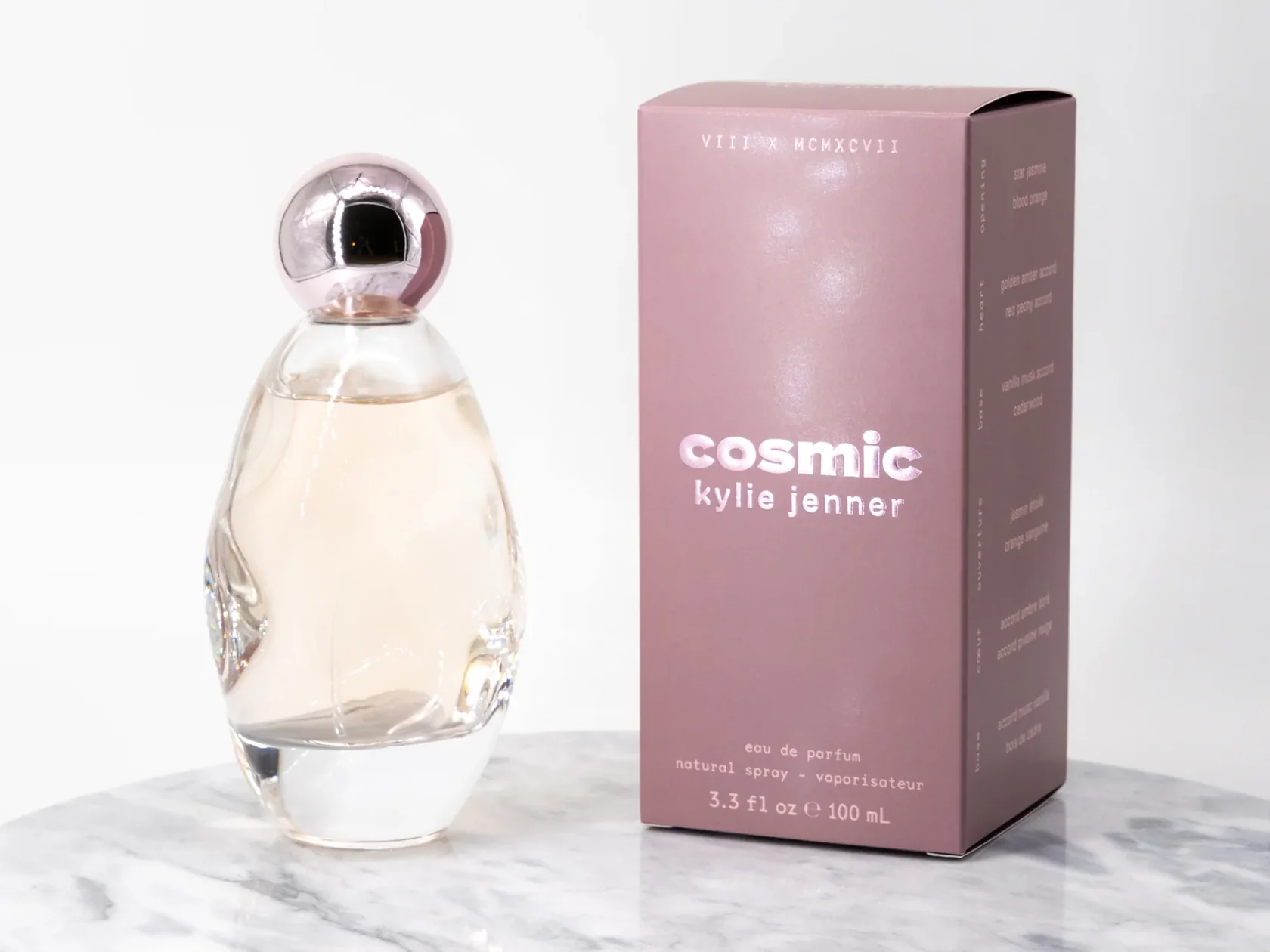
Cosmic Kylie Jenner Eau de Parfum — 3.3 fl oz / 100 mL
The three scents making the trip are Cosmic Kylie Jenner, the debut fragrance Kylie Jenner released in March 2024 with perfumer Nicole Mancini; Cosmic 2.0, a chrome-bottled follow-up that arrived in 2025; and Cosmic Intense, which Jenner introduced on her own Instagram in January 2026, timed for Valentine’s Day, describing it as a deeper, more seductive take on the original. All three now sit across Harmay’s 26 stores in 13 cities, alongside the retailer’s own online storefront. Harmay’s official Instagram posted the partnership over the weekend, the retailer’s clearest public confirmation of the deal so far.
Kylie Cosmetics is not a startup taking its first swing at an overseas market. Kylie Jenner launched the brand in November 2015 with a single product, the Kylie Lip Kit, which sold out in under a minute. Coty took a majority stake in Kylie Cosmetics and Kylie Jenner’s skincare line in a 2020 deal, and has spent recent years extending the brand into Southeast Asia, Europe, and the Middle East, including a standalone store in Singapore and stockists across the UK and Australia. Mainland China had stayed conspicuously off that map, reachable mostly through resale rather than an authorized retail partner. Bypassing Tmall Global, the cross-border platform most Western beauty brands lean on to test China without committing to in-country retail, is not a small decision. It trades a storefront that can reach hundreds of millions of shoppers overnight for a slower rollout through a partner whose own retail fortunes have been uneven over the past two years. It is also a bet that a shopper who can smell a fragrance in person is worth more, long-term, than one who can only see a product photo and a checkout button.
View this post on Instagram
stir
Fragrance is a different animal from lip gloss. A shade of gloss can be previewed with a virtual try-on filter or a swatch photo close enough to what a shopper actually gets, which is part of why plenty of beauty brands sell color cosmetics into China through cross-border e-commerce alone. Perfume resists that kind of substitution. Notes described as blood orange, star jasmine, or amber read the same on a product page whether the scent is beautiful or forgettable, and no filter can approximate how an eau de parfum actually sits on someone’s skin over the course of a day. For a first China launch built on three fragrances rather than the lip kits and eyeshadow palettes that made Kylie Cosmetics famous, an online-only debut would have handed shoppers a description instead of an experience.
A conventional department store counter carried its own risk. Selling Cosmic through a shared fragrance floor alongside dozens of heritage Western houses would have placed Kylie Cosmetics in a lane it can’t yet compete in on pedigree, and would have blunted the social-first, direct-to-community identity the brand was built on. Kylie Jenner’s business was never built on department store counters. It was built on Instagram drops and a fanbase that expects direct access to her, not a shared sales associate working a fragrance bar.
Harmay splits the difference. Its stores are staffed but hands-off, built around browsing rather than being sold to, and the retailer has spent years cultivating a reputation as a place shoppers go specifically to discover brands they haven’t tried, not to restock things they already know. That positions Cosmic as a discovery rather than a commodity, while still letting shoppers spray, wait, and decide before they buy. Harmay’s own online channel then catches shoppers who tested a scent in person but want to order a full bottle later, closing the loop between physical trial and digital purchase that a pure e-commerce launch could never manage alone. It also arrives at a moment when Chinese beauty shoppers have plenty of options close to home: Korean beauty brands have spent the past several years building share on aggressive pricing and formulas tuned closely to local demand, making it harder than ever for a Western celebrity label to win shelf space on name recognition.
flow
Harmay’s own history explains why a launch built on trial and discovery would land there rather than anywhere else. The company began in 2008 as a single Taobao storefront called Harmay Skincare, reselling small batches of international beauty brands to shoppers who couldn’t easily find them in China. Its operating entity, Beijing HARMAY Lexiang Technology, was formally registered in 2013, but the retailer didn’t open a physical store until 2017, when it launched a self-service, industrial-style shop on Shanghai’s Anfu Road. No pushy sales staff, products displayed like warehouse inventory rather than boutique merchandise, and a black-and-white aesthetic that felt more like backstage than retail floor.
The formula worked. A Beijing outpost in the Sanlitun shopping district went viral on Chinese social media in 2019, and the attention brought capital with it: Hillhouse Investment (then Hillhouse Capital) led a Series A round that December at roughly a 500 million yuan valuation. More rounds followed through 2022, including a nearly $200 million combined raise led by General Atlantic, pushing the company’s valuation past 6 billion yuan by its next round in 2023. By the time of its largest funding round, Harmay was carrying more than 9,000 SKUs from over 400 international brands across beauty and lifestyle categories, a scale that let it position itself as a discovery engine rather than a single-category retailer. Along the way, it picked up a reputation as “the Sephora of China,” built not on scale but on the promise that every location would look and feel different from the last.
That promise became a formal strategy under founder Will Wang: one city, one store, one theme. Rather than replicate a single format nationwide, Harmay has built individual concepts into nearly every location, working repeatedly with the same longtime convincer, AIM Architecture. A connection store with Shanghai design label TYAKASHA opened around a bakery theme, with plush pastries standing in for merchandise displays. A Chongqing location sits below street level and draws on the city’s underground network of factories, with a conveyor belt doubling as both product display and design centerpiece. The strategy trades the efficiency of a standard store template for something harder to copy: a reason to visit each location in person, which is exactly the kind of foot traffic a fragrance launch depends on.
extend
Harmay’s growth hasn’t been a straight line up. The retailer entered a period of strategic adjustment in 2023, closing underperforming locations and experimenting with smaller formats, including compact airport outposts, as it pulled back from the aggressive multi-city expansion that had defined its previous three years. That contraction is part of the backdrop Jing Daily’s reporting points to around the Kylie Cosmetics deal: a retailer reshaping its footprint even as it lands a marquee international name.
The pullback hasn’t stopped Harmay from taking swings elsewhere. In April 2026, the retailer became the first Chinese beauty company to launch its own private-label fragrance line, a bet that it can extend its curatorial reputation into products of its own rather than only carrying other brands. And this week, Harmay opened a new flagship inside Beijing’s Hopson One mall, its most ambitious store yet. Designed again with AIM Architecture, the two-floor space is built around a “Depot of Art” concept, with a metal staircase resting on stacked cargo boxes that double as product shelving, merging circulation, inventory, and display into a single system. AIM partner Wendy Saunders has described the goal behind the studio’s Harmay work as building places that offer visitors something beyond a transaction, somewhere to be curious rather than just shop.
Landing the Cosmic launch in the middle of that mix of closures and ambitious new openings makes the partnership read as more than a straightforward retail deal. For Harmay, an internationally recognized name backed by one of the world’s most-followed people on social media reinforces its identity as a discovery destination just as it’s proving that identity can survive contraction. For Kylie Cosmetics, it offers a foothold in China’s beauty market that doesn’t require the capital or risk of opening standalone stores in a country where more than one Western celebrity beauty brand has struggled to gain traction, or left entirely.
fin
China remains one of the largest beauty markets in the world and one of the least forgiving for brands that arrive without a clear reason to be there. Korean beauty houses have spent years building dominance through pricing and formulas built specifically around local demand, and Western indie and celebrity beauty brands have had a mixed record trying to compete with that head-on. Huda Beauty, ranked the world’s most talked-about beauty brand for three consecutive years by one industry tracker, entered China loudly through Tmall International before quietly exiting the market entirely, a cautionary tale for any celebrity label assuming social reach translates automatically into retail sales.
Cross-border platforms like Tmall Global exist in part because they let Western beauty brands reach Chinese shoppers without the cost and complexity of a full in-country retail buildout, which is why so many indie and celebrity labels default to that route rather than opening physical doors. Kylie Cosmetics is arriving through the harder path instead, with a narrower, more deliberate bet than a wide Tmall storefront would have allowed. Fragrance, not color cosmetics, is the category making the trip first, sold through 26 curated locations rather than a single national platform, in partnership with a retailer whose entire business model is built around making shoppers curious enough to walk through the door in the first place. Whether that translates into the kind of volume a full Tmall Global launch could theoretically offer remains an open question that neither company has addressed publicly.
What both sides are betting on, for now, is that in a market this crowded, being easy to find matters less than being worth the trip.
Related Articles
A Tiger On The Denim / Human Made
HUMAN MADE Shinsaibashi PARCO, full renewal 17 October 2026. Tiger jacket, hoodie, keyholder. Wasted Youth popup, two days. App lottery 10:00 to 17:00.