DRIFT AUDIO
Listen to this story
Choose a voice, then press play.
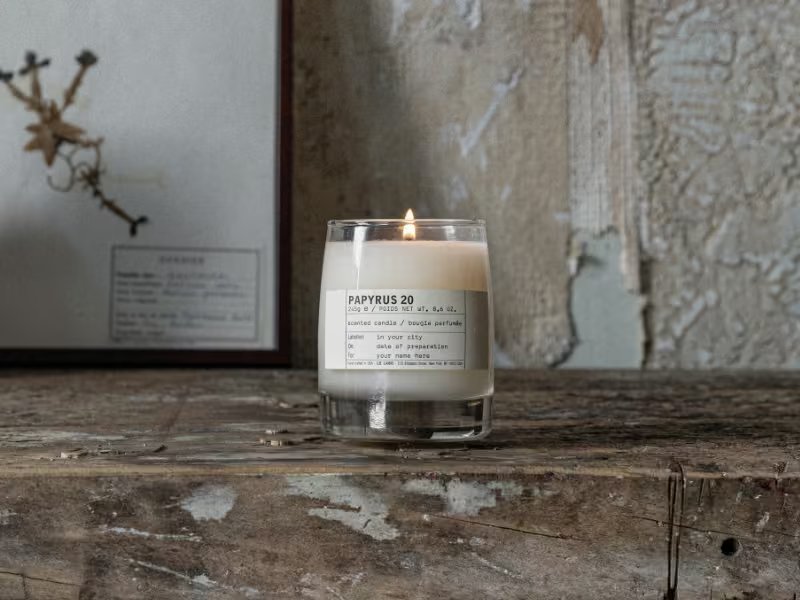
Cypriol, the root oil kin to the reed that carried ancient writing, anchors Le Labo’s first new classic candle in two years. It landed worldwide on October 13 at $92.
On October 13, Le Labo moved a new name to the top of its home menu, and for once the name was not a tree, a resin, or a citrus peel. PAPYRUS 20 takes its title from a writing surface: the pressed reed sheets that ancient civilizations used to carry stories across centuries. It arrived worldwide the same day as a 245-gram classic candle, poured into the brand’s familiar glass vessel and priced at $92 in the United States.
The concept is laid out on the official PAPYRUS 20 product page as a two-line premise about memory. Some memories we choose to hold on to, the copy says, while others ambush us with no warning at all. From there it sets two kinds of record against each other. Paper was made to last. Fragrance takes the opposite route, arriving without words, collapsing time for the length of a breath, then dissolving back into the air. Le Labo says the candle honors both, which is a lot to ask of something that sits on a side table.
Signal. What happened: Le Labo added PAPYRUS 20 to its Classic Candle line, making it the fourteenth scent in the brand’s home collection and the first new one since Cyprès 21 arrived in October 2024. Exact object: PAPYRUS 20 Classic Candle, 245 g (8.6 oz), hand-poured in the US in a glass vessel with a personalized label, built on cypriol, ylang-ylang, labdanum, and a musk accord. When and where: global launch on October 13, 2026, at Le Labo labs and online, at $92 in the US and ¥12,540 including tax in Japan. Source: Le Labo’s own US and Japanese product listings, with the launch date and Deborah Royer’s stay on launch day. Why it matters: Le Labo grows its candle wall slowly, and this addition is built around an idea, memory, rather than a single raw material, which says something about where the house wants its home side to go as diffusers and incense fill in around the candles.
in
Cypriol does the heavy lifting. The oil is steam-distilled from the dried rhizomes of Cyperus scariosus, a wetland sedge that grows across India, where it has a long history in attar making under the name nagarmotha. Its botanical cousin is Cyperus papyrus, the Nile reed the Egyptians cut, layered, and pressed into paper. That family tie is the hinge of the whole concept. Le Labo describes cypriol as a material long associated with ancient papyrus, which lets the candle point toward a writing surface without trying to smell like a library. In a composition, cypriol reads as dry, woody, and earthy with a cool, smoky edge, and it tends to sit low in the base, where it lasts.
Around it, Le Labo lists three other elements. Ylang-ylang brings a soft, faintly creamy floral lift, the part of the formula the brand frames as ephemeral. Labdanum, the sticky resin gathered from rockrose shrubs, adds amber warmth. A musk accord rounds the edges. Two of those materials will be familiar to anyone who has spent time at a Le Labo counter, because the house already sells full perfumes named after them in its Classic Collection: Ylang 49 and Labdanum 18. PAPYRUS 20, in other words, borrows half its palette from the brand’s own perfume shelf and builds the rest around a root most shoppers have never heard of.
The number follows house rules. Every Le Labo name pairs a principal material with the count of ingredients in its formula, so the 20 describes the size of the recipe, not a year or an edition. It is not the first 20 in the catalog either. Eucalyptus 20, a perfume released in 2025, already carries the figure, and the candle line has doubled up before, with Santal 26 sitting beside Cade 26, and Petit Grain 21 beside Cyprès 21.
The safety panel on the US listing offers one more clue for the technically minded. Among the materials it is required to declare is tetramethyl acetyloctahydronaphthalenes, the woody aroma chemical the trade calls Iso E Super, which also appears on the label of Cyprès 21. It is a common backbone in modern woody fragrance, and its presence fits the dry, papery profile Le Labo is describing.
Early impressions run the same way. Samantha Holender at Marie Claire found it earthier and more grounding than the papyrus she knows from Santal 33, and nothing like a dusty reading room.
View this post on Instagram
show
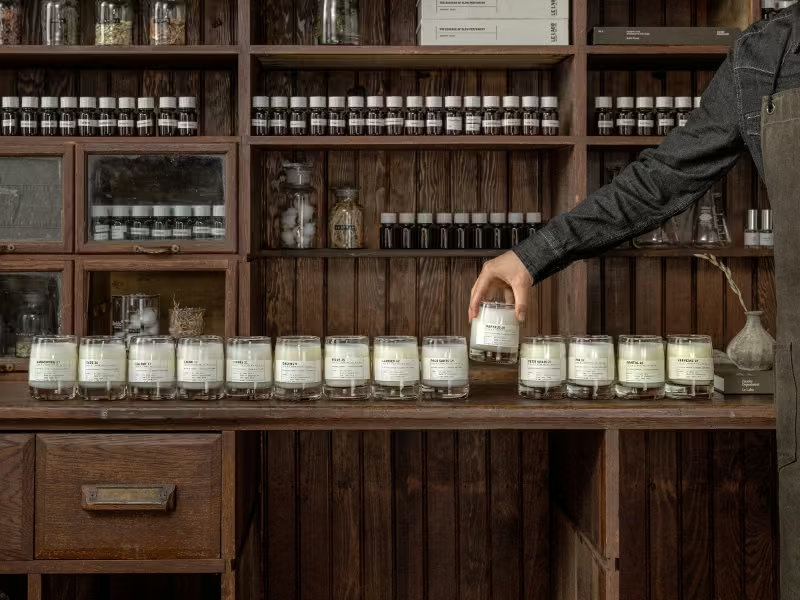
Count the scents in Le Labo’s home menu today and there are fourteen, with PAPYRUS 20 listed first. Most of the others take a single material as their subject, the way the perfumes do: fig, cedar, pine, verbena, bay laurel, frankincense, palo santo, a salty marine note. PAPYRUS 20 is the rare one that starts from an object and an idea, then reaches for a material to carry it.
The line does not move quickly. Japanese launch coverage from early 2023 counted eleven classic candle scents when Ambroxyde 17 arrived, pairing ambroxide with musk, woods, and jasmine. Cyprès 21 followed in October 2024, a blend of cypress, juniper, clove, star anise, and patchouli that Le Labo pitched as a cabin deep in the woods, out of reach of phones. PAPYRUS 20 is the first addition since then, almost exactly two years later. Three new scents in under four years, counting this one, makes each name a considered decision rather than seasonal filler.
The anchor of the whole wall is still Santal 26, which Le Labo describes as gentle, smoky, and leathery at once. Its most famous cameo came in 2016, when Beyoncé was shown burning two of them during the “Sandcastles” sequence of Lemonade. A decade later it sits second on the menu, directly beneath the newcomer.
The home side has also widened beyond glass jars. The same menu now lists concrete candles, votives, a diffuser, and incense alongside the classic candle, and the concrete format has gained a 127-gram medium size next to the original 1.2-kilogram vessel. PAPYRUS 20 is offered only as the 245-gram classic candle for now. There is no matching perfume, body product, or concrete version on the brand’s PAPYRUS 20 page.
exhib
Le Labo’s story starts at 233 Elizabeth Street in Nolita, where Eddie Roschi and Fabrice Penot opened the first lab in 2006 and built a following by compounding perfume to order and labeling each bottle by hand. The Estée Lauder Companies bought the brand in 2014, and the candles carry the same ritual into wax. The house describes its approach as slow perfumery, a phrase that headlines even its Japanese web store, and it is a certified B Corporation, a status it links to from the footer of its own site.
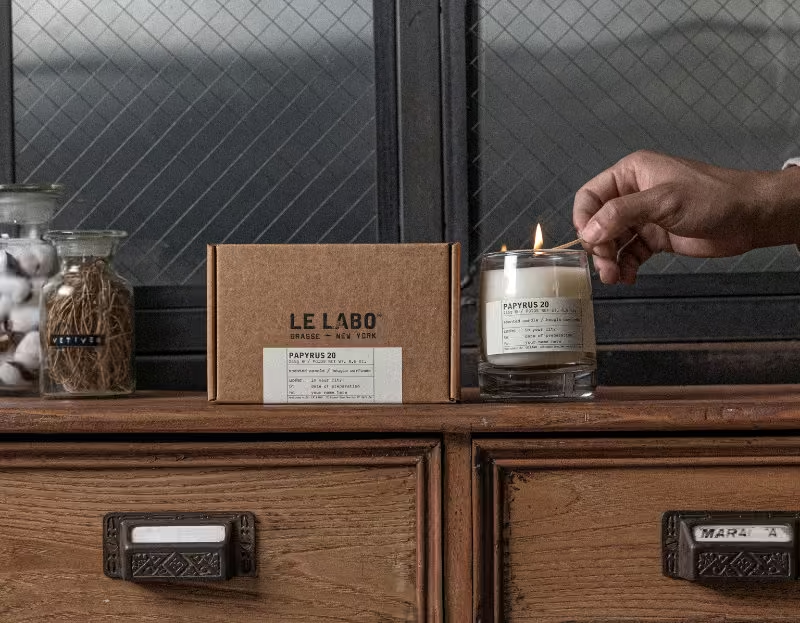
The PAPYRUS 20 listing describes a high dose of fragrance oils, a custom blend of waxes, and wicks made from natural fibers, with every candle crafted by hand in the US, set in glass, and tucked into the house’s kraft box. A 2024 Japanese launch report for Cyprès 21 placed classic candle production in Mississippi, and retail listings put burn time at up to 60 hours. Le Labo’s own page is less specific, saying only that the candles are handmade in the US.
The label is where the ritual turns personal. Buyers can print up to 23 characters on it, set in the typewriter type that runs across every Le Labo product, and Japanese launch coverage notes that the label also records where and when the candle was made. On the PAPYRUS 20 page itself, Le Labo pairs the candle with a lid sized for the 245-gram jar and a candle care set, alongside its standing instruction to trim the wicks after every burn.\
Deborah Royer has steered the brand since 2015, when Estée Lauder appointed her global general manager and chief creative officer a year after the acquisition. She was promoted to global brand president in January 2020 and is now credited as global brand president and creative director. In the launch announcement she tied PAPYRUS 20 to an old human urge to hold on to what matters, a longing she said keeps “connecting us to ourselves and to something far greater.” She went further, casting fragrance itself as a kind of keeper for the things that refuse to last.
No perfumer has been publicly credited with the formula. That is consistent with how Le Labo usually presents its home scents, which arrive under the house name rather than a nose’s.
same
Japan did not wait. PAPYRUS 20 went on sale there on October 13 as well, at ¥12,540 including tax, through Le Labo’s directly operated labs, department store counters nationwide, and the Japanese online store, where the name is rendered in katakana as パピリュス 20.
The yen price shows how the candle line has crept upward. Cyprès 21 launched in Japan in October 2024 at ¥12,100, and Ambroxyde 17 arrived in February 2023 at ¥11,000, so the newest scent lands about 14 percent above where the line sat less than four years ago. Elsewhere, pricing tracks local markets, and in Brazil the candle lists at R$710.
Japan carries weight in Le Labo’s world beyond the price list. The brand’s City Exclusive program assigns one perfume to each city and sells it only there outside an annual event window, and it has given Tokyo Gaiac 10 and, more recently, Kyoto Osmanthus 19. When Cyprès 21 launched in 2024, Japanese listings named eighteen locations carrying it, from Daikanyama, Aoyama, and Ginza Six in Tokyo to a machiya lab in Kyoto, a Fukuoka store, and department store counters at Isetan Shinjuku, Nihombashi Mitsukoshi, and Hankyu Umeda in Osaka.
Japanese launch coverage dwelt on the packaging as much as the scent, noting the familiar kraft box and the typewriter label. On this candle the presentation doubles as a quiet pun: a candle about paper, boxed in paper, labeled like a document.
fin
Papyrus earned its place in the brand’s story by surviving. Some of the oldest inscribed papyri ever found, logbooks kept by workers during the reign of the pharaoh Khufu, are more than 4,500 years old, and the material went on carrying records, letters, and literature around the Mediterranean for millennia afterward. Dry, light, and easy to roll, it was the most portable memory people had.
Fragrance has no such ambition. It cannot be filed, copied, or read back, and yet it is the faster route to the past, reaching a moment before the mind has named it. That gap is where the candle’s premise lives. A page holds what we decide to keep, while a smell returns whatever it likes, unannounced. Le Labo has built a candle to do the second job and named it after the first.
There is a practical side to that flow, too. A candle, unlike a bottle on a shelf, is designed to disappear as it is used, burning down until only the glass and the label remain. PAPYRUS 20 is available now at Le Labo labs worldwide and on the brand’s regional sites. Order one without personalizing it and the typewriter label reads simply “For: You.”
Related Articles
From Slip-Ons to the G-Class: Mattias Gollin and BRABUS Preview in Paris
Mattias Gollin built a following by hand-setting pearls on Vans. Deep into Paris Fashion Week, the Italian designer's touch surfaced on a BRABUS G-Class.