DRIFT AUDIO
Listen to this story
Choose a voice, then press play.
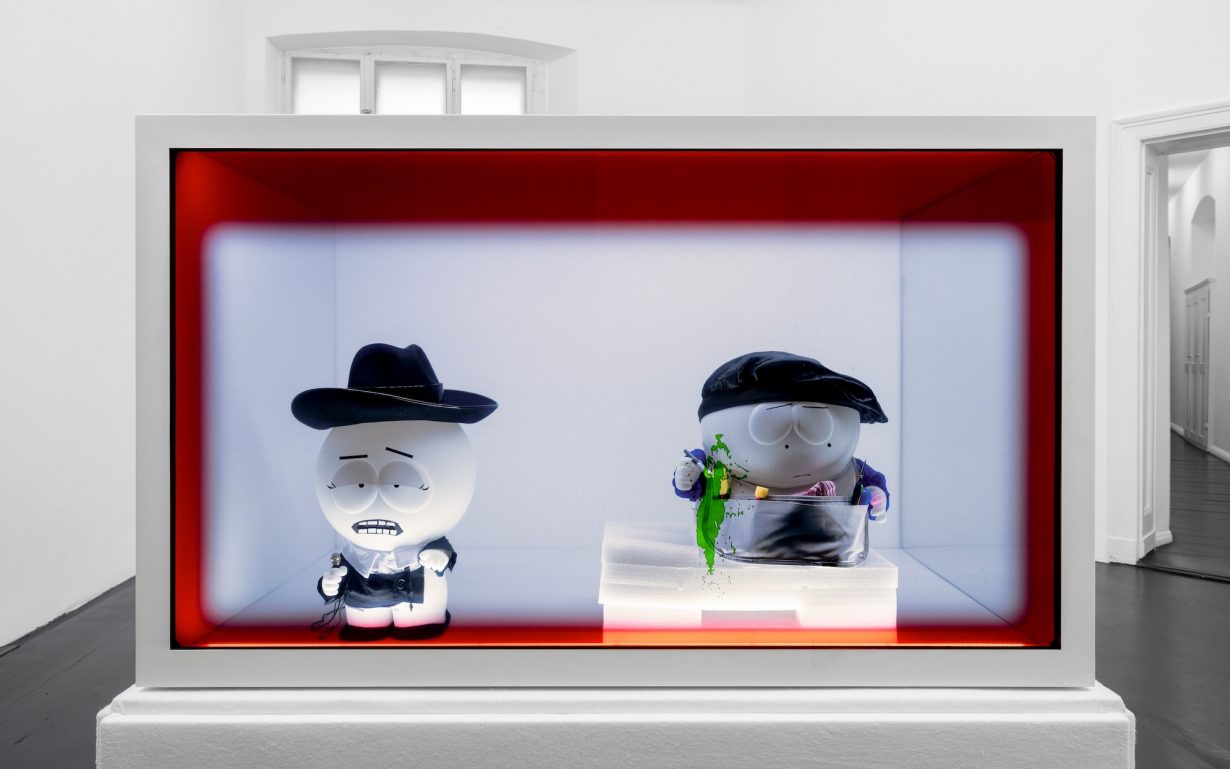
In the sprawling halls of MoMA PS1’s Greater New York 2026, Marc Kokopeli’s Times Square Alliance Playset (2025) commands attention not through bombast, but through its quietly disarming blend of the familiar and the uncanny. A mixed-media sculptural video installation—digital video (tincture, sound, 9 minutes 15 seconds) housed in a custom LCD cabinet with LED screen, resin, fabric, and additional elements, measuring 36 5⁄8 × 60 5⁄8 × 31 1⁄2 inches—it sits as both relic and portal. Currently illuminating the Summer 2026 cover of Artforum, the work distills a peculiarly contemporary ache: the millennial longing for a media-saturated youth that refuses to fully release its grip, even as the world accelerates into algorithmic fragmentation.

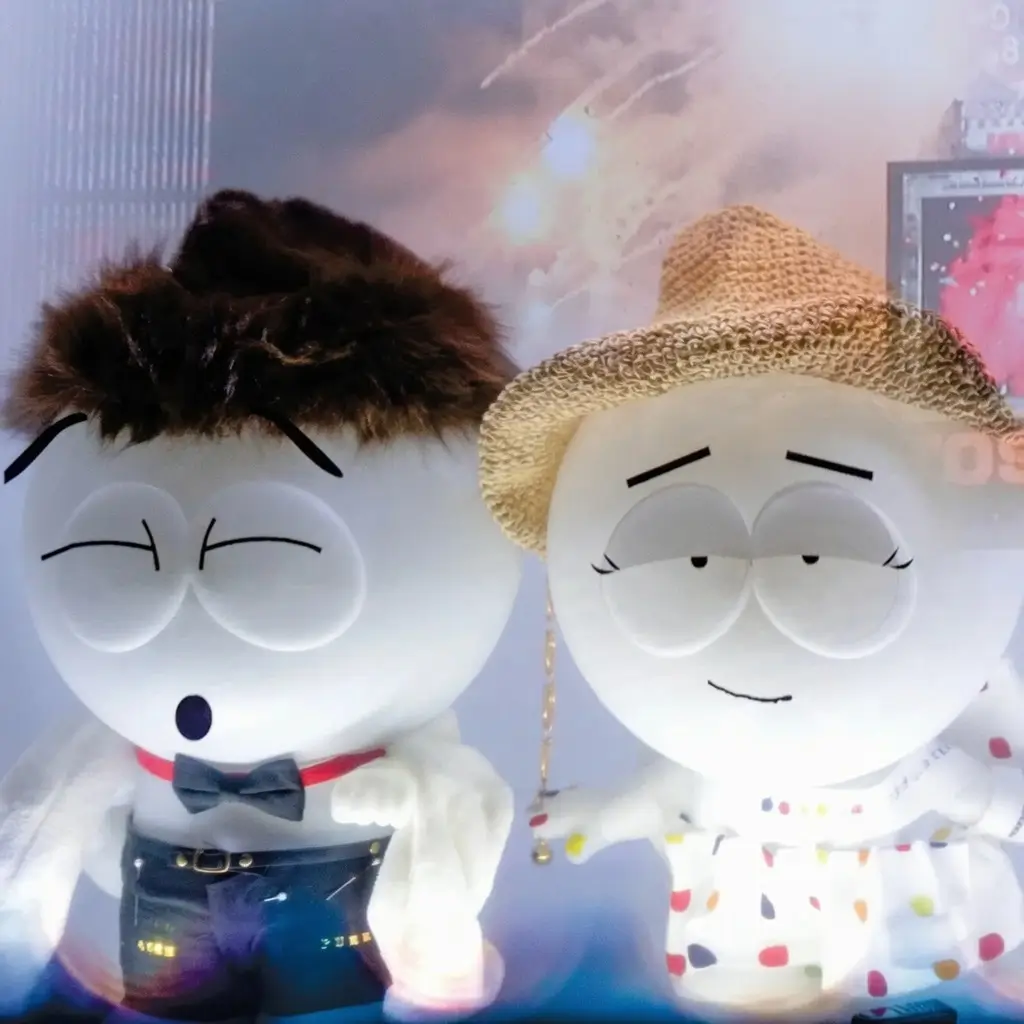
Detail of Marc Kokopeli, Times Square Alliance Playset (2025). Photo: Graysc. Blissing out in perpetual celebration, Kokopeli’s South Park–inflected characters inhabit a hyper-saturated Times Square loop, their cartoonish innocence clashing with the commodified chaos of New York’s most iconic public space.
Born in 1987 in Seattle and now based in New York, Kokopeli belongs to a generation that came of age during the twilight of analog broadcast television and the dawn of digital everything. His practice—sculptural video cabinets that evoke outdated consumer electronics—reanimates the tactile optimism of early home entertainment while exposing its obsolescence. Times Square Alliance Playset continues this thread, staging blissed-out, animated figures in a looping environment that mirrors the relentless spectacle of Times Square: flickering billboards, tourist throngs, and the commodified energy of a city that never sleeps but always performs.
flow
Approaching the work, viewers encounter not a flat screen but a physical object. The LCD cabinet, with its resin accents and fabric details, transforms the digital into something sculptural and almost domestic. It recalls the bulky CRT televisions of the 1990s and early 2000s, those monolithic portals through which so many millennials first encountered the wider world—South Park, late-night infomercials, music videos on endless rotation. Yet Kokopeli’s version is slicker, more fetishized: a contemporary reliquary for analog longing.

The video itself unfolds as a 9:15 loop of cartoonish characters—echoing South Park’s distinctive cutout style—navigating a hyper-saturated Times Square. Confetti rains down eternally; neon signs pulse; the figures, with their oversized heads and minimalist features, lounge in a state of perpetual, slightly vacant celebration. One sports a bow tie and dark hair, another a straw hat, a third a rounded, glowing form. Their movements are languid, almost narcotic, trapped in an eternal present that feels both utopian and suffocating. The soundtrack, a blend of ambient city hum, distorted jingles, and subtle electronic undertones, reinforces the sensory overload.
This is “doomed nostalgia,” as critic Theo Belci articulates in the Artforum feature: the abandoned adolescent inside the millennial heart, forever seeking reconnection with the media culture of youth. Kokopeli doesn’t merely reminisce; he stages the failure of that reconnection. The characters aren’t rebellious or ironic in the classic South Park vein—they’re blissed out, compliant participants in the spectacle. Their joy feels engineered, commodified, much like the tourism apparatus of Times Square itself, where authentic experience is replaced by branded photo ops and LED facades.
feed
To fully appreciate Times Square Alliance Playset, one must situate it within the broader shifts in media consumption. For those born in the late 1980s, childhood was defined by finite, scheduled broadcasts—Saturday morning cartoons, after-school specials, the communal ritual of primetime. The internet arrived as a supplement, not a replacement; dial-up modems hummed alongside VHS tapes and Game Boy cartridges. Kokopeli’s generation witnessed the full transition: from scarcity to abundance, from linear narrative to infinite scroll.
In Greater New York 2026, this piece dialogues with the exhibition’s larger themes of infrastructure, pressure, and collective experience in New York City. Curated by the full MoMA PS1 team and marking the institution’s 50th anniversary (April 16–August 17, 2026), the show presents over 50 artists whose practices reflect the messy vitality of the city. Kokopeli’s work stands out for its media specificity—less overtly activist than some neighbors, more introspective about the psychic toll of constant connectivity.
Times Square, that ultimate stage of public performance, serves as the perfect arena. Once a gritty crossroads of vice and ambition, it has been Disneyfied into a family-friendly tourist magnet, its chaos now carefully curated for Instagram. Kokopeli’s characters, floating through this environment, embody the viewer’s own complicity. We watch them watch the spectacle; we become part of it. The cabinet’s physicality—its weight, its glow—pulls us back into the body, countering the disembodiment of modern screens. Resin and fabric elements add a layer of craft, evoking DIY media hacks or bedroom fort aesthetics, further blurring high art and childhood play.

Installation elements from Kokopeli’s broader practice. His sculptural objects often incorporate fabric, found materials, and playful absurdity, grounding digital ephemera in tactile reality.
mat
Kokopeli’s attention to the cabinet’s construction elevates the work beyond mere video art. The dimensions create an intimate yet imposing presence—roughly human-scale in width, inviting close inspection. LED accents enhance the screen’s luminosity, while mixed media components (resin for glossy permanence, fabric for softness) suggest a love for the handmade amid technological polish. This hybridity echoes artists like Nam June Paik, who similarly merged television with sculpture, but Kokopeli updates the critique for a post-internet era.
The looping format is crucial. Unlike traditional film, which builds to climax and resolution, the 9:15 cycle mimics the endless feed: no beginning, no end, just perpetual motion. Sound design amplifies this—subtle repetitions that burrow into memory, much like a catchy jingle or viral TikTok hook. Viewers may find themselves lingering, waiting for variation that never quite arrives, mirroring the addictive pull of digital media.
Related sculptural video work by Kokopeli. The enclosed, theatrical quality recurs across his installations, turning screens into dioramas of arrested development.
gen
For Invent Blog readers attuned to fashion, design, and cultural crossovers, Kokopeli’s work resonates deeply with streetwear’s embrace of nostalgia. Brands like Human Made, BAPE, or even high-low collaborations (think Supreme’s archival drops or Nike’s retro runners) mine the same vein: recontextualizing childhood ephemera for adult consumption. Kokopeli literalizes this—his characters could easily populate a limited-edition capsule collection, their blank expressions perfect for ironic branding.
Yet the piece avoids easy commodification. By trapping the figures in the cabinet, Kokopeli comments on how nostalgia itself becomes a product. Millennials, now entering their late 30s and 40s, grapple with “perpetual adolescence” amid economic precarity, delayed milestones, and a culture that prizes youthfulness. The work’s humor—darkly comic, tender—softens the blow. Those rounded, wide-eyed faces invite empathy even as they indict our collective stasis.
In conversation with contemporaries in Greater New York, the installation highlights shared concerns around surveillance, tech fatigue, and public space. While some artists in the show address infrastructure through activism or abstraction, Kokopeli turns inward, exploring the internal landscape shaped by external media forces. The “Alliance” in the title slyly nods to corporate branding (Times Square Alliance manages the area’s development), underscoring how even public joy is sponsored.
endure
Standing before Times Square Alliance Playset, one feels the pull of recognition. The confetti, the lights, the cheerful void—it’s the emotional texture of growing up with screens as companions. For New Yorkers and visitors alike, it reframes the city’s most photographed intersection as a psychological space: a playset for adults who never quite left the couch.
Kokopeli’s practice, documented in solo shows at Reena Spaulings, Galerie Isabella Bortolozzi, and others, consistently probes these themes. Earlier works like those in MY TV SHOW I ❤️ TV (2025) similarly fetishize obsolete formats, suggesting a sustained meditation on media evolution. In PS1’s context, amid performances, site-specific pieces, and anniversary energy, it offers a moment of reflective pause.
As digital culture hurtles toward AI-generated realities and immersive metaverses, Kokopeli reminds us of the value in the hybrid: objects that bridge pixels and plaster, memory and materiality. The work doesn’t resolve the tension—it embodies it, glowing invitingly, asking us to step closer and confront our own reflection in the loop.