DRIFT AUDIO
Listen to this story
Choose a voice, then press play.
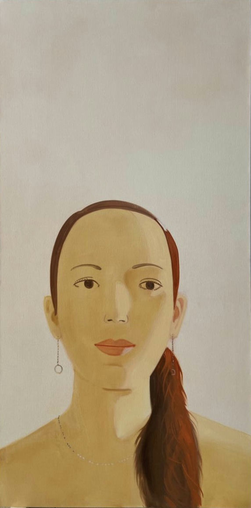
The painting “Corinne, 2007” carries the same one word title Alex Katz has used for portraits for more than sixty years, and that repetition is part of the point.
Records for “Corinne, 2007” are thin in the places most art writing usually pulls from. What does surface is a related work titled “Study for Corinne,” an oil on board measuring roughly five by twelve inches and dated 2006, cataloged through auction house records. That detail alone tells you almost everything about how the finished painting most likely came to exist, because Alex Katz has spent the better part of seventy years working the same way: small first, large second, and rarely the reverse.
No public auction result, gallery listing, or museum accession record for the full scale “Corinne, 2007” canvas turned up in research for this piece. That gap gets stated plainly here rather than papered over with invented dimensions or a fabricated collection history. What can be said with confidence is the process that almost certainly produced it, because Katz has described that process, in more or less the same terms, in interviews going back decades.
how
A Katz portrait rarely starts on the canvas it ends up on. It starts as a small, quickly executed oil study, often painted from life in a single sitting, sometimes finished in under an hour. From there, Katz makes a full size line drawing, which he calls a cartoon, a term borrowed from mural and fresco painting rather than the comic strip sense of the word. The cartoon gets pricked with tiny holes along its outlines, then dusted with charcoal or pigment through those holes onto the primed canvas below, a centuries old transfer technique called pouncing. Only after that outline is set does Katz paint the final large scale version, usually in broad, fast, confident strokes of flat, unmodulated tincture, often completed in a single day of work.
That method explains why a small oil study and a much larger finished painting can share a title separated only by a year. The study is not a sketch in the casual sense. It is closer to a blueprint, tested and resolved at a small scale before Katz commits to the wall sized version most people associate with his name. If “Study for Corinne” from 2006 fed directly into “Corinne, 2007,” that one year gap fits the rhythm of how Katz has worked since at least the 1960s, when he first developed the cartoon and cutout techniques that still define his studio practice.
The final painting stage is where Katz’s reputation for speed becomes almost literal rather than a figure of speech. Once the cartoon has been transferred and the composition is locked in, Katz mixes his tinctures in advance, often in large batches, so that he can move across the canvas without stopping to remix a shade mid stroke. The paint itself typically goes down wet on wet, in a single extended session, which is part of why his surfaces read as so smooth and unbroken. There is little visible reworking in a finished Katz canvas because there is usually very little actual reworking involved. The planning happens beforehand, in the study and the cartoon. The painting itself is closer to execution than exploration, a deliberate inversion of the slower, more visibly revised process associated with much of twentieth century figurative painting before him.
why
“Corinne” belongs to a naming convention Katz has used with almost total consistency across a career now well into its eighth decade: a single first name, no surname, no explanatory subtitle. His most famous recurring subject, his wife Ada Katz, has appeared under her own first name in well over a thousand paintings since the two married in 1958. Friends, poets, fellow artists and members of his circle in New York and coastal Maine have filled out the rest of that naming pattern for decades: Vincent, his son, is simply “Vincent.” A colleague or acquaintance becomes “Christy” or “Nicole” or, in this case, “Corinne.”
That flatness of title mirrors the flatness of the paintings themselves. Katz strips his subjects of narrative context on purpose, favoring solid background flow, cropped composition and a lack of shading that owes more to billboard advertising and film close ups than to traditional portraiture. Critic Robert Storr once described the effect as a distinctive kind of realism that combines abstraction and representation at once, a way of making a face feel both specific and iconic in the same brushstroke. A name with no last name and no caption does the same work on the title card that the flat background show does on the canvas: it removes context so the viewer’s attention has nowhere to go except the face itself.
That approach also means most Katz portraits function less like documentary records of specific individuals and more like studies of a type of presence: composed, self-possessed, lit as if for a camera rather than a window. Corinne, whoever she is in Katz’s life or social circle, becomes less a biographical subject and more a vehicle for the same formal problem Katz has returned to again and again since the 1950s, namely how much information a face actually needs before it reads as a complete likeness. His answer, consistently, has been far less than most painters assume.
length
The years surrounding “Corinne, 2007” were a genuinely active stretch even by Katz’s standards. “Alex Katz Paints Ada, 1957 to 2005” had just opened at the Jewish Museum in New York that October, running into March of 2007. Weeks later, “Alex Katz: New York” opened at the Irish Museum of Modern Art in Dublin, running from February through May 2007. A Barcelona show titled “Alex Katz: Paintings, Studies, Cartoons” at Galeria Toni Tàpies followed not long after, its title alone a useful confirmation of exactly the working method described above, presented publicly rather than left to interviews and catalog essays.
By 2008, Katz had solo exhibitions running simultaneously at Galleria Monica de Cardenas in Milan, Galerie Jablonka in Berlin, and Richard Gray Gallery in Chicago, the latter under the title “Alex Katz: Subject to Reversal.” A single year like 2007, then, was not an outlier for Katz. It was closer to a typical year in a career built on volume, speed of execution, and a refusal to slow down that has defined him since he first started exhibiting in the early 1950s.
influ
Part of what makes a single 2007 portrait worth examining is how much Katz’s flattened, billboard-influenced style has seeped into painting well beyond his own studio. Katz emerged in New York in the early 1950s at the height of Abstract Expressionism, and rather than joining that movement’s emphasis on gesture and psychological intensity, he built a style around the opposite instincts: cool surfaces, cropped compositions, and a commercial, almost advertising-adjacent flatness that critics initially treated with skepticism. That skepticism has largely reversed itself over the following seven decades. Younger figurative painters working today, particularly ones drawn to flat color fields and cropped, poster-like compositions, are frequently described by critics in direct relation to Katz, whether or not they cite him as a direct influence themselves.
That influence is part of why institutions have kept returning to his catalog with major surveys well into his nineties, including a career retrospective at the Solomon R. Guggenheim Museum that ran from October 2022 through February 2023, titled “Alex Katz: Gathering.” A retrospective of that scale, staged for a painter still actively producing new work at the time, is relatively rare, and it underscores how unusual Katz’s career arc has become: a painter whose historical importance was locked in decades ago, still adding new chapters to it in real time.
fin
This piece is being written the day after Katz turned ninety nine. He was born July 24, 1927, in Brooklyn, and the fact that he is still actively producing new work at this age is not a footnote to his career, it is close to the headline of it. Current exhibitions listed through his own studio include a show at Timothy Taylor Gallery in London that opened in March, a survey titled “Dancing with Reality” running at Kunsthalle Tübingen in Germany through September, and a show called “Black Roses” that ran earlier this year at Galerie Thaddaeus Ropac in Salzburg. None of these are retrospective clip shows built entirely from decades old work. Katz has continued producing new canvases well into his late nineties, still working from life, still making small studies before scaling them up, using the same cartoon and pouncing process he learned as a younger painter in the 1950s and never abandoned.
Katz is represented in the United States by Gladstone Gallery, in Chicago by Richard Gray Gallery, in France and Austria by Galerie Thaddaeus Ropac, in the United Kingdom by Timothy Taylor Gallery, and in Italy and Switzerland by Galleria Monica de Cardenas, a roster that has shifted over the decades but has rarely gone shh. His paintings sit in the permanent collections of more than a hundred museums worldwide, including the Museum of Modern Art, the Metropolitan Museum, the Whitney, the Tate, the Centre Georges Pompidou and the Smithsonian, alongside the concentrated holdings at Colby College, where his connection stretches back to his first summers in nearby Lincolnville in the 1950s.
A single painting like “Corinne” is easy to lose inside a body of work this large. Katz has made thousands of portraits over seventy plus years, many sharing this exact naming pattern, many built through this exact same small study to large canvas process. What makes any individual one worth pausing on is not scarcity. It is the opposite: the consistency of a method that has barely changed since Katz was in his thirties, still being applied, one first name at a time, by a painter now closing in on a full century of work.
That consistency is arguably the more remarkable story than any single canvas could tell on its own. Painters change styles, switch subjects, chase trends, or simply stop working as the decades pile up. Katz found his method early, in a stretch of the 1950s and 60s that most artists spend still searching, and has spent every year since refining rather than replacing it. A portrait like “Corinne” is not a departure from anything. It is one more data point in an unusually long, unusually stable line, painted by someone who, at ninety nine, still shows every sign of adding to it.
Read Drift’s related feature, Sunlit Solitude: Alex Katz’s White Visor and the Poetics of Minimalist Portraiture.
Related Articles

fnnch Revives the Honey Bear Hunt for Halloween, No Tape Required
San Francisco’s honey bear artist is turning porch season into a scavenger hunt again, five […]